James Cameron’s Mariana Trench Dive — The First Solo Descent to Challenger Deep
On 26 March 2012 (local time), film director James Cameron piloted the one-person submersible Deepsea Challenger to the bottom of Challenger Deep in the Mariana Trench, about 10,900 m down. It was only the second crewed visit in history, 52 years after Trieste, and the first by a single pilot. The descent took 2 hours 36 minutes, he spent roughly two and a half to three hours on the bottom, and he returned with 3D footage and sediment samples.
What did James Cameron do in the Mariana Trench?
He became the first person to dive alone to the deepest known point of the ocean. Before dawn on 26 March 2012, local time, Cameron sealed himself into the pilot sphere of Deepsea Challenger and descended to the floor of Challenger Deep, at the southern end of the Mariana Trench southwest of Guam. It was only the second time people had reached the spot, 52 years after Jacques Piccard and Don Walsh made the first descent in the bathyscaphe Trieste, and it was the fourth dive by any vehicle, after Trieste and the robotic vehicles Kaikō in 1995 and Nereus in 2009.
Cameron, best known for directing Titanic and Avatar, was already an experienced deep-sea explorer. He had made dozens of submersible dives to the wreck of the Titanic and other deep wrecks while filming documentaries, and had helped develop camera and lighting systems for those dives. His goal for the Mariana Trench was not just to touch the bottom, as Trieste had done, but to spend hours exploring it, film it in 3D and bring back samples for science.
How was the Deepsea Challenger built?
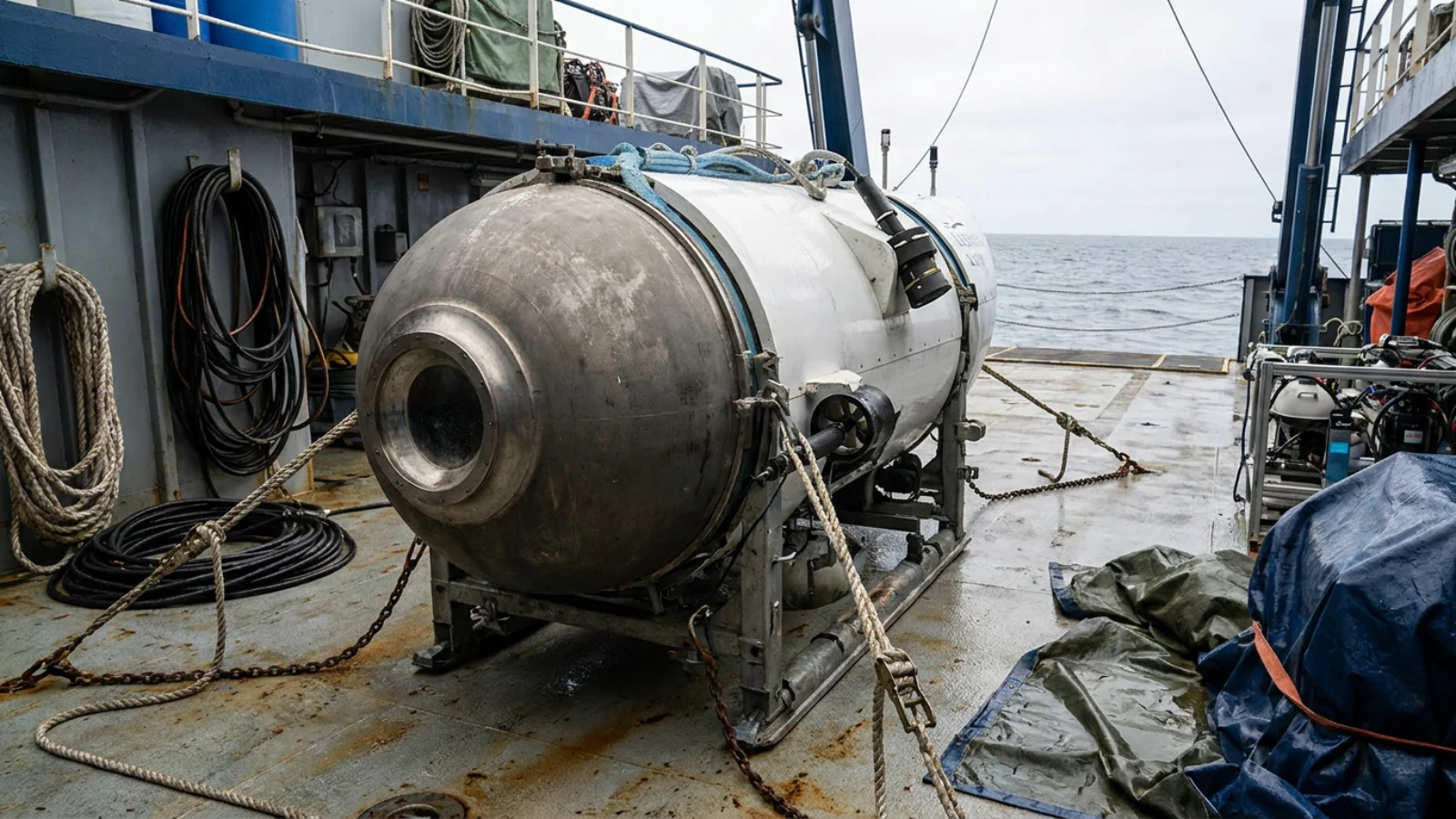
Mostly in secret, in a small engineering workshop in the Sydney suburb of Leichhardt. The vehicle was built by Acheron Project Pty Ltd for the DEEPSEA CHALLENGE programme, run in partnership with the National Geographic Society and with support from Rolex. Construction was led by the Australian engineer Ron Allum, a veteran cave diver who had worked with Cameron on the communication and camera systems used on his Titanic and Bismarck documentaries. Several members of the team came from Sydney’s cave-diving community.
The biggest technical problem was buoyancy. A deep submersible has to carry enough flotation to bring a heavy steel crew sphere back up, but ordinary floats would be crushed at the bottom of the trench, where the pressure is more than a thousand times that at the surface. Allum developed a new syntactic foam, called Isofloat, made of tiny hollow glass spheres set in epoxy resin. It was more uniform and stronger than commercial foams, had a density of about 0.7 so it floated, and could withstand the full pressure of the deep. The foam made up about 70 percent of the submersible’s volume and also served as part of its structure.
The finished vehicle was about 7.3 metres (24 feet) long and weighed about 11.8 tonnes. It had 12 thrusters, a top speed of about 3 knots and more than 180 onboard systems, including lithium batteries housed within the foam, LED light arrays and 3D cameras, all monitored by a programmable controller that sent depth, heading, temperature and battery data to the support ship every three minutes through an acoustic link. The pilot sphere was made of steel 64 millimetres thick and was tested in a pressure chamber at Pennsylvania State University to withstand about 114 megapascals, or roughly 16,500 pounds per square inch. It was so small that Cameron had to sit with his knees bent for the whole dive.
| Feature | Trieste (1960) | Deepsea Challenger (2012) |
|---|---|---|
| Crew | 2 (Piccard, Walsh) | 1 (Cameron) |
| Descent | 4 h 47 min | 2 h 36 min |
| Bottom time | About 20 minutes | About 2.5–3 hours |
| Buoyancy | Petrol-filled float | Syntactic foam |
| Imaging | View clouded by stirred-up sediment | 3D video, still cameras, LED lighting |
How did the Deepsea Challenger work?
Unlike a conventional submarine, Deepsea Challenger travelled standing upright, like a vertical torpedo, with the pilot sphere at the bottom. The streamlined shape let it fall quickly. It carried about 500 kilograms of steel ballast weights that took it down; releasing them made it buoyant enough to rise. If the release system failed and the craft was stuck on the bottom, a backup galvanic release was designed to corrode through in seawater and drop the weights automatically, so that the vehicle would eventually float to the surface on its own.
Once on the bottom the submersible could tilt and move horizontally with its thrusters, so the pilot could drive across the sea floor while the cameras recorded. A manipulator arm and sample tray were fitted for collecting sediment and animals, and a Rolex watch was strapped to the arm as a publicity test. It kept working throughout.
How was the sub tested?
The team built up to the trench in stages. In late January 2012 Cameron spent three hours in the submersible just below the surface in Sydney’s naval dockyard to test its systems. A test dive on 21 February off New Britain, Papua New Guinea, intended to reach more than 1,000 metres, was cut short after an hour because of camera and life-support problems. Two days later he reached the sea floor at 991 metres, and on 28 February he spent six hours in the sub during a dive to about 3,700 metres.
On 4 March a dive to the New Britain Trench was stopped at more than 7,260 metres when the vertical thrusters failed, which was still a solo depth record. A few days later, with the problem fixed, Cameron reached the floor of the New Britain Trench at 8,221 metres. There he found a wide plain of loose sediment with anemones and jellyfish, and varied habitats where the plain met the trench walls. After repairs and upgrades in Apra Harbor, Guam, the expedition left from Ulithi atoll for Challenger Deep and waited for calm enough seas to launch.
How did the dive go?
The descent began at about 5:15 a.m. local time on 26 March. Deepsea Challenger fell fast, and at 7:52 a.m. it touched down, after 2 hours and 36 minutes, nearly twice as fast as Trieste’s descent. Figures for the depth differ slightly: Cameron’s reading at touchdown was 10,898 metres (35,756 feet), and the maximum depth recorded during the dive was 10,908 metres (35,787 feet), slightly less than the depth reached by Trieste in 1960.
Not everything worked. Bait-carrying landers that were supposed to be dropped in advance were not deployed because the sonar needed to find them on the bottom was not working. Once on the floor, a hydraulic fluid leak in the lines controlling the manipulator arm clouded the view out of the single viewing port and knocked out the starboard thrusters, which also hampered sampling. Cameron had planned to spend about six hours on the bottom, but began his ascent after roughly two and a half hours, according to the dive log. Accounts of the ascent also differ: the expedition website said the sub surfaced after a 90-minute climb, while tweets from Paul Allen’s yacht Octopus, which was monitoring the dive by underwater telephone, suggested about 67 minutes.
What did James Cameron see at the bottom?
Less than he had hoped. At a press conference after the dive, Cameron said he had landed on “a very soft, almost gelatinous flat plain” and had driven across it for some distance before working his way up a slope. He saw no fish and no living creature more than about an inch (2.5 centimetres) long. “The only free swimmers I saw were small amphipods,” he said, referring to the shrimp-like scavengers that dominate the deepest trenches. He described the scene as desolate and isolated, as if he had travelled to another planet.
The lack of fish was not surprising to scientists. In 1960 Piccard and Walsh reported seeing a flatfish on the bottom, but that observation is now widely doubted. Physiologists think fish cannot survive much below about 8,000 to 8,500 metres, because at greater depths they would need more of the protective molecule TMAO in their tissues than their bodies can tolerate. The deepest fish ever filmed, snailfishes, have been seen at a little over 8,000 metres. At the bottom of Challenger Deep, life is dominated by amphipods, sea cucumbers, single-celled foraminifera and microbes.
What did the expedition discover?
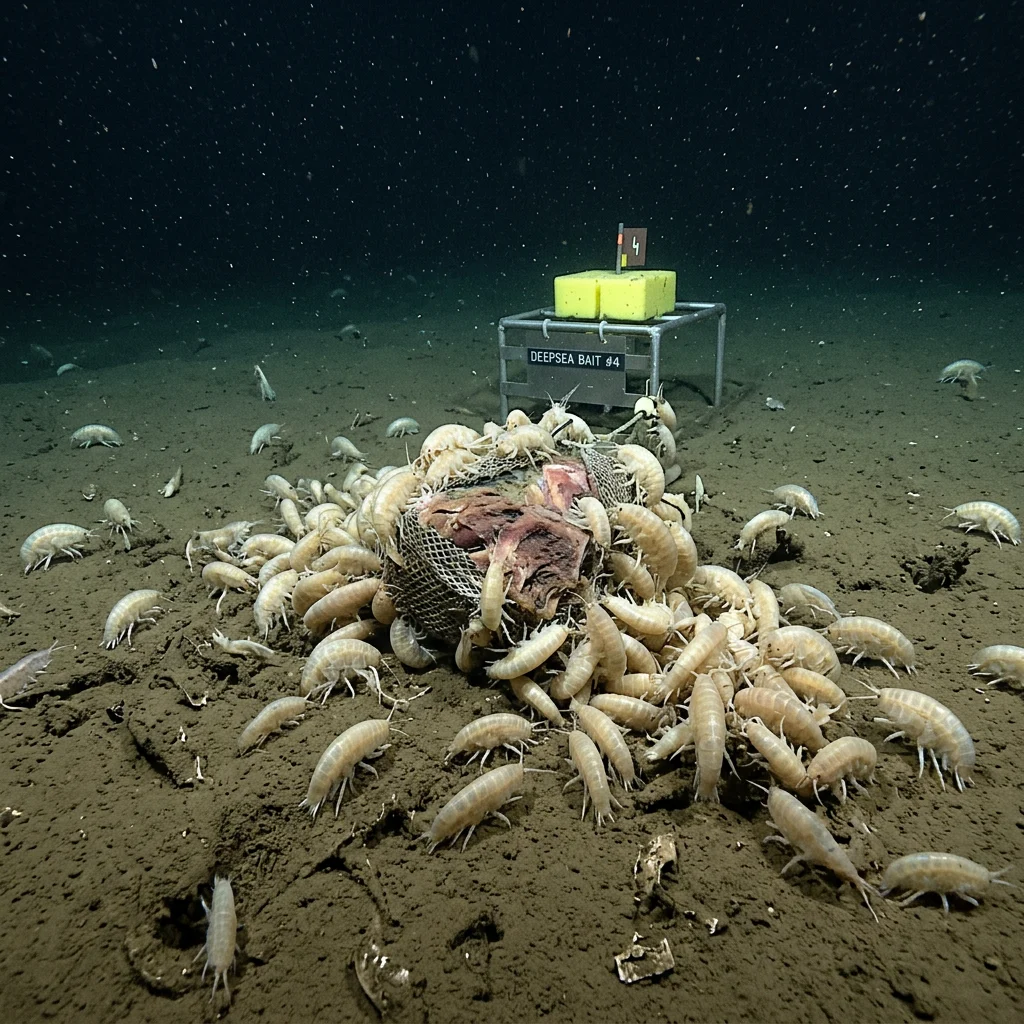
The DEEPSEA CHALLENGE expedition was a science project as well as an adventure. Scientists from the Scripps Institution of Oceanography and other institutions used landers and the submersible’s samples to study animals, sediments and microbes from both the New Britain Trench and the Mariana Trench. A comparison of the two trenches, led by Natalya Gallo and Lisa Levin and published in Deep-Sea Research in 2015, found that the New Britain Trench, which lies under more productive surface waters and receives more food from above, supported richer and more abundant communities than the Mariana Trench at similar depths. Food supply, not just depth, shapes how much life a trench can hold.
The expedition also produced some of the first high-quality video of trench floors and the first 3D footage from the deep. The 2014 documentary Deepsea Challenge 3D told the story of the project. For more on the trench itself, see how deep is the Mariana Trench?
How does Cameron’s dive compare with Trieste’s?
The two dives were very different achievements. Trieste, designed by Auguste Piccard and bought by the US Navy in 1958, was a bathyscaphe: a large float filled with petrol, which is lighter than water and nearly incompressible, slung above a steel crew sphere. On 23 January 1960 it carried Jacques Piccard and Lieutenant Don Walsh down in 4 hours 47 minutes. After passing 9,000 metres, one of the outer acrylic window panes cracked with a bang that shook the vessel. The two men spent about twenty minutes on the bottom, where sediment stirred up by their landing clouded the view, and the cabin temperature was about 7°C.
Cameron’s vehicle was much smaller and faster, built around modern materials and electronics, and designed to stay on the bottom for hours, move around and record what it saw. Walsh, then 80, was aboard the expedition ship during Cameron’s dive. Together, the two dives bracket half a century of progress in deep-sea engineering.
Was there a race to the bottom?
In a sense, yes. In the years around 2012 several teams were building crewed vehicles to reach the deepest ocean, encouraged by the same advances in materials and batteries that made Deepsea Challenger possible. Virgin Oceanic, backed by Richard Branson’s Virgin Group, developed DeepFlight Challenger, a one-person winged submersible designed by Graham Hawkes that would have taken about 140 minutes to reach the bottom. That mission was later scrapped after the company concluded the craft was fit for only a single dive rather than the repeated missions it had planned. DOER Marine announced a two- or three-person vehicle called Deepsearch, with support from Google’s Eric Schmidt, and Triton Submarines of Florida proposed a three-person design.
Cameron’s team got there first, largely because it had worked quietly for years and built a vehicle with one purpose. In the end it was Triton, the company behind Limiting Factor, that built the first submersible able to make repeated trips to full ocean depth, seven years after Cameron’s dive.
Why is diving to Challenger Deep so hard?
The main enemy is pressure. Water pressure rises by roughly one atmosphere for every ten metres of depth, so at nearly 11 kilometres it is more than a thousand times the pressure at the surface, about 16,000 pounds on every square inch. That is why Deepsea Challenger’s pilot sphere was proof-tested to 114 megapascals before Cameron climbed in. Every part of a vehicle exposed to the sea, from cables and connectors to lights and batteries, has to survive that pressure or be filled with oil so it cannot be crushed.
The other problems are cold, darkness and distance. The water at the bottom is only a degree or two above freezing, there is no sunlight below about 1,000 metres, and the vehicle is hours away from help, linked to its support ship only by slow acoustic signals. A failed ballast release, an entanglement or a fire in a sealed sphere could be fatal. That combination is why, for more than fifty years after Trieste, nobody went back, and why Cameron’s designers included backup systems such as the galvanic release that would eventually free the vehicle even if everything else failed.
What happened to the Deepsea Challenger?
Cameron donated the submersible to the Woods Hole Oceanographic Institution in Massachusetts in 2013 so that its technology could be studied and used in future vehicles. On 23 July 2015, while it was being trucked from Woods Hole to Baltimore to be shipped to Australia on loan, the truck caught fire on Interstate 95 in Connecticut, probably because of a brake failure that ignited its rear tyres. Fire officials initially feared it was a total loss, but the vehicle survived and has since been exhibited, including at the Natural History Museum of Los Angeles County in 2022–23 and at the Royal Canadian Geographical Society in Ottawa in 2023. Allum’s foam, lighting and camera developments have influenced later deep-sea systems.
Who has been to Challenger Deep since?
Cameron remained only the third person ever to reach the bottom until 2019. On 28 April that year, during his Five Deeps Expedition, the American explorer Victor Vescovo piloted the two-person submersible Limiting Factor, built by Triton Submarines, to Challenger Deep, and then dived again on 1 May. Unlike earlier vehicles, Limiting Factor was designed for repeated dives, and it went on to carry many more people to the bottom. In November 2020 China’s submersible Fendouzhe took three people down at once. By July 2022, twenty-seven people had made the trip. See more people on the Moon than in the deep?
When did James Cameron dive the Mariana Trench?
On 26 March 2012, local time in the western Pacific (the evening of 25 March in the US).
How deep did James Cameron go?
About 10,898 m (35,756 ft) at touchdown, with a maximum of 10,908 m recorded during the dive.
How long did James Cameron stay at the bottom?
Roughly two and a half to three hours. He had planned up to six but surfaced early after a hydraulic leak.
Was James Cameron the first person to reach Challenger Deep?
No. Jacques Piccard and Don Walsh reached it in 1960. Cameron was the first to do it alone.
What submarine did James Cameron use?
Deepsea Challenger, a 7.3 m (24 ft), roughly 11.8-tonne vertical submersible built in Sydney, Australia.
What did James Cameron see at the bottom?
A soft, flat plain of sediment with small amphipods, but no fish.
How fast did Deepsea Challenger descend?
The descent took 2 hours 36 minutes, nearly twice as fast as Trieste in 1960.
Where is the Deepsea Challenger now?
It was donated to Woods Hole Oceanographic Institution in 2013, damaged in a truck fire in 2015, and has since been exhibited.
- Wikipedia: Deepsea Challenger; Challenger Deep; Trieste (bathyscaphe); Victor Vescovo (construction, test dives, dive timeline, depth records, 2021 estimate of 10,935 m ± 6 m).
- National Geographic: DEEPSEA CHALLENGE expedition reports and press conference, March 2012.
- Gallo, N.D. et al. (2015). Submersible- and lander-observed community patterns in the Mariana and New Britain trenches. Deep-Sea Research Part I 99: 119–133.
- Woods Hole Oceanographic Institution (2013). James Cameron donates Deepsea Challenger to WHOI.
Blane Perun has been exploring Earth’s oceans and marine life for over 25 years. Founder of TheSea.Org in 1999, underwater photographer, coral aquaculture pioneer, and explorer of 80+ countries.
About Blane Perun →