Prehistoric Sea Creatures — 500 Million Years of Ocean Monsters, Living Fossils and Lost Giants
Prehistoric sea creatures are the marine animals known mainly or only from fossils, spanning more than 500 million years from the Cambrian explosion to the end of the Pliocene. They include arthropods such as trilobites, Anomalocaris and sea scorpions; shelled cephalopods such as orthocones and ammonites; armored fish such as Dunkleosteus; the great Mesozoic marine reptiles (ichthyosaurs, plesiosaurs and mosasaurs); and the Cenozoic giants such as megalodon, Livyatan and Basilosaurus. A few lineages, like the coelacanth, are still alive today. The largest of them, an ichthyosaur, may have reached about 25 m, longer than most blue whales.
Prehistoric Sea Creatures
What counts as a prehistoric sea creature?
A prehistoric sea creature is any marine animal whose story is told mainly by fossils. That covers extinct groups, like trilobites and mosasaurs, and the deep ancestors of living groups, like the first sharks and the walking whales that went back to sea.
The ocean is where animal life got going. The first big burst of complex animals, the Cambrian explosion, began roughly 539 million years ago, and for the next 170 million years or so almost every animal on Earth lived in water. That is why the marine fossil record is so long and so rich: limestone, chalk and shale are largely made of sea floor, and sea floor is very good at burying bodies.
This section of TheSea.Org works through the animals people actually search for, one page each, with the sizes, ages and fossil sites checked against museum, university and peer-reviewed sources. Where scientists disagree, especially on size, each page gives the range and says who produced which number. Scientific names live in the body of each page, not in the titles.
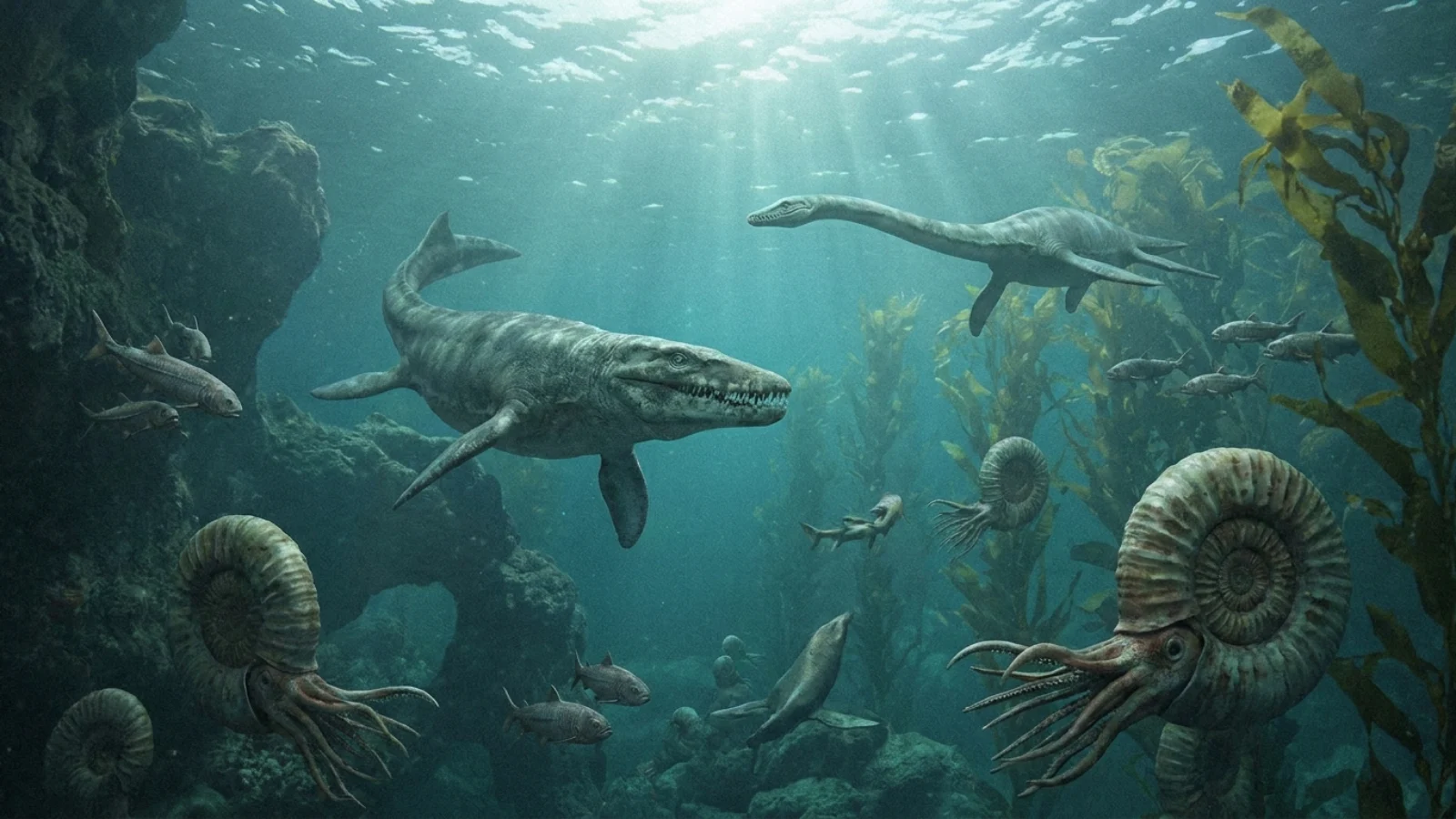
When did the major prehistoric sea creatures live?
The short version: arthropods ruled the Paleozoic seas, marine reptiles ruled the Mesozoic, and sharks and whales took over in the Cenozoic.
| Era / period | Approx. dates | Headline animals |
|---|---|---|
| — | — | — |
| Cambrian | 539–485 Ma | Anomalocaris, early trilobites |
| Ordovician–Silurian | 485–419 Ma | Giant orthocones, sea scorpions |
| Devonian | 419–359 Ma | Dunkleosteus, early sharks, first coelacanths |
| Carboniferous–Permian | 359–252 Ma | Helicoprion, the last trilobites |
| Triassic | 252–201 Ma | Giant ichthyosaurs, Shastasaurus |
| Jurassic | 201–145 Ma | Plesiosaurs, Liopleurodon, ammonites |
| Cretaceous | 145–66 Ma | Mosasaurus, Tylosaurus, Elasmosaurus, Kronosaurus |
| Paleogene–Neogene | 66–2.6 Ma | Basilosaurus, Livyatan, megalodon |
Those boundaries are not arbitrary. Most of them are drawn at extinction events, and the five biggest reshaped ocean life each time. Based on the summary by Barnosky and colleagues in Nature (2011), the end-Ordovician (about 444 million years ago) took roughly 86% of species, the Late Devonian (about 360 Ma) about 75%, the end-Permian (about 250 Ma) about 96%, the end-Triassic (about 200 Ma) about 80% and the end-Cretaceous (about 66 Ma) about 76%.
What was the largest prehistoric sea creature?
The current front-runner is a Late Triassic ichthyosaur. A 2024 study in PLOS One named Ichthyotitan severnensis from jaw bones found at Blue Anchor, Somerset, and its discoverers estimate a length of 20–26 m; the Natural History Museum in London uses up to 25 m.
That figure comes from a jaw fragment, not a skeleton, so treat it as an estimate. The best-known giant ichthyosaur with a substantial skeleton is Shonisaurus sikanniensis from British Columbia, usually put at about 21 m. For context, megalodon’s most generous body-length estimate is 24.3 m, published by Kenshu Shimada of DePaul University and 28 co-authors in 2025, who called it the largest reasonable estimate on current evidence; the same team put a typical large individual at about 16.4 m. Our full ranking is on the largest prehistoric sea creature page, and the living comparison is on megalodon vs blue whale.
Were prehistoric marine reptiles dinosaurs?
No. Ichthyosaurs, plesiosaurs and mosasaurs were marine reptiles that lived alongside dinosaurs but belonged to separate lineages.
Mosasaurs were actually giant marine lizards, closer to monitors and snakes than to any dinosaur. Plesiosaurs and ichthyosaurs sit on their own branches. Our explainer on prehistoric marine reptiles covers the family tree, and largest marine reptile compares the living and extinct giants.
Which prehistoric sea creatures are still alive?
The coelacanth is the famous one: a lineage with fossils as old as about 409 million years, whose youngest fossils are about 66 million years old, so it was assumed extinct until a fisherman’s catch in South Africa on 22 December 1938.
Nautiluses are another survivor from the age of shelled cephalopods, and you can read about them on our nautilus page. The frilled shark and the vampire squid are often called living fossils too, although “living fossil” is a loose label rather than a scientific category. See frilled shark and vampire squid.
Where can you see prehistoric sea creature fossils?
Natural history museums hold the best specimens, but some of the most rewarding fossil hunting happens on beaches and in rivers.
Florida and the Carolinas are famous for fossil shark teeth, including megalodon; see our guide to megalodon teeth in Florida and the local walkthrough for finding shark teeth in Venice, Florida. England’s Jurassic Coast is the classic hunting ground for ammonites and ichthyosaurs. For the cephalopod side of the story, see prehistoric cephalopods, and for the arthropods, prehistoric crustaceans.
Where did the story of animal life in the sea begin?
Some of the best evidence for the first complex sea animals comes from a mountainside in western Canada. On 30 August 1909 the American geologist Charles Doolittle Walcott came across what is now the original Burgess Shale site in Yoho National Park, British Columbia, between Wapta and Field mountains. He had first visited Yoho in 1907 to study the trilobite beds on Mount Stephen. Between 1909 and 1925 Walcott and his family worked the site, eventually digging the excavation now called the Walcott Quarry.
The rocks date to the middle of the Cambrian, about 505 to 510 million years ago, and they are unusual because they are made up mainly of soft-bodied animals, the kind that almost never fossilise. About 150 species have been identified from the Walcott Quarry alone. Among them is Anomalocaris canadensis, which the Canadian Encyclopedia gives a maximum length of 100 cm and calls the largest predator of the Cambrian, and the small, eel-like Pikaia gracilens, often described as the most primitive known vertebrate. In 2012 researchers found a second rich bed at Marble Canyon in neighbouring Kootenay National Park, which has yielded 55 taxa. Yoho and Kootenay are among the seven parks that make up the Canadian Rocky Mountain Parks World Heritage site.
How do soft bodies end up as fossils?
Usually they don’t. Shells, teeth and bones fossilise well, so the fossil record is biased toward animals that had them, which is why so much of this section is about trilobites, ammonites, sharks and marine reptiles. Soft parts survive only when something unusual happens very quickly after death, and the places where that happened are some of the most valuable sites in paleontology.
Volcanic ash is one route. A 2024 study from the University of Poitiers and the University of Bristol, published in Science, described Cambrian trilobites from Morocco, roughly 515 million years old, that had been smothered by ash on a shallow sea floor, so completely that legs, mouthparts and even the gut survived in three dimensions. Iron pyrite is another: at Beecher’s Trilobite Bed in New York, the small trilobite Triarthrus was replaced by pyrite, keeping antennae, gills and eggs about 0.2 mm across.
Western Australia’s Gogo Formation, which formed around tropical reefs about 380 million years ago, preserves armored placoderm fish in three dimensions. In 2008 a team led by John Long found an embryo inside one of them, the earliest known evidence of live birth in a vertebrate, and in 2022 a team led by Kate Trinajstic of Curtin University reported a fossil placoderm heart, the oldest yet known from a jawed vertebrate. Sites like these are why the profiles in this section can say anything at all about how ancient animals fed, bred and moved, not just what their hard parts looked like.
How do scientists date marine fossils?
Two methods work together. Volcanic ash beds contain minerals that can be dated with radioactive isotopes, giving an age in years. Fossils of fast-evolving animals then extend those dates to rocks that have no ash at all. Ammonites are the classic tool. In the Late Cretaceous of North America’s Western Interior, ammonite zones calibrated by numerous dated ash beds average roughly half a million years apiece (plus or minus about 200,000 years), according to a 2019 abstract by Joshua Slattery and colleagues; the same work found average zones of about 1.2 million years on the U.S. Atlantic and Gulf coastal plains, where the record is less complete.
That precision is what lets paleontologists say that two fossils in different parts of the world lived at about the same time, or that one group disappeared before another. It also explains why the ages quoted across this section sometimes shift a little: as more ash beds are dated, the numbers attached to the zones are refined. The end of the Cretaceous, for example, was long given as 65.5 million years ago and is now usually placed at about 66 million years.
Why do size estimates for ancient sea creatures disagree so much?
Because the biggest animals are rarely found whole. Most giant marine reptiles, fish and sharks are known from skulls, jaws, teeth or single bones, and their body length has to be worked out by scaling up from that part. The method chosen can change the answer by more than half.
Mosasaurus is the clearest example. An older rule of thumb held that a mosasaur’s jaw was about a tenth of its body length, which turns the largest jaws into animals of 17 m or more. Later work suggested a ratio closer to one to seven for the skull, which gives about 11 to 12 m for the same fossils. Trilobites show the same effect at a smaller scale: the biggest complete specimen is about 70 cm long, yet the University of Bristol has given an upper range of more than 90 cm, because body size can also be estimated from fragments. Megalodon, known almost entirely from teeth and vertebrae, has published body-length estimates that range from about 16 m to a little over 24 m.
That is why the ranking and comparison pages in this section give ranges, name the study behind each figure and separate complete specimens from estimates. A larger number is not necessarily a better one; it may simply rest on a more generous assumption.
How do we know what prehistoric sea creatures ate?
Mostly from indirect clues, with the occasional direct one. Tooth shape and wear suggest whether an animal sliced, crushed or gripped its food. Chemical signatures in bone and teeth show roughly where it fed in the food web: work by Anne Schulp and colleagues found that the largest Mosasaurus had the carbon-isotope values expected of a top predator. Bite marks record failed or successful attacks, and stomach contents occasionally survive.
The best direct evidence is rare and often surprising. In 2011 Isabelle Kruta and colleagues used synchrotron X-ray scanning to look inside the mouths of 70- to 80-million-year-old Baculites ammonites from South Dakota and found a tiny larval snail and three tiny crustaceans in one of them, showing that at least some ammonites fed on plankton rather than hunting large prey. Findings like that can change how a whole group is pictured.
Were ancient seas more dangerous than today’s?
In terms of the number of big predators, apparently yes. In 2024 Nick Longrich of the University of Bath and colleagues described Khinjaria acuta, an orca-length mosasaur with dagger-shaped teeth, from Moroccan phosphate deposits laid down near the very end of the Cretaceous. The same fauna included more than one mosasaur bigger than any great white. In the Bath team’s view, this Moroccan sea was among the richest marine communities ever recorded, whereas today’s oceans support only a handful of large apex hunters, orcas and great whites among them.
The Mesozoic marine reptiles did not drift slowly into decline. Many of them were still flourishing when the asteroid struck 66 million years ago, and the end-Cretaceous extinction removed an entire tier of top predators at once. Sharks survived, and whales evolved later to fill much of the space the reptiles left, which is why the Cenozoic part of this section is dominated by megalodon, Livyatan and Basilosaurus.
Can you collect prehistoric sea creature fossils yourself?
Often, as long as you follow local rules. On England’s Jurassic Coast, the Charmouth Heritage Coast Centre’s fossil collecting code asks collectors to take loose fossils from the beach rather than digging into the cliffs, to record scientifically important finds, and to offer significant specimens to an accredited museum before selling them. In Florida, fossil shark teeth are a popular find, and the megalodon pages in this section cover where to look and what the rules are.
If you buy rather than find, be careful. The American Museum of Natural History says Moroccan workshops have supplied most fake trilobites on the market since the late 1980s, from fully moulded copies to composites made of parts from different animals. Examining a specimen under a hand lens for air bubbles and under ultraviolet light, which often reveals added material, are among its recommended checks.
What is the oldest prehistoric sea creature?
Among the animals in this section, the oldest are the Cambrian ones: trilobites first appear about 521 million years ago, and Anomalocaris comes from the Burgess Shale of British Columbia, about 505 to 510 million years old.
What was the biggest prehistoric sea creature?
The leading candidate is the ichthyosaur Ichthyotitan severnensis, estimated at 20 to 26 m from jaw bones described in PLOS One in 2024. Shonisaurus sikanniensis was about 21 m. Megalodon’s upper estimate is 24.3 m (Shimada et al. 2025), with large individuals more often put at about 16 m.
When did megalodon live?
Megalodon lived from roughly 15 million to about 3.6 million years ago according to the 2025 study led by Kenshu Shimada; some older studies extend its start date further back into the early Miocene.
Were mosasaurs dinosaurs?
No. Mosasaurs were giant marine lizards (squamates), related to monitor lizards and snakes. They lived in the Late Cretaceous alongside dinosaurs and died out with them about 66 million years ago.
Are any prehistoric sea creatures still alive?
Yes. The coelacanth, known only from fossils until a living one was caught in South Africa in 1938, is the best-known example. Nautiluses and horseshoe crabs belong to very ancient lineages too.
What killed the prehistoric sea creatures?
Mostly mass extinctions. The end-Permian event, around 252 million years ago, wiped out about 96% of species including the last trilobites. The end-Cretaceous event 66 million years ago ended the mosasaurs, plesiosaurs and ammonites.
What prehistoric sea creature had the strongest bite?
Bite-force estimates exist for only a few animals and they vary by method. Dunkleosteus, megalodon and the large pliosaurs are the usual contenders. See the individual pages for the published figures and their caveats.
Where are prehistoric sea creature fossils found?
On every continent, including Antarctica. Famous sites include the Burgess Shale in Canada (Cambrian), the Cleveland Shale in Ohio (Dunkleosteus), the Niobrara Chalk of Kansas (mosasaurs and plesiosaurs), the Jurassic Coast of England, and the Pisco Formation of Peru (Livyatan).
The ‘Terror Crocodile’ That Ate Dinosaurs.
SuperCroc of the Cretaceous Rivers.
From Deinosuchus to Purussaurus.
12 Ancient Fish That Still Haunt the Fossil Record.
Basilosaurus, Livyatan and Walking Whales.
About 3.6 million years ago.
Cooling Seas, Whales and Great Whites.
The Great White Competition Theory.
Size, Bite and Teeth Compared.
How Big Was It and Could It Swallow a Person?
Bite Marks on Whale Bones.
Nursery Grounds and Global Range.
No — here’s the timeline.
Blane Perun has been exploring Earth’s oceans and marine life for over 25 years. Founder of TheSea.Org in 1999, underwater photographer, coral aquaculture pioneer, and explorer of 80+ countries.
About Blane Perun → All prehistoric sea creatures →