Shortfin Mako Shark — Isurus oxyrinchus, Isurus oxyrinchus, the Fastest Shark in the Ocean
The shortfin mako (Isurus oxyrinchus) is the fastest shark on Earth. Burst speeds of ~74 km/h (46 mph) have been documented in adults, supported by regional endothermy that keeps muscle temperature 7–10°C above ambient water. Adults reach 3–4 m in length and weigh up to 570 kg, with the indigo-blue back and slim torpedo body of the lamnid family. The shortfin is a sought-after gamefish and one of the most heavily exploited sharks worldwide; the IUCN listed it as Endangered in 2019.
Shortfin Mako Shark
Identification — the fast lamnid with the dagger teeth
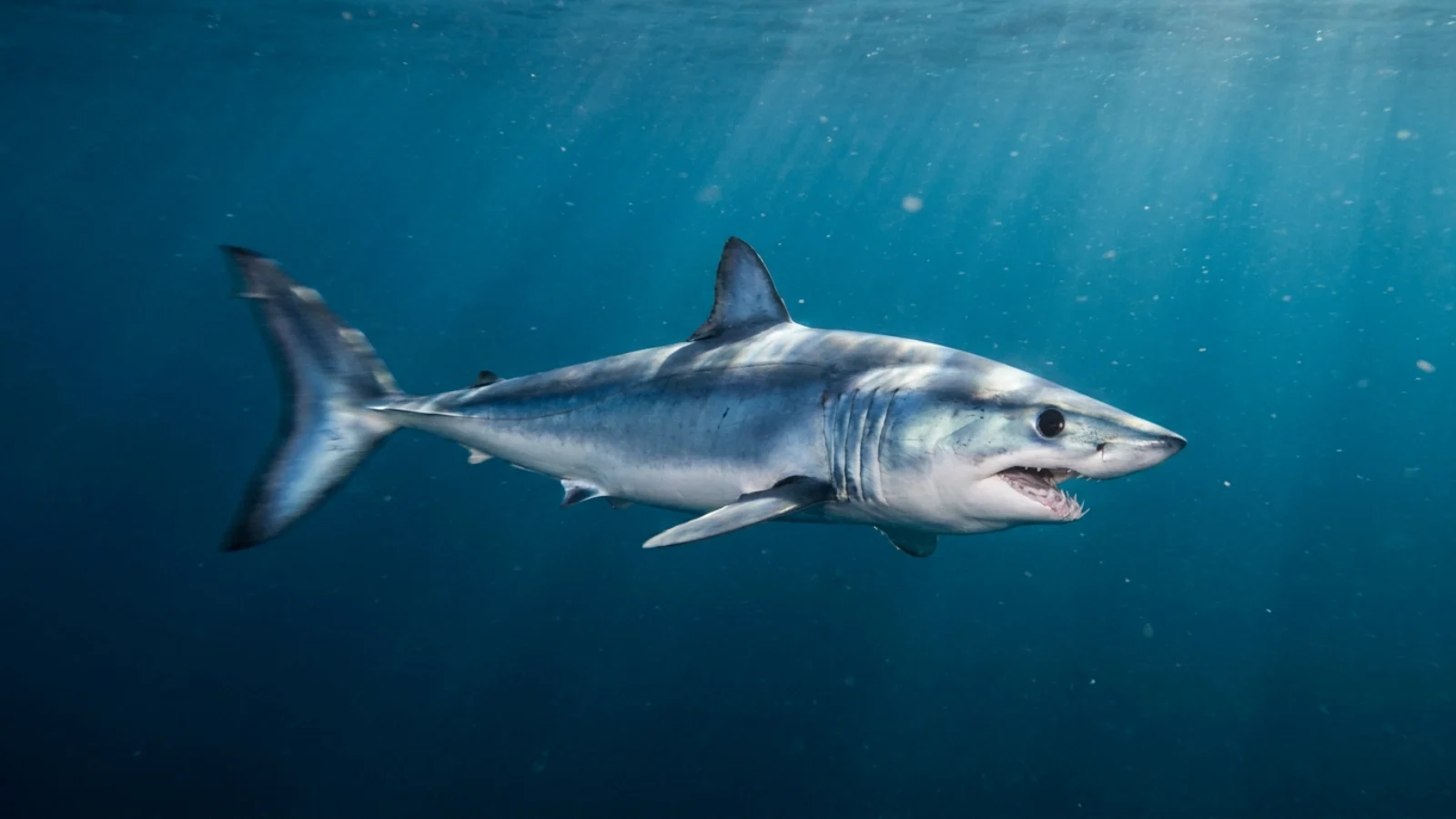
Shortfin makos have a torpedo body, a long pointed snout, indigo-blue dorsal coloration, and a mouth full of slender, smooth-edged teeth that curve inward like daggers.
The shortfin's body plan is built for speed. The body is muscular and torpedo-shaped, the snout is long and conical, the pectoral fins are short to mid-length (the key field distinction from the longfin), and the caudal fin is deeply lunate — the symmetrical, crescent-moon shape shared by tuna, swordfish, and other open-ocean sprinters. The dorsal coloration is a deep indigo-blue that fades after death (similar to the blue shark). The teeth are diagnostic: long, slender, and recurved, with smooth edges — a tooth shape designed to grip and pierce slippery, agile prey rather than slice large pieces of flesh.
Adult shortfin makos reach 3–4 m in length, with the largest reliably measured individual at 4.4 m taken off Cuba in 1991. Weight scales steeply with length: a 4-m animal can weigh 500–570 kg, more than three times the mass of a 3-m animal.
Range — pelagic and circumglobal in temperate seas
Shortfin makos occur in pelagic waters of every temperate and tropical ocean, with strong seasonal migrations following warm-water bands.
Major populations occur in the North Atlantic (with the largest sportfishery off the northeastern United States), the South Atlantic (Brazil, South Africa), the eastern Pacific (California to Chile), the western Pacific (Japan, Australia, New Zealand), and the Indian Ocean. The species is highly migratory: tagging work has documented individuals travelling over 13,000 km in a year, and individuals tagged off New York have been recaptured off Brazil and the Azores. Preferred temperature is around 16°C, which keeps the species clear of polar waters but well into the temperate band.
Diet — tuna, billfish, and the speed to catch them
Shortfin makos are one of the few predators capable of running down adult tuna and billfish in open water. Stomach contents reflect this: tuna, swordfish, mackerel, squid, and on documented occasions other large sharks.
Stomach analyses across multiple oceans show a diet dominated by tuna, mackerel, swordfish, and squid. Smaller blue sharks and other carcharhinids appear in stomachs of larger makos. The shortfin is one of the only marine predators that regularly takes adult swordfish — the bills of large swordfish have been recovered from mako stomachs and from wounds on caught animals, indicating that the predator–prey contest is occasionally lost. Hunting tactics rely on the species' speed advantage: a shortfin mako accelerates into a tuna school from below at burst speed and seizes individual fish with the slender recurved teeth.
Speed — the fastest shark, and one of the fastest fish
Shortfin makos are documented at burst speeds of approximately 74 km/h (46 mph), making them the fastest shark on record and one of the five fastest fish in the ocean.
The 74 km/h figure comes from photographic and acoustic-tracking work on shortfin makos pursuing hooked tuna; it is a burst speed, not a sustained cruising speed. Cruise speed is more like 10–15 km/h. The mechanism is two-fold: lamnid regional endothermy keeps red muscle 7–10°C warmer than the surrounding water, increasing the speed and power of muscle contraction; and the body shape (rigid torpedo, lunate tail, narrow caudal peduncle) is optimised for high-speed cruising rather than agile turning. The same body plan is shared with the great white, salmon shark, and porbeagle — the warm-bodied sharks — and with the most pelagic tunas.
Attack record — rare attacks, occasionally serious
Shortfin makos rarely attack humans because their hunting habitat is well offshore. The few documented attacks tend to be on people in the water with hooked or speared fish.
ISAF records 10 unprovoked attacks attributed to Isurus oxyrinchus, with 1 fatality. Many of those attacks occurred in spear-fishing or longline contexts where the shark was responding to struggling prey. The species' offshore distribution means recreational swimmers and divers rarely encounter shortfin makos; cage-diving operations off San Diego, the Azores, and South Africa run hundreds of dives a year with shortfin makos with a strong safety record.
Conservation — the most heavily exploited large pelagic shark
The shortfin mako is one of the most commercially valuable sharks in the world. The combination of high gamefishing interest, premium-priced fins, and slow reproduction has driven population declines of more than 60% in the North Atlantic.
Shortfin makos have been a flagship gamefish for the U.S. east coast and Mediterranean fisheries for a century. They are also caught as bycatch (and increasingly as targeted catch) in pelagic longline fisheries worldwide. North Atlantic ICCAT stock assessments since 2012 have shown population declines of over 60%. The IUCN uplisted the species from Vulnerable to Endangered in 2019, and the species was added to CITES Appendix II in 2019, requiring sustainable-trade documentation. EU and US recreational fisheries have moved to release-only regulations on most North Atlantic mako catches since 2022.
Where the shortfin mako sits among the major shark species
Comparing shortfin makos against the major species at a glance.
The shortfin mako is one of the larger pelagic sharks but smaller than the great white and tiger shark. It is the fastest of the comparison set, the most heavily exploited, and one of the most actively conserved.
| Species | Max length | Max weight | Bite force | Attacks (unprov.) | Lifespan |
|---|---|---|---|---|---|
| Great white shark | 6.0 m | 2,300 kg | ~4,000 PSI | 354 | 70 yrs |
| Tiger shark | 5.5 m | 900 kg | ~6,000 PSI | 142 | 27–50 yrs |
| Bull shark | 3.5 m | 320 kg | 1,250 PSI | 121 | 16 yrs |
| Oceanic whitetip | 4.0 m | 170 kg | n/a | 15 | 22 yrs |
| Shortfin mako | 4.0 m | 570 kg | n/a | 10 | 30 yrs |
| Great hammerhead | 6.1 m | 580 kg | n/a | 17 | 44 yrs |
| Whale shark | 12.0 m | 19,000 kg | n/a (filter) | 0 | 80–130 yrs |
Related on TheSea
How fast can a shortfin mako swim?
Burst speeds of approximately 74 km/h (46 mph) have been documented in shortfin makos pursuing hooked tuna. Cruising speed is more like 10–15 km/h. The species is the fastest shark on record and one of the five fastest fish in the ocean.
How big does a shortfin mako get?
Adult shortfin makos typically reach 3–4 m (10–13 ft). The largest reliably measured individual was 4.4 m taken off Cuba in 1991, weighing more than 600 kg.
Are shortfin makos dangerous to humans?
Rarely. ISAF records 10 unprovoked attacks and 1 fatality. Most attacks involved spear-fishers in the water with struggling fish, not unprovoked predation on swimmers. The species lives offshore where humans rarely encounter it.
Why are shortfin makos endangered?
The North Atlantic population has declined by over 60% over recent decades, driven by sportfishing pressure and pelagic longline bycatch. The IUCN uplisted the species to Endangered in 2019. EU and US recreational fisheries have moved to release-only regulations on most North Atlantic catches since 2022.
Where can I dive with shortfin makos?
The most established sites are San Diego, California (July–October), the Azores (June–October), and Cape Town, South Africa (November–April). All operate as offshore baited dives. Encounters are reliable but the dives are not for novice divers — the species moves fast and approaches from open water.
Blane Perun has been exploring Earth’s oceans and marine life for over 25 years. Founder of TheSea.Org in 1999, underwater photographer, coral aquaculture pioneer, and explorer of 80+ countries.
About Blane Perun → More on Sharks →