James Cameron — The Filmmaker Who Went Seven Miles Down Alone
Beyond Titanic, The Abyss and Avatar, Cameron is a working ocean explorer and National Geographic Explorer-in-Residence. He has made many dives to the Titanic and Bismarck wrecks, co-developed deep-sea camera and lighting systems, and on March 26, 2012 piloted the submersible Deepsea Challenger solo to the bottom of the Challenger Deep, recording a maximum depth of 10,908 m. It was the first crewed dive there since Jacques Piccard and Don Walsh in 1960.
James Cameron is best known as the director of Titanic and Avatar, but for more than thirty years he has also been one of the most active private explorers of the deep ocean. He has made dozens of submersible dives to shipwrecks and hydrothermal vents, helped build cameras and robots for the deep sea, and in 2012 became the first person to reach the bottom of the Challenger Deep alone.
This page is a profile of Cameron as an ocean explorer: where the interest came from, how his films pulled him underwater, what his expeditions to the Titanic, the Bismarck and the mid-ocean ridges found, and why scientists take his work seriously even though he has no degree in the field. The dive itself is told minute by minute on our page about Cameron’s record dive into the Mariana Trench.
Who is James Cameron?
James Francis Cameron was born on 16 August 1954 in Kapuskasing, Ontario, the eldest of five children of Philip Cameron, an electrical engineer, and Shirley Cameron, an artist and nurse. He has described a childhood fascination with shipwrecks and the sea, and he spent summers on his grandfather’s farm in southern Ontario. The family later moved to California, where he enrolled at Fullerton College in 1973 to study physics before switching to English and leaving at the end of 1974.
For several years he worked odd jobs, including driving a truck and working as a school janitor, while teaching himself special effects by reading technical papers and writing in his spare time. His first short film, Xenogenesis, appeared in 1978, paid for with money borrowed from a group of dentists. That combination of engineering curiosity and self-teaching would shape his later approach to exploration: when a camera or vehicle he needed did not exist, he set out to have one built.
How did Cameron’s films lead him into the ocean?
Water appears early in his career. His first feature as director was Piranha II: The Spawning (1982), shot partly on Grand Cayman, a production he later disowned. After The Terminator (1984) and Aliens (1986) made his name, he turned to an idea he had carried since high school: a story about oil-rig workers who meet an unknown intelligence on the deep seabed. The Abyss (1989) was shot largely underwater, required the cast and crew to dive for long periods, and ran well over its original budget of about $41 million. It was a punishing production, but it gave Cameron years of experience with underwater filming, diving logistics and the design of fictional deep-sea vehicles.
The bigger step came with Titanic. In 1995, before filming began, Cameron chartered the Russian research ship Akademik Mstislav Keldysh and its two Mir submersibles and made 12 dives to the wreck, nearly 3,800 m down in the North Atlantic, to capture real footage for the film. The work was not without cost to the site: during that expedition one of the Mir submersibles struck the hull, damaging both vessel and wreck and leaving fragments of its propeller shroud on the superstructure, one of several incidents that have worried archaeologists about visits to the ship. The film was released in December 1997, cost about $200 million, became the highest-grossing film ever for twelve years, and won Cameron Oscars for Best Director, Best Picture and Best Film Editing.
What did Cameron find on his Titanic expeditions?
After Titanic, Cameron and his brother John founded Earthship Productions in 1998 to make documentaries about the deep sea. In August and September 2001 he returned to the wreck for Ghosts of the Abyss, again using the Keldysh and the two Mir submersibles, which carried the filming team on 12 dives. The team was diving on 11 September 2001 when news of the attacks in the United States reached the ship. The actor Bill Paxton, who had appeared in the 1997 film, came along and narrated the result.
The main innovation was inside the ship. Cameron’s team used small, purpose-built remotely operated vehicles, tethered to the submersibles, to fly through corridors and cabins that no one had seen since 1912, filming in 3D for IMAX. The expedition also reported something unexpected living on the wreck: a previously unknown type of sea cucumber, lavender in colour with a row of glowing spots along its side. Cameron returned to the wreck again in 2005 for the documentary Last Mysteries of the Titanic, and in 2012 he gathered eight experts for a television special that re-examined how the ship broke apart. In total he has made more than 30 dives to the wreck. For the ship’s history, see our RMS Titanic page.
What did Cameron learn from the Bismarck?
In May and June 2002, Cameron took the Mir submersibles to the wreck of the German battleship Bismarck, which lies about 4,790 m deep in the eastern Atlantic after being sunk by the Royal Navy in May 1941. The result was the Discovery Channel documentary Expedition: Bismarck, which won an Emmy in 2003 for sound editing. Unlike Robert Ballard’s earlier visit, Cameron’s team was able to examine parts of the sides of the hull, which were important for an old argument.
German survivors had long said the crew scuttled their own ship; British accounts stressed the effect of shells and torpedoes. Cameron’s survey found that although roughly 719 large-calibre shells were fired at Bismarck in her final battle, only two places in the visible hull showed full penetration of the 320 mm main armour belt. His report concluded that shellfire and torpedo hits together overwhelmed the ship and started uncontrollable flooding, and that she would certainly have sunk hours later even without scuttling, which may have hastened the end. It is a good example of what underwater survey can add to a well-documented historical event. More on Robert Ballard, who found both the Bismarck and the Titanic, is on his profile page.
Why did Cameron explore hydrothermal vents?
Cameron’s interest in the deep sea has always overlapped with his interest in life beyond Earth. For Aliens of the Deep (2005), co-directed with Steven Quale and filmed in IMAX 3D, he returned to the Keldysh with NASA scientists and marine biologists to visit ten hydrothermal vents on the mid-ocean ridges of the Atlantic and Pacific. The expedition filmed giant tube worms, swarms of white crabs and vent shrimp that sense the faint glow of hot water, all part of food webs powered by chemical energy rather than sunlight.
The film’s argument was that ecosystems like these offer a model for how life might exist in the dark, ice-covered oceans thought to lie beneath the surfaces of moons such as Europa. That idea had already been discussed by planetary scientists, and the film helped bring it to a wide audience. Cameron’s links with NASA continued; he later served on the NASA Advisory Council and worked with the agency on a proposed 3D camera for the Curiosity Mars rover.
What technology has Cameron developed for the deep sea?
Much of Cameron’s contribution to ocean exploration is technical. With the cinematographer Vince Pace he developed the Fusion 3D camera system, first used underwater for his documentaries before it became the basis for shooting Avatar. His teams built compact lights, cameras and small robotic vehicles able to work at the depth of the Titanic and to enter tight spaces inside wrecks. In July 2004 the University of Southampton awarded him an honorary doctorate for his contributions to underwater filming and remote vehicle technology, presented at the National Oceanography Centre.
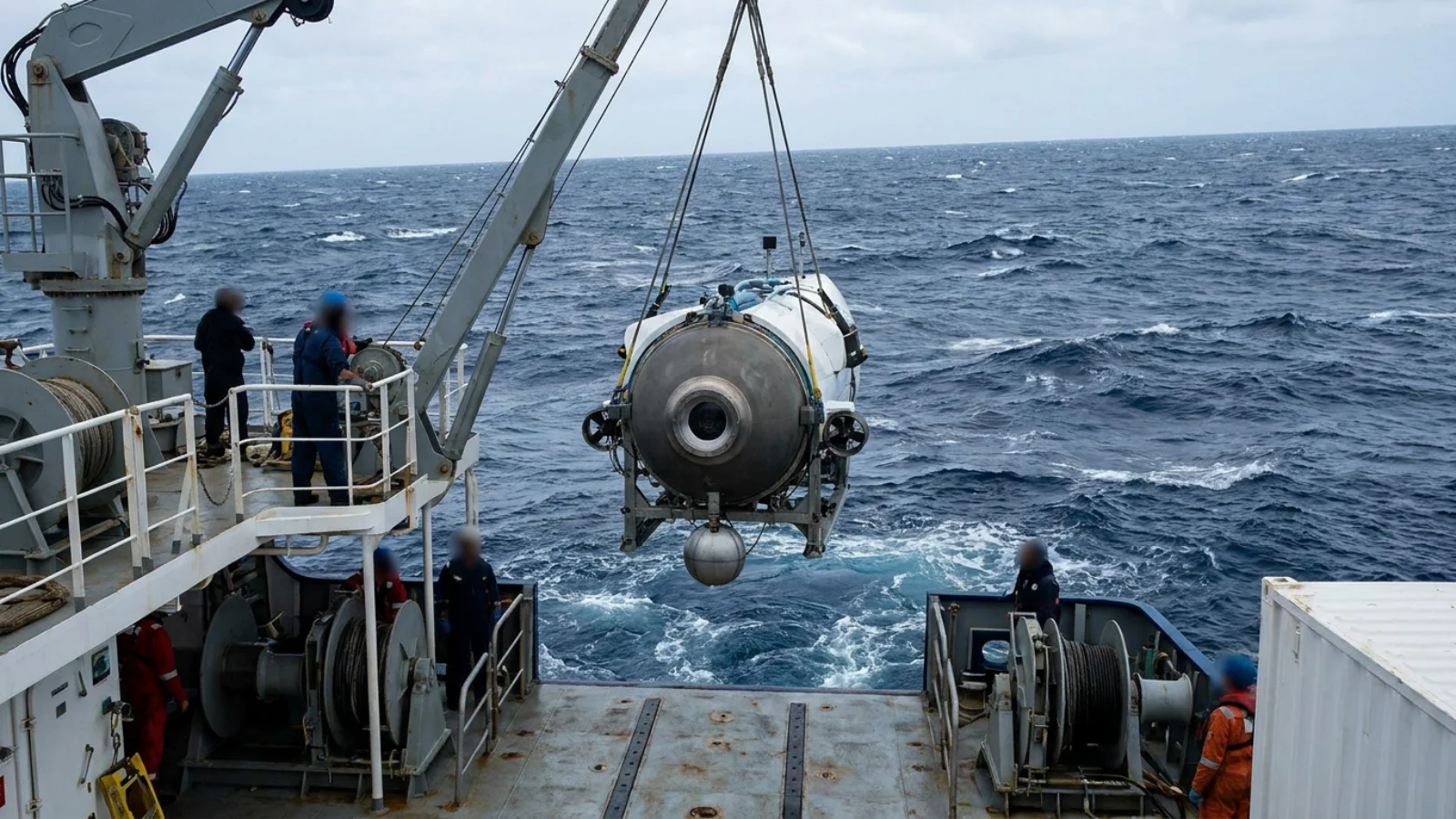
The largest project was the Deepsea Challenger, a 7.3 m submersible built in Sydney with the National Geographic Society and support from Rolex. The construction team was led by the Australian engineer Ron Allum, who developed a new syntactic foam, called Isofloat, strong enough to resist the pressure at nearly 11 km depth while still providing buoyancy. The vehicle carried more than 180 onboard systems, including batteries, thrusters, life support, 3D cameras and arrays of LED lights. In 2011 Cameron became a National Geographic Explorer-in-Residence, the role under which the dives were made.
What happened on the Challenger Deep dive?
On 7 March 2012 Cameron piloted the Deepsea Challenger to about 8,221 m in the New Britain Trench off Papua New Guinea. Nineteen days later, on 26 March, he descended into the Challenger Deep at the southern end of the Mariana Trench. The descent took about two hours and 37 minutes, roughly half the time the bathyscaphe Trieste had needed in 1960, and the maximum depth recorded on the dive was 10,908 m. He spent about three hours on the bottom before a hydraulic leak and failing thrusters ended the dive early. It was only the second crewed visit to the Challenger Deep, after Jacques Piccard and Don Walsh, and the first by one person alone.
The expedition’s scientific results came from the whole programme rather than one dive. Samples and footage collected by the submersible and by unmanned landers contributed to studies of deep-trench animals, and expedition scientists reported new species of sea cucumber, squid worm and a giant single-celled amoeba among the finds. Our page on how deep the Mariana Trench is explains the setting, and the hadal zone describes the animals that live there.
Where is the Deepsea Challenger now?
Cameron donated the submersible to the Woods Hole Oceanographic Institution in Massachusetts so that its foam, lighting, cameras and other systems could be studied and adapted for future research vehicles. In July 2015, while it was being trucked from Woods Hole to Baltimore to be shipped to Australia on loan, the truck caught fire on Interstate 95 in Connecticut, apparently after a brake failure ignited its rear tyres. The submersible was damaged and returned to Woods Hole; the full extent of the damage was not made public. Since then, other vehicles have taken over the job of reaching full ocean depth, notably the Limiting Factor, which began diving to the Challenger Deep in 2019, and China’s Fendouzhe, which took three people there in 2020.
What did Cameron say about the Titan submersible?
In June 2023 the submersible Titan, operated by the company OceanGate, imploded on a dive to the Titanic, killing all five people aboard. Among them was the French explorer Paul-Henri Nargeolet, a friend of Cameron’s for more than 25 years. In the days that followed, Cameron gave a series of interviews criticising OceanGate for not having its vehicle independently certified and warning that its carbon-fibre composite hull was a poor choice for a deep-diving pressure vessel, a material he said has no strength in external compression. Coming from someone who had designed and piloted a submersible to more than twice the Titanic’s depth, the comments drew wide attention to the engineering standards behind safe deep diving.
Is James Cameron really an oceanographer?
Not in the academic sense. He has no degree in marine science and does not publish research as a lead scientist. But exploration has always depended on people who build vehicles, fund expeditions and bring the results to the public, and Cameron has done all three. He has worked alongside oceanographers, NASA researchers and marine biologists, and his expeditions produced footage, samples and engineering that scientists have used. In 2013 the Scripps Institution of Oceanography gave him its Nierenberg Prize for Science in the Public Interest, an award for people who communicate science to a wide audience.
His public influence is hard to separate from his films. The Abyss, Titanic and the Avatar series, especially the ocean-centred Avatar: The Way of Water (2022), have put deep-sea and reef imagery in front of hundreds of millions of viewers. Since 2012 Cameron and his family have followed a plant-based diet, which he links to climate and environmental concerns, and he has lived mainly in New Zealand since 2020. Among modern explorers he sits closest to figures such as Sylvia Earle and William Beebe, whose achievements also combined personal risk, new technology and storytelling. More profiles are in our oceanographers section.
Did James Cameron go to the bottom of the Mariana Trench?
Yes. On 26 March 2012 he dived solo to the Challenger Deep in the Deepsea Challenger, recording a maximum depth of 10,908 m.
How long did Cameron stay at the bottom?
About three hours, before a hydraulic leak and thruster problems ended the dive early.
How many times has James Cameron dived to the Titanic?
More than 30 times, beginning with 12 dives in 1995 for the film Titanic.
What did Cameron find on the Bismarck?
His 2002 survey found only two full penetrations of the main armour belt in the visible hull and concluded she would have sunk from flooding even without scuttling.
Is James Cameron a scientist?
No. He has no science degree, but he has led and funded expeditions, developed deep-sea cameras and vehicles, and worked closely with scientists.
Who reached the Challenger Deep before Cameron?
Jacques Piccard and Don Walsh in the bathyscaphe Trieste on 23 January 1960.
Where is the Deepsea Challenger now?
It was donated to the Woods Hole Oceanographic Institution; it was damaged in a truck fire in Connecticut in 2015.
Where was James Cameron born?
In Kapuskasing, Ontario, Canada, on 16 August 1954.
- Wikipedia contributors. James Cameron; Deepsea Challenger; Ghosts of the Abyss; Aliens of the Deep; Expedition: Bismarck; Wreck of the Titanic; German battleship Bismarck (Kiwix mirror, 2023 edition).
- National Geographic / Deepsea Challenge expedition reports (2012).
- NBC News (2012). James Cameron completes journey to deepest spot on Earth.
- Woods Hole Oceanographic Institution. Deepsea Challenger donation (2013).
Blane Perun has been exploring Earth’s oceans and marine life for over 25 years. Founder of TheSea.Org in 1999, underwater photographer, coral aquaculture pioneer, and explorer of 80+ countries.
About Blane Perun →