Cinco Chagas — The Treasure Carrack That Burned and Exploded Off the Azores in 1594
The Cinco Chagas was a giant Portuguese carrack, homeward bound from Goa with the riches of the Indies, that burned and blew up off the island of Faial in the Azores on 22–23 June 1594. English privateers attacked her for nearly a full day; she caught fire, burned through the night and exploded at dawn. Only 13 Portuguese survived, and the treasure, including 22 chests of diamonds, rubies and pearls, went to the bottom in water thought to be more than a mile deep. Nobody has found it since.
Her name means “Five Wounds”, after the wounds of Christ, and she shared it with an earlier famous carrack also built in Goa about three decades before. For more lost cargoes, see the shipwreck treasure hub.
Why was the Cinco Chagas so rich?
She was one of the great Portuguese India ships, the floating warehouses that carried pepper, spices, silks, porcelain and gems from Asia to Lisbon. Reports put her at about 2,000 tons burthen, several times the size of an ordinary nau. On her maiden voyage she left Goa in 1593 under Francisco de Mello, reportedly overloaded. She wintered at Mozambique, where she was found to be in very poor condition, then sailed on into the Atlantic.
Her passengers included the nobleman Nuno Velho Pereira and other fidalgos returning with their fortunes. Prisoners later told their captors that surrender had been impossible because the riches were for the king of Spain and Portugal, and that the captain, high in the king’s favour, would have been made viceroy of the Indies on his return.
| Detail | What sources say |
|---|---|
| Tonnage | About 2,000 tons |
| Guns | 32 |
| People aboard | About 700 (battle accounts) to about 1,400 including 270 enslaved people (other accounts) |
| Cargo value | Well over 2,000,000 ducats, plus 22 chests of gems |
| Modern value claims | Some articles cite US$15–20 billion; speculative |
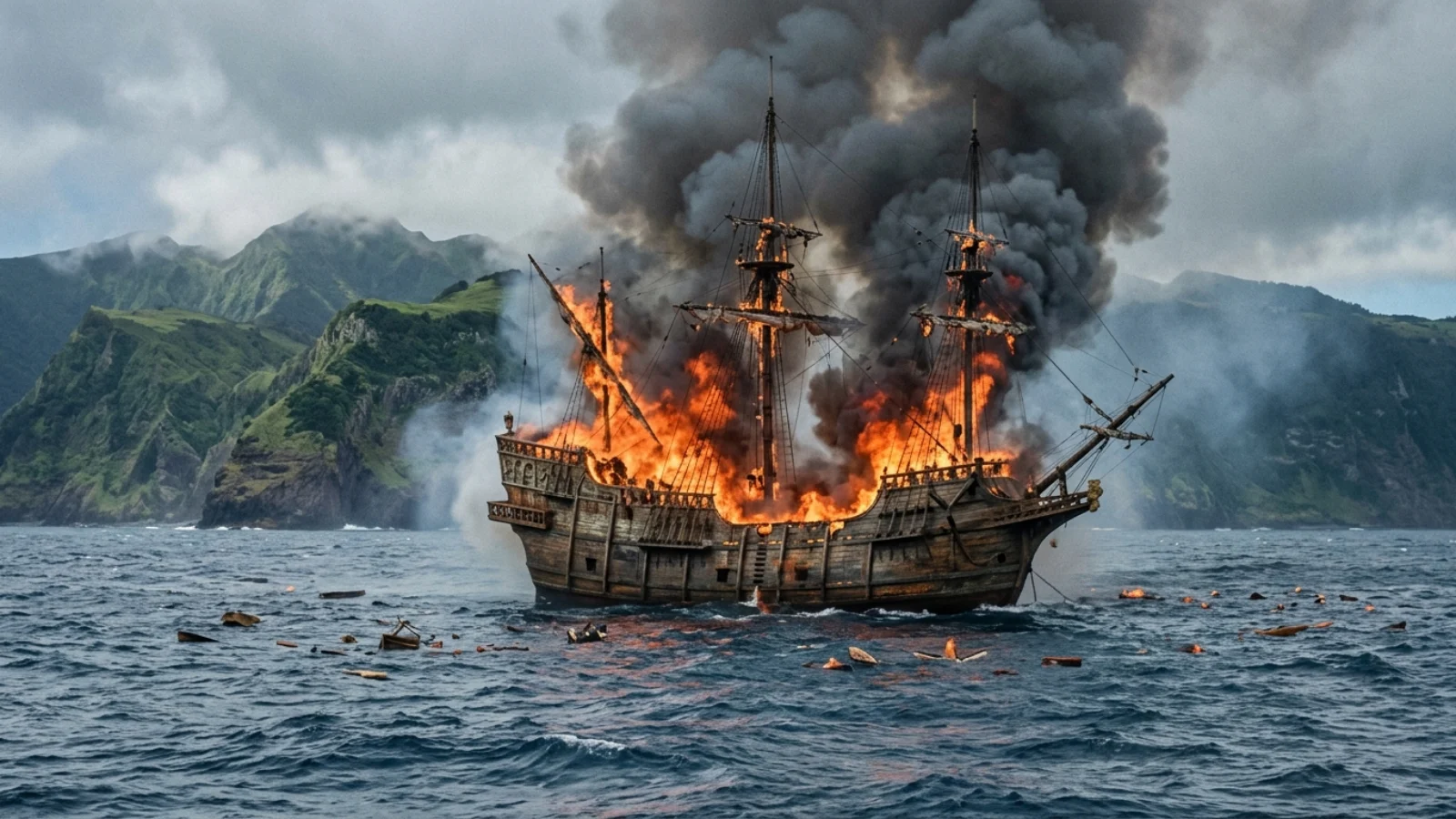
What happened at the Action of Faial?
Portugal was then united with Spain under Philip II, so Portuguese ships were fair game for English privateers in the Anglo-Spanish War. In 1594 George Clifford, Earl of Cumberland, sent three privateers of 250–300 tons, the Royal Exchange, Mayflower and Sampson, with about 420 sailors and soldiers to cruise the Azores, where homeward-bound Indiamen called for water and food.
| Time | Event |
|---|---|
| 22 June, noon | The Mayflower sights the carrack off Faial; the battle begins |
| Afternoon–evening | Three English boarding attempts are beaten back; captain George Cave is killed, William Anthony mortally wounded and Nicholas Downton wounded |
| Night | The English concentrate fire on the unarmed stern; the Royal Exchange boards; fire spreads through the rigging and masts |
| Overnight | English marksmen stop the Portuguese from manning the pumps; the crew abandon ship as she burns |
| 23 June, dawn | The powder magazine explodes and the carrack sinks |
Casualties were appalling: battle accounts give about 600 Portuguese killed or wounded and 13 survivors, while other sources say more than 500 died. On the English side about 60 were killed or wounded, roughly 35 of them in the final explosion. Among the episodes recorded is that of Dona Isabel Pereira and her teenage daughter, who leapt into the sea rather than be stripped by the English sailors.
Did anyone get the treasure?
No. Unlike the famous Madre de Deus, captured by the English off the Azores in 1592 and plundered in Dartmouth, the Cinco Chagas was destroyed before anyone could take her cargo. The English gained only their prisoners: Nuno Velho Pereira and Dom Braz Correia were held for a year and ransomed for 2,500 ducats each. The fire and explosion denied the riches to England, Portugal and Spain alike.
Where is the Cinco Chagas wreck?
Estimates place her about 18 miles south of the channel between the islands of Pico and Faial, in water more than a mile (about 1.6 km) deep. That makes her a deep-sea wreck, far beyond divers and within reach only of remotely operated vehicles or crewed submersibles. Treasure hunters have searched for her, without success, and the wreck site has never been confirmed.
Why has the Cinco Chagas never been found?
- Depth. Over 1,600 m of water off the Azores rules out conventional diving and makes searching slow and expensive.
- Uncertain position. The fight drifted over many hours, and 16th-century positions were vague.
- Destruction. She burned to the waterline and exploded, so any wreckage is scattered and the hull may be largely gone.
- Volcanic, rugged seabed. The Azores sit on the Mid-Atlantic Ridge, with steep slopes and rough terrain that hide debris.
- Legal protection. Portugal and the Azores protect underwater cultural heritage, and commercial salvage of historic wrecks is tightly restricted.
In deep, cold water, however, organic material can survive far better than in the shallows. Gems, gold and porcelain would not rot, and if the wreck is ever located by a scientific survey, it could be one of the most important Portuguese India-ship sites anywhere. See the Bom Jesus, the only India ship of this period excavated in detail.
What does the Cinco Chagas tell us about treasure fleets?
That the richest ships were also the most vulnerable. Overloaded, poorly maintained giants were slow, hard to handle and easy targets for smaller, faster privateers waiting in the Azores. The same pattern sank or delivered many treasure ships to their enemies, from the Flor de la Mar to the Spanish plate fleets of the 1700s; see the 1715 Treasure Fleet.
Has the Cinco Chagas been found?
No. Her wreck has never been located; it is thought to lie more than a mile deep off the Azores.
When did the Cinco Chagas sink?
On 23 June 1594, after a battle that began on 22 June off Faial in the Azores.
Who sank the Cinco Chagas?
English privateers sent by the Earl of Cumberland: the Royal Exchange, Mayflower and Sampson.
What treasure was on the Cinco Chagas?
Goods worth over two million ducats plus 22 chests of diamonds, rubies and pearls.
How many people died on the Cinco Chagas?
Hundreds: sources say over 500 died, and only 13 Portuguese survived.
How deep is the Cinco Chagas wreck?
Estimates put it over 1.6 km (one mile) deep.
What does Cinco Chagas mean?
“Five Wounds”, referring to the wounds of Christ.
How big was the Cinco Chagas?
About 2,000 tons, one of the largest ships of its time.
- Wikipedia: Cinco Chagas; Action of Faial.
- Clowes, W.L. (1897). The Royal Navy: A History, vol. 1.
- Boxer, C.R. (1969). The Portuguese Seaborne Empire, 1415–1825. Hutchinson.
- Monson, W. Naval Tracts (Navy Records Society edition).
Blane Perun has been exploring Earth’s oceans and marine life for over 25 years. Founder of TheSea.Org in 1999, underwater photographer, coral aquaculture pioneer, and explorer of 80+ countries.
About Blane Perun →