What Do Dolphins Eat? — Fish, Squid and Shrimp, Swallowed Whole
Dolphins eat fish, squid and crustaceans such as shrimp and crabs. Bottlenose dolphins favor mullet, croaker, menhaden and other schooling fish, and an adult eats about 4 to 6% of its body weight a day, roughly 15 to 30 pounds. Dolphins swallow prey whole, head first, and find it with echolocation. The largest dolphin, the orca, also hunts seals, sharks and whales.
All dolphins are carnivores. Their diet changes with species, place and season. Coastal bottlenose dolphins eat a wide mix of bottom and schooling fish, squid and shrimp; offshore species such as spinner and pantropical spotted dolphins hunt lanternfish, small squid and shrimp that rise toward the surface at night; river dolphins eat catfish, croakers and freshwater crabs. Dolphins use their conical teeth to grab prey, not chew it, and swallow it whole.
What do different dolphin species eat?
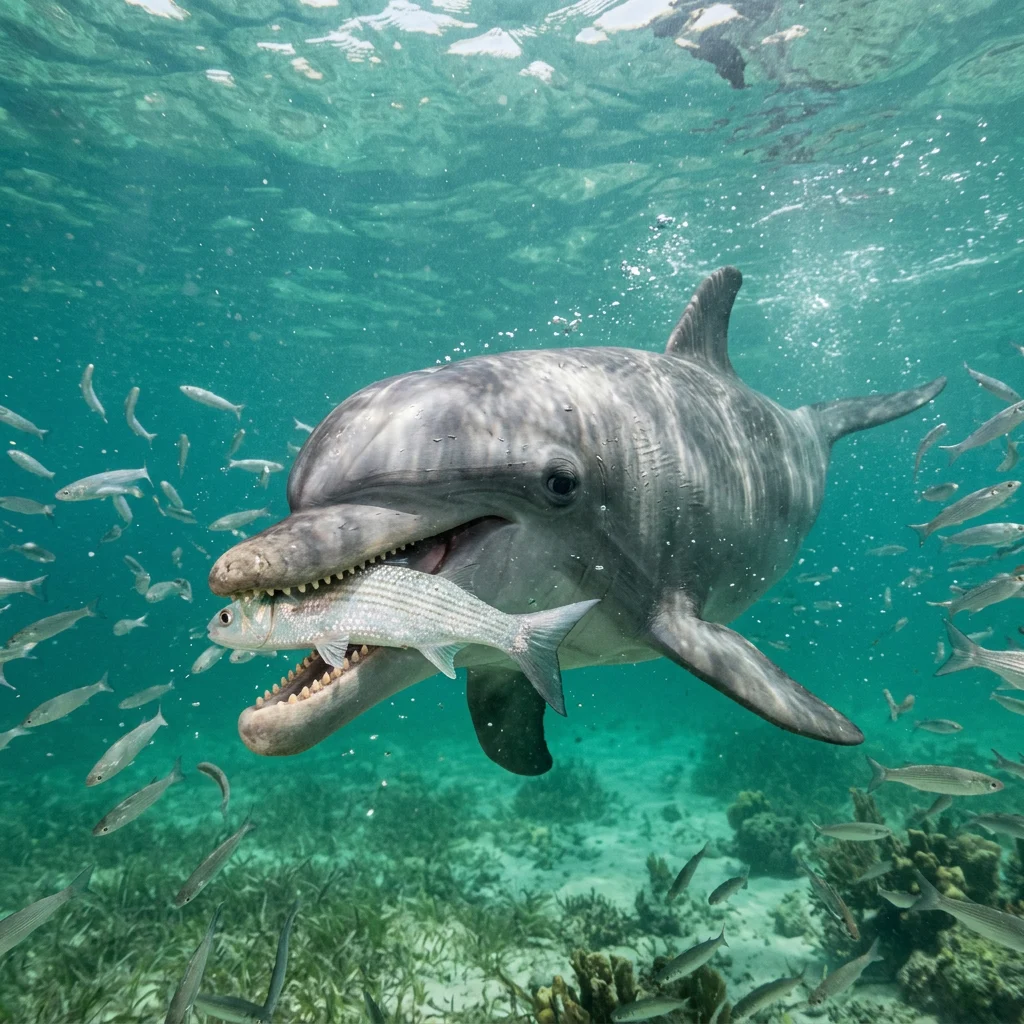
Each species has its own menu, set by where it lives and how deep it can dive.
| Dolphin | Main prey | Where it feeds |
|---|---|---|
| Common bottlenose | Mullet, croaker, menhaden, pinfish, squid, shrimp | Bays, coasts, offshore |
| Spinner dolphin | Lanternfish, small squid, shrimp | Deep scattering layer, at night |
| Short-beaked common dolphin | Sardines, anchovies, squid | Open ocean, often in large schools |
| Risso’s dolphin | Almost entirely squid | Deep slopes, 300 m+ |
| Orca (killer whale) | Fish, seals, sea lions, sharks, whales | All oceans |
| Amazon river dolphin | 50+ fish species, crabs, turtles | Flooded forest and rivers |
| Ganges river dolphin | Fish, prawns | Muddy rivers, by echolocation |
Read species profiles for spinner dolphins, Risso’s dolphins and the orca.
Night hunters of the open ocean
Many ocean dolphins feed on the “deep scattering layer”, the dense band of lanternfish, shrimp and small squid that spends the day hundreds of metres down and rises towards the surface at night. NOAA describes spinner dolphins feeding through the night on small fish, shrimp and squid that live about 200–300 m (650–1,000 ft) deep by day. In Hawaii, spinner dolphins rest in shallow, sandy bays during the day and move offshore at dusk to feed, which is why disturbing them in their resting bays is a real welfare concern.
Acoustic studies off O‘ahu by Kelly Benoit-Bird and Whitlow Au revealed how they hunt in the dark. A group of about 20 spinners swims side by side until it finds a patch of prey, then forms about ten pairs that circle the patch and squeeze it into a dense ball. Two pairs at a time dart into the ball from opposite sides, feed for about 15 seconds and pull back out while the next pairs take their turn. The circle keeps the prey trapped while every pair gets a share, a level of coordination that would be impossible to see without sonar.
Risso’s dolphins and pilot whales, the largest members of the dolphin family after the orca, are squid specialists that dive deep along continental slopes, mainly at night. Risso’s dolphins become covered in white scars over their lives, many from the teeth of other Risso’s dolphins and some from the suckers and beaks of the squid they hunt.
Orcas: one species, many diets
The orca is the largest dolphin and, according to NOAA, has the most varied diet of any cetacean, yet individual populations are strict specialists. Diet is set mainly by culture, the hunting traditions each ecotype learns from its elders. In the Pacific Northwest, the fish-eating “resident” killer whales eat almost only fish, mainly salmon, and the endangered Southern Residents depend heavily on Chinook salmon, the largest salmon species. In the same waters, Bigg’s (transient) killer whales hunt harbour seals, sea lions, porpoises and even large whales, and they ignore salmon entirely. Elsewhere, killer whales specialise on herring in Norway, on bluefin tuna around the Strait of Gibraltar, on seals taken from ice floes in Antarctica, and on sharks. Because the ecotypes rarely mix or interbreed, some scientists think several of them may be separate species.
What river dolphins eat
River dolphins live in murky water where sight is of little use, and they rely heavily on echolocation. The Amazon river dolphin, or boto, has a flexible neck and a long beak with teeth of two types, cone-shaped in front and broader, molar-like teeth at the back that help it crush armoured catfish, crabs and even small river turtles. Studies of stomach contents have recorded more than 50 species of fish in its diet, and during the high-water season it follows fish into flooded forest, swimming among the tree trunks. The South Asian river dolphins of the Ganges, Brahmaputra and Indus have tiny eyes without lenses and are effectively blind, finding fish and prawns in silty water by sonar alone, often swimming on their sides with one flipper trailing along the bottom.
How much does a dolphin eat a day?
An adult bottlenose dolphin eats about 4 to 6% of its body weight daily.
For a 400-pound (180 kg) bottlenose that works out to roughly 15 to 30 pounds of fish a day, more for nursing mothers and growing juveniles, and more in cold water where keeping warm costs energy. Dolphins have a three-chambered stomach (a muscular forestomach that stores and starts breaking down food, a main glandular stomach and a pyloric stomach), and they digest quickly. Wild dolphins feed throughout the day and night in short bouts rather than one big meal.
Teeth, swallowing and digestion
Dolphin teeth are simple pegs or cones, all the same shape, built for gripping slippery prey rather than cutting or chewing. The number varies enormously between species. Bottlenose dolphins have roughly 18 to 28 teeth on each side of each jaw, and some slender-beaked oceanic dolphins, such as the spinner, have even more. Risso’s dolphins are the opposite: they usually have no teeth in the upper jaw and only two to seven pairs of peg-like teeth at the front of the lower jaw, a reflection of a diet made up mostly of squid, which can be sucked in rather than seized.
A dolphin swallows its catch whole and turns fish to go down head first so that the spines of the fins fold flat instead of catching in the throat. Large prey can be a problem. Bottlenose dolphins sometimes shake or batter a big fish to break it into pieces, or rub it on the seabed to remove spines, and some fish, such as sheepshead and catfish with stout spines, occasionally lodge in the throat of a dolphin that misjudges them. Food passes into the forestomach, which stores it and begins breaking it down mechanically, then into the main stomach where digestive enzymes and acid do most of the work. The hard parts left over, such as the ear stones (otoliths) of fish and the beaks of squid, are what scientists use to reconstruct what a dolphin has eaten.
Flavour probably plays little part in any of this. Toothed whales have lost the sense of smell, and genetic studies have found that most of the genes for taste receptors in dolphins no longer work, so a dolphin likely judges food by its sound, appearance, texture and behaviour rather than its taste. That fits the way they hunt: a fish is located by ear and sonar, grabbed, turned and swallowed in seconds.
How do scientists know what dolphins eat?
Most of what we know comes from the stomachs of dead dolphins. Fish otoliths and squid beaks resist digestion and are different for each species, so researchers can identify the prey and even estimate its size from the size of the otolith or beak. For years critics argued that stranded animals, often sick, might not have been eating normally. A 2013 study in Biology Letters led by Glenn Dunshea tested this by collecting stomach fluid and faeces from 18 healthy bottlenose dolphins briefly captured for health checks in Sarasota Bay and identifying the prey from its DNA. The results closely matched the stomach contents of stranded dolphins from the same area, supporting the traditional method.
Other methods fill in the picture. Chemical signatures in skin and blubber, such as stable isotopes of carbon and nitrogen and the mix of fatty acids, show what a dolphin has eaten over weeks to months and how high in the food web it feeds. Suction-cup tags with hydrophones and motion sensors record every click, buzz and lunge, showing when and how often dolphins catch prey, and boat-based and drone observations document the hunting behaviour itself.
How do dolphins catch their food?
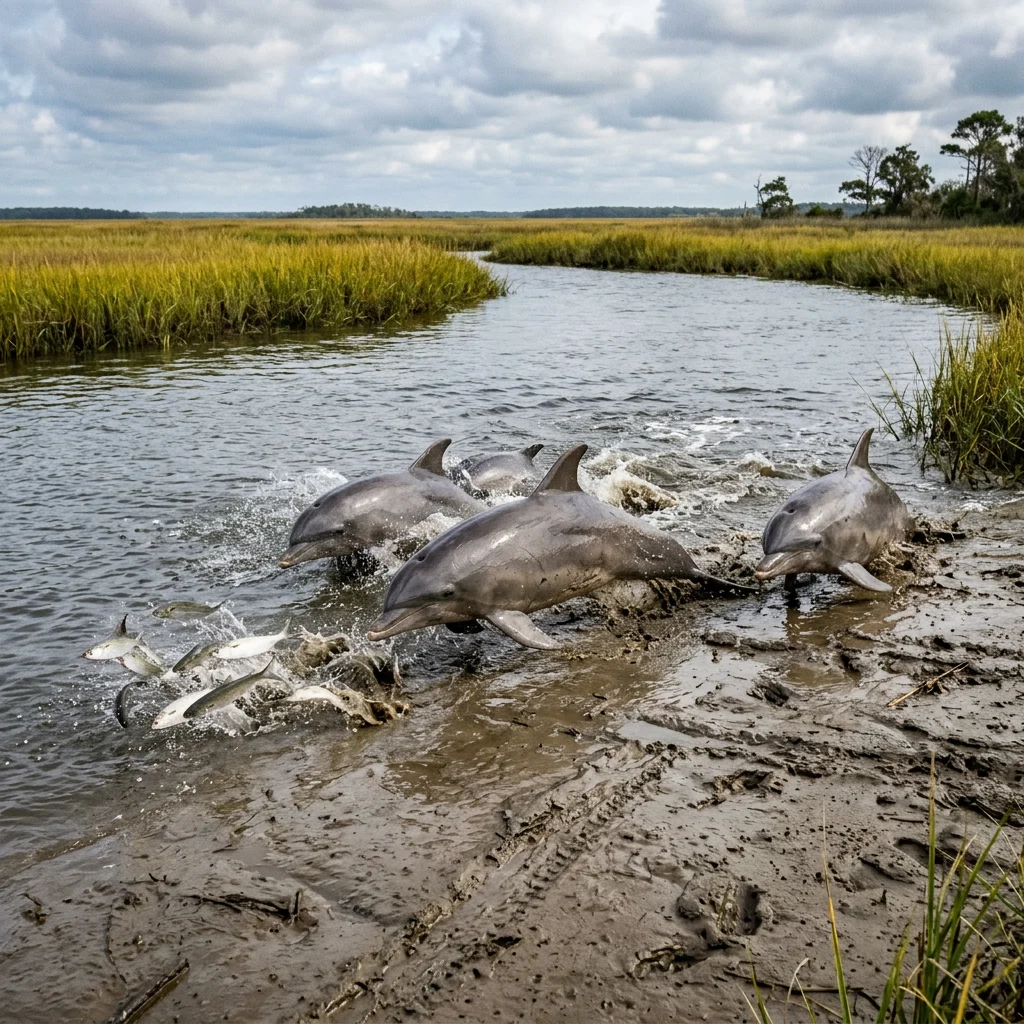
With echolocation, teamwork and some remarkable local traditions.
Dolphins produce rapid clicks from the nasal passages and focus them through the fatty melon in the forehead. Echoes bouncing back from fish, including from their gas-filled swim bladders, give the dolphin a detailed acoustic picture of prey, even buried in sand or hiding in murky water. Some populations have developed hunting cultures passed from mother to calf.
How do dolphins find their prey?
They listen first and echolocate second, and some can even sense the electric fields of buried prey.
Echolocation is the dolphin’s best-known hunting tool, but wild dolphins use it more sparingly than most people assume. Many of the fish that bottlenose dolphins eat most often are “soniferous”: species such as croakers, drums, toadfish and grunts that make grunting and drumming sounds, especially when spawning. In playback experiments in Sarasota Bay, Florida, published in 2005, Doug Gannon, Randall Wells and colleagues played recorded fish calls to wild dolphins. The dolphins turned towards the speaker and immediately increased their rate of echolocation clicks, while recordings of snapping shrimp produced no such response. The researchers concluded that dolphins search largely by passive listening, using the prey’s own sounds to learn its identity, size and position, then switch on their sonar to track and catch it.
Once a dolphin closes in, its click rate rises sharply into a rapid “buzz” that gives it a fast-updating acoustic picture of the last few metres before capture. Echoes are especially strong from the gas-filled swim bladders of fish, which helps dolphins pick out prey hidden in sand, seagrass or murky water. In clear water they also hunt by sight, and their eyes work well both in water and in air. One river and coastal species has an extra sense. In 2012 researchers showed that the Guiana dolphin (Sotalia guianensis) of South American coasts can detect weak electric fields through the pits left where its whiskers were shed after birth, a sense that may help it find fish buried in mud.
How dolphin calves learn to eat
NOAA reports that bottlenose dolphin calves nurse for about 20 months and generally stay with their mothers for three to six years. Calves begin chasing and catching small fish in their first year, but milk remains an important part of their diet long after that, and most of what they learn about hunting comes from watching their mothers. That is why hunting methods differ so much between neighbouring populations. In Shark Bay, Western Australia, sponge-carrying dolphins learn the technique from their mothers, and most spongers are female. Strand-feeding in South Carolina and mud-ring feeding in Florida Bay are likewise local traditions, practised by some groups and unknown to others nearby.
Do dolphins eat jellyfish, sharks or other mammals?
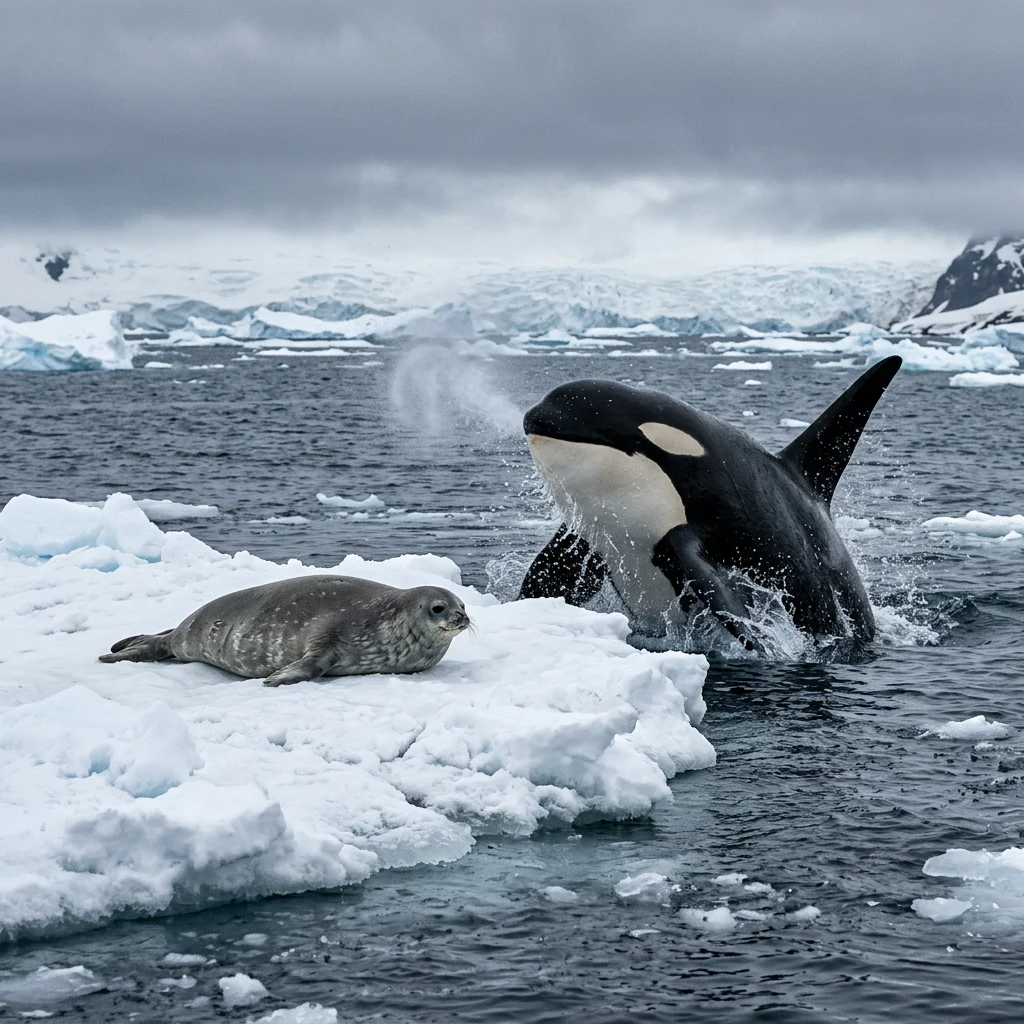
Jellyfish rarely, small sharks occasionally, mammals only in the case of orcas.
Dolphins sometimes play with jellyfish but do not rely on them; see do dolphins eat jellyfish? Bottlenose dolphins in a few areas have been recorded eating small sharks and rays, covered in will dolphins kill sharks? Only orcas, and to a lesser degree false killer whales, regularly hunt other marine mammals.
Do dolphins drink water with their food?
Mostly no: they get the water they need from their prey.
Fish and squid are 60 to 80% water, and digesting fat produces metabolic water. Dolphins have efficient kidneys and rarely drink seawater. More in do dolphins drink water?
Dolphins, fishers and food from people
For more than 140 years, Lahille’s bottlenose dolphins in the lagoon at Laguna, in southern Brazil, have fished alongside people. The dolphins drive schools of mullet towards fishers standing in the shallows and give a distinctive dive or head slap that tells the fishers when to cast their nets. A 2023 study by Mauricio Cantor and colleagues, using drones and underwater recordings, showed that both sides catch more fish when they act together, and that dolphins that take part have a survival rate about 13% higher than those that do not. The tradition is at risk as mullet stocks decline and fewer young fishers learn the craft.
Other interactions with people are harmful. Dolphins learn to take fish from hooks and nets, a behaviour called depredation, and many are injured or killed by swallowing hooks or becoming entangled in line. Feeding wild dolphins is illegal in the United States under the Marine Mammal Protection Act, because it teaches them to approach boats and anglers for handouts. “Begging” dolphins in places such as Florida are more likely to be hit by propellers, hooked, or fed food that is harmful to them, and calves of begging mothers learn to beg instead of hunt. The best way to watch a dolphin eat is from a respectful distance, without offering it anything.
What do dolphins eat?
Fish, squid and crustaceans such as shrimp and crabs. Orcas also eat seals, sharks and whales.
What is a dolphin’s favorite food?
It varies. Bottlenose dolphins in the US Southeast favor mullet, croaker and menhaden; Risso’s dolphins eat almost only squid.
How much does a dolphin eat per day?
About 4 to 6% of its body weight, roughly 15 to 30 pounds for an adult bottlenose.
Do dolphins chew their food?
No. They use their teeth to grip prey and swallow it whole, usually head first.
Are dolphins carnivores?
Yes. All dolphins are carnivores.
Do dolphins eat plants?
No. Any seagrass or algae swallowed is incidental.
What do baby dolphins eat?
Calves drink their mother’s fat-rich milk for about 20 months and start catching fish within the first year.
Do dolphins eat octopus?
Yes. Bottlenose dolphins in Australia even shake and toss octopuses to break them up before swallowing.
- NOAA Fisheries: Common bottlenose dolphin profile (diet, nursing).
- SeaWorld Parks & Entertainment: Bottlenose dolphin diet and eating habits.
- Torres, L. G. & Read, A. J. (2009). Where to catch a fish? Mud-ring feeding in Florida Bay. Marine Mammal Science.
- Krutzen, M. et al. (2005). Cultural transmission of tool use in bottlenose dolphins. PNAS.
- Gannon, D.P. et al. (2005). Prey detection by bottlenose dolphins, Tursiops truncatus: an experimental test of the passive listening hypothesis. Animal Behaviour 69.
- Dunshea, G. et al. (2013). Study of bottlenose dolphin diet using DNA from stomach fluid and faeces, Sarasota Bay. Biology Letters.
- Benoit-Bird, K.J. & Au, W.W.L. (2009). Cooperative prey herding by the pelagic dolphin, Stenella longirostris. Journal of the Acoustical Society of America.
- Czech-Damal, N.U. et al. (2012). Electroreception in the Guiana dolphin (Sotalia guianensis). Proceedings of the Royal Society B.
- Cantor, M. et al. (2023). Foraging synchrony drives resilience in human–dolphin mutualism. Proceedings of the National Academy of Sciences.
- NOAA Fisheries. Species profiles: Risso’s dolphin, spinner dolphin, killer whale.
Blane Perun has been exploring Earth’s oceans and marine life for over 25 years. Founder of TheSea.Org in 1999, underwater photographer, coral aquaculture pioneer, and explorer of 80+ countries.
About Blane Perun →