Andaman Sea
The Andaman Sea is a marginal sea of the eastern Indian Ocean, bounded by Myanmar to the north and west, Thailand and Malaysia to the east, and India’s Andaman and Nicobar Islands to the west. It covers approximately 797,700 square kilometers, reaches over 4,200 meters at its deepest point in the Andaman Basin, and is home to over 500 coral species and approximately 3,000 fish species — making it one of the most biologically diverse marine environments in Asia.
The Andaman Sea sits in a part of the world where the Indian Ocean narrows between two landmasses — the long finger of the Malay Peninsula reaching south on one side, and the arc of the Andaman and Nicobar Islands curving down on the other. Between them lies a body of water that is sheltered enough to develop extraordinary marine biodiversity, connected enough to receive the rich open-ocean species that pass through, and remote enough that large parts of it remain genuinely little-explored.
Geography — where is the Andaman Sea?
The Andaman Sea is defined by the geography that surrounds it — four countries, one island chain, and two major waterways connecting it to the wider ocean.
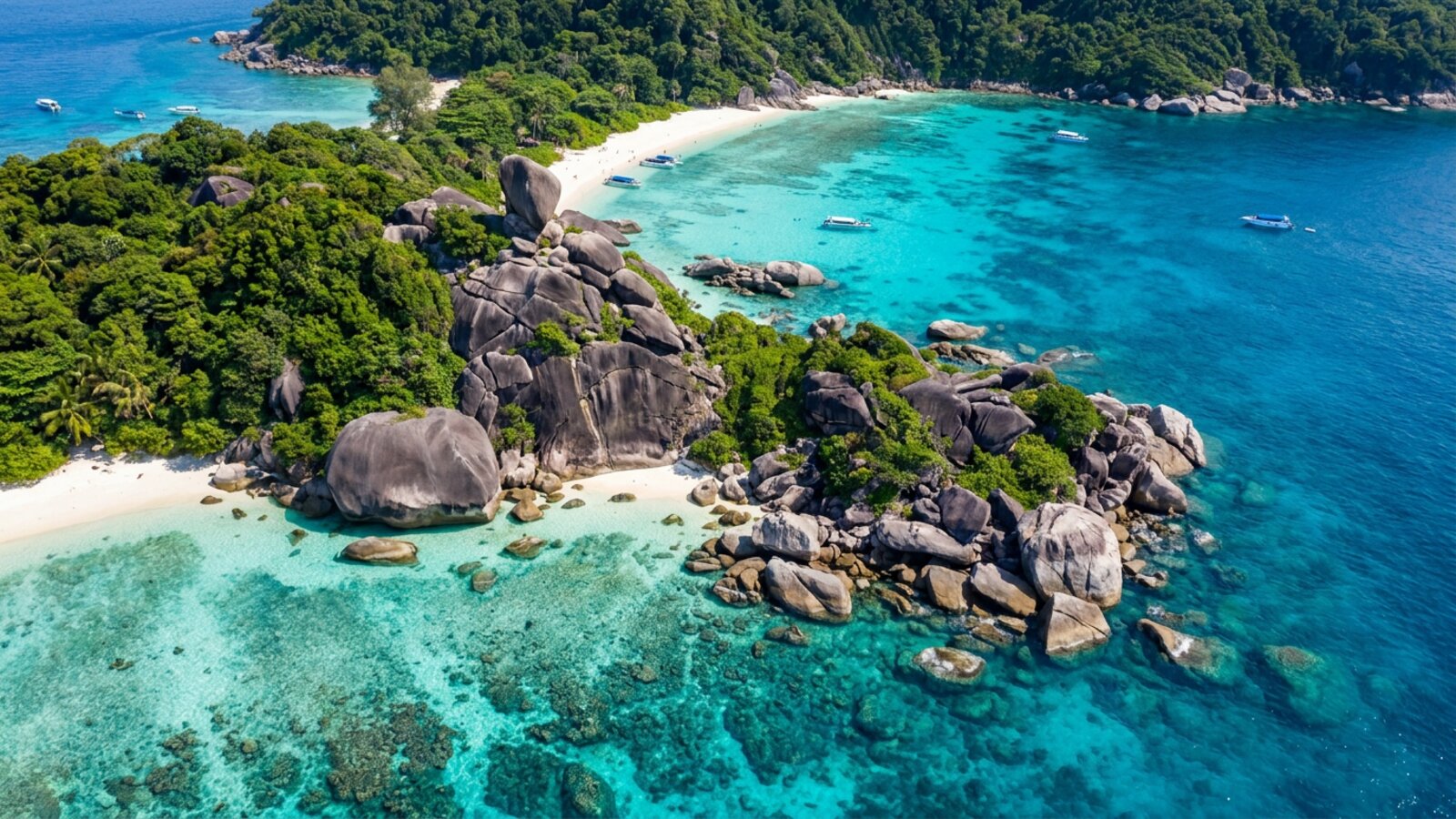
The sea’s northern limits reach into the Gulf of Martaban off the coast of Myanmar. Moving south, the coastline transitions through the Mergui Archipelago in Myanmar and then the Andaman Coast of Thailand — the stretch of turquoise water and limestone karsts that most international visitors associate with the region. The western boundary is the chain of the Andaman and Nicobar Islands — over 500 islands belonging to India. The southern end narrows into the Strait of Malacca, carrying an estimated 25% of global seaborne trade. The underlying geology is active — the Andaman Basin is a back-arc basin formed by the subduction of the Indian Plate beneath the Burma Plate, the same tectonic setting that produced the catastrophic 2004 earthquake and tsunami.
Marine biodiversity
The Andaman Sea is one of Asia’s richest marine environments — a fact not always reflected in how well it is studied or protected.
Over 500 coral species have been documented, supporting fish communities of approximately 3,000 species. Whale sharks are present year-round, with peak concentrations from November through April. Manta rays are regular visitors at sites like Koh Bon and Koh Tachai. Dugongs feed on seagrass beds around the Surin Islands and Libong Island. Hawksbill and green turtles nest throughout the island chain. Marine mammals include sperm whales in deeper water, Irrawaddy dolphins in estuarine areas, spinner dolphins offshore, and occasionally humpback whales during migration.
Diving — top sites in the Andaman Sea
The Andaman Sea contains some of the finest dive sites in Asia, from accessible day trips to remote liveaboard expeditions.
The Moken — sea nomads of the Andaman
The Moken are one of the few remaining sea nomadic peoples in the world, and their connection to the Andaman Sea extends across centuries.
The Moken are an Austronesian people who have lived semi-nomadically on and around the Andaman Sea’s islands for centuries — traditionally spending most of the year on wooden boats called kabang, built entirely without nails. Moken children demonstrate underwater visual acuity roughly twice as sharp as that of European children — documented in a 2003 Current Biology study. They learn to control their pupils and lens curvature underwater in a way that most humans cannot achieve without training. An estimated 2,000–4,000 Moken remain today, primarily in the Mergui Archipelago of Myanmar and around the Surin Islands of Thailand. Traditional nomadic life has largely given way to shore-based settlement under government pressure on both sides of the border.
Seasons and weather — when to visit the Andaman Sea
| Season | Months | Conditions | Best for |
|---|---|---|---|
| Dry / High Season | November – April | Calm seas, 20–30 m visibility, air temp 28–35°C | Diving, snorkeling, island-hopping, whale shark season |
| Shoulder | May, October | Variable, some rain, still diveable | Lower prices, fewer crowds |
| Monsoon / Low Season | June – September | Southwest monsoon, rough seas, poor visibility | Budget travel, Phuket mainland |
Conservation challenges
Coral bleaching events have become more frequent and severe. The 2010, 2016, and 2020 bleaching events caused widespread coral mortality, with recovery between events increasingly incomplete. Destructive fishing practices — blast fishing and cyanide fishing — remain problems in less-monitored parts of Myanmar. Coastal development along the Thai Andaman coast has destroyed mangrove habitat — Thailand has lost an estimated 50–60% of its mangrove coverage since the 1960s. On the positive side, enforcement of Thai national marine parks has improved considerably over the past decade, and seasonal closures of the Similan and Surin Islands have allowed meaningful reef recovery.
What is the Andaman Sea?
The Andaman Sea is a marginal sea of the eastern Indian Ocean, located between Myanmar, Thailand, Malaysia, and India’s Andaman and Nicobar Islands. It covers approximately 797,700 square kilometers, reaches 4,200 meters at its deepest, and is one of the most biologically rich marine environments in Asia, with 500+ coral species and ~3,000 fish species.
What countries border the Andaman Sea?
Myanmar, Thailand, and Malaysia border the sea from the east and north. India’s Andaman and Nicobar Islands form its western boundary, separating it from the main body of the Indian Ocean.
What is the best time to visit the Andaman Sea?
November through April is the dry season — calm seas, good visibility, and the peak of whale shark season. The southwest monsoon (June through September) brings rough conditions and most dive operations in Thailand close. Shoulder months (May and October) offer lower prices but variable conditions.
Can you see whale sharks in the Andaman Sea?
Yes. The Andaman Sea is one of Asia’s best regions for whale shark encounters. Richelieu Rock and the Similan Islands in Thailand are the most reliable sites, with peak season from February through April.
Is the Andaman Sea part of the Indian Ocean?
Yes. The Andaman Sea is a marginal sea of the eastern Indian Ocean, separated from the main basin by the Andaman and Nicobar Islands. It connects to the Bay of Bengal in the north and the Strait of Malacca in the south.
How deep is the Andaman Sea?
The average depth is approximately 870 meters. The Andaman Basin in the southern part of the sea reaches over 4,200 meters. The basin is geologically active, formed by the subduction of the Indian Plate beneath the Burma Plate.
Blane Perun has been exploring Earth’s oceans, coral reefs, and marine life for over 25 years. Founder of TheSea.Org in 1999, underwater photographer, and explorer of 80+ countries. He has dived the Similan Islands, Richelieu Rock, and the Mergui Archipelago.
About Blane Perun → Diving in the Andaman Sea →