Bull Sharks in the Mississippi River — How Far Up They Really Go
Yes, bull sharks enter the Mississippi River system, but sightings far upstream are extremely rare. The famous record is a bull shark of about 5 feet and 84 pounds caught in a fisherman’s net at Alton, Illinois, in 1937, roughly 1,100 kilometres (700 miles) from the sea; a second was reported near St. Louis in 1995. A 2021 review found those were the only two upper-river captures of the twentieth century, and a 2022 follow-up concluded that one of them is probably a hoax. Bull sharks are common, however, in the brackish waters of coastal Louisiana, including Lake Pontchartrain, the lower Mississippi and the Atchafalaya.
Bull sharks live at the bottom of the Mississippi system in Louisiana; a shark in St. Louis or Illinois is a once-in-a-lifetime wanderer, not a resident.
Are there bull sharks in the Mississippi River?
Yes, but you need to be precise about where. Bull sharks (Carcharhinus leucas) are common in the brackish bays, lakes and lower rivers of coastal Louisiana, where the Mississippi and its distributaries meet the Gulf of Mexico. Records from far up the main river are a different matter. In two papers in the journal Marine and Fishery Sciences, Ryan Shell of the Cincinnati Museum Center and Nicholas Gardner reviewed hundreds of reports of sharks in the Mississippi. They concluded that only two bull sharks were captured in the river’s upper portion during the entire twentieth century, and that historical, archaeological and fossil evidence of bull sharks more than 500 kilometres upstream of the delta is almost non-existent.
So the honest answer to “are there bull sharks in the Mississippi?” is that there are plenty in its salty and brackish lower reaches, a few that move some way upriver from time to time, and almost none, ever, in the middle of the continent. The rare far-travelled individuals are what make headlines.
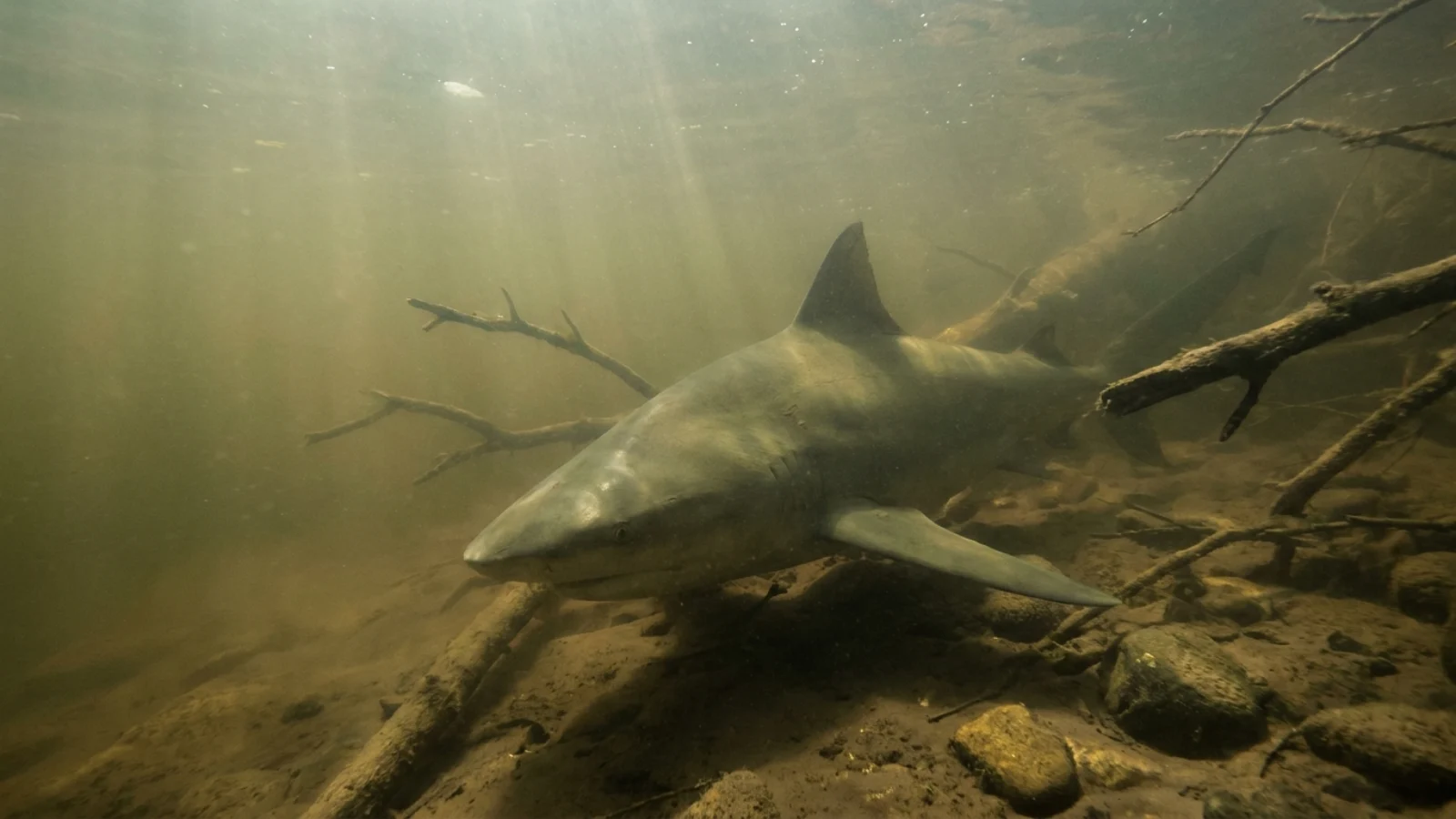
What was the 1937 Alton, Illinois bull shark?
The record most often quoted for bull sharks in North America comes from Alton, Illinois, a river town just upstream of St. Louis near the mouth of the Illinois River. In 1937, according to the Alton Evening Telegraph, a bull shark became tangled in a commercial fisherman’s seine net there. It was described as about 5 feet (1.5 metres) long and weighing 84 pounds (38 kilograms), a young shark rather than a full-grown adult. Alton lies about 1,100 kilometres (700 miles) up the river from the ocean, which is why it is regularly cited as the farthest inland bull shark record in the Mississippi system.
The second twentieth-century record came in 1995, when a shark was found just outside St. Louis, Missouri, pulled from the screen of a cooling-water intake canal at a power plant. A 2004 report on the ecology of the river classified both the 1937 and 1995 sharks as accidental, one-off wanderers rather than evidence of a regular population.
Was one of the Mississippi bull shark records a hoax?
In 2022, Shell and Gardner published a correction with a third author, Robert Hrabik. They reported that new evidence suggested one of the two twentieth-century occurrences was probably a hoax, and they corrected their earlier paper accordingly. That leaves the upper Mississippi with at most a single credible bull shark capture in a hundred years.
The finding fits a wider pattern. Shell and Gardner found that most modern reports of sharks in the river were incomplete or simply wrong, and that many were copied from one news story to the next until a rumour looked like a fact. Shark teeth turned up at inland archaeological sites have also been offered as evidence that sharks once swam up the river, but some of those teeth were found away from natural fossil beds, which suggests people carried them inland as trade goods. Native American communities of the Mississippi valley did trade marine shells and shark teeth over great distances, so a tooth in Illinois proves trade, not a shark. The authors called for better tools to settle the question, such as environmental DNA sampling, which can detect traces of an animal’s DNA in water.
How can a bull shark survive in fresh water?
Most sharks die quickly in fresh water. Their blood is kept about as salty as seawater by holding high levels of urea and other compounds, and in fresh water they absorb water and lose salt faster than they can cope. Bull sharks are the main exception among large sharks. In fresh water they lower the urea in their blood, produce large volumes of dilute urine, and conserve salt rather than excreting it.
Experiments on bull sharks from the Brisbane River in Australia show how flexible they are. Pillans and colleagues, writing in the Journal of Fish Biology in 2008, caught sharks in the river’s freshwater reaches and gradually moved one group to full seawater over 17 days while keeping another group in fresh water. Both groups stayed healthy. In seawater the sharks used the rectal gland, a small organ near the end of the gut, to pump out excess salt; in fresh water they conserved salt instead. Remarkably, the gland itself barely changed: its size, number of secretory tubules and cellular structure were largely the same in both groups, suggesting the switch is mostly a matter of how the gland’s cells are regulated rather than a rebuilding of the organ. Our article on how long a bull shark can live in fresh water goes further into the physiology.
Why do young bull sharks go up rivers?
Bull sharks give birth in estuaries, and the pups spend their first years in brackish and fresh water, where the large sharks that would eat them, including adult bull sharks, are scarce. Studies in the northern Gulf show how precisely young bull sharks track conditions. In Mobile Bay, Alabama, Marcus Drymon and colleagues tracked 35 young bull sharks between 60 and 114 centimetres long and found that they gathered near the mouth of the largest river entering the bay, preferring water of 29 to 32 °C with a salinity of about 10 to 11 parts per thousand, roughly a third that of seawater. As they grow, bull sharks spend more of their time in salty water.
That life history explains the Mississippi records. The sharks that wander far upriver are typically young ones, exploring from nursery areas in brackish water. The Alton shark, at about 1.5 metres, fits that picture. Bull sharks can be up to about 81 centimetres long at birth, while adult females average about 2.4 metres and 130 kilograms and adult males about 2.25 metres and 95 kilograms, so the Alton fish was a sub-adult, several years old but far from full size. Young bull sharks are also the ones most tolerant of fresh water for long periods, while adults are more tied to the coast.
Where do bull sharks live in the Mississippi system?
The core of bull shark country in the Mississippi system is Louisiana’s coast. Lake Pontchartrain, just north of New Orleans, is a broad, shallow estuary of about 1,600 square kilometres with an average depth of only about 4 metres. Its water is almost fresh at the western end near Mandeville and reaches about half the salinity of seawater in the east, where it connects to the Gulf through passes. That gradient is ideal for bull sharks. After Hurricane Katrina in 2005, which pushed a surge of Gulf water into the lake, many bull sharks were sighted there, and they are caught regularly by anglers in summer.
The Atchafalaya River, the Mississippi’s largest distributary, is another bull shark haunt. Formed where the Red River meets the Mississippi near Simmesport, it now receives about 30 percent of the combined flow of the two rivers, a share fixed by the Old River Control Structure built to stop the Mississippi from switching its main course into the Atchafalaya. In July 2023 local fishermen on the Atchafalaya reported increasing numbers of bull sharks. The wider Gulf picture, including the bull shark nurseries of Alabama, Mississippi and Florida, is covered in sharks in the Gulf of Mexico.
How does salt water get up the Mississippi?
The lower Mississippi is not entirely fresh. Because seawater is denser than river water, salt water from the Gulf slides upstream along the riverbed as a wedge beneath the outflowing fresh water. In normal years the river’s flow keeps the wedge near the mouth, but in droughts it can travel a long way inland. In 2022 the salt wedge reached about 103 kilometres (64 miles) upriver, threatening drinking water supplies, and the US Army Corps of Engineers has built underwater sills across the riverbed to hold it back in 1988, 1999, 2012 and 2022.
For a bull shark, a salt wedge is a highway. A shark following the salty bottom layer can move far up the lower river without ever leaving brackish water, and from there a fresh-water-tolerant juvenile can continue into the river proper. This is one reason why a shark sighting far upriver in a drought is less outlandish than it first sounds.
Could a bull shark reach St. Louis or beyond today?
It is possible, but it would be rare. The Mississippi flows about 2,340 miles (3,766 kilometres) from Lake Itasca in Minnesota to the Gulf, and it is the world’s thirteenth-largest river by discharge. Its lower course runs free of navigation locks to the Gulf, so a shark faces no engineered barrier until the St. Louis area, but it does face a long swim against a strong current through cooler water, past miles of levees and wing dikes that have replaced much of the river’s natural backwaters. North of St. Louis the river becomes a staircase of locks and dams; 29 dams on the upper river, starting in Minneapolis, carry locks for barge traffic.
Temperature is the bigger limit. Bull sharks are warm-water animals, and the middle Mississippi cools sharply in autumn and winter. A shark that wandered north in a hot summer would need to head south again before the water cooled. That is consistent with the scarcity of records: in a river watched by thousands of anglers and commercial fishermen every year, a bull shark in Missouri or Illinois has been documented at most once or twice in a century. The same logic, extended north through Chicago’s canals, explains why there are no sharks in Lake Michigan.
What Mississippi fish get mistaken for sharks?
Many “river shark” stories turn out to involve the Mississippi’s own giants, several of which look primitive and shark-like. The alligator gar is the most likely culprit. It is a long, torpedo-shaped fish with a broad snout full of sharp teeth, and anecdotal reports suggest it can reach 3 metres and 159 kilograms. The largest officially recorded was netted by commercial fisherman Kenny Williams of Vicksburg, Mississippi, on 14 February 2011 in Lake Chotard, an oxbow lake of the Mississippi; it was about 2.57 metres long and weighed 327 pounds (148 kilograms). Like bull sharks, alligator gar are euryhaline, living in fresh lakes and swamps as well as brackish marshes and bays along the Gulf, where they eat blue crabs and catfish.
The American paddlefish is another. It has a skeleton made almost entirely of cartilage, like a shark’s, and a long, flat snout that makes up nearly a third of its body length, covered with tens of thousands of sensory receptors that it uses to find swarms of zooplankton, which it filters from the water. Paddlefish once ranged freely through the Mississippi basin and still live in the Mississippi and Missouri systems. The pallid sturgeon, an endangered fish of the Missouri and lower Mississippi that averages 76 to 152 centimetres and up to about 39 kilograms, and its smaller relative the shovelnose sturgeon, have shark-like upturned tails. None of these fish is a danger to people, but a dark fin or a long body rolling at the surface of a muddy river is easy to misread.
What about bull sharks in other inland places?
Claims of bull sharks far inland are common, and some are true. Bull sharks have been recorded about 4,000 kilometres up the Amazon, live in Lake Nicaragua, and have been found in the Potomac River in Maryland. Others are not. Stories of bull sharks in Iowa or the Great Lakes have no confirmed records behind them, as our articles on bull sharks in Iowa and bull sharks in Lake Erie explain. The difference between the Amazon and the Mississippi is temperature: the Amazon is warm year-round, while the Mississippi heartland has cold winters.
Should you worry about bull sharks in the Mississippi?
Not upstream. A bull shark in the upper Mississippi is so rare that it would be a national news story. In coastal Louisiana, where bull sharks are common, the usual precautions apply: avoid swimming in murky brackish water at dawn and dusk, especially near fish-cleaning areas, river mouths and places where people are fishing. Bull sharks are powerful and are involved in a share of serious bites worldwide, but encounters in Louisiana’s bays are uncommon given how many people fish and boat there.
So, how far up the Mississippi do bull sharks go?
In the rarest cases, as far as Alton, Illinois, about 1,100 kilometres from the sea, and perhaps only once in the twentieth century once a probable hoax is removed from the record. In everyday terms, bull sharks belong to the bottom of the Mississippi system: Lake Pontchartrain, the Atchafalaya, the lower river near New Orleans and the brackish bays of the Louisiana coast, where young sharks grow up in warm, low-salinity water. Their ability to switch between fresh and salt water is real and remarkable, but cold winters, a long upstream swim and a staircase of locks keep the heartland of America shark-free in practice.
Have bull sharks been found in the Mississippi River?
Yes. They are common in coastal Louisiana, and rare individuals have been reported far upriver.
What is the farthest a bull shark has gone up the Mississippi?
Alton, Illinois, where an 84-pound shark was netted in 1937, about 1,100 km from the sea.
How many bull sharks have been caught in the upper Mississippi?
Two were reported in the 20th century, in 1937 and 1995, and researchers think one was probably a hoax.
Are there bull sharks in Lake Pontchartrain?
Yes. The brackish lake is good bull shark habitat, and many were seen there after Hurricane Katrina.
Can bull sharks live in fresh water permanently?
Young bull sharks can live in fresh water for long periods, but adults spend most of their lives in salt water.
Are there bull sharks in St. Louis?
Only one has ever been reported near St. Louis, in 1995, and that record is questioned.
Why don’t bull sharks live in the upper Mississippi?
The water gets too cold in winter, and the upper river is a long swim against the current through locks and dams.
Are there sharks in the Atchafalaya River?
Yes. Fishermen reported increasing numbers of bull sharks in the Atchafalaya in 2023.
- Shell R, Gardner N (2021). Movement of the bull shark (Carcharhinus leucas) in the upper Mississippi River Basin, North America. Marine and Fishery Sciences; Shell R, Gardner N, Hrabik RA (2022). Updates on putative bull shark occurrences in the upper Mississippi River Basin. Marine and Fishery Sciences.
- Alton 1937 and St. Louis 1995 records as summarised from the 2021 paper (Gizmodo, July 2021, citing the Alton Evening Telegraph).
- Pillans RD, Good JP, Anderson WG et al. (2008). Rectal gland morphology of freshwater and seawater acclimated bull sharks. Journal of Fish Biology, doi:10.1111/j.1095-8649.2008.01765.x.
- Drymon JM, Ajemian MJ, Powers SP (2014). Distribution and dynamic habitat use of young bull sharks in a highly stratified northern Gulf of Mexico estuary. PLOS ONE 9: e97124.
- Alligator gar record (Lake Chotard, 2011), American paddlefish and pallid sturgeon (Wikipedia articles of those names).
- Mississippi River length, discharge, salt wedge and locks; Lake Pontchartrain; Atchafalaya River and Old River Control Structure; bull shark range (Wikipedia articles of those names).
Blane Perun has been exploring Earth’s oceans and marine life for over 25 years. Founder of TheSea.Org in 1999, underwater photographer, coral aquaculture pioneer, and explorer of 80+ countries.
About Blane Perun →