Merchant Royal — The 1641 Treasure Ship Lost Off Land’s End With Spain’s Army Pay
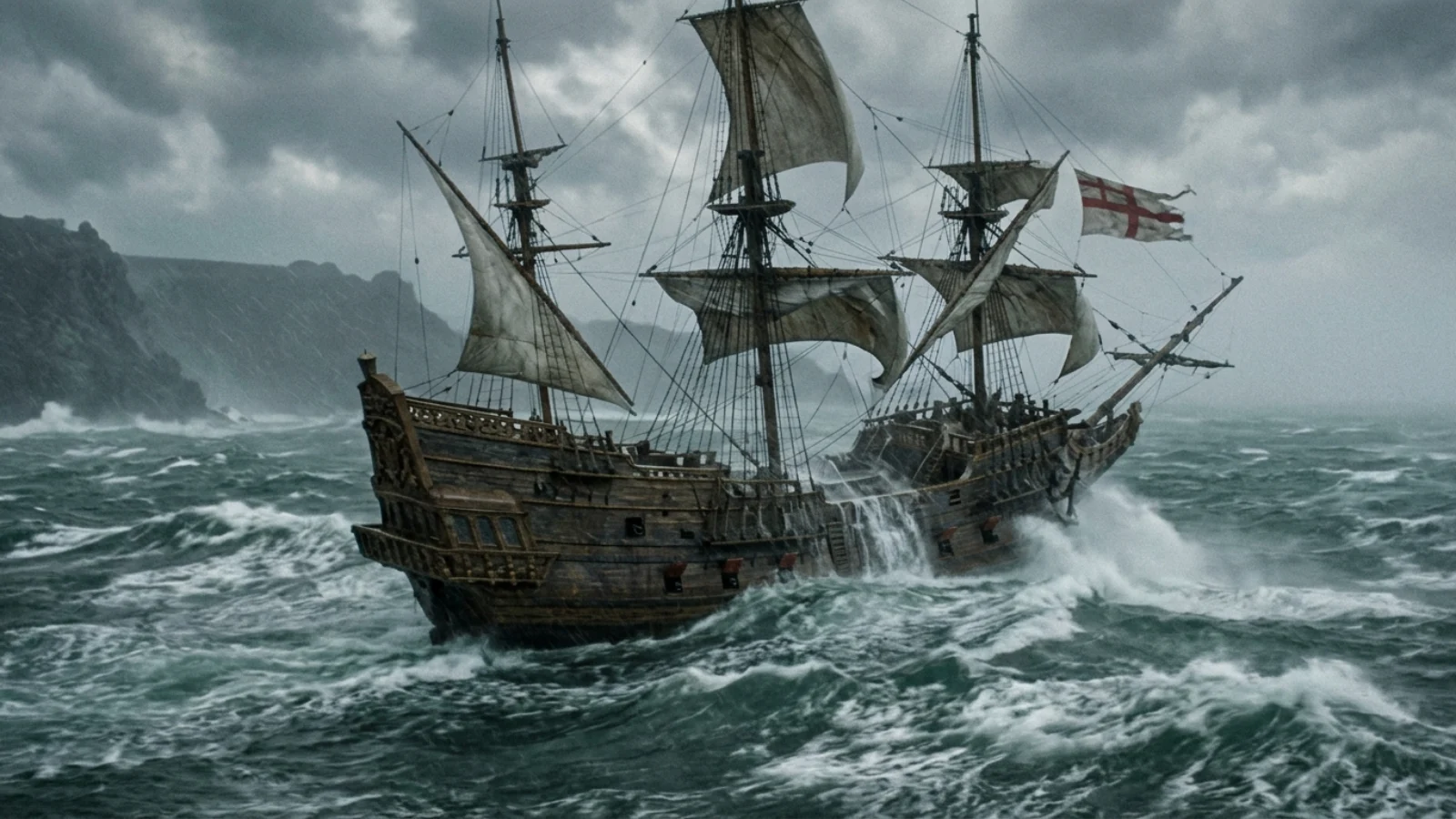
The Merchant Royal was an English merchant galleon that sank off Land’s End, Cornwall, on 23 September 1641, carrying a huge cargo of Spanish gold and silver that was meant to pay Spain’s army in Flanders. A London newsletter written a week later called it “the greatest that was ever sustained in one ship, being worth 400,000l. at least”. Modern writers often value the cargo at more than a billion dollars and call her the “El Dorado of the seas”, but nobody has found the wreck.
Her name appears as both Merchant Royal and Royal Merchant. She was built at Deptford and launched in 1627, an armed merchantman of about 700 tons. For other lost cargoes, see our shipwreck treasure hub.
Why was an English ship carrying Spanish treasure?
Because England and Spain were at peace, and because of a fire. From 1637 to 1640 the Merchant Royal traded with the Spanish colonies in the West Indies. On the way home she and her sister ship, the Dover Merchant, called at Cadiz, already leaking badly. There, a Spanish ship that was due to carry bullion north to pay Spain’s soldiers in Flanders caught fire. Captain Limbrey offered to carry the treasure to Antwerp on his way to London, earning freight money for his owners, and the bullion was loaded aboard.
| Date | Event |
|---|---|
| 1627 | Launched at Deptford |
| 1637–1640 | Trading voyage to the Spanish West Indies |
| 1641 | Calls at Cadiz; takes on bullion bound for Antwerp |
| 23 Sep 1641 | Pumps fail in rough weather; sinks off Land’s End |
| 30 Sep 1641 | London newsletter reports a loss of £400,000 |
| 2007 | Odyssey Marine’s “Black Swan” find is rumoured to be her, but proves to be a Spanish frigate |
| 2019 | An anchor trawled off Cornwall sparks headlines; it is not confirmed as hers |
What treasure was on the Merchant Royal?
Popular accounts describe at least 100,000 pounds (about 45 tonnes) of gold, 400 bars of Mexican silver and nearly 500,000 pieces of eight and other coins, but those figures come from later retellings rather than an official manifest. The firmest contemporary source is the London newsletter of 30 September 1641, preserved in the Calendar of State Papers, which valued the loss at £400,000 at least and said £300,000 of bullion belonged to the merchants of Antwerp. That was an enormous sum in 1641. Modern dollar values of $1–1.5 billion are estimates built on the popular figures.
How did the Merchant Royal sink?
She was never seaworthy after her long Caribbean voyage. After leaving Cadiz she kept leaking, and in rough weather off Cornwall her pumps broke down. On 23 September 1641 she sank. Captain Limbrey and about 40 of his men escaped in boats and were picked up by the Dover Merchant; 18 drowned. Historians think it unlikely that any of the treasure was moved to the Dover Merchant. The newsletter added that the loss might leave the Spanish commander in Flanders unable to pay his troops.
Where is the Merchant Royal wreck?
Accounts say she sank about 10 leagues from Land’s End, roughly 30–35 nautical miles, but they do not say in which direction. That leaves a search area of hundreds of square miles of the western Channel approaches, which also takes in the Isles of Scilly. The water there is deep, cold and often rough, with strong tides.
Who has searched for the Merchant Royal?
The American firm Odyssey Marine Exploration searched for her for several years. In 2007 its “Black Swan” recovery of nearly 600,000 mostly silver coins, valued at around US$500 million, was rumoured in the press to come from the Merchant Royal, but the coins proved to come from the Spanish frigate Nuestra Señora de las Mercedes, sunk in 1804, and were returned to Spain after a court case; see treasure found on the Mercedes. Odyssey searched again for the 2009 television series Treasure Quest, without success. Scilly-based diver Todd Stevens has also hunted for her for years. In 2019 a fishing boat trawled up a large anchor off Cornwall, prompting headlines that the wreck had been found, but Stevens and others judged the anchor to be Dutch and too late in date.
Why has the Merchant Royal never been found?
- Vague position. “Ten leagues off Land’s End” describes a huge circle of sea.
- Deep, rough water. The western approaches are exposed to Atlantic swell and strong tides.
- Crowded seabed. The approaches to the English Channel hold thousands of wrecks.
- Wooden hull. After nearly four centuries, little of a wooden ship survives above the seabed; sonar targets are subtle.
- Legal hurdles. Any recovery in UK waters must be reported to the Receiver of Wreck, and Spain may claim bullion shipped on its behalf.
Who would own the Merchant Royal treasure?
It would be complicated. The bullion belonged to Spain and to Antwerp merchants, the ship to English owners, and the site may lie in UK territorial waters or beyond them. The Mercedes case set an important precedent, with US courts accepting Spain’s sovereign claim to a state ship’s cargo. Any find would almost certainly end in court.
Has the Merchant Royal been found?
No. Despite searches by Odyssey Marine and others, the wreck has not been located.
Where did the Merchant Royal sink?
About 10 leagues (roughly 30–35 nautical miles) off Land’s End, Cornwall, on 23 September 1641.
What was the Merchant Royal carrying?
Spanish gold and silver bullion and coin, meant to pay Spain’s army in Flanders.
How much is the Merchant Royal treasure worth?
It was valued at £400,000 or more in 1641; modern estimates of $1–1.5 billion are speculative.
Why did the Merchant Royal sink?
She was leaking badly after a long voyage, and her pumps failed in rough weather.
Was the Black Swan treasure from the Merchant Royal?
No. It came from the Spanish frigate Nuestra Señora de las Mercedes (1804) and went back to Spain.
How many died on the Merchant Royal?
Eighteen men drowned; the captain and about 40 crew were rescued.
Who was the captain of the Merchant Royal?
Limbrey.
- Wikipedia: Royal Merchant; Black Swan Project.
- Calendar of State Papers Domestic: Charles I, 1641–3 (1887), vol. 484, September 1641.
- BBC News (2019). Report on the anchor trawled up off Cornwall.
- Odyssey Marine Exploration. Project reports.
Blane Perun has been exploring Earth’s oceans and marine life for over 25 years. Founder of TheSea.Org in 1999, underwater photographer, coral aquaculture pioneer, and explorer of 80+ countries.
About Blane Perun →