Oceanic Whitetip Shark — Carcharhinus longimanus, Carcharhinus longimanus, the Open-Ocean Pirate
The oceanic whitetip (Carcharhinus longimanus) is a stocky, pelagic predator famous for the white-tipped, paddle-shaped fins that give the species its name. Adults reach 3–4 m in length and weigh up to 170 kg. The species is the leading suspect in many of the historical sinking-ship attacks — including the USS Indianapolis disaster of 1945, where roughly 600 sailors are estimated to have died from shark attacks during the four-day rescue. Once the most abundant pelagic shark in the world, oceanic whitetip populations have collapsed by over 90% in some regions, and the species was uplisted to Critically Endangered in 2019.
Oceanic Whitetip Shark
Identification — the white-tipped, paddle-finned pelagic shark
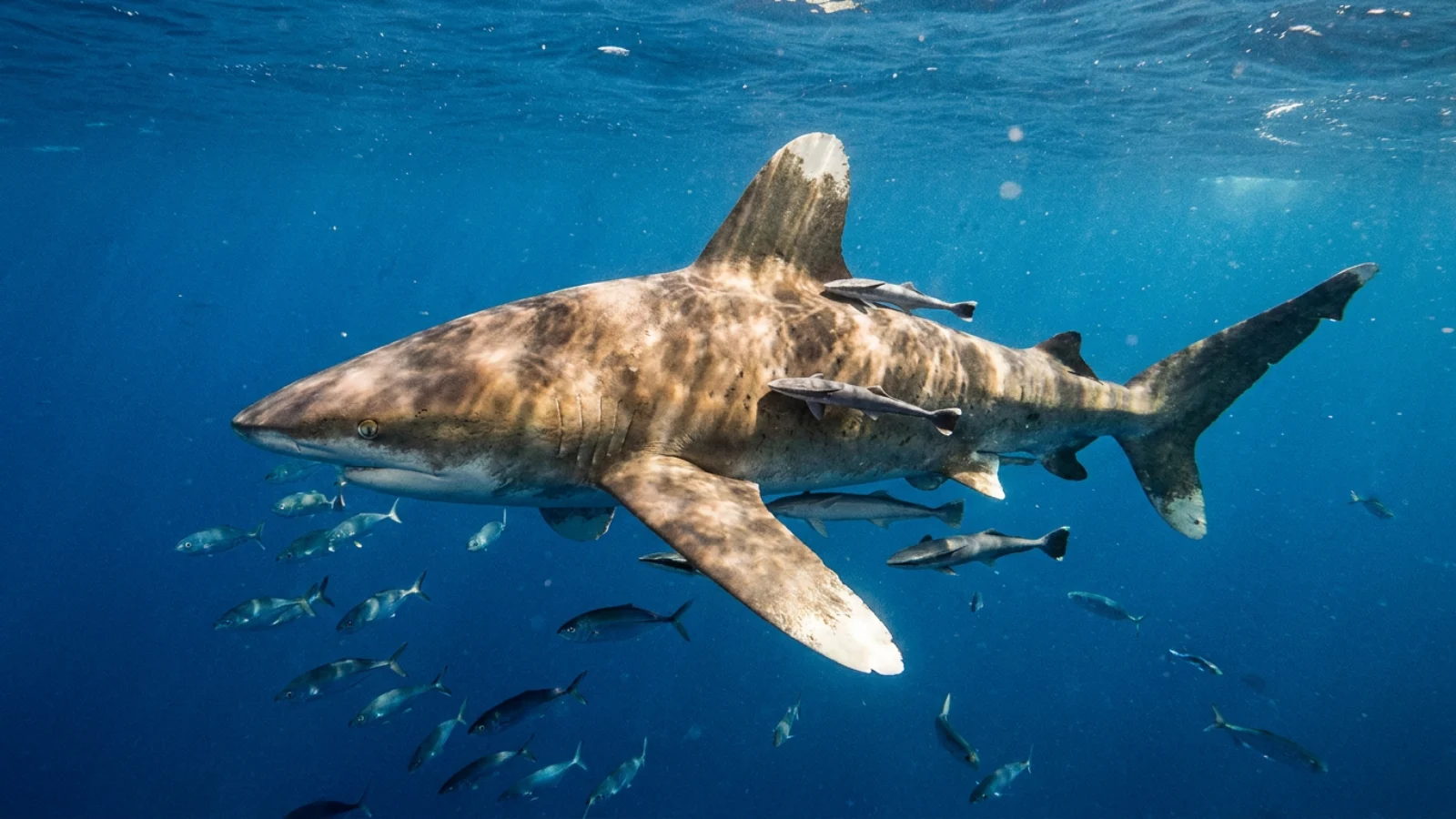
Oceanic whitetips are easily distinguished from any other shark by the bright white tips on the rounded, paddle-shaped pectoral fins, first dorsal, and pelvic fins. The species is the only large shark with this combination.
The oceanic whitetip's body is stocky and powerful but more slender than the bull shark, with disproportionately long and rounded pectoral fins (the source of the species name longimanus, "long-handed"). The dorsal coloration is grey-brown, with bright white — sometimes mottled — tips on the first dorsal, both pectorals, and the pelvic and caudal lobes. Adult oceanic whitetips reach 3–4 m in length, with the largest documented individual at 4 m and 170 kg. The teeth are diagnostic: broadly triangular and serrated in the upper jaw, slender and recurved in the lower — a tooth pattern matched by the dusky shark and several other carcharhinids.
Range — once the most abundant pelagic shark, now severely depleted
Until the 1960s, oceanic whitetips were the most common shark in the open tropical ocean. Pelagic longline fisheries drove population collapses through the 1980s and 1990s.
Historical accounts — particularly from sinking-ship survivors during World War II — describe the species as overwhelmingly abundant in tropical pelagic waters. By the 2000s, regional stock assessments documented declines of over 90% in the Atlantic and Indo-Pacific. The species is currently most reliably encountered at the Red Sea's Daedalus and Elphinstone reefs (June–November), Cat Island in the Bahamas (April–June), and occasionally at Hawaiian offshore seamounts.
Diet — opportunistic and aggressive in open water
Oceanic whitetips are opportunistic predators that take any pelagic prey they can catch, scavenge whale carcasses, and are notorious for aggressive investigation of any unusual object in open water.
The diet is dominated by tuna, squid, sea birds, smaller sharks, and rays, with extensive scavenging at whale carcasses and longline catches. The species is famous for its boldness around bait and around objects in the water — this same trait is what makes the species particularly dangerous to humans in shipwreck and ditching situations. Oceanic whitetips are documented attacking and killing tuna twice their own length, and as scavengers they have been observed driving great whites off whale carcasses in the western Atlantic.
Reproduction — viviparous with small litters
Oceanic whitetips give live birth to 1–15 pups every two years. The species reproduces faster than several other large sharks, but not fast enough to recover from the scale of recent population declines.
Females reach maturity at ~6 years. Gestation is 10–12 months, producing litters of 1–15 pups at 60–65 cm. The species is placentally viviparous, with embryos developing through a yolk-sac connection that converts to a true placenta in late pregnancy. Despite reproducing faster than great white or whale shark, the population cannot keep pace with the offtake from pelagic longline fisheries, which catch oceanic whitetips both as bycatch and as targeted catch for the fin trade.
Attack record — the species behind the historical sinking-ship attacks
Oceanic whitetips are responsible for some of the most catastrophic mass-attack events in maritime history, including the USS Indianapolis disaster of 1945. Per individual encounter, the species is one of the most dangerous to humans.
ISAF records 15 unprovoked attacks attributed to Carcharhinus longimanus, with 9 fatal — an unusually high case-fatality rate that reflects the species' aggressive investigation of objects in open water. The most catastrophic mass attack in recorded history is the USS Indianapolis sinking on July 30, 1945: of approximately 900 crew who survived the initial torpedo strike, only 316 survived the four-day rescue, with most fatalities attributed to oceanic whitetip and tiger shark attacks on the survivors in the water. The 1942 SS Nova Scotia sinking off South Africa produced a similar event with mostly oceanic whitetip attribution.
In a normal recreational context, oceanic whitetip attacks are very rare because the species lives offshore. Cage-diving operations at the Red Sea and Cat Island have run hundreds of dives without serious incident, though both operators emphasise that the species is unpredictable and aggressive in close contact compared to most other sharks.
Conservation — one of the most catastrophic shark population declines on record
Oceanic whitetip populations have declined by over 90% in some regional stock assessments. The species was uplisted to Critically Endangered in 2019.
The collapse is driven primarily by pelagic longline fisheries: oceanic whitetips are caught both as bycatch and as targeted catch for fins, meat, and oil. The species' tendency to investigate hooked fish makes it particularly susceptible to longline gear. CITES Appendix II protection from 2013 has reduced fin-trade pressure but enforcement is variable. The IUCN uplisted C. longimanus from Vulnerable to Critically Endangered in 2019.
Where the oceanic whitetip sits among the major shark species
Comparing oceanic whitetips against the major species at a glance.
The oceanic whitetip is similar in length to the great hammerhead and shortfin mako but lighter, with a far higher case-fatality rate (60% of recorded attacks fatal) than any other species in the comparison. Its conservation status is the most severe.
| Species | Max length | Max weight | Bite force | Attacks (unprov.) | Lifespan |
|---|---|---|---|---|---|
| Great white shark | 6.0 m | 2,300 kg | ~4,000 PSI | 354 | 70 yrs |
| Tiger shark | 5.5 m | 900 kg | ~6,000 PSI | 142 | 27–50 yrs |
| Bull shark | 3.5 m | 320 kg | 1,250 PSI | 121 | 16 yrs |
| Oceanic whitetip | 4.0 m | 170 kg | n/a | 15 | 22 yrs |
| Shortfin mako | 4.0 m | 570 kg | n/a | 10 | 30 yrs |
| Great hammerhead | 6.1 m | 580 kg | n/a | 17 | 44 yrs |
| Whale shark | 12.0 m | 19,000 kg | n/a (filter) | 0 | 80–130 yrs |
Related on TheSea
Why is the oceanic whitetip so dangerous?
Two factors. First, the species is one of the most aggressive sharks in close contact, with a documented willingness to investigate and attack objects much larger than itself. Second, the species lives offshore where humans are usually only encountered in distress — shipwrecks, ditched aircraft, swamped boats — situations that already favour predator success. The combination drove the historic mass attacks at USS Indianapolis (1945) and elsewhere.
What happened with the USS Indianapolis?
The USS Indianapolis was torpedoed on July 30, 1945 in the Philippine Sea after delivering Hiroshima atomic bomb components to Tinian. Approximately 900 of 1,196 crew survived the initial sinking. Over the next four days, before rescue arrived, an estimated 200–800 sailors died — from exposure, dehydration, and a shark feeding event widely attributed to oceanic whitetips and tiger sharks. Only 316 survived. It is the worst mass shark-attack event in recorded history.
Are oceanic whitetips really that endangered?
Yes. Multiple regional stock assessments document population declines of over 90% over recent decades, driven primarily by pelagic longline fisheries. The IUCN uplisted the species from Vulnerable to Critically Endangered in 2019.
Where can I dive with oceanic whitetips?
The two most reliable destinations are the Red Sea (Daedalus and Elphinstone reefs, June–November) and Cat Island in the Bahamas (April–June). Both operate as offshore baited dives with experienced operators. The species is not for novice divers — close-quarters encounters demand strict protocols.
How big does an oceanic whitetip get?
Adult oceanic whitetips typically reach 2.5–3.5 m, with the largest documented individuals at 4 m and approximately 170 kg. They are smaller than tiger or great white sharks but on a par with bull and shortfin mako.
Blane Perun has been exploring Earth’s oceans and marine life for over 25 years. Founder of TheSea.Org in 1999, underwater photographer, coral aquaculture pioneer, and explorer of 80+ countries.
About Blane Perun → More on Sharks →