Does Colossal Squid Food Pass Through Its Brain? — Yes — Every Bite Squeezes Through a Doughnut-Shaped Brain
Yes, it passes through, but it isn’t digested there. In the colossal squid, as in every octopus, squid and cuttlefish, the esophagus runs through a hole in the middle of a ring-shaped brain. Digestion happens later, in the stomach and caecum. The design means a squid must cut food into small pieces with its parrot-like beak and toothed radula before swallowing. A bite that is too big could press on the brain.
It’s an accident of history. Cephalopods evolved from mollusc ancestors whose nerve cords formed a ring around the gut. As cephalopods became active predators, those nerve clusters fused and grew into a large brain, but the gut still runs through the middle. Evolution builds on what’s there; it doesn’t start over.
Yes. In the colossal squid, as in every squid, octopus and cuttlefish, the oesophagus, the tube that carries food from mouth to stomach, runs straight through a hole in the middle of a ring-shaped brain. Food passes through the brain but is not digested there. Because of this odd layout, a squid has to cut every meal into small pieces with its beak and toothed radula before it swallows.
It sounds like a design flaw, and in a sense it is. But it is a flaw that cephalopods have lived with for hundreds of millions of years, and it shapes how the world’s heaviest invertebrate hunts, eats and even how fast it lives. This article explains how the arrangement works, why it evolved, how a colossal squid eats around it, and what we actually know about this rarely seen animal.
Does a colossal squid’s food really go through its brain?
Yes. The brain wraps around the oesophagus like a doughnut around a straw.
The squid brain is a nerve ring encircling the oesophagus, protected inside a cartilage capsule called the cranium. Above the oesophagus sit paired cerebral ganglia that receive information from the eyes and from the balance organs, the statocysts. Below it lie further ganglia that control the muscles of the mouth, the arms, the mantle and the internal organs. The oesophagus threads through the gap between the upper and lower parts. In the colossal squid (Mesonychoteuthis hamiltoni), the largest invertebrate known, every mouthful takes this route on its way to the stomach.
Nothing is digested in the brain region. The oesophagus is simply a passage. In squids it is long and leads to a muscular stomach roughly in the middle of the body. The digestive gland, the cephalopod equivalent of a liver, and a pancreas connect to a pouch called the caecum, where most nutrients are absorbed. Indigestible material can be passed straight from the stomach to the rectum, and waste leaves through the anus into the mantle cavity, to be flushed out through the funnel with exhaled water.
| Stage | Organ | What happens |
|---|---|---|
| 1 | Arms and tentacles (with swivelling hooks) | Seize and hold prey |
| 2 | Beak | Bites prey into small chunks |
| 3 | Radula | Rows of tiny teeth draw food back and grind it |
| 4 | Oesophagus, through the brain ring | Carries small pieces past the brain; no digestion here |
| 5 | Stomach | Muscular; begins breaking food down |
| 6 | Caecum and digestive gland | Most digestion and nutrient absorption |
| 7 | Intestine and anus | Waste leaves into the mantle cavity and out through the funnel |
Why would a brain be built around the throat?
Because cephalopods inherited the plan from simpler mollusc ancestors.
Many invertebrates, including snails and other molluscs, have a ring of nerve tissue around the front of the gut. In early molluscs this ring connected a few clusters of nerve cells. As cephalopods evolved into fast, visual predators, those clusters grew and fused into one of the most complex brains among invertebrates. The cephalopod brain-to-body-mass ratio falls between that of warm-blooded and cold-blooded vertebrates. Yet the gut still runs through the middle, because evolution modifies existing structures rather than redesigning from scratch.
Vertebrates took a different path. Our brain sits in the skull above the throat, and the spinal cord runs along the back, completely separate from the digestive tract. That gives us the freedom to swallow large mouthfuls. Cephalopods solved the problem another way, by never swallowing anything large in the first place. Octopuses face the same constraint, which is part of why they take crabs apart piece by piece; see how do octopus eat?
How does a colossal squid eat without hurting its brain?
By catching prey with its arms, then slicing and grinding it into small pieces before swallowing.
Even though squid can catch large prey, the mouth is relatively small. The beak, made of chitin and cross-linked proteins, is very hard and sharp, stiffer than most comparable synthetic organic materials, and it cuts food into chunks small enough to swallow. Behind the beak, the radula, a tongue-like ribbon covered in rows of tiny teeth, draws food backwards and grinds it further. The cephalopod radula typically has symmetrical rows of up to nine teeth. Some squids also inject toxic saliva that helps subdue large prey before it is torn apart.
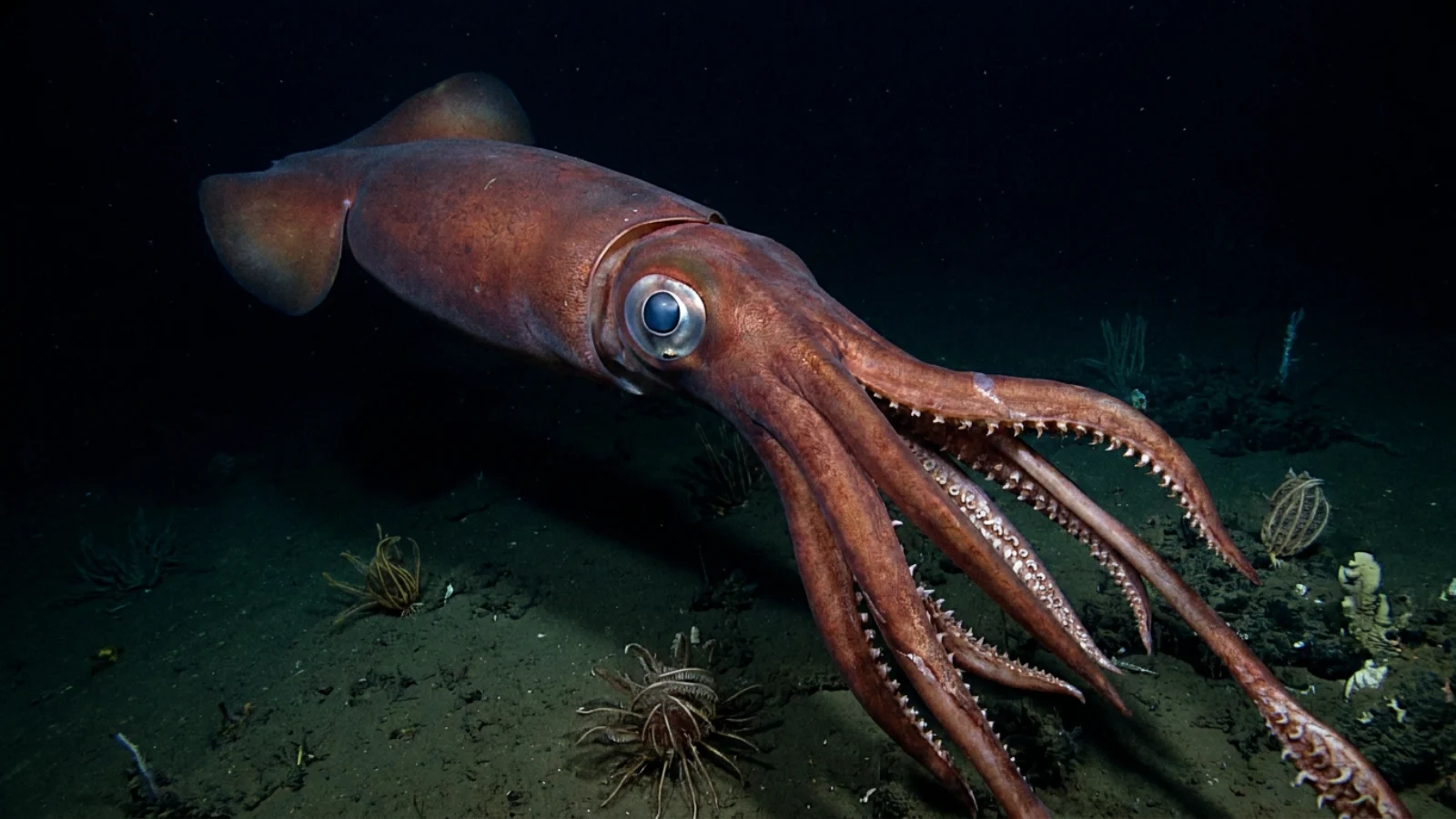
The colossal squid adds weapons of its own. It is the only member of its family, the glass squids or Cranchiidae, with hooks on its arms and tentacles. Some of these hooks swivel and others have three points, giving the animal a firm grip on slippery fish. Researchers have long suggested that an oversized mouthful could press on the brain as it passes through, which would explain why squids are such careful, piecemeal eaters. Whether or not that risk is the main reason, the anatomy means that a colossal squid cannot gulp a large fish whole the way a shark or grouper can.
What does a colossal squid eat?
Large deep-sea fish such as toothfish, smaller squid and other animals of the Southern Ocean depths.
Almost nothing has been seen of colossal squid feeding in the wild. Its diet has been inferred from stomach contents, from damage to fish caught by fishing boats and from chemical analysis of beaks. It is thought to eat chaetognaths (arrow worms), large fish including Patagonian toothfish, and smaller squid, possibly using bioluminescence to attract prey. A study by Remeslo, Yakushev and Laptikhovsky found that Antarctic toothfish are a significant part of its diet: of about 8,000 toothfish brought aboard trawlers between 2011 and 2014, 71 showed clear signs of colossal squid attack. Several of the whole specimens ever recovered were caught while trying to take toothfish from longlines.
Studies of nitrogen isotopes in the beaks of cephalopods show that the colossal squid sits high in the food web, with its trophic level rising as it grows. That matches a picture of a large predator that tackles big fish and smaller squid, which in turn makes the beak-and-radula system essential. A large toothfish cannot pass through a brain ring; it has to be reduced to a long series of small bites.
How much does a colossal squid need to eat?
Surprisingly little. Estimates suggest an adult needs only about 30 g of food a day.
The colossal squid is thought to have a very slow metabolism. One frequently cited estimate is that a 500 kg adult needs only around 30 g of prey a day. Calculations of its energy budget suggest that it is a slow-moving ambush predator that uses its enormous eyes mainly to detect prey and threats rather than chasing fast prey over long distances. If that is right, a single large fish could supply a colossal squid for a long time, and the slow, careful process of cutting, grinding and swallowing small pieces is no handicap.
Those eyes are the largest measured in any animal. The eye of the 2007 specimen was 27 cm across, with a lens 12 cm wide, and since it had partly collapsed, the living eye was probably 30 to 40 cm across. Photophores beside the lens make the eyes glow. One hypothesis is that such huge eyes let the squid detect the disturbance of bioluminescent plankton by an approaching sperm whale at ranges beyond 120 m, which would give it early warning of its main predator.
How big is the colossal squid?
The heaviest invertebrate known, confirmed at 495 kg and probably larger.
The heaviest specimen ever recovered, a female, was caught in February 2007 by a New Zealand fishing boat in the Ross Sea off Antarctica. It was first estimated at around 10 m long and 450 kg, but after thawing it weighed 495 kg and measured only 4.2 m in total length with a 2.5 m mantle, probably because the tentacles shrank after death. It is now on display at the Museum of New Zealand Te Papa Tongarewa in Wellington. Its beak is considerably smaller than some found in sperm whale stomachs, suggesting that bigger colossal squid exist. Estimates based on those beaks run as high as 600 to 700 kg, and total length has been estimated at up to about 7 m in recent reporting and up to 9–10 m in older sources.
| Specimen or record | Year | Key facts |
|---|---|---|
| First description | 1925 | Two arm crowns from a sperm whale stomach; named by Guy Coburn Robson |
| Ross Sea trawler catch | 1981 | Immature female over 4 m total length |
| Subadult female near the surface | 2003 | 6 m total length, 2.5 m mantle |
| Longline off South Georgia | 2005 | First full living specimen, from 1,625 m; est. 150–200 kg |
| Ross Sea, New Zealand vessel | 2007 | 495 kg female, 2.5 m mantle; now at Te Papa |
| Second Te Papa specimen | 2014 | Female, about 3.5 m and 350 kg |
| First wild footage | 2025 | Juvenile about 30 cm long at 600 m near the South Sandwich Islands |
The giant squid (Architeuthis) can be longer, mainly because of its very long feeding tentacles, but the colossal squid is much heavier and bulkier. Compare the two in colossal squid vs giant squid, and see the full species profile at colossal squid.
Has a colossal squid ever been filmed alive?
Yes, for the first time in March 2025, a century after the species was described.
On 9 March 2025, during an Ocean Census expedition run with the Schmidt Ocean Institute, a remotely operated vehicle filmed a juvenile colossal squid about 30 cm long at a depth of 600 m near the South Sandwich Islands in the South Atlantic. The footage was announced on 15 April 2025, after squid researcher Kat Bolstad of Auckland University of Technology and other independent experts confirmed the identification. The young squid was almost completely transparent, with thin arms, unlike adults, which become opaque dark red or purple. Until then, every colossal squid known to science had been a dead or dying animal from a fishing boat or a sperm whale’s stomach.
Do octopuses and cuttlefish eat the same way?
They share the brain-around-the-gut plan but have each found their own ways to break food down outside the body.
All living cephalopods have a two-part beak, and most have a radula, although it is reduced in most octopuses and absent altogether in the small deep-sea squid Spirula. Octopuses add chemistry to mechanics. They eject digestive juices from their salivary glands onto prey held in the mouth, and the salivary gland ends in a small tooth that can be pushed into prey to begin digesting it from the inside. This lets an octopus loosen the meat inside a crab shell or a snail before it ever reaches the oesophagus. Food is then forced into the oesophagus by side extensions of its walls as well as by the radula.
Octopuses are also less dependent on a single central brain than squids. About two-thirds of an octopus’s neurons lie in the nerve cords of its arms, which can carry out complex reflex actions without input from the brain. The brain that surrounds the gut is therefore only part of the octopus nervous system, but the constraint on swallowing is the same. Whether the animal is a tiny bobtail squid, a reef octopus or a half-tonne colossal squid, every meal must be reduced to pieces small enough to slide through the ring.
What else is unusual about the colossal squid’s body?
It is a giant member of the glass squid family, with hooks, huge eyes and a body plan built for slow living in cold, deep water.
The colossal squid belongs to the Cranchiidae, a family often called glass or cockatoo squids because many of its members are small and transparent. Its next largest relative, Megalocranchia fisheri, is far smaller. The colossal squid shares the basic squid anatomy of a muscular mantle for jet propulsion, one pair of gills, eight arms, two tentacles, a head and two fins. In squids generally, giant nerve fibres up to 1 mm across carry signals rapidly to the mantle muscles so that they contract together for a powerful jet. The colossal squid, however, is thought to rely more on ambush than on bursts of speed.
Its life history is still mostly a mystery. Adult females have been found in shallower water than usual, which may mean that females move upward to spawn, and eggs measured in specimens ranged from about 1.4 by 0.5 mm to 3.2 by 2.1 mm. Colossal squid are not targeted by fisheries; they are caught only when they try to take fish already hooked on longlines. Because they live in the remote Southern Ocean at depths of hundreds to thousands of metres, almost everything about how they hunt, how long they live and how they reproduce remains to be discovered.
Why is the colossal squid linked to sperm whales?
Because most of what we know comes from sperm whale stomachs.
The species was first described by Guy Coburn Robson in 1925 from two arm crowns found in the stomach of a sperm whale caught in the winter of 1924–25. Since then, beaks, the hard, indigestible part of a squid, have been the main source of information. Fifty-five colossal squid beaks have been recorded, compared with only a handful of fins, mantles or arms. In Antarctic sperm whales, colossal squid beaks make up about 14% of the squid beaks found in their stomachs, but because each colossal squid is so heavy, they are estimated to make up 77% of the squid biomass these whales eat.
Many sperm whales carry scars on their backs thought to be caused by colossal squid hooks. Other animals eat colossal squid too, including beaked whales, southern sleeper sharks, toothfish, elephant seals and albatrosses, but beaks from mature adults have only been found in the very largest predators: sperm whales and southern sleeper sharks. For more on this rivalry, see giant squid vs sperm whale.
Does a colossal squid’s food pass through its brain?
Yes. Its oesophagus runs through the hole in its ring-shaped brain, as in all cephalopods. Food passes through but is digested later in the stomach and caecum.
Why is a squid’s brain shaped like a doughnut?
Cephalopods evolved from molluscs with a nerve ring around the gut. The nerve clusters grew into a large brain, but the oesophagus still runs through the middle.
Can a squid hurt its brain by eating?
Researchers have suggested that an oversized bite could press on the brain, which is one reason squid cut prey into small pieces with beak and radula.
How big is a colossal squid?
The heaviest confirmed specimen weighed 495 kg. Beaks from sperm whale stomachs suggest some may reach 600–700 kg.
Has a colossal squid been filmed alive?
Yes. In March 2025 a juvenile about 30 cm long was filmed at 600 m near the South Sandwich Islands.
What eats colossal squid?
Mainly sperm whales; beaks from adults have also been found in southern sleeper sharks.
How much does a colossal squid eat?
Estimates suggest a 500 kg adult needs only about 30 g of food a day because of its slow metabolism.
Do octopuses have the same brain layout?
Yes. All living cephalopods have a brain that encircles the oesophagus.
- Associated Press / PBS NewsHour (16 April 2025). Colossal squid caught on camera for first time in the deep sea (Schmidt Ocean Institute, Ocean Census).
- Museum of New Zealand Te Papa Tongarewa: colossal squid specimens (2007, 2014).
- Robson GC (1925). On Mesonychoteuthis, a new genus of oegopsid Cephalopoda. Annals and Magazine of Natural History.
- Remeslo A, Yakushev M, Laptikhovsky V (2015). Alien vs. Predator: interactions between the colossal squid and the Antarctic toothfish. Journal of Natural History.
- Budelmann BU. The cephalopod nervous system. In Cephalopod Neurobiology, Oxford University Press.
- Wikipedia: Colossal squid; Squid (anatomy and digestive system); Cephalopod (feeding, radula).
Blane Perun has been exploring Earth’s oceans and marine life for over 25 years. Founder of TheSea.Org in 1999, underwater photographer, coral aquaculture pioneer, and explorer of 80+ countries.
About Blane Perun →