Oceans and Seas — Facts, Records and Every Story in This Section
Earth’s oceans cover about 71% of the planet, hold about 97% of its water and average roughly 3,680–3,690 m deep. Geographers recognise five oceans, the Pacific, Atlantic, Indian, Southern and Arctic, which are really parts of one connected World Ocean. Seas are smaller, shallower areas, usually partly enclosed by land. This section gathers TheSea.org’s articles on ocean records and mysteries, deep-sea exploration, shipwrecks and sunken cities; the full card index is below.
What is the difference between an ocean and a sea?
Mostly size, depth and how much land surrounds them. There is no sharp scientific line between the two: an ocean is one of the five great divisions of the single World Ocean, while a sea is generally a smaller, often shallower area that is partly enclosed by land, as a marginal sea, or wholly enclosed, as an inland sea.
Seas are usually defined by geography and history rather than by any physical rule. Most are marginal seas on the edge of an ocean, separated from it by islands, peninsulas or undersea ridges: the Caribbean, the Mediterranean, the Coral Sea and the Bering Sea are all examples. Because they are partly cut off, seas can differ sharply from the open ocean around them. The Mediterranean loses more water to evaporation than it gains from rain and rivers, so its average salinity is about 38 parts per thousand, against a global ocean average of roughly 35 grams of salt per kilogram of seawater.
The names are not always consistent. The Sargasso Sea in the North Atlantic is the only region called a sea with no land boundaries at all; it is defined by the currents that circle it, so its edges shift, and its water is known for its deep blue colour and clarity, with visibility of up to 60 m. At the other extreme, the Caspian Sea is the world’s largest inland body of water, an endorheic basin between Europe and Asia that is often described as the world’s largest lake. Even the Arctic Ocean is sometimes treated as a marginal sea of the Atlantic. Our guides to the five oceans and the seas of the world go through them one by one.
How big are the five oceans?
The Pacific is by far the largest, with almost half of the World Ocean’s area and about half its water. The Atlantic is second, then the Indian, Southern and Arctic.
The ocean as a whole covers about 71 percent of Earth’s surface, some 361 million km², and holds about 97 percent of the planet’s water, roughly 1.33 billion km³. Within that, the Pacific covers about 168.7 million km², or 46.6 percent of the ocean’s area, which works out to roughly a third of the whole planet’s surface, and it holds about 50 percent of the ocean’s volume. The Atlantic covers 85.1 million km² and the Indian Ocean 70.6 million km². The Southern Ocean, around Antarctica, covers about 22 million km², and the Arctic, the smallest and shallowest, about 15.6 million km².
The Southern Ocean is the newest addition to the list. The International Hydrographic Organization included it, defined as the waters south of 60°S, in a 2000 revision of its boundaries, although that edition was never formally adopted because of unrelated disputes over other names. The National Geographic Society formally recognised it as the fifth ocean in June 2021. The IHO’s reasoning was oceanographic: the importance of the overturning circulation around Antarctica had become clear, and the Southern Ocean is defined by that water rather than by surrounding continents.
| Ocean | Area (million km²) | Share of ocean area | Average depth |
|---|---|---|---|
| Pacific | ~168.7 | 46.6% | ~3,970 m |
| Atlantic | ~85.1 | 23.5% | ~3,646 m |
| Indian | ~70.6 | 19.5% | ~3,741 m |
| Southern | ~22.0 | 6.1% | ~3,270 m |
| Arctic | ~15.6 | 4.3% | ~1,205 m |
How deep is the ocean?
On average about 3,680 to 3,690 m, or roughly 2.3 miles. The deepest known point, the Challenger Deep in the Mariana Trench, is about 10,920 m deep.
Estimates of the mean depth differ slightly with the bathymetric data used; a widely cited 2010 study by Charette and Smith in Oceanography re-estimated the ocean’s volume and mean depth, and other compilations give about 3,688 m. The Challenger Deep, at the southern end of the Mariana Trench in the western Pacific, is listed in the GEBCO gazetteer at 10,920 ± 10 m. Submersibles, robotic vehicles and landers have measured between about 10,902 and 10,929 m there, with sonar sometimes giving slightly more, so any single figure should be read as approximate. The deep is named after HMS Challenger, whose crew recorded a sounding of 8,184 m near the site on 23 March 1875, during the voyage that founded modern oceanography.
How much of the ocean has been explored?
Surprisingly little. The international Seabed 2030 project reported in June 2025 that 27.3 percent of the world’s seafloor had been mapped with modern sonar, which leaves almost three-quarters known only from coarser satellite estimates.
The gap is not just in maps. Most of the deep sea has never been seen directly, and estimates of how many marine species remain undescribed run very high. These are the themes behind some of the most-read articles in this section: why we have better maps of Mars than of the ocean floor, where the claim that most ocean species are undiscovered comes from, and why more people have walked on the Moon than have reached the deepest sea.
Why do the oceans matter to the rest of the planet?
They make about half the oxygen in the atmosphere, absorb roughly a quarter of the carbon dioxide people emit, and store most of the extra heat trapped by greenhouse gases.
Photosynthesis by marine algae and bacteria at the sea surface produces about half of the oxygen in Earth’s atmosphere, and the ocean takes up an estimated 25 percent of human carbon dioxide emissions. That uptake comes at a cost: dissolved carbon dioxide lowers the ocean’s pH, a process known as ocean acidification. The ocean also absorbs most of the additional heat in the climate system, which drives rising sea temperatures, more frequent marine heatwaves, sea-level rise, loss of sea ice and falling oxygen levels in the water. Sea level has changed dramatically before: during the last ice age, when glaciers covered almost a third of Earth’s land, the oceans were about 122 m lower than today.
Ocean extremes worth knowing
The ocean’s numbers are often hard to believe. Point Nemo, the spot in the South Pacific farthest from any land, lies about 2,688 km from the nearest shore, so remote that space agencies use the surrounding region as a graveyard for spacecraft. The largest waterfall on Earth is underwater: in the Denmark Strait between Greenland and Iceland, cold, dense water from the Nordic Seas plunges southward into the Irminger Sea and descends more than three times the height of Angel Falls, carrying about 3.2 million cubic metres of water per second, far more than the Amazon discharges into the Atlantic. We tell that story in the tallest waterfall is underwater.
This section is where TheSea.org keeps those records honest. Alongside the ocean facts you will find deep-sea exploration, ocean mysteries, shipwrecks and sunken cities, each checked against current sources and updated when the numbers change.
How many oceans are there?
Five: the Pacific, Atlantic, Indian, Southern and Arctic, all connected as one World Ocean. National Geographic recognised the Southern Ocean in 2021.
What is the difference between an ocean and a sea?
Oceans are the five vast basins between continents; seas are smaller, usually shallower areas partly or wholly enclosed by land. There is no strict rule.
How much of Earth is covered by ocean?
About 71% of the surface, some 361 million km², holding about 97% of Earth’s water.
What is the deepest part of the ocean?
Challenger Deep in the Mariana Trench, about 10,920 m deep (measurements range from about 10,902 to 10,929 m).
What is the largest ocean?
The Pacific, with about 46.6% of the ocean’s area, roughly a third of Earth’s surface.
How much of the ocean has been explored?
About 27.3% of the seafloor had been mapped with modern sonar by June 2025, and far less has been seen directly.
Is the Caspian Sea a sea?
It is the world’s largest inland body of water and is often described as the largest lake, despite its name.
Where is the Great Barrier Reef?
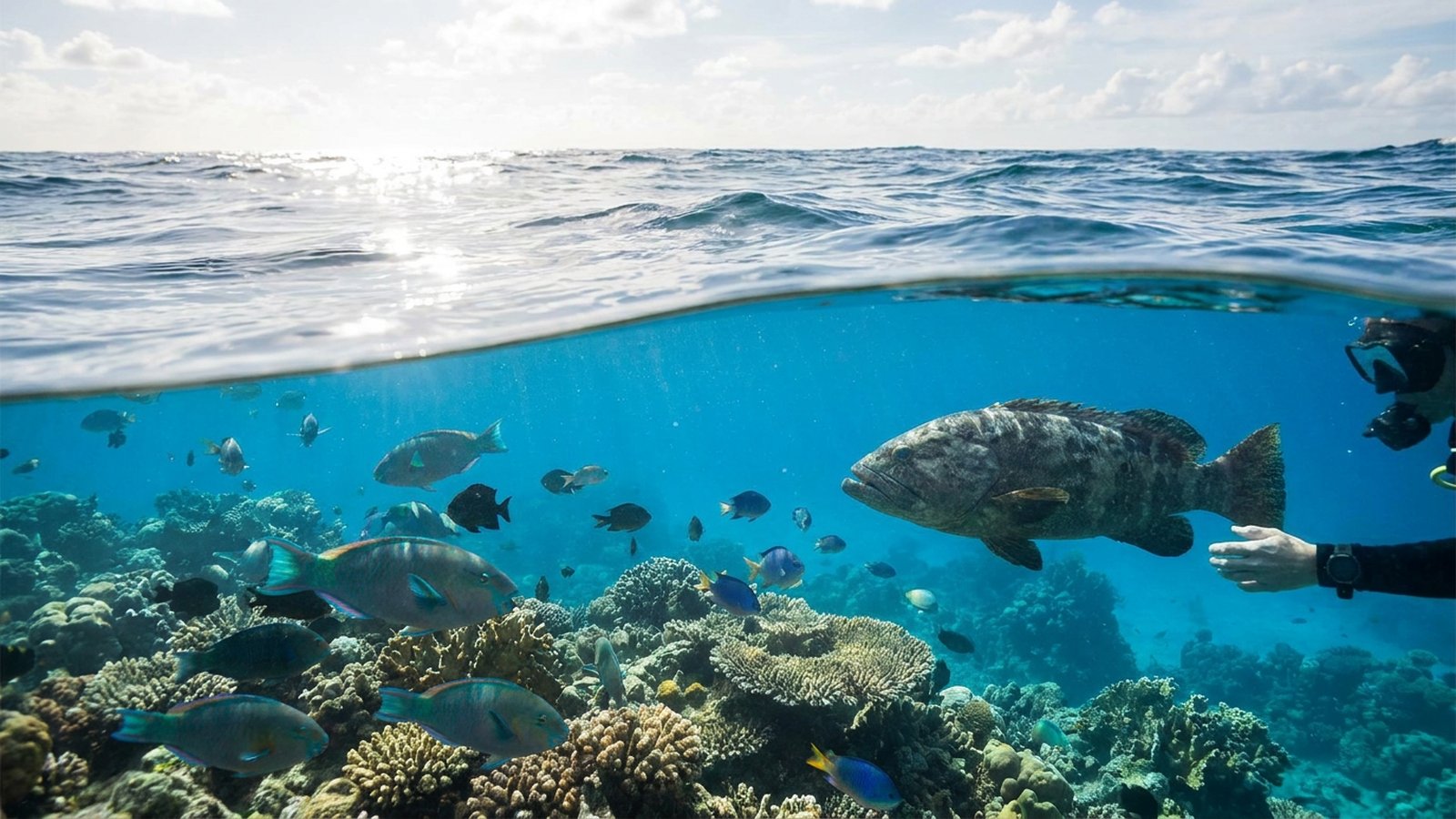
In the Coral Sea off Queensland, Australia, not the Caribbean.
- Wikipedia: Ocean; World Ocean. Coverage, water share, volume, ocean areas and depths, salinity, oxygen and CO2 uptake.
- Charette, M.A. & Smith, W.H.F. (2010). The volume of Earth’s ocean. Oceanography 23(2). doi:10.5670/oceanog.2010.51
- Wikipedia: Challenger Deep (GEBCO depth, submersible measurements, HMS Challenger sounding).
- Wikipedia: Southern Ocean (IHO 2000 definition, National Geographic 2021).
- Seabed 2030 / Nippon Foundation (June 2025). 27.3% of world’s ocean floor now mapped.
- Wikipedia: Sargasso Sea; Caspian Sea; Denmark Strait cataract.
- Great Barrier Reef Marine Park Authority. Reef location and area.
Blue holes, sea caves and colored-sand beaches.
Krakens, ghost ships and the Bermuda Triangle.
Where Rivers Meet the Sea.
The Salt-Tolerant Forests Where Land Meets Sea.
What Lives Between the Tides.
Manatee Pasture and Fish Nursery.
Mangroves, Estuaries, Seagrass and Tide Pools.
How to Tell Red, Black and White Mangroves Apart.
The Salty-Fresh Middle Ground and the Animals That Live There.
4 Bands of Survival Between the Tides.
The Grassland of the Tides and One of Earth’s Most Productive Ecosystems.
How Sanibel, Marco Island and the Gulf Coast’s Sand Islands Formed.
The "Walking Tree" That Stands in the Sea.
Florida’s Living Water Filters.
How One Carcass Feeds the Deep Sea for Decades.
Black Smokers and Life Without Sunlight.
Life on the Deep Ocean Floor, 4,000 to 6,000 Metres Down.
Life in the Ocean Trenches Below 6,000 Metres.
The 5 Layers of the Ocean From Sunlight to Hadal.
The Endless Blizzard That Feeds the Deep Sea.
Florida’s Ocean River and How It Shapes the Atlantic.
The Shallow Sea Where Most Ocean Life Lives.
The Physics of Sea Colour, Explained.
Mapped, Seen and Still Unknown.
Who Lives Where, and How They Survive.
Records by Group.
Sharks, Rays and Bony Giants.
Rod-and-Reel Records.
Paedocypris and the Infantfish.
The Biggest, Deepest, Fastest and Smallest.
14 Adorable Ocean Animals and the Science of Cute.
And how fish make their colors.
From the Vaquita to the Red Handfish.
Blane Perun has been exploring Earth’s oceans and marine life for over 25 years. Founder of TheSea.Org in 1999, underwater photographer, coral aquaculture pioneer, and explorer of 80+ countries.
About Blane Perun →