Jacques Cousteau’s Accomplishments — Inventor, Filmmaker, Explorer and Ocean Advocate
Jacques-Yves Cousteau (1910–1997) co-invented the Aqua-Lung, the first widely successful open-circuit scuba, with Émile Gagnan in 1943; ran the French Navy’s first diving research unit; turned the former minesweeper Calypso into the world’s best-known research ship; built the Conshelf undersea habitats and the SP-350 diving saucer; made films that won the Palme d’Or and three Academy Awards; directed the Oceanographic Museum of Monaco for 31 years; and spent his last decades campaigning for Antarctica, the Mediterranean and the rights of future generations.
This page sets out what he actually achieved, decade by decade, and how much of the credit is his alone. His scientific finds, such as the shipwrecks and the Blue Hole, have their own page on Cousteau’s discoveries, and the story of the breathing set is told in full on the Aqua-Lung. Here the focus is on the career: the equipment, the institutions, the films and books, the campaigns and the honours.
What are Jacques Cousteau’s greatest accomplishments?
| Year | Accomplishment |
|---|---|
| 1943 | Tests the Aqua-Lung with Émile Gagnan; films Épaves |
| 1945–46 | Heads the French Navy’s new Underwater Research Group (GRS) in Toulon |
| 1950 | Leases Calypso for a symbolic one franc a year |
| 1953 | Publishes The Silent World with Frédéric Dumas |
| 1956–57 | The Silent World film wins the Palme d’Or and an Oscar |
| 1957 | Becomes director of the Oceanographic Museum of Monaco (to 1988) |
| 1959 | SP-350 diving saucer; first president of the world diving federation CMAS |
| 1960 | Helps stop a radioactive-waste dump in the Mediterranean |
| 1962–65 | Conshelf I, II and III undersea habitats |
| 1965 | World Without Sun wins his second Oscar for Best Documentary |
| 1968–76 | The Undersea World of Jacques Cousteau on US television |
| 1973 | Founds the Cousteau Society |
| 1985 | Turbosail ship Alcyone launched; US Presidential Medal of Freedom |
| 1988 | Elected to the Académie française |
| 1990–92 | Antarctica and future-generations petitions; speaks at the Rio Earth Summit |
How did a naval officer become an underwater pioneer?
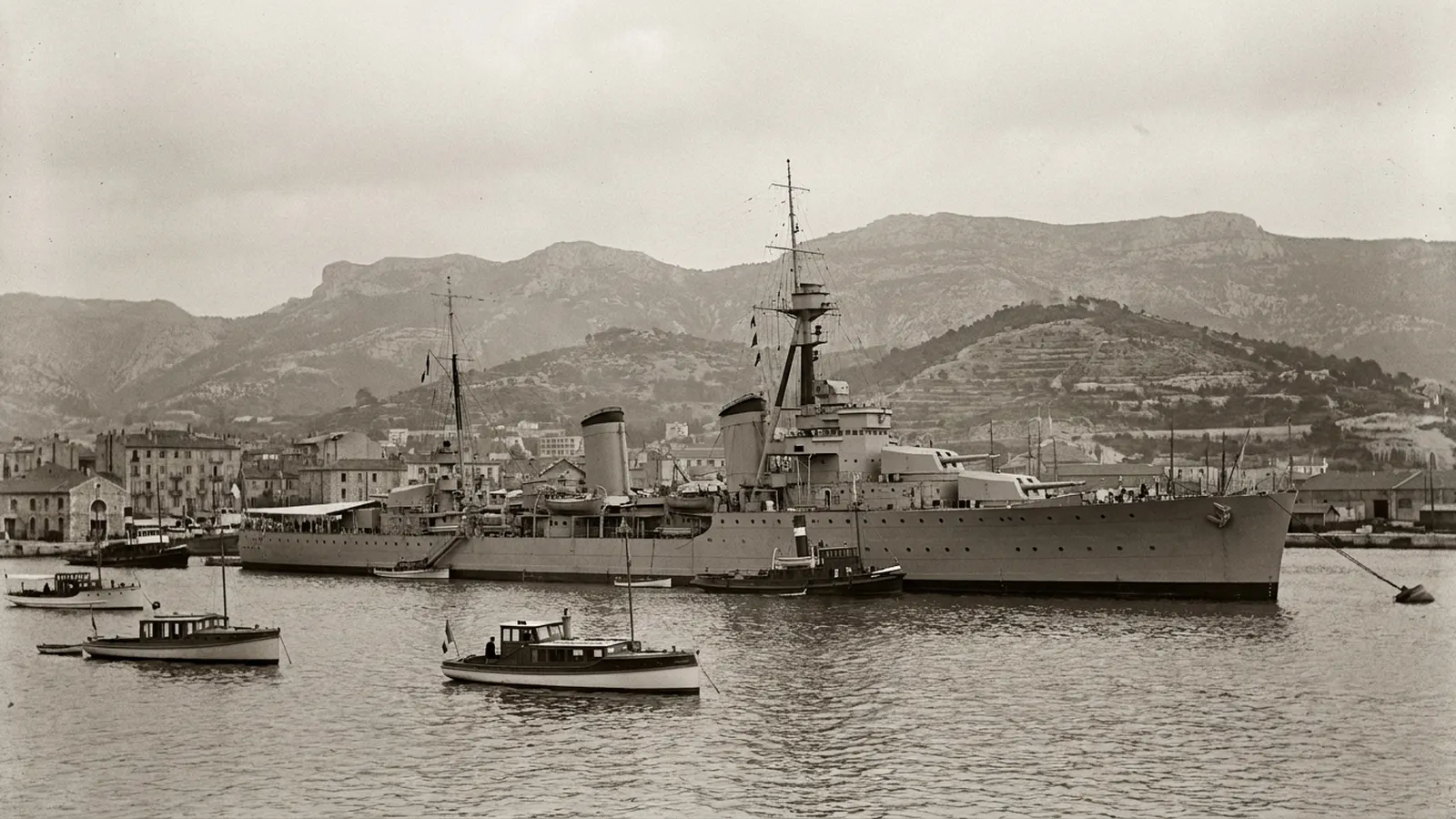
Cousteau was born on June 11, 1910, in Saint-André-de-Cubzac near Bordeaux. He entered the French naval academy, the École navale, in 1930 and graduated as a gunnery officer in 1933. His first ambition was to fly for the navy, but a serious car accident in the mid-1930s broke both of his arms and ended that plan. While he was recovering and serving at Toulon, his fellow officer Philippe Tailliez lent him a pair of Fernez underwater goggles in 1936. Cousteau later described looking through them as the moment his life changed direction.
With Tailliez and the spear-fisherman Frédéric Dumas he formed a small diving group, later nicknamed the mousquemers, that experimented with breath-hold diving, cameras and early breathing sets along the Var coast. In 1942 the three men shot Par dix-huit mètres de fond (“Eighteen metres down”) off the Embiez islands without any breathing apparatus, using a pressure-proof camera case built by the engineer Léon Vèche. It shared first prize at a French documentary film congress in 1943 and is regarded as the first French underwater film.
Cousteau was also a working naval officer through the Second World War. He had served on intelligence missions to Shanghai and Japan in the late 1930s, and during the occupation he helped organise operations against Italian intelligence services in France, work that earned him the Croix de guerre 1939–1945 and, later, the Legion of Honour. That double life, officer by day and diver by vocation, explains much of what followed: he had the navy’s discipline and access, and an amateur’s freedom to try new things.
What did the Aqua-Lung change?
The single achievement most people associate with Cousteau is the Aqua-Lung. In December 1942 he met Émile Gagnan, an engineer at the industrial gas company Air Liquide who had adapted a demand valve to run car engines on gas during wartime fuel shortages. Cousteau asked him to adapt it so that a diver could breathe from a cylinder of compressed air on demand, at the pressure of the surrounding water. The two men patented the result in 1943, Air Liquide built two prototypes at Boulogne-Billancourt, and that summer Cousteau and Dumas used them to film Épaves (“Shipwrecks”), cementing together dozens of short still-camera film reels because proper cine film was unavailable.
The idea of a demand regulator was not new. The Rouquayrol–Denayrouze apparatus of the 1860s and Yves Le Prieur’s constant-flow set of the 1920s came first. What Cousteau and Gagnan produced was the first open-circuit system that was safe, simple and cheap enough to sell to the public. In 1946 Air Liquide set up a subsidiary, La Spirotechnique, to manufacture it, and its CG45 regulator went on sale that year. By 1960, according to the historian Anthony Brandt, about a million Americans were diving with scuba gear. Cousteau’s claim to be the “inventor of scuba” is therefore best put as co-inventor of the design that made scuba a mass activity.
What did Cousteau achieve in the French Navy after the war?
In 1945–46 Cousteau and Tailliez showed Épaves to Admiral André Lemonnier, the navy’s chief of staff, who put them in charge of a new unit at Toulon, the Groupement de Recherches Sous-marines (GRS). Its job was practical: clearing mines from French harbours, inspecting wrecks and testing what the new breathing sets could safely do. The GRS still exists in another form; after several changes of name it became CEPHISMER, the French Navy’s expert centre for human diving.
The work had a high price. In 1947 the GRS diver Maurice Fargues died while attempting a depth record of around 120 m on compressed air, the first recorded death of an Aqua-Lung diver. The team’s experiences with what Cousteau called “rapture of the depths”, nitrogen narcosis, helped establish the practical depth limits of air diving that still shape recreational training. In 1948 the group sailed on the navy sloop Élie Monnier to the Roman wreck at Mahdia in Tunisia, and in 1949 it helped recover the float of Auguste Piccard’s bathyscaphe FNRS-2 off Dakar, a rescue that let the navy reuse the sphere in the FNRS-3. In 1949 Cousteau asked to be placed outside the regular navy cadre with the rank of capitaine de corvette, or lieutenant-commander, which is why the French still call him “le Commandant”.
How did Cousteau turn Calypso into a floating laboratory?
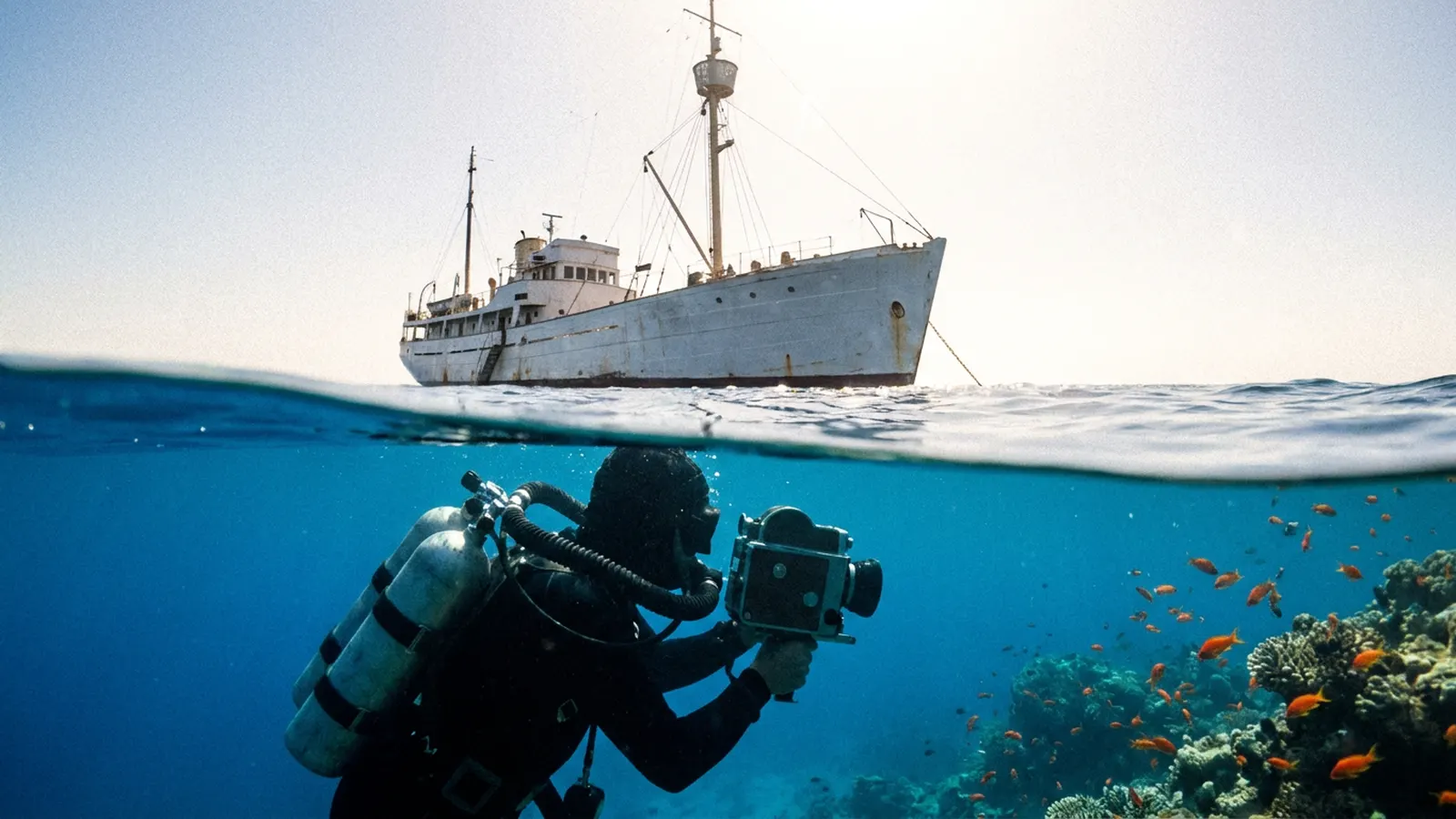
In 1950 Cousteau founded a non-profit company, Campagnes Océanographiques Françaises, and took on Calypso, a wooden-hulled minesweeper launched in Seattle in 1942 for the Royal Navy under lend-lease, which had spent a few months in 1950 as a ferry between Malta and Gozo. The British millionaire and former MP Thomas Loel Guinness bought the ship and leased it to Cousteau for a symbolic one franc a year, on condition that his role stay secret; it became public only after Cousteau’s death. Cousteau refitted her with a diving well, an underwater observation chamber in the bow, a laboratory and, later, a helicopter pad.
Keeping a research ship at sea was expensive, and Cousteau paid for it partly with commercial work. In 1954 Calypso surveyed the waters off Abu Dhabi for British Petroleum, with a young Louis Malle filming the expedition. Over four decades the ship carried scientists, divers and camera crews on dozens of expeditions, from the Red Sea and Indian Ocean to Antarctica and the Amazon. Her career ended on January 11, 1996, when a barge accidentally rammed and sank her in the port of Singapore. She was refloated and taken back to France, where restoration began in Concarneau in 2007. Her full story is told on our Calypso page.
What vehicles and equipment did Cousteau develop?
The Aqua-Lung was the first of several machines. In 1959 Cousteau’s team, working with the engineer Jean Mollard, completed the SP-350 “diving saucer”, a two-person submersible rated to 350 m that could hover and manoeuvre over the seabed while its crew filmed through portholes. It was faster to deploy than a bathyscaphe and allowed the first sustained filming of deep reef walls. In 1965 two smaller one-person craft, nicknamed “sea fleas”, were built for depths of 500 m. You can read more on the diving saucer page.
Underwater photography was another field he pushed forward. A member of Calypso’s crew, the Belgian engineer Jean de Wouters, designed a self-contained amphibious 35 mm camera from Cousteau’s idea, building a prototype in 1957. La Spirotechnique sold it as the Calypso, or “Calypso-Phot”, from around 1960–61, rated to about 60 m. Nikon acquired the design and from 1963 sold it as the Nikonos, which became the standard underwater camera for several decades. Cousteau’s team also worked with Harold “Doc” Edgerton of MIT on deep-sea strobe and sonar equipment from the 1950s onward.
His last major engineering project was about energy rather than diving. From around 1980 Cousteau, the aerodynamicist Lucien Malavard and the engineer Bertrand Charrier developed the “turbosail”, a fixed, hollow cylinder that works like a wing by sucking air through its surface with a fan. They tested it on a catamaran, Moulin à Vent, in 1981–82, then fitted two turbosails to a new expedition ship, Alcyone, launched at La Rochelle in 1985. The sails assist her diesel engines rather than replacing them. The idea did not spread to commercial shipping at the time, but it anticipated today’s interest in rotor and suction sails to cut ship fuel use.
What did Cousteau achieve as a filmmaker?
Film was the thread that ran through Cousteau’s whole career, and it is where his achievement is easiest to measure. His 1953 book The Silent World, written with Dumas, became a bestseller, said to have sold around five million copies. Its film version, co-directed with Louis Malle and shot over two years in the Mediterranean, Persian Gulf, Red Sea and Indian Ocean, opened at Cannes on May 26, 1956, and won the Palme d’Or. It remained the only documentary to win the festival’s top prize until Fahrenheit 9/11 in 2004. In 1957 it won the Academy Award for Best Documentary Feature.
Two more Oscars followed. The Golden Fish (Histoire d’un poisson rouge), a 19-minute short directed by Edmond Séchan and produced by Cousteau, won the Oscar for best live-action short subject at the 1960 ceremony. World Without Sun (Le Monde sans soleil), Cousteau’s own 1964 film about the Conshelf II undersea village in the Red Sea, won Best Documentary Feature at the 37th Academy Awards in 1965. That makes three Oscars for films he made or produced, two of them as director.
Television brought him a far larger audience. ABC commissioned a one-hour special on the Conshelf III experiment, broadcast in September 1966, and its success led to The Undersea World of Jacques Cousteau, which ran on American television from January 1968 to 1976. The series, narrated in the US by Rod Serling, made Cousteau’s red cap and French accent familiar in millions of homes and received 16 Emmy nominations, winning several for editing, cinematography and music. It was followed by The Cousteau Odyssey on public television (1977–82), the Amazon series of the early 1980s and Rediscovery of the World (1986–92). By his death, Cousteau and his teams had made more than 120 television documentaries.
The films also changed how science reached the public. Cousteau called himself an “oceanographic technician” rather than a scientist, and some academics criticised his style as popularisation. Yet the format he developed, with a narrated expedition, a crew of recurring characters and footage nobody had seen before, became a template for natural-history television. His son Philippe, who co-produced his films from 1969 and was his chosen successor, shot much of the award-winning photography until his death in a seaplane crash on the Tagus near Lisbon in 1979.
What institutions did Cousteau lead or found?
In 1957 Cousteau was appointed director of the Oceanographic Museum of Monaco, founded by Prince Albert I, and he stayed in the post until 1988. He used it as a base for expeditions and research and as a showcase for marine science. The museum’s legacy is not spotless: it has been identified as a likely source of the invasive “killer alga” Caulerpa taxifolia, which spread through parts of the Mediterranean from the 1980s.
In January 1959 delegates from national diving federations met in Monaco to found the Confédération Mondiale des Activités Subaquatiques (CMAS), the World Underwater Federation. Cousteau was chosen as its first president and held the role until 1973. CMAS remains one of the oldest international diving organisations and still certifies divers and governs underwater sports.
In 1973, with his sons and the American lawyer Frederick Hyman, he founded the Cousteau Society for the Protection of Ocean Life (some sources date its formal launch to 1974), followed in France by the Fondation Cousteau, later renamed l’Équipe Cousteau. At its height the Society had about 300,000 members, which gave Cousteau a political voice that few scientists have enjoyed. Both organisations are still active; the Society today describes itself as having over 50,000 members worldwide.
What were the Conshelf habitats?
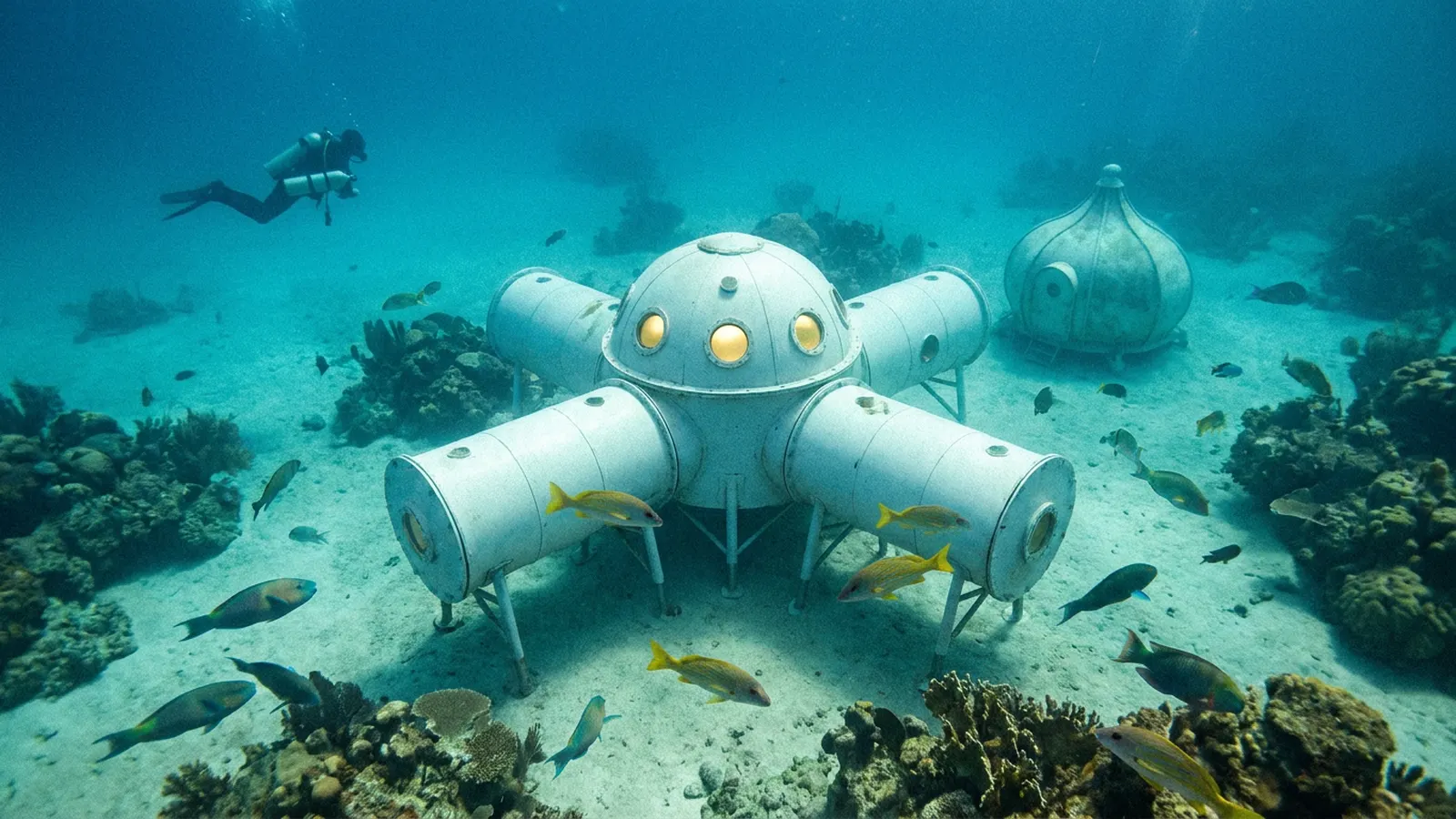
Between 1962 and 1965 Cousteau ran three “Précontinent” or Conshelf experiments to show that people could live and work on the seabed for long periods. In Conshelf I, off Marseille in 1962, two divers lived in a small cylinder at about 10–12 m; most accounts say for a week, some say two. Conshelf II in 1963, on Sha’ab Rumi reef off Sudan, housed a team of oceanauts in a star-shaped house at 10 m for about a month, with a hangar for the diving saucer and a deeper cabin where two men lived at about 30 m for a week. In Conshelf III in 1965, six men lived for about three weeks at roughly 100 m off Cap Ferrat. The program fed directly into commercial saturation diving. Cousteau later withdrew his support for using such stations to exploit the seabed, and turned to conservation instead. For what the aquanauts learned, see the discoveries page linked above and the modern tribute Mission 31.
What did Cousteau do for ocean conservation?
Cousteau’s first big public campaign came in October 1960, when France’s atomic energy commission planned to dump radioactive waste in the Mediterranean between Nice and Corsica. Cousteau and other oceanographers disputed the claim that there was little water circulation at the site, and he ran a publicity campaign that won wide support in under two weeks. A train carrying the waste was blocked by protesters sitting on the tracks and sent back, and the dump was postponed.
His views shifted over the following decades. Early films such as The Silent World include scenes that are hard to watch now: dynamite set off near a reef to count the fish, and a frenzy in which the crew killed sharks attracted to a whale calf that had been struck by the ship. By the 1970s his work had turned firmly toward protection. In 1977 he and the British naturalist Peter Scott shared the UN International Environment prize. His campaigns took on overfishing, pollution, and whaling, and in 1979 he published A Bill of Rights for Future Generations.
Antarctica became his signature cause. In 1988 the Antarctic Treaty nations agreed a convention that would have regulated mining on the continent. France and Australia, led by prime ministers Michel Rocard and Bob Hawke, pushed instead for a permanent ban. Cousteau launched a petition in 1990 calling for Antarctica to be declared a nature reserve, “land of peace and science”, and returned there that year with children from six continents to film Lilliput in Antarctica. The Protocol on Environmental Protection to the Antarctic Treaty, signed in Madrid on October 4, 1991, designated Antarctica a natural reserve and prohibited mineral resource activities. Many groups, including Greenpeace, also claim credit, and the protocol was the work of governments, but Cousteau’s public campaign is widely seen as part of the pressure that produced it.
From 1991 he collected signatures for a petition asking the United Nations to recognise the rights of future generations; National Geographic puts the total at about nine million. At the UN Earth Summit in Rio de Janeiro in 1992 he urged world leaders to accept that future generations have a right to an uncontaminated planet, and afterwards he became a regular adviser to the UN and the World Bank. In November 1997, a few months after his death, UNESCO adopted a Declaration on the Responsibilities of the Present Generations Towards Future Generations, which echoes his language.
What honours did Cousteau receive?
Recognition came from science, film, television and government. Among the main honours are the Croix de guerre 1939–1945; the National Geographic Society’s Special Gold Medal, presented by President John F. Kennedy in 1961; Commander of the Legion of Honour in 1972; the UN International Environment prize in 1977; the US Presidential Medal of Freedom, presented by Ronald Reagan in 1985; the Grand Cross of France’s National Order of Merit in 1985; induction into the US Television Hall of Fame in 1987; and honorary Companion of the Order of Australia in 1990. He was also admitted to the US National Academy of Sciences.
On November 24, 1988, he was elected to the Académie française, the body of 40 “immortals” that guards the French language, taking seat 17 in succession to the psychiatrist Jean Delay. He was formally received on June 22, 1989. For a man whose first book was co-written with a spear-fisherman, it was an unusual mark of literary standing, and it reflected the 50-plus books he wrote or co-wrote, from The Silent World and The Living Sea (1963) to Dolphins (1975) and Jacques Cousteau: The Ocean World (1985).
How should Cousteau’s accomplishments be judged?
Cousteau died of a heart attack in Paris on June 25, 1997, two weeks after his 87th birthday, and was buried in the family vault at Saint-André-de-Cubzac. His record is unusually broad: one engineering breakthrough with world-wide impact, a run of prize-winning films, a decade of prime-time television, three decades running a major museum, a federation and a society that outlived him, and conservation campaigns that helped shift public opinion on the Mediterranean and Antarctica.
It is also a record with shadows. He shared most of his inventions with engineers such as Gagnan, Mollard, de Wouters and Malavard, and his films were team efforts in which Philippe Cousteau, Dumas, Albert Falco and many others did much of the diving and filming. His early films harmed the animals they showed. His comments on population control in a 1991 UNESCO Courier interview drew criticism, and his final years were marked by a legal dispute with his son Jean-Michel over the use of the family name. Historians and biographers, including the 2021 documentary Becoming Cousteau, now tend to present both sides: a showman and promoter as much as a scientist, whose greatest single accomplishment may simply have been to make millions of people care about what happens under the surface of the sea. For more on the man himself, start with our Jacques Cousteau hub. For how his story ended, see how Jacques Cousteau died, and for the books that carried his work to millions of readers, Cousteau’s books.
What is Jacques Cousteau best known for?
Co-inventing the Aqua-Lung with Émile Gagnan in 1943, his research ship Calypso, and films and series such as The Silent World and The Undersea World of Jacques Cousteau.
Did Jacques Cousteau invent scuba?
He co-invented the Aqua-Lung, the first open-circuit scuba to succeed commercially. Earlier demand regulators and breathing sets existed, so “co-inventor of modern scuba” is the accurate description.
How many Oscars did Cousteau win?
Films he made or produced won three: The Silent World (1957) and World Without Sun (1965) for Best Documentary Feature, and the short The Golden Fish (1960), which he produced.
How many documentaries did Cousteau make?
More than 120 television documentaries, plus feature films and early short films, along with more than 50 books.
What did Cousteau do for Antarctica?
He campaigned from 1990 for Antarctica to become a nature reserve and against mining there. The 1991 Madrid Protocol designated it a natural reserve and banned mineral resource activities.
When did Cousteau found the Cousteau Society?
In 1973, with his sons and Frederick Hyman (some sources say 1974). At its peak it had about 300,000 members.
Was Cousteau in the French Navy?
Yes. He graduated from the École navale in 1933, led the navy’s Underwater Research Group after the war and left the regular cadre in 1949 as a capitaine de corvette, hence “Commandant Cousteau”.
When did Jacques Cousteau die?
On June 25, 1997, in Paris, aged 87. He is buried at Saint-André-de-Cubzac, where he was born.
- Wikipedia: Jacques Cousteau; The Silent World (film); World Without Sun; The Golden Fish (film); Conshelf; Turbosail; Calypso (camera); La Spirotechnique; CMAS; Oceanographic Museum; Protocol on Environmental Protection to the Antarctic Treaty.
- Encyclopædia Britannica: Jacques Cousteau (naval career, Oscars, Cousteau Society).
- Television Academy: The Undersea World of Jacques Cousteau (Emmy nominations and wins).
- Earth Magazine, “Benchmarks: February 3, 1953: Jacques Cousteau’s Silent World published”.
- National Geographic, “5 ways Jacques Cousteau pushed to protect the planet”.
- Cousteau Society: Antarctica expeditions; who we are.
- Australian Antarctic Division: tribute to Bob Hawke (Madrid Protocol, 1991).
- Actunautique: “JYC, le capitaine de corvette Jacques-Yves Cousteau” (navy status, 1949).
Blane Perun has been exploring Earth’s oceans and marine life for over 25 years. Founder of TheSea.Org in 1999, underwater photographer, coral aquaculture pioneer, and explorer of 80+ countries.
About Blane Perun →