Bermuda Shipwrecks — 300 Wrecks on the Atlantic’s Loneliest Reef
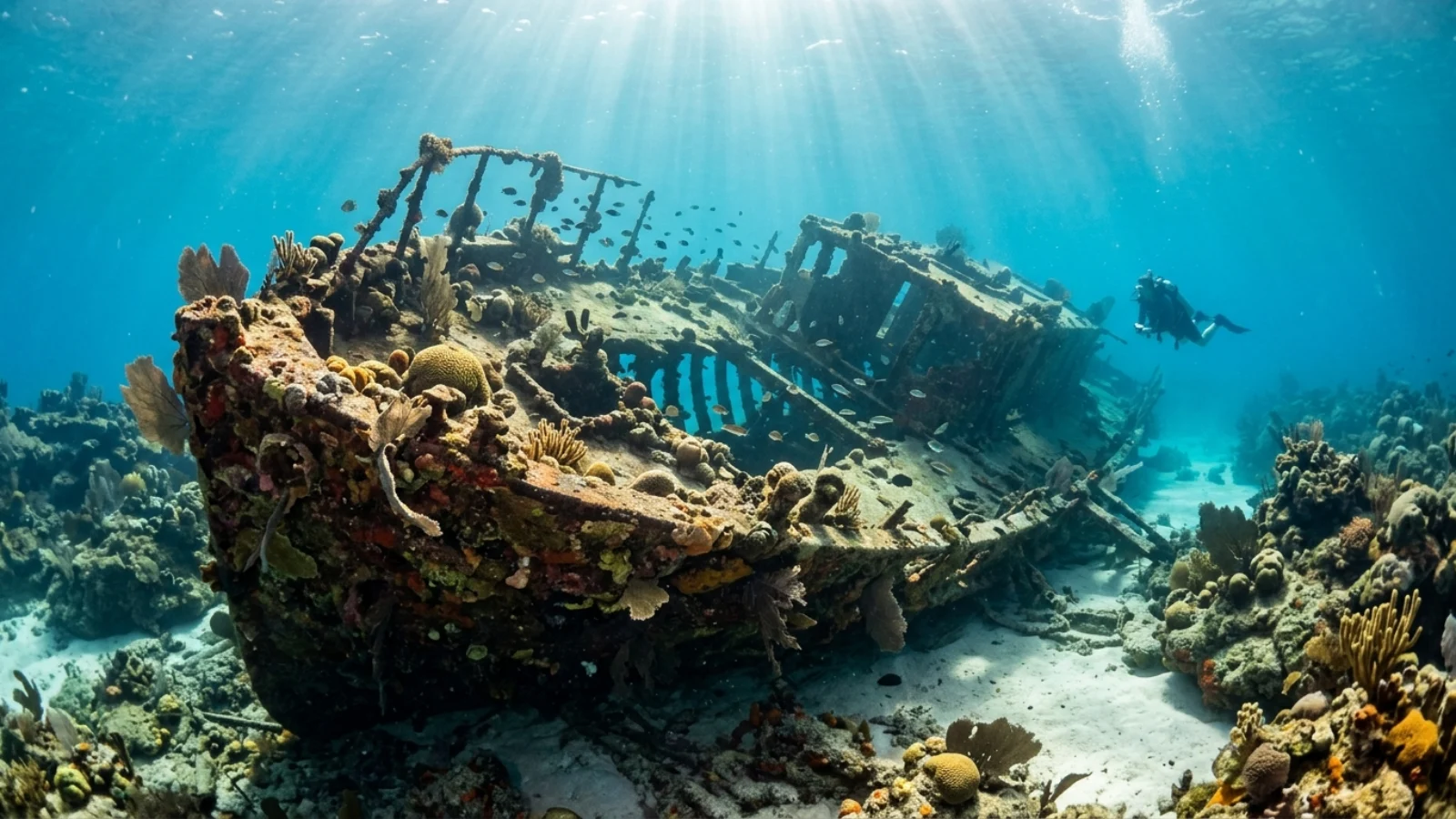
Bermuda has more than 300 known shipwrecks, one of the highest densities of wrecks per square mile anywhere, because a wide, shallow coral reef platform surrounds the island far out from shore in the middle of the North Atlantic. Most of the wrecks lie in 8 to 80 feet of water, so divers and even snorkelers can reach them.
Ships have been hitting these reefs since the 1500s. Some losses were famous: the Sea Venture, which founded the colony in 1609, and the Cristobal Colon, the largest wreck in Bermuda waters. Others are working steamers, blockade runners and sunken tugs that now serve as artificial reefs.
Why are there so many shipwrecks around Bermuda?
Geography. Bermuda is the northernmost coral reef system in the Atlantic, kept alive by the warm Gulf Stream. The reef platform spreads miles out from the islands, especially to the north, where North Rock lies about 8 miles offshore. For centuries ships following the Gulf Stream and the westerlies home to Europe passed close to Bermuda, and in storms or poor visibility the reefs were invisible until a hull struck. Beyond the reef the seafloor drops quickly to about 120 m (390 ft), so a ship that drifted past the breakers was usually gone for good; those that hit the reef stayed in shallow water, which is why so many survive for divers.
Which are the most famous Bermuda shipwrecks?
| Wreck | Lost | What it was | Approx. depth |
|---|---|---|---|
| Sea Venture | 1609 | English flagship of the Jamestown relief fleet | Shallow, off St. George’s |
| Montana | 1863 | Paddlewheel steamer | Shallow; under the Constellation |
| Mary Celestia | 1864 | Confederate blockade runner, paddlewheel steamer | ~55 ft |
| North Carolina | 1880 | Iron-hulled sailing ship, ~250 ft | Mid-depth reef wreck |
| Cristobal Colon | 1936 | Spanish luxury liner, 499 ft | Spread over 100,000 sq ft; ~15–55 ft |
| Iristo | 1937 | Norwegian freighter, ~250 ft | Reef wreck near the Colon |
| Constellation | 1943 | Wooden schooner carrying cement | Cement bags at ~8 ft |
| B-50 bomber | 1963 | US Air Force tanker aircraft | ~25 ft |
| Hermes | 1984 (scuttled) | 165 ft freighter built 1943 | Intact, off Horseshoe Bay |
What happened to the Sea Venture?
The Sea Venture was the flagship of a fleet carrying settlers and supplies to Jamestown, Virginia. In late July 1609 a hurricane separated it from the fleet, and Admiral Sir George Somers deliberately ran the leaking ship onto the reef off St. George’s to save the roughly 150 people aboard. All of them reached shore. They spent about nine months on the island and built two small ships, the Deliverance and Patience, which reached Jamestown on May 23, 1610. Their accounts are widely believed to have inspired Shakespeare’s The Tempest, and the shipwreck gave England its claim to Bermuda. Sport divers rediscovered the wreck in October 1958.
Who were the first to wreck on Bermuda?
Spanish and Portuguese ships were wrecking on Bermuda long before the English arrived. The islands take their name from the Spanish navigator Juan de Bermúdez, who sighted them in the early 1500s, and for the next century treasure fleets returning from the Americas rode the Gulf Stream past them on the way to Europe. Sailors feared the islands, which they called the Isle of Devils, both for their reefs and for the eerie cries of nesting seabirds heard in the dark.
Several of those early ships are known from their remains. The most famous find came in 1955, when the Bermudian diver Teddy Tucker recovered a gold cross set with emeralds from a Spanish wreck of the 1590s. The Tucker Cross became one of the best-known pieces of shipwreck treasure in the world. It was later displayed at the Bermuda Aquarium, and in 1975, shortly before a visit by Queen Elizabeth II, staff discovered that it had been stolen and replaced with a replica. The original has never been recovered.
What can be seen of the Sea Venture and the Warwick today?
The Sea Venture’s remains lie in shallow water off the east end of the island, and they have been studied by archaeologists since the wreck was rediscovered in 1958. Much of the hull had been salvaged by the castaways themselves to build their two escape ships, so what survives is the lower hull, ballast stones and small objects such as pottery, pewter and weapons. It is a protected site that can be visited only under licence.
Ten years after the Sea Venture, the colony suffered another loss. In 1619 the English supply ship Warwick, sent out with settlers and goods, was driven ashore and sank in Castle Harbour during a hurricane. Buried in mud, its lower hull has survived unusually well, and archaeological excavations from 2010 onward recorded a large section of timber construction. It ranks among the best-preserved early 17th-century English ships ever found and has shed light on how the ships that carried colonists to the Americas were built.
What happened to the Cristobal Colon?
The Cristobal Colon was one of the largest ships in the Spanish merchant fleet, a liner of about 499 feet built for the transatlantic run to the Caribbean and Mexico. In October 1936, during the first months of the Spanish Civil War, it ran onto the reefs north of Bermuda at speed and stuck fast. The crew survived, but the ship could not be refloated. Salvors stripped it of fittings, and furniture, fixtures and dishes from the liner found their way into homes and hotels around the island.
The hulk later served as a target for military aircraft practicing bombing runs, which helps explain why its remains are now spread so widely across the reef. Just months after the Colon grounded, the Norwegian freighter Iristo struck the reef close by in 1937, so divers can visit the two wrecks on the same trip. Most of the Colon now lies in pieces between about 15 and 55 feet, with large sections of hull, boilers and machinery scattered among coral heads and sand channels, home to big schools of grunts and snappers.
What should first-time wreck divers know in Bermuda?
Most of the island’s wreck sites are shallow enough for newly certified divers, but they still reward planning. Surge can be strong over the reef in a swell, so guides often plan dives on the sheltered side of the island and keep groups close to the wreck. Sharp metal, broken coral and fire coral are common on the older sites, and gloves are not a substitute for good buoyancy control. Divers who stay a few feet above the wreckage protect both themselves and the fragile growth on the hull.
Which Bermuda wrecks are best to dive?
- Mary Celestia: a 55 ft dive off the South Shore with paddlewheels, boilers and an anchor still visible. The ship was running guns to Wilmington, North Carolina, in 1864 when it hit a reef; only the cook died. Divers later found unopened wine bottles in the bow.
- Cristobal Colon: Bermuda’s largest wreck, a Spanish liner that ran onto the reef near North Rock in 1936 and was later used for bombing practice. Huge debris field, good for several dives.
- Constellation and Montana: two wrecks stacked on top of each other in shallow water, ideal for snorkelers and new divers; cement bags from the Constellation lie in pyramids.
- Hermes: a 165 ft ship scuttled in 1984 as an artificial reef about a mile off Horseshoe Bay, upright and intact with its mast pointing up.
- King George: a government dredger that arrived in 1911 and was later sunk inside North Rock; the island’s largest fully intact wreck.
Why were Civil War blockade runners in Bermuda?
During the American Civil War, from 1861 to 1865, the Union Navy blockaded Southern ports to cut off the Confederacy’s trade. Bermuda, a British colony just three days’ steaming from the Carolina coast, became one of the main bases for the fast ships that slipped through it. Weapons, ammunition, medicine and luxury goods arrived from Britain, were loaded onto long, low, often paddle-driven steamers at St. George’s and run into Wilmington, North Carolina, or Charleston, South Carolina, usually at night. On the return trip the ships carried cotton, which sold for enormous prices in Britain.
The trade made fortunes for some merchants in St. George’s and brought a short boom to the town. It also left wrecks. Blockade runners were built for speed rather than strength and often ran close to the reefs without lights, so several were lost on the way in or out. The Mary Celestia and the Montana are the best known to divers, and their engines and paddlewheels are among the clearest surviving traces of that brief era.
Do Bermuda’s wrecks prove the Bermuda Triangle is real?
No. The Bermuda Triangle, an area roughly between Bermuda, Miami and Puerto Rico, became famous through magazine articles and books in the 1960s and 1970s that linked a series of disappearances of ships and aircraft. Investigations have found that the region does not see more losses than other heavily traveled ocean areas, once its busy shipping and air traffic are taken into account. The U.S. Coast Guard and the insurer Lloyd’s of London have both said they find no evidence of unusual danger there.
Bermuda’s wrecks have ordinary causes: shallow reefs far from shore, storms, poor charts, navigation errors and, before modern technology, the difficulty of fixing an exact position in the open Atlantic. Many of the island’s famous wrecks hit the reef in clear sight of land. The real mystery is the opposite one: how so many survive in such good condition and such easy reach of divers.
Which Bermuda wreck can you see without getting wet?
HMS Vixen, a Royal Navy ironclad gunboat, was deliberately sunk in 1896 across Chubb Cut, a channel through the reef near Daniel’s Head on Bermuda’s western end. The navy wanted to block the passage so that no enemy torpedo boat could use it to approach the dockyard. Its bow still rises above the surface, and glass-bottom boats and snorkel trips from the West End stop beside it, so visitors can look down into the hull and see the fish that live inside. Snorkelers can float over the wreck in calm weather, but it should not be entered.
Why are Bermuda’s reefs so far from shore?
Bermuda sits on top of an extinct volcano, a seamount that rises from the deep floor of the western Atlantic. Over millions of years the volcanic peak eroded and sank, and a thick cap of limestone built up over it from coral, shells and windblown sand. The present islands are only the highest part of that cap. Around them a broad, shallow platform stretches for miles, ringed by reefs that stand close to the surface.
On the north side the reef sits far offshore, so a ship could be well out of sight of land and still run aground. On the South Shore, many reefs are built partly by coralline algae and tube-forming snails as well as corals, forming rounded cup-shaped structures, known locally as boilers, that break the surface and foam in a swell. Both kinds of reef have claimed ships, and both now shelter the wrecks they sank.
What are Bermuda divers asked to do about lionfish?
Indo-Pacific lionfish, released or escaped from aquariums in Florida, spread through the western Atlantic in the 2000s and reached Bermuda early in that invasion. They eat large numbers of small reef fish and have no effective natural predators in the region, and wrecks, with their ledges and holes, are favorite places for them to gather.
Bermuda responded by encouraging divers to remove them. Trained and licensed divers can take lionfish with special pole spears designed for the purpose, and local programmes have promoted lionfish as a food fish in restaurants. Visiting divers who see lionfish on a wreck are encouraged to report them to the dive guide, who may be licensed to remove them.
What marine life lives on Bermuda’s wrecks?
Expect hard corals such as brain coral, sea fans, sponges and the reef fish of the western Atlantic: parrotfish, grunts, snapper, angelfish and schools of sergeant majors, with the occasional barracuda or turtle. Because the water is cooler than the Caribbean in winter, coral growth is slower, and the reef structure is dominated by a smaller set of hardy species. See our Bermuda coral reef maps for the reef layout.
How are Bermuda’s historic wrecks protected?
Bermuda treats its wrecks as part of its national heritage. Under the Historic Wrecks Act of 2001, wrecks more than 50 years old and their contents belong to the government, and anyone who wants to excavate or recover objects must hold a licence and work to archaeological standards. Diving on most wrecks to look and take photographs is allowed, but taking even small items, such as a bottle or a piece of pottery, is an offence.
Many of the artifacts recovered over the past century are on display at the National Museum of Bermuda, housed in the old Royal Naval Dockyard at the island’s western end. Its galleries cover Spanish treasure, the Sea Venture, blockade running and the island’s long relationship with the sea, and it is the best place to see objects from wrecks that are too fragile or too deep to visit.
When is the best time to dive Bermuda’s wrecks?
The main dive season runs from about May to October, when sea temperatures rise into the upper 20s °C and calm days are common. In winter the water drops to around 18 to 20 °C, so a thicker wetsuit or semi-dry suit is needed, but visibility can be excellent because there is less plankton in the water. Hurricane season peaks from August to October, and storms can close dive sites for days.
Bermuda’s wrecks lie mainly on the north, west and south sides of the island, so dive operators choose sites according to the wind. When a strong southerly blows, boats head for the sheltered northern reefs; in a north wind, the South Shore sites such as the Mary Celestia are usually calmer. A typical day includes two dives, often one deeper wreck and one shallow reef or wreck site.
How do so many wooden wrecks survive in Bermuda?
Wood normally disappears quickly in warm seas, eaten by shipworms and broken by waves. Bermuda’s oldest wrecks survive mainly where sand or mud covered the timbers soon after the sinking, cutting off the oxygen that shipworms and bacteria need. Storms can reverse that process. Hurricanes regularly strip sand from some sites and bury others, so timbers, cannon and ballast piles appear and disappear from year to year. Archaeologists monitor important sites after big storms, and divers occasionally report newly exposed features that have not been seen for decades.
How does Bermuda compare with other wreck destinations?
Few places pack so many shallow wrecks so close to shore. For a sunken navy ship placed as an artificial reef, see the Kittiwake in Grand Cayman; for a WWII freighter in shallow water, try the Antilla in Aruba; and for deep, cold wrecks compare Lake Superior.
Bermuda’s many wrecks helped feed the legend of the Bermuda Triangle; for more sea folklore, see ghost ships and the Flying Dutchman.
How many shipwrecks are there around Bermuda?
More than 300 recorded, dating from the 1600s to the 1990s.
Why does Bermuda have so many shipwrecks?
A wide, shallow reef platform surrounds the island far offshore, on a busy route between the Americas and Europe.
What is the most famous Bermuda shipwreck?
The Sea Venture, wrecked in 1609, which led to the settlement of Bermuda and is thought to have inspired The Tempest.
What is the largest shipwreck in Bermuda?
The Cristobal Colon, a 499 ft Spanish liner wrecked in 1936.
Can you snorkel Bermuda shipwrecks?
Yes. Shallow wrecks such as the Constellation and Montana sit within snorkeling range.
How deep are Bermuda wrecks?
Most lie between about 8 and 80 feet.
What is the Mary Celestia?
A Confederate blockade-running paddle steamer that sank off Bermuda’s South Shore in 1864, in about 55 ft of water.
Is the Bermuda Triangle why ships sink there?
No. The cause is Bermuda’s hidden reef platform and Atlantic storms, not anything mysterious.
- Smithsonian Magazine: Exploring five of the most iconic wreck sites in Bermuda.
- Go To Bermuda: Bermuda’s top shipwreck dives.
- National Geographic Travel: The lost legends of Bermuda’s seas.
- Wikipedia: Sea Venture.
- National Museum of Bermuda: shipwrecks and underwater archaeology collections.
- Government of Bermuda: Historic Wrecks Act 2001 and wreck licensing.
- Bojakowski, P. & Bojakowski, K.C.: Warwick (1619) excavation reports, Castle Harbour, Bermuda.
Blane Perun has been exploring Earth’s oceans and marine life for over 25 years. Founder of TheSea.Org in 1999, underwater photographer, coral aquaculture pioneer, and explorer of 80+ countries.
About Blane Perun →