Cambodia Coral Reef Maps — Island Reefs of the Gulf of Thailand
Cambodia’s coral reefs lie off its short southern coastline in the Gulf of Thailand, almost entirely around offshore islands rather than along the muddy, mangrove-lined mainland. The main reef areas are the Koh Rong archipelago off Sihanoukville, the Koh Sdach group to the north-west toward Koh Kong, and the remote Koh Tang and Koh Prins islands far offshore. The reefs are small — the UNEP-WCMC global dataset maps roughly 48 km² — but surveys over the last two decades have shown them to be far more diverse than once assumed, and the Koh Rong area now holds Cambodia’s first large Marine Fisheries Management Area.
Most people think of Cambodia as a land of temples, rice fields and the Mekong, not coral. Yet the country has a 400-odd kilometre coastline on the Gulf of Thailand and more than sixty offshore islands, and around many of them lie living coral reefs. They are modest in size compared with the vast reef systems of Indonesia or the Philippines, and for decades they were barely studied. That is changing. This page maps where Cambodia’s reefs are, explains why they sit where they do, and covers the wildlife, protection, diving and threats that shape their future.
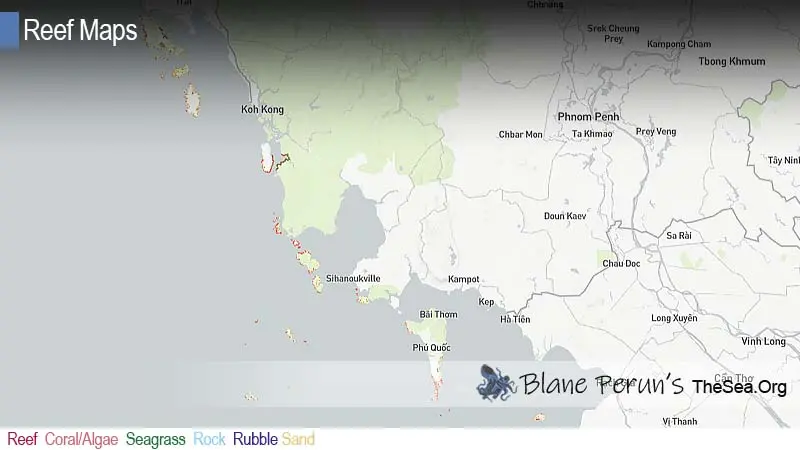
Cambodia coral reef map
Small fringes of reef around offshore island groups, with almost none on the mainland coast.
On the map, Cambodia’s reef extent appears as small coral-coloured fringes scattered across the eastern Gulf of Thailand. The biggest cluster sits around the Koh Rong archipelago, a short boat ride west of Sihanoukville. A second group lies around Koh Sdach and its neighbouring islets further up the coast toward Koh Kong province. Far to the south-west, the isolated Koh Tang and Koh Prins islands carry their own small reef fringes in clearer, more oceanic water.
The reef outlines come from the UNEP-WCMC global warm-water coral reef dataset, which combines satellite imagery with field survey records. The shading shows where reef structure has been mapped, not how much live coral it holds, and small or deeper patches may be missing. Treat the map as a guide to where reefs occur, not as a navigation chart.
Why Cambodia’s reefs grow around islands
Rivers, mangroves and mud dominate the mainland; coral needs the clearer water offshore.
Reef-building corals need warm, clear, well-lit water with little sediment. Cambodia’s mainland coast is the opposite for much of its length. Rivers draining the Cardamom and Elephant Mountains carry silt and fresh water into the sea, and extensive mangroves and mudflats line estuaries such as those around Koh Kong and Kampot. Near the shore, the water is often green-brown and turbid, especially during the rainy south-west monsoon.
A few kilometres offshore the picture changes. Around the granite and sandstone islands of the Koh Rong and Koh Sdach groups the water clears, and corals settle on rocky slopes and boulders to form fringing reefs. These reefs are generally shallow, often finishing on sand at depths of well under 20 metres, because the Gulf of Thailand itself is a shallow sea. Further offshore, Koh Tang and Koh Prins sit in bluer, more open water and have tended to hold the healthiest coral in the country.
Between the reefs, Cambodia’s coastal sea is a patchwork of seagrass meadows, sand and mud. The Kep archipelago and the waters off Kampot are better known for seagrass than coral, but they are part of the same connected system: many reef fish spend their juvenile stages in seagrass and mangroves before moving onto the reef.
Cambodia’s main reef areas
Three island groups hold almost all of the country’s coral.
Koh Rong archipelago. Koh Rong and Koh Rong Sanloem, together with smaller islands such as Koh Koun, Koh Touch and Koh Bong, hold the largest concentration of reef in Cambodia. Fringing reefs run along sheltered bays and around rocky headlands, with hard corals such as branching Acropora, massive Porites and brain corals, along with soft corals and sponges. Over the past fifteen years these islands have changed from quiet fishing communities to busy backpacker and dive destinations, and the reefs are now central to the local economy.
Koh Sdach group. North-west along the coast toward Koh Kong, the Koh Sdach islands are home to fishing villages whose daily life is tied to the sea. Reefs here are smaller and more exposed to fishing pressure and sediment, but conservation groups working with local communities have mapped and monitored them and supported community fisheries.
Koh Tang and Koh Prins. These remote islands lie far offshore in the south-west of Cambodia’s waters. Koh Tang is best known internationally as the site of the 1975 Mayaguez incident, but for divers it is known for clearer water and some of the country’s least-disturbed coral. Their distance from the mainland has been their main protection, and they are surveyed far less often than the Koh Rong reefs.
Closer to Sihanoukville, the islands of Ream National Park also have small patches of reef and extensive seagrass and mangrove habitat, protected as part of one of Cambodia’s few coastal national parks.
Marine life on Cambodian reefs
More species than once believed, including seahorses, reef fish and nesting-turtle history.
For a long time Cambodia’s reefs were assumed to be poor relatives of the great Southeast Asian reef systems. Survey work around the Koh Rong archipelago and Koh Sdach since the 2000s has shown otherwise, recording a good range of hard and soft corals and reef fish. Typical residents include damselfish, butterflyfish, angelfish, parrotfish, rabbitfish, groupers, snappers and wrasses, with moray eels and blue-spotted stingrays in sandy patches. Giant clams, sea cucumbers and sea urchins are found on reef flats, although many have been heavily harvested.
Seagrass and sandy areas around Koh Rong are known for seahorses, which have become a focus of local research and conservation. Hawksbill and green sea turtles occur in Cambodian waters, though nesting is now rare. Coastal waters, especially toward Kep and Kampot, are also home to dolphins, and dugongs were historically recorded in the seagrass beds, although sightings are now very uncommon. For a broader look at reef food chains, see our guide to the coral reef ecosystem food web.
Protecting Cambodia’s reefs
The Koh Rong Marine Fisheries Management Area set a new model for the coast.
Cambodia’s most important step for reef protection came in 2016, when the government declared the Koh Rong Archipelago Marine Fisheries Management Area (MFMA), the country’s first large-scale marine protected area. It was developed by the Fisheries Administration with conservation organisations and island communities, and it divides the waters around Koh Rong and Koh Rong Sanloem into zones: core areas where fishing is banned to let reefs and stocks recover, and wider zones for sustainable local fishing.
Community fisheries, patrols against illegal trawling and reef monitoring by local and international groups support the MFMA. Elsewhere, Ream National Park protects coastal habitats near Sihanoukville, and further fisheries management areas have been proposed or set up along the coast, including in the Kep archipelago where community efforts have focused on seagrass and protecting the seabed from trawlers. Enforcement is the hard part: patrol boats, fuel and staff are limited, and illegal fishing remains a serious problem. Our coral reef conservation guide explains why protected zones like these matter.
Diving and snorkelling in Cambodia
Relaxed, shallow island diving, best from late in the year into spring.
Dive operators work out of Sihanoukville and from the islands themselves, mostly on Koh Rong and Koh Rong Sanloem. Dives are typically shallow and gentle, suited to beginners and training courses, with longer liveaboard or day trips to the outer islands such as Koh Tang and Koh Prins for clearer water and more coral. Visibility in the Gulf of Thailand varies widely; it is often moderate around the inshore islands and better offshore.
The dry season, roughly November to May, usually brings calmer seas and the best conditions. During the south-west monsoon, from about June to October, rain, wind and runoff reduce visibility and can make boat crossings rough. Many island beaches also offer easy snorkelling over shallow coral and seagrass straight from the shore.
- Choose responsible operators — ask whether they use moorings rather than anchors and brief divers on not touching coral.
- Respect no-take zones — core zones in the Koh Rong MFMA are closed to fishing and collecting.
- Use reef-safe habits — avoid standing on coral, wear a rash guard instead of heavy sunscreen, and take rubbish back to the mainland.
- Never buy shells or coral — souvenir sales drive collecting from already pressured reefs.
Threats to Cambodia’s coral reefs
Rapid coastal development, trawling and warming seas.
Coastal development is the most visible pressure. Sihanoukville has seen explosive, often poorly regulated construction in recent years, along with land reclamation and expanding tourism on the islands. Sediment, untreated sewage and rubbish wash into the sea, clouding the water corals need and feeding algae that compete with them.
Overfishing and illegal trawling have damaged reefs and seagrass and stripped out many larger fish, including groupers and snappers. Trawlers, sometimes operating inside protected or inshore waters, drag gear across the seabed, while destructive methods such as fine-mesh nets add to the pressure. Past harvesting of giant clams, sea cucumbers and other invertebrates has thinned their populations.
Warming seas add a global threat. The shallow Gulf of Thailand heats quickly during marine heatwaves, and corals there have suffered bleaching during strong El Niño years. Reefs already stressed by sediment and fishing are less able to recover. Read more about coral reef bleaching and what happens when coral reefs die.
Does Cambodia have coral reefs?
Yes. Cambodia has small but diverse fringing reefs around its offshore islands in the Gulf of Thailand, mainly the Koh Rong archipelago, the Koh Sdach group and the remote Koh Tang and Koh Prins islands. UNEP-WCMC maps about 48 km² of reef.
Where is the best snorkelling in Cambodia?
Koh Rong and Koh Rong Sanloem offer the easiest access to reefs, with snorkelling from beaches and short boat trips. Clearer water and healthier coral are usually found around the more remote islands such as Koh Tang and Koh Prins, reached by longer boat trips.
Is Koh Rong good for diving?
Koh Rong is the centre of Cambodian diving, with relaxed, shallow reef dives well suited to beginners and courses. Visibility varies, and the best conditions are usually in the dry season from about November to May.
Are Cambodia’s coral reefs protected?
Partly. The Koh Rong Archipelago Marine Fisheries Management Area, declared in 2016, protects reefs around Koh Rong and Koh Rong Sanloem with no-take core zones. Ream National Park and community fisheries also protect coastal habitats, but enforcement against illegal fishing remains difficult.
What sea are Cambodia’s reefs in?
The Gulf of Thailand, a shallow, warm arm of the South China Sea shared with Thailand, Vietnam and Malaysia.
What threatens coral reefs in Cambodia?
Rapid coastal development around Sihanoukville, land reclamation, sewage and sediment, illegal trawling and overfishing, and coral bleaching during marine heatwaves.
- UNEP-WCMC, WorldFish Centre, WRI, TNC: Global distribution of warm-water coral reefs, v4.1 (2021)
- Fisheries Administration of Cambodia: Koh Rong Archipelago Marine Fisheries Management Area
- Burke et al., World Resources Institute: Reefs at Risk Revisited (2011)
Blane Perun has been exploring Earth’s oceans and marine life for over 25 years. Founder of TheSea.Org in 1999, underwater photographer, coral aquaculture pioneer, and explorer of 80+ countries.
About Blane Perun → More Asia Coral Reef Maps →