Nuestra Señora de las Mercedes — The Treasure Frigate That Started a War
The Nuestra Señora de las Mercedes was a 36-gun Spanish frigate that exploded and sank off Cape Santa Maria in southern Portugal on October 5, 1804, during a surprise British attack in peacetime. Roughly 250 people died, and the attack pushed Spain into war with Britain two months later.
In 2007 the American salvage company Odyssey Marine Exploration recovered about 594,000 coins from a deep-water wreck it code-named “Black Swan.” Spain sued, US courts ruled the wreck was the Mercedes and a Spanish warship, and in February 2012 about 17 tons of silver and gold were flown back to Spain.
What was the Mercedes?
The Mercedes was launched in Havana in 1786 as a frigate of the Spanish Navy. In 1804 it was one of four frigates under Brigadier José de Bustamante carrying silver, gold and passengers from Montevideo and the Río de la Plata to Cádiz. Spain was officially neutral in the Napoleonic wars, but Britain suspected the treasure would be used to pay subsidies to France.
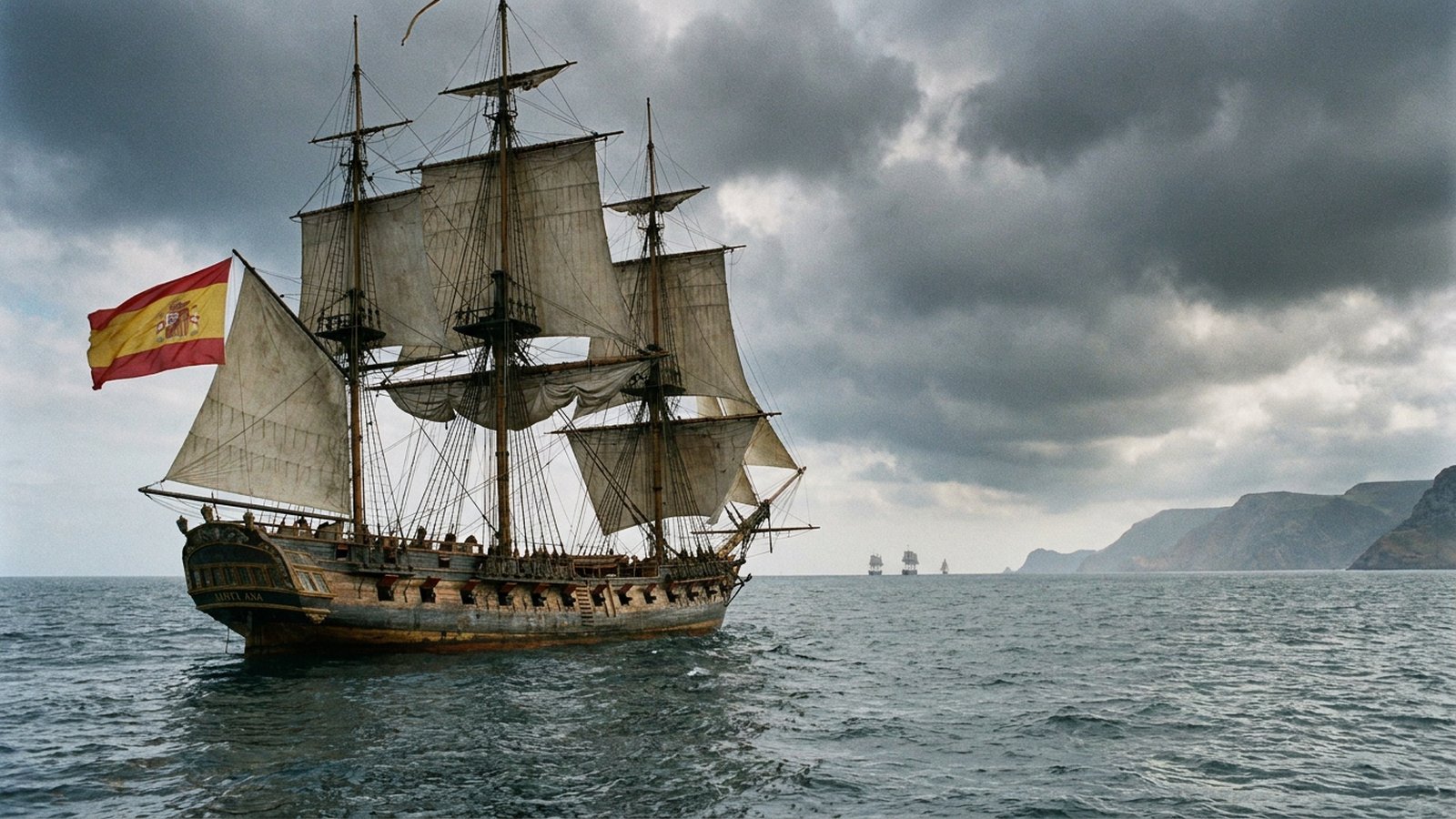
What happened on October 5, 1804?
A British squadron of four frigates under Commodore Graham Moore, led by HMS Indefatigable with Lively, Amphion and Medusa, intercepted the Spanish squadron a day’s sail from Cádiz and demanded that it surrender. Bustamante refused, and the British opened fire. About ten minutes into the fight a shot reached the Mercedes’ powder magazine and the ship blew apart. Of its roughly 240 crew, only about 40 survived, and passengers, including women and children, died with them. Among the dead were almost all of the family of naval officer Diego de Alvear, who watched from another frigate with his 16-year-old son, Carlos María de Alvear, later a leader of Argentine independence. The other three frigates were captured.
| Date | Event |
|---|---|
| 1786 | Mercedes launched in Havana |
| 1804 | Sails from the Río de la Plata with Bustamante’s squadron |
| Oct 5, 1804 | British attack off Cape Santa Maria; Mercedes explodes |
| Dec 14, 1804 | Spain declares war on Britain |
| 2007 | Odyssey recovers ~594,000 coins, flies them to Tampa |
| 2009 | US judge rules the wreck is the Mercedes |
| Feb 2012 | Coins returned to Spain |
| 2015 onward | Spanish state archaeologists survey and excavate the wreck |
Why does the Mercedes matter to history?
Because Britain struck without a declaration of war, historians have described the attack as technically an act of piracy. Spain declared war on December 14, 1804. Less than a year later, the combined Franco-Spanish fleet was destroyed at the Battle of Trafalgar in October 1805. The Mercedes is therefore one of the sparks that brought Spain into the war at sea against Britain.
How was the Mercedes found?
In 2007 Odyssey Marine Exploration announced the recovery of a huge coin cargo from a site in international waters off Portugal, which it called “Black Swan” and declined to identify. It used a remotely operated vehicle to lift about 17 tons of coins, mostly silver, from more than 1,100 m down, and flew them to Florida. Spain sued in US federal court. In 2009 a judge found that the wreck was the Mercedes, and courts held that as a sunken Spanish Navy vessel it had sovereign immunity, so Odyssey had no salvage rights. Peru’s claim failed because Peru was then part of the Spanish Empire. After a final appeal was refused in February 2012, two Spanish military planes carried the coins home.
The ship and its last cargo
The Mercedes came out of the royal shipyard at Havana in 1786, one of the sailing frigates Spain used to escort and carry the trade of its American viceroyalties. Spanish naval lists credit it with 36 guns, mostly 12-pounders with a battery of lighter 6-pounders, and a nominal crew of about 300. Frigates of this kind were fast, well-armed cruisers rather than lumbering treasure galleons, which is why by 1804 the crown trusted small squadrons of them to move bullion that had once crossed in great convoys.
Its final voyage began on the Pacific side of South America, at Callao, the port of Lima, before the ship joined the squadron gathering in the Río de la Plata. Bustamante’s four frigates left Montevideo in early August 1804; the battle accounts give August 9, while a biography of one passenger gives August 7 as the day he embarked. Alongside gold and silver the holds carried colonial goods typical of the route: vicuña cloth, cinchona bark (the source of quinine), cinnamon, tin, copper, wool and sealskins. Across the four ships the registered specie came to about 4.3 million Spanish dollars, and roughly 1.2 million of that silver, with half the copper and a quarter of the tin, was aboard the Mercedes when it blew up.
Why Britain struck in peacetime
The attack had a precise political logic. Under a secret convention with Napoleon, Spain was paying France a subsidy usually given as 72 million francs a year in exchange for staying out of the war. British intelligence knew about the arrangement and expected Spain to join France openly once its treasure ships were safely home. Since Spanish law required the frigates to land at Cádiz, and Britain knew roughly when and from where they had sailed, intercepting them was a matter of waiting off the Spanish coast.
On 22 September 1804 Admiral William Cornwallis ordered Captain Graham Moore of the 44-gun HMS Indefatigable to stop and detain the Spanish squadron, peacefully if he could. Indefatigable reached the approaches to Cádiz on 29 September and was joined by Lively on 2 October and by Medusa and Amphion the next day. The four British frigates then patrolled in line abreast across the route the Spanish had to take.
The ten minutes off Cape Santa Maria
At dawn on 5 October the Spanish lookouts sighted the Portuguese coast, and at about 7 a.m. they saw the British. Bustamante formed a line of battle, and within an hour the British had come up to windward at very close range. Moore sent Lieutenant Ascott across to Bustamante’s flagship, the 40-gun Medea, to explain that the squadron was to be taken into a British port. Diego de Alvear and his son, both English speakers, had been called to the flagship to interpret.
Bustamante refused. Around 10 a.m. Moore had a shot fired across Medea’s bows, and a general exchange broke out almost at once. Within about ten minutes the Mercedes, which was engaged by Amphion, exploded when fire reached its magazine. Medea and Santa Clara surrendered within half an hour. The Fama tried to run, and the faster Lively chased and took it a few hours later. Britain reported 9 killed and wounded; Spanish losses, counting the Mercedes, are usually given as about 349 killed and wounded, with some 600 men taken prisoner.
Death tolls for the Mercedes itself vary with the source. A common English account says the explosion killed all but 40 of 240 crew; Spanish reference works give 249 dead and 51 survivors taken to Britain as prisoners. Passengers, including whole families returning from the Americas, were among the dead, which is why modern Spain treats the site as a grave.
The Alvear family
The best-known victims were the family of Diego de Alvear y Ponce de León, a Spanish officer who had spent close to thirty years in the Río de la Plata region and was returning home with his fortune. His wife, María Balbastro, and the children travelling with her were aboard the Mercedes; Alvear and his 16-year-old son Carlos María were on Medea and watched the ship explode. Carlos María de Alvear would later become Supreme Director of the United Provinces of the Río de la Plata, one of the founding figures of independent Argentina.
Taken to England, Diego de Alvear was held as a prisoner with honours, and the British government eventually compensated him for part of his financial loss. During that captivity he met a young Irishwoman, Luisa Ward, whom he married in January 1807 and with whom he had ten more children. His story gave the 1804 attack a human face that still features in Spanish and Argentine accounts of the battle.
Prize money and the captured frigates
In wartime the captors would have shared the value of three treasure frigates. Because Britain and Spain were not formally at war, the Admiralty Court ruled the ships and cargo “Droits of the Admiralty”: they belonged to the Crown, not to the crews. The captured ships and cargo were valued at about £900,000, and after much argument the government made an ex gratia payment of £160,000 to the captors, of which each of the four captains is said to have received around £15,000.
The captured frigates entered the Royal Navy. Medea became HMS Iphigenia and later HMS Imperieuse, Santa Clara became HMS Leocadia, and Fama kept its name. Spain declared war on Britain on 14 December 1804, and historians have called Bustamante’s squadron the last of its kind: the final Spanish treasure convoy to carry New World bullion home under the old system.
The Black Swan case, step by step
The modern dispute began in secrecy. On April 4, 2007, Odyssey Marine Exploration asked a federal court in Tampa to arrest the cargo from an unnamed site, and on May 18, 2007, the public learned that the company had flown about 17 tons of coins from Gibraltar to Florida. Odyssey did not name the ship; speculation pointed to the English merchantman Merchant Royal, lost in 1641, but the edges of the coins in Odyssey’s photographs showed they were struck in the eighteenth century or later, far too late for that ship. Spain filed its claim on May 31, 2007, identifying the cargo as the Mercedes, and in October 2007 Spanish authorities forced Odyssey’s ship Odyssey Explorer into Algeciras after it left Gibraltar.
Location was part of the fog. In early 2008 the Tampa court ordered Odyssey to share site details with Spain, and the company described the find as lying in the Atlantic roughly 180 miles west of Portugal, which on its face seemed too far offshore for a frigate thought to have gone down about 30 nautical miles off the Portuguese coast. The physical evidence told a different story. Spain pointed to the dates and mints of the coins and to the guns and copper ingots on the site, which matched what Bustamante’s squadron was known to carry, and the courts accepted that the evidence fitted the Mercedes.
On June 4, 2009, a magistrate judge in Tampa concluded from the evidence that the coins came from the Mercedes, a Spanish naval vessel, and that the court lacked jurisdiction because of sovereign immunity. A district judge confirmed that ruling in December 2009, writing that the wreck, its cargo and any human remains were Spain’s legal and natural patrimony. In September 2011 the Eleventh Circuit agreed under the Foreign Sovereign Immunities Act, while noting that it was not deciding who ultimately owned the coins, only that the immunity covering the warship extended to its cargo.
Claims from Peru and from descendants of merchants who shipped coins aboard were dismissed along with Odyssey’s. After the Supreme Court refused to block the transfer, two Spanish Air Force C-130 Hercules aircraft collected the coins in Florida on February 24, 2012. On December 2, 2012, about 14.5 tons of coins were formally deposited at ARQUA, Spain’s National Museum of Underwater Archaeology in Cartagena, where Spanish law bars their sale. In 2015 a US district court ordered Odyssey to pay Spain $1 million for bad-faith and abusive litigation, finding that the company had never asked Spain to help identify a wreck it had good reason to think was Spanish.
Archaeology at more than a kilometre down
Spain then did something no treasure company had attempted: a scientific excavation at extreme depth. Expeditions in August 2015, September 2016 and August 2017, run by ARQUA with the Spanish Institute of Oceanography and the Spanish Navy, worked the site with remotely operated vehicles at about 1,133 m. The government noted that earlier European underwater excavations had gone no deeper than about 90 m. The 2016 campaign sailed from Cartagena aboard the research ship Ángeles Alvariño with 13 scientists and technicians under ARQUA director Iván Negueruela; the 2017 campaign used the CSIC ship Sarmiento de Gamboa.
The teams mapped several hundred objects, measured currents, salinity and biological change on the wreck, and raised 51 items judged fragile or at risk, among them an 80 cm bronze swivel gun, a mortar with a gold pestle, a silver candlestick, two silver candelabra and silver tableware. They also set out to separate damage from the 1804 explosion from damage caused by Odyssey’s recovery, and concluded that the company’s seabed sweeps had seriously harmed the site. In August 2017 the Navy recovered two bronze cannons, Santa Bárbara and Santa Rufina, each weighing more than 2 tonnes and signed by the founder Bernardino de Tejeda.
The Mercedes on screen and on the page
The case has taken on a life in popular culture. The Spanish diplomat Guillermo Corral, who worked on the legal battle, wrote the graphic novel El tesoro del Cisne Negro (The Treasure of the Black Swan) with the artist Paco Roca in 2018. Alejandro Amenábar adapted it as the 2021 television series La Fortuna, and National Geographic released the documentary Battle for the Black Swan the same year. Parts of the recovered treasure have toured Spanish museums since 2014 in an exhibition on the frigate’s last voyage.
Is the Mercedes a war grave?
Yes, Spain treats it as one, which was central to the court case: a navy shipwreck with its dead is protected by the flag state. The case strengthened the principle, also behind the UNESCO 2001 Convention on underwater cultural heritage, that sunken warships remain the property of their governments. Compare the very different legal outcome of the Atocha, where private finders won, and the SS Gairsoppa, where Odyssey salvaged under a UK government contract.
What was the Nuestra Señora de las Mercedes?
A 36-gun Spanish frigate carrying silver and passengers from South America to Spain, sunk in 1804.
How did the Mercedes sink?
A British shot hit its gunpowder magazine during the Battle of Cape Santa Maria and the ship exploded.
How many people died on the Mercedes?
About 250 by most accounts; estimates range from about 200 to more than 275.
Where is the Mercedes wreck?
In international waters off southern Portugal, about 1,130 m deep.
Who found the Mercedes treasure?
Odyssey Marine Exploration, which recovered about 594,000 coins in 2007 under the code name Black Swan.
Who owns the Mercedes treasure?
Spain. US courts ruled in its favor, and the coins were returned in February 2012.
Did the Mercedes start a war?
The attack led Spain to declare war on Britain on December 14, 1804.
Why was the Mercedes attacked?
Britain feared the treasure would fund France, even though Spain and Britain were not at war.
- Wikipedia: Action of 5 October 1804; Spanish frigate Nuestra Señora de las Mercedes.
- Al Jazeera (2012): Spain wins battle for shipwreck treasure.
- GeoGarage / Spanish Ministry of Culture: recent excavation reports.
- WorldAtlas: The Black Swan Project.
- La Moncloa (Spanish Government): second expedition to the Mercedes, 7 September 2016; third expedition, 17 August 2017.
- Wikipedia: Black Swan Project; Diego de Alvear y Ponce de León.
- Hispanopedia: Nuestra Señora de las Mercedes (1786) (construction, armament, 1804 cargo, casualties).
Blane Perun has been exploring Earth’s oceans and marine life for over 25 years. Founder of TheSea.Org in 1999, underwater photographer, coral aquaculture pioneer, and explorer of 80+ countries.
About Blane Perun →