SS Central America — The Ship of Gold Lost in the Hurricane of 1857
The SS Central America was a 280 ft (85 m) side-wheel steamer, nicknamed the “Ship of Gold”, that sank in a hurricane off the Carolinas on the evening of September 12, 1857, while carrying California Gold Rush passengers and an estimated 10 to 15 short tons of gold from Panama to New York. About 425 of the roughly 575 people aboard died, the worst loss of life in a US commercial ship disaster up to that time, and the missing gold added to the strain on New York banks during the Panic of 1857.
The wreck was found in 1988 at about 2,200 m (7,200 ft), some 160 miles off South Carolina, by a team using a then-novel probability search. What followed was one of the richest deep-water recoveries ever made, a decade of court fights over who owned the gold, and the long imprisonment of the man who found it. For the coins and bars themselves, see treasure found on the SS Central America; this page tells the story of the ship.
What was the SS Central America?
A mail and passenger steamer on the Atlantic half of the fastest route between California and the East Coast. She was launched in New York for the United States Mail Steamship Company and named George Law, after George Law of New York; her bell, recovered from the wreck, is cast with “New York 1853”. Sources give her length as 278 to 280 ft and her tonnage as about 2,141 long tons. She was later renamed Central America, and by the time she was lost she had completed 43 round trips between Panama and New York.
The route existed because of gold. After gold was found in California in January 1848, the quickest way between San Francisco and New York was by sea to Panama, across the isthmus and by sea again. Crossing the isthmus originally meant four to eight days by dugout canoe up the Chagres River and by mule over old Spanish trails. The Panama Railroad, 47.6 miles (76.6 km) long, ran its first revenue train the full width of the isthmus on January 28, 1855. Steamers on the Pacific side carried miners and gold from San Francisco to Panama City; trains took them to Aspinwall, today’s Colón; and Atlantic steamers such as Central America carried them on to New York. Nearly all the gold shipped out of California went this way, and Congress subsidised the steamship lines to carry the mail.
Under the arrangement of the time, US Navy officers commanded the mail steamers while private companies ran them. Her captain in 1857 was Commander William Lewis Herndon, a career naval officer who had led the US expedition down the Amazon in 1851–52.
How did the SS Central America sink?
She left Aspinwall on September 3, 1857, called at Havana and headed north. Sources differ slightly on the numbers aboard: the most widely used figures are 477 passengers and 101 crew, about 578 in all, while other accounts give 474 passengers or a total of 571. Many of the passengers were miners returning east with their earnings, and the hold carried commercial gold bound for New York banks.
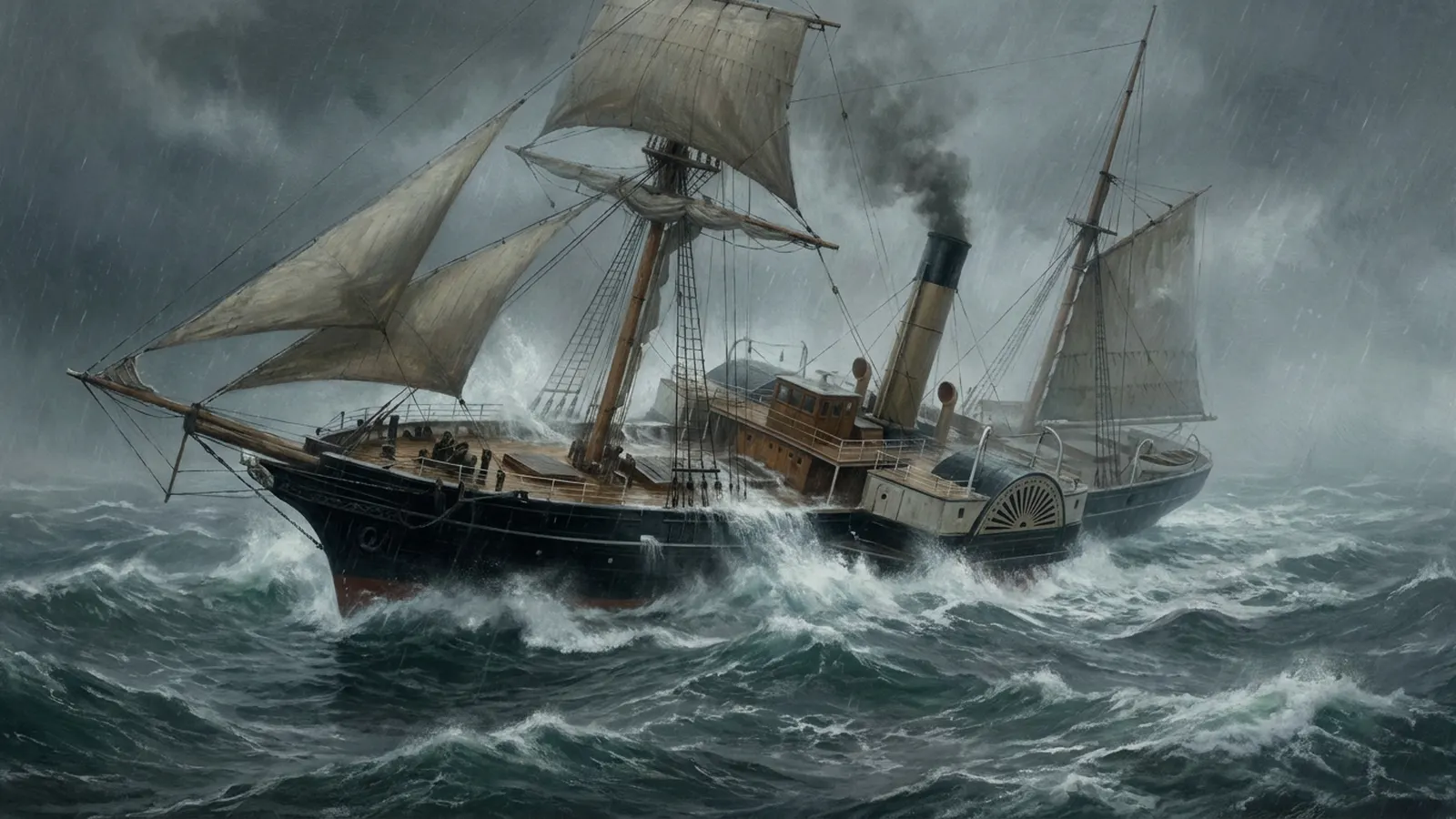
On September 9 the ship ran into a hurricane off the Carolinas, estimated as a Category 2 storm. By September 11, winds of about 105 mph and heavy seas had shredded her sails and she was taking on water. A leak around one of the seals where a paddle-wheel shaft passed through the hull let in more water than the pumps could handle, and the ship, which had no watertight bulkheads, began to settle by the stern. At noon the boiler fires failed. With no steam, the bilge pumps stopped and the paddle wheels could no longer hold her head to the wind. The crew flew the flag upside down as a distress signal, but no ship appeared.
Passengers and crew formed a bucket brigade and bailed through the night. In the calm of the hurricane’s eye they tried to relight the boiler, without success, and then the second half of the storm struck. On the morning of September 12 two ships came in sight, including the brig Marine. Lifeboats carried about 100 people across, mostly women and children; Herndon’s biographers credit him with ensuring the rescue of 152 women and children. Wind and sea then drove the two ships apart, and men on Central America broke up woodwork to use as floats. She sank at about 8 p.m.
The Norwegian bark Ellen later pulled about 50 survivors from the water, and three more were found alive in a drifting lifeboat more than a week after the sinking. Survivors said they last saw Herndon in full uniform by the wheelhouse, hat in hand and head bowed, as the ship lurched and went down. Newspapers called the loss of life appalling and without parallel among American shipping disasters.
Who was Commander William Lewis Herndon?
Herndon was born in Fredericksburg, Virginia, in 1813 and became a midshipman in 1828. From 1842 to 1846 he worked at the US Naval Observatory’s Depot of Charts and Instruments with his cousin and brother-in-law Matthew Fontaine Maury, the pioneer of ocean wind and current charts. In 1851 the Navy sent him to survey the commercial potential of the Amazon basin. Leaving Lima in May 1851 with Lieutenant Lardner Gibbon and five other men, he crossed the Andes and followed the river to Pará in Brazil, which he reached in April 1852 after a journey of 4,366 miles. His report, Exploration of the Valley of the Amazon, was published by the Navy in 1854 and widely read.
His death made him a national hero. Fellow officers raised the Herndon Monument at the US Naval Academy in Annapolis in 1860; two Navy ships and the town of Herndon, Virginia, carry his name; and his daughter Ellen married Chester A. Arthur, later the 21st president, two years after the sinking. The ship’s 268 lb bell, about 2 ft tall, was raised in 1988, given to the Academy in 2021 and dedicated beside the Herndon Monument on May 23, 2022.
Did the SS Central America cause the Panic of 1857?
It contributed, but it did not start it. The early 1850s boom had been fed by California gold expanding the money supply, and by the mid-1850s gold output was falling while railroad and land speculation ran ahead of real assets. On August 24, 1857, more than two weeks before the ship sank, the Ohio Life Insurance and Trust Company suspended payments at its New York branch, exposing fraud and setting off the panic. Telegraph lines spread the news faster than in any earlier American crisis.
The loss of the Central America in September came as New York banks were waiting for a badly needed shipment of gold, and her cargo, valued at about $8 million in 1857 money, never arrived. That deepened the run on confidence. Railroads failed, hundreds of thousands of workers were laid off, and the crisis jumped the Atlantic: banks in Liverpool and Glasgow failed in October and November, and the British government had to suspend the Bank Charter Act. The North recovered slowly, while the largely agricultural South, with few railroads, suffered little.
How was the wreck found?
By statistics as much as by sonar. Tommy Thompson formed the Columbus-America Discovery Group and used Bayesian search theory, the method that had been used to find the lost submarine USS Scorpion and the hydrogen bomb lost off Palomares, Spain, in 1966. The idea is to turn every clue, such as the ship’s last reported positions, the testimony of survivors and rescuers, the winds and the currents, into a probability map divided into cells. Searchers look first in the most likely cells. If a cell is searched and nothing is found, Bayes’ theorem lowers its probability and raises everyone else’s, so the map keeps improving as the search goes on. A cell with a prior probability p of holding the wreck, searched with detection probability q without result, drops to p(1−q)/(1−pq). The method also lets backers see in advance what a given number of days at sea is likely to buy.
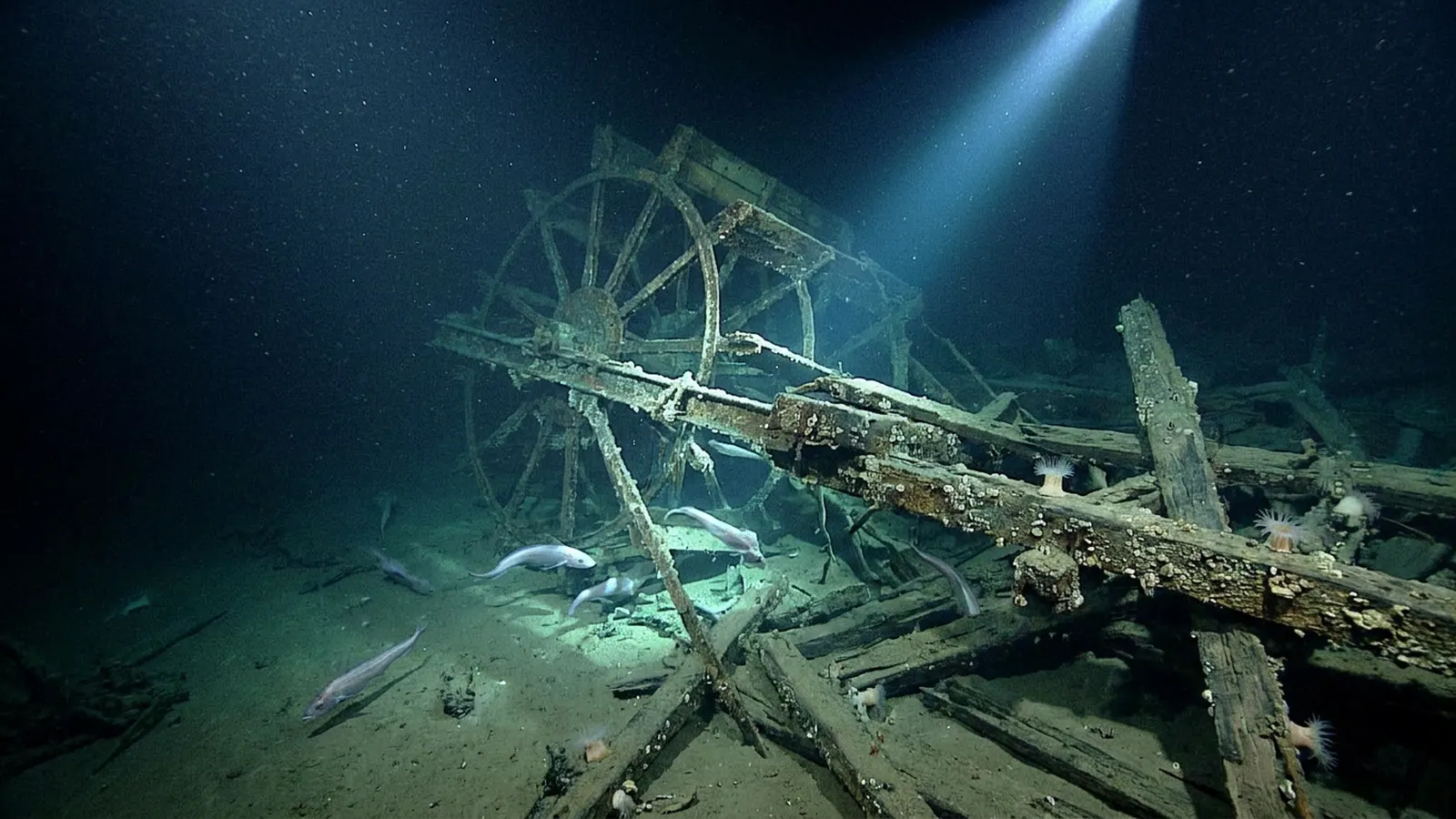
Surveys of the high-probability area found the wreck, and on September 11, 1988, a remotely operated vehicle reached it. The wreck lay at about 2,200 m, too deep for divers, so the team built a second, purpose-made recovery ROV, named Nemo, operated from the ship Arctic Discoverer. Over the next three years it lifted gold bars, coins and nuggets along with fragile artifacts, including a daguerreotype portrait of a young woman. Estimates of the value of the gold recovered ran from $100 million to $150 million. An 80 lb (36 kg) gold ingot later sold for a record $8 million, at the time described as the most valuable piece of currency in the world. Interest in the wreck may originally have been encouraged by Harry John, an heir to the Miller Brewing fortune who funded haphazard treasure hunts late in his life.

Who owned the gold?
The finders, mostly, after a long fight. Thirty-nine insurance companies, or their successors, sued for the treasure, arguing that because they had paid claims on the lost gold in the 1850s it belonged to them. The discovery group argued that the gold had been abandoned. In 1996 the courts awarded 92 percent of the recovered gold to the finders. In 2000 the gold was sold for about $50 million to $52 million.
The money then became the problem. About $22 million was invested in the venture in total, from backers including the Dispatch Printing Company, which had put up $1 million. Investors who had provided $12.5 million sued Thompson in 2005, saying they had seen no return, and members of his crew sued in 2006. Thompson said most of the sale proceeds had gone on legal fees and bank loans. In 2009 he held an offshore account in the Cook Islands worth $4.16 million.
What happened to Tommy Thompson?
He became a fugitive. In 2012 a federal judge in Ohio issued an arrest warrant when Thompson failed to appear in court, and he disappeared. US Marshals found him in January 2015 at a hotel in West Palm Beach, Florida, with his companion Alison Antekeier. In April 2015 he pleaded guilty to failing to appear and was sentenced to two years in prison and a $250,000 fine. His plea deal required him to answer questions about around 500 gold coins minted from the ship’s gold, then valued at about $2.5 million. He said they had gone to a trust in Belize and that he could not remember where the gold was.
From December 2015 he was held indefinitely for civil contempt. Federal law normally caps contempt confinement at 18 months, but in 2019 an appeals court ruled that the cap did not apply because his refusal also breached his plea agreement. In November 2018 a jury awarded the investors $19.4 million in damages, $3.2 million to the Dispatch Printing Company and $16.2 million to a court-appointed receiver for the rest. The judge eventually ended the contempt sentence and imposed a two-year term for the missed 2012 hearing, and Thompson, then 73, was released in March 2026 after about a decade behind bars. The coins have never been found.
What has been recovered since 2014?
The first expedition worked on only about 5 percent of the site. In March 2014 the court-appointed receiver gave Odyssey Marine Exploration a contract to carry out archaeological recovery and conservation of the rest. On a reconnaissance dive on April 15, 2014, the company’s ROV Zeus brought up more than 60 lb (27 kg) of treasure in two hours, including five gold bars and two gold coins, one minted in Philadelphia in 1850 and one in San Francisco in 1857. Bob Evans, quoted by Live Science, said the dive confirmed the site had not been disturbed since 1991.
By the end of that season Odyssey reported more than 15,500 gold and silver coins and 45 gold bars, many of them freshly minted $20 double eagles. The cold, dark water had also preserved the belongings of the passengers: bracelets, buckles and brooches, glass stemware and perfume bottles, photographic plates, the remains of a music box, clay pipes and chewing tobacco still in its package. Under its contract Odyssey was to receive 80 percent of recovery proceeds until its fees and agreed expenses were paid, and 45 percent after that. Pieces have continued to reach the market; in 2019 a single 174.04 oz (4.93 kg) ingot from the assayers Harris, Marchand & Co. sold at auction for $528,000.
Why does the SS Central America matter?
It is a time capsule of the Gold Rush, preserving coins, assay bars, letters and personal belongings of people returning from California at the moment the boom was ending. It is also a landmark in two other fields. In ocean search, it showed that a probability-driven search could find a small target on the deep seafloor on a private budget. In admiralty law, the ownership fight became a reference case on abandonment and salvage rights, alongside other treasure disputes such as the Atocha. Compare the Civil War-era gold wreck of the SS Republic, or browse shipwreck treasure for the other great recoveries.
Why is the SS Central America called the Ship of Gold?
It carried an estimated 10 to 15 short tons of California gold, valued at about $8 million in 1857, when it sank.
When and where did the SS Central America sink?
At about 8 p.m. on September 12, 1857, in a hurricane off the Carolinas; the wreck lies about 160 miles off South Carolina at about 2,200 m.
How many people died on the SS Central America?
About 425 of roughly 575 aboard. About 100 were transferred to the brig Marine, about 50 were rescued by the bark Ellen and three were found in a lifeboat a week later.
Who found the SS Central America?
Tommy Thompson’s Columbus-America Discovery Group, using Bayesian search theory; an ROV first reached the wreck on September 11, 1988.
Did the SS Central America cause the Panic of 1857?
It deepened it. The panic began with the failure of Ohio Life Insurance and Trust in August 1857; the lost gold then hurt New York banks already under strain.
What happened to Tommy Thompson?
He went into hiding in 2012, was arrested in Florida in 2015, was jailed for about a decade for refusing to account for about 500 gold coins, and was released in March 2026.
Who got the gold?
In 1996 courts awarded 92 percent to the finders over 39 insurers’ claims. The gold was sold in 2000 for about $50 million.
Is there still treasure on the wreck?
The first campaign excavated only about 5 percent. Odyssey Marine Exploration recovered more than 15,500 coins and 45 gold bars in 2014.
- Wikipedia (kiwix mirror): SS Central America; William Lewis Herndon; Panic of 1857; Panama Canal Railway; Bayesian search theory; Tommy Gregory Thompson.
- Live Science (2014). Gold rush shipwreck: depth 7,200 ft, 160 miles offshore, 43 round trips, ROV Zeus dive of April 15, 2014.
- NBC News (2014). Salvagers tally up treasures from sunken ‘Ship of Gold’: 15,500 coins, 45 gold bars, artifact list, Odyssey contract terms.
- Associated Press via WTOP (March 2026). ‘Ship of Gold’ treasure hunter released from prison, but 500 gold coins remain unaccounted for.
- Herndon, W.L. & Gibbon, L. (1854). Exploration of the Valley of the Amazon. US Navy.
- Kinder, G. (1998). Ship of Gold in the Deep Blue Sea; Thompson, T. (1998). America’s Lost Treasure.
Blane Perun has been exploring Earth’s oceans and marine life for over 25 years. Founder of TheSea.Org in 1999, underwater photographer, coral aquaculture pioneer, and explorer of 80+ countries.
About Blane Perun →