How Big Is a Great White Shark? — Average vs Record Size
An adult great white shark is usually 3.4 to 4.9 metres (11 to 16 feet) long. Females are the bigger sex: males average 3.4 to 4.0 m and females 4.6 to 4.9 m. Pups are born roughly 1.1 to 1.65 m long, and the largest females have been verified at about 6 m (20 ft), with a museum specimen in Lausanne measuring 5.83 m. Reports of 7, 9 or 11-metre great whites have not survived scientific scrutiny, though a few 6.5 to 7 m claims cannot be ruled out.
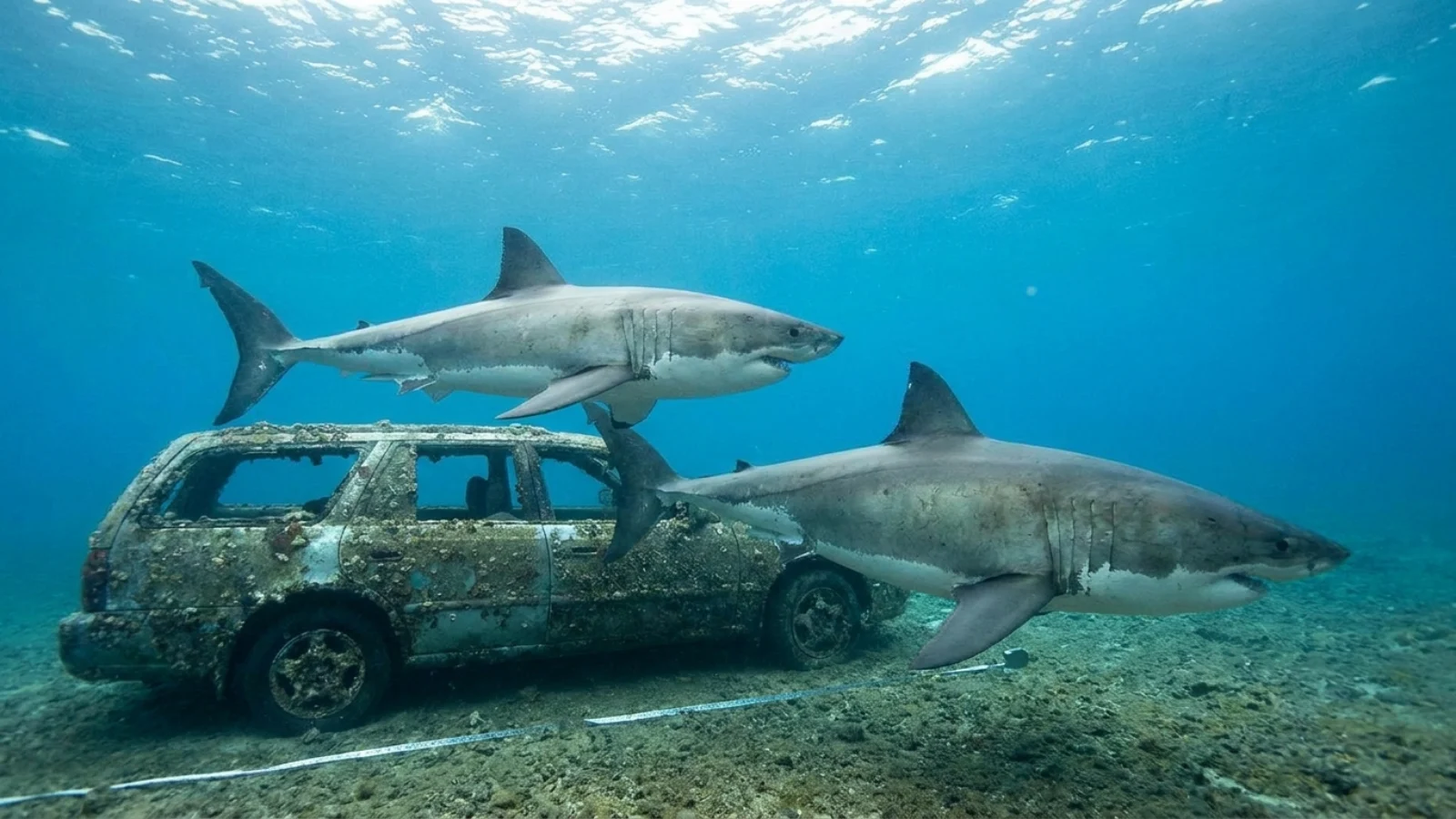
A big great white is about as long as a family car and can outweigh it, but the 10-metre monsters of legend do not exist.
How big is a great white shark?
The great white shark, Carcharodon carcharias, is the largest predatory fish alive today. Bigger fish exist, the whale shark and the basking shark, but both feed on plankton. Among sharks that hunt large prey, nothing living matches a full-grown great white for bulk.
Most adults are smaller than people imagine. Male great whites typically measure 3.4 to 4.0 metres (11 to 13 feet) and females 4.6 to 4.9 metres (15 to 16 feet). That is long, but not monstrous: a typical adult female is roughly the length of a mid-sized car. What makes great whites seem so enormous is their girth. Unlike slim requiem sharks, a great white has a deep, spindle-shaped body that is very thick through the middle, so a 4.5-metre animal carries far more mass than its length suggests.
The upper end of the range is debated, but the scientific consensus is that the largest females reach about 6 metres (20 feet). Anything much beyond that sits in the category of claims rather than confirmed measurements, which we look at below and in more detail in our guide to the biggest great white sharks ever recorded.
Why are female great whites bigger than males?
Great whites show clear sexual dimorphism in size, and females are the larger sex. This is common in sharks, and the usual explanation is reproduction. A female great white carries her developing young inside her body for many months, and those young are large at birth. A bigger body means more room for pups and more energy reserves to support them, so selection favours females that keep growing.
Size also shapes social life. Observations at seal colonies in South Africa have shown that great whites sort themselves into a dominance hierarchy based on size, sex and what researchers call squatter’s rights: females dominate males, larger sharks dominate smaller ones, and residents dominate newcomers. Being big is not only about catching prey, but about holding a position at the feeding grounds.
How big are great white sharks at birth?
Birth has never been observed in great white sharks, but pregnant females have been examined, and the size of newborns has been estimated from those animals and from the smallest free-swimming juveniles. A Canadian status report by the Committee on the Status of Endangered Wildlife in Canada (COSEWIC) gives a length at birth of 1.09 to 1.65 metres, citing the shark specialist Leonard Compagno. Litters range from two to ten pups, possibly up to 17, with an average of about seven.
In other words, a great white is born longer than many adult sharks of other species. That head start matters, because the pups are on their own from the moment they are born. They are already capable predators of fish, and their size protects them from many potential predators in the coastal nursery areas where they spend their first years.
How fast do great white sharks grow?
Much more slowly than scientists used to think. For decades, growth and maturity were estimated by counting the paired bands in a shark’s vertebrae, much like tree rings, on the assumption that each pair marked one year. In 2015, Lisa Natanson of NOAA and Gregory Skomal of the Massachusetts Division of Marine Fisheries published a study in Marine and Freshwater Research based on vertebrae from 81 white sharks collected in the western North Atlantic between 1963 and 2010. They checked the band counts against bomb radiocarbon, a chemical time-marker left in the oceans by nuclear weapons tests in the 1950s and 1960s, and found that the counts were reliable only up to about 44 years. Their conclusion was blunt: white sharks grow more slowly and live longer than previously thought.
The practical result was a new estimate of when great whites become adults. According to the study, males reach sexual maturity at about 26 years of age and females at about 33. Earlier estimates had put maturity at 4 to 10 years for males and 7 to 13 years for females. Older length-based figures, summarized by COSEWIC, put male maturity at 3.5 to 4.1 metres and female maturity at 4 to 5 metres. Put the two together and the picture is of a shark that spends decades growing into its adult size, which is one reason great whites are so vulnerable to overfishing. For more on how long they live, see our page on how long sharks live.
When does a great white become big enough to hunt seals?
Size controls diet. Juvenile great whites feed mainly on fish, including rays and other sharks, because their jaws are not yet strong enough to handle the forces involved in attacking seals, sea lions or dolphins. Reference accounts put the shift at around 3 metres in length. Before that point, a young great white simply is not built to tackle a large, struggling mammal.
Once they pass that threshold, the diet broadens dramatically. In the northwest Atlantic, mature great whites feed on harbour and grey seals, while juveniles in the same area stay with smaller fish until they are large enough to switch. Whale carcasses become important too: one estimate suggests that 30 kilograms of whale blubber could fuel a 4.5-metre great white for a month and a half. In 2020, marine biologists Sasha Dines and Enrico Gennari described a group of great whites in South Africa attacking and killing a live juvenile humpback whale about 7 metres long, a reminder of what several large sharks can do together. Our page on the great white shark diet covers what they eat at each life stage.
How do scientists measure a great white shark?
Measuring a living great white is surprisingly difficult. Most historical records come from dead sharks, landed by fishermen or caught in beach nets, and even those can be measured in different ways. The standard measurement is total length, from the tip of the snout to the tip of the tail, but the tail can be measured in its natural position or pressed down in line with the body, which adds length. Old records often do not say which method was used.
Free-swimming sharks have traditionally been estimated by eye, by comparison with a boat or a cage of known size, or from photographs. All of these methods are prone to exaggeration, and divers in particular tend to overestimate the size of a large animal close to them. That is why scientists treat sighting-based size claims with caution.
Newer methods are far more precise. Researchers now use paired underwater cameras, lasers projected onto the shark’s flank and drones flying overhead. A 2026 study in PLOS ONE by DiGiacomo, Andrzejaczek and Block used drone imagery analysed with deep learning to measure white sharks remotely in Monterey Bay National Marine Sanctuary, extracting each shark’s total length and body condition. The data showed that the sharks form size-structured aggregations linked to ocean conditions, with parts of Monterey Bay acting as transitional zones as young sharks grow. Methods like these mean future size records will be based on calibrated measurements rather than guesswork.
How big is the biggest great white shark?
The largest great whites have been verified at about 6 metres (20 feet) in length and an estimated 1,900 kilograms or more. The largest preserved specimen, a complete female held by the Museum of Zoology in Lausanne, Switzerland, measured 5.83 metres with the tail lowered and is estimated to have weighed about 2,000 kilograms. The ichthyologist John E. Randall considered a 5.94-metre shark from Ledge Point, Western Australia, reported in 1987, to be the largest reliably measured, although it is not clear how its tail was positioned.
A few larger animals remain unresolved. In 1987, a great white caught near Kangaroo Island, South Australia, was estimated at more than 6.9 metres, and another caught off Malta the same month was estimated at about 7.13 metres. Other researchers, applying Randall’s methods, suggested smaller sizes, but a 1996 review by Mollet, Cailliet, Klimley, Ebert, Testi and Compagno re-examined the remains and photographs and concluded that the original estimates were reasonable and could not be ruled out. Famous individual sharks such as Deep Blue, filmed off Guadalupe Island and later off Oahu, are estimated at around 6 metres. Our page on the biggest great white shark goes through each of these cases.
Why do so many record claims turn out to be wrong?
For much of the twentieth century, reference books listed two monsters as the largest great whites: a 10.9-metre shark said to have been caught near Port Fairy in southern Australia in the 1870s, and an 11.3-metre animal trapped in a herring weir in New Brunswick, Canada, in the 1930s. Neither holds up. In the 1970s, Randall examined the jaws of the Port Fairy shark and concluded that it was of the order of 5 metres long, suggesting a mistake in the original record. The New Brunswick shark may well have been a misidentified basking shark, a species with a similar body shape that genuinely does reach those lengths.
Another famous case, a shark caught off Cojímar, Cuba, in 1945 and reported as 6.4 metres long and more than 3,000 kilograms, was once accepted by some experts. Later studies placed it within the normal maximum range, at about 4.9 metres. Again and again, the pattern is the same: the biggest numbers come from the oldest, least documented records, and they shrink when someone checks the jaws, teeth or photographs.
None of this means a 6.5-metre great white is impossible. The species is widespread, many large animals are never measured, and Randall himself believed great whites may exceed 6.1 metres. But the burden of proof is high, and so far nothing above about 6 metres has been measured to modern scientific standards.
How does a great white compare with other big sharks?
The great white is not the longest shark. The whale shark and basking shark both grow far longer, but they are filter feeders with tiny teeth. Among the predatory sharks, the closest rival is the tiger shark, which has been confirmed to reach at least 5.5 metres, though it is usually a little shorter and much leaner than a great white of the same length. The Greenland shark and the Pacific sleeper shark are also reported to approach great white lengths, but they are slow, cold-water animals with very different bodies.
The great white’s only recorded natural predator, the orca, is bigger still. Adult orcas are larger and heavier than even the biggest great whites, and orcas have killed great whites off South Australia and, almost certainly, South Africa, where carcasses washed ashore near Gansbaai in 2017 with their livers removed. Off California’s Farallon Islands, even brief visits by orcas send the sharks away from their feeding grounds for the rest of the season. And of course the great white is dwarfed by its extinct relative-in-popular-imagination, megalodon, which some estimates put at up to 14 to 20 metres. Our megalodon vs great white comparison shows the difference side by side.
How heavy is a great white shark?
Length and weight go together, but weight rises much faster than length, because a longer shark is also deeper and wider. Reference figures put average adult weight at around 520 to 770 kilograms, with mature females averaging roughly 680 to 1,110 kilograms. The largest verified females are estimated at about 1,900 kilograms and perhaps up to 2,270 kilograms. The heaviest great white recognised by the International Game Fish Association was caught by Alf Dean off southern Australia in 1959 and weighed 1,208 kilograms. Weight also varies with condition: a shark that has just fed on a whale carcass is much heavier than the same animal after a long migration. We cover the numbers in detail on our page about how much great white sharks weigh.
How big are great whites in captivity?
Great whites have proved almost impossible to keep in aquariums, so captive animals have always been small. Perhaps the most famous was Sandy, a 2.4-metre female housed at the Steinhart Aquarium in San Francisco in August 1980, who was released because she would not eat and kept bumping into the walls. One of the largest adults ever exhibited was a 3.5-metre male at Japan’s Okinawa Churaumi Aquarium in 2016, which died after three days. The cost, space and stress involved mean that seeing a full-sized great white almost always means seeing it in the wild.
So how big is a great white shark?
A newborn great white is about the length of an adult human, roughly 1.1 to 1.65 metres. It spends decades growing, with males maturing at about 3.5 to 4 metres and females at 4 to 5 metres. Typical adults measure 3.4 to 4 metres for males and 4.6 to 4.9 metres for females, and the largest verified females reach about 6 metres. Claims beyond that range are possible but unproven, and the famous 10-metre giants of old record books have all been cut down to size.
How big is an average great white shark?
Adult males average 3.4 to 4.0 m (11 to 13 ft) and females 4.6 to 4.9 m (15 to 16 ft).
How long is a great white shark at birth?
About 1.1 to 1.65 m, according to the Canadian COSEWIC status report.
What is the biggest great white shark ever measured?
Verified females reach about 6 m (20 ft); a preserved Lausanne specimen measures 5.83 m.
Are female great whites bigger than males?
Yes. Females are the larger sex, probably because a bigger body supports large pups.
How old is a great white when it is fully grown?
Males mature at about 26 years and females at about 33, according to a 2015 study.
Can great whites grow to 30 feet?
No reliable record supports it. Old 10 to 11 m claims were mistakes or misidentified basking sharks.
How do scientists measure great whites?
From landed sharks, and now from lasers, stereo cameras and drones that measure free-swimming animals.
Is a great white bigger than a tiger shark?
Usually. Tiger sharks reach at least 5.5 m but are leaner; great whites are bulkier and slightly longer.
- Natanson, L.J. & Skomal, G.B. (2015), “Age and growth of the white shark, Carcharodon carcharias, in the western North Atlantic Ocean”, Marine and Freshwater Research.
- COSEWIC, White shark (Carcharodon carcharias) assessment and status report, chapter 6: biology, Government of Canada.
- DiGiacomo, A.E., Andrzejaczek, S. & Block, B.A. (2026), “Ontogenetic shifts in morphology and ecology of eastern Pacific white sharks revealed by computer vision”, PLOS ONE.
- Mollet, H.F., Cailliet, G.M., Klimley, A.P., Ebert, D.A., Testi, A.D. & Compagno, L.J.V. (1996), review of length estimates of the KANGA and MALTA white sharks, in Great White Sharks: The Biology of Carcharodon carcharias.
Blane Perun has been exploring Earth’s oceans and marine life for over 25 years. Founder of TheSea.Org in 1999, underwater photographer, coral aquaculture pioneer, and explorer of 80+ countries.
About Blane Perun →