What Is the Most Aggressive Shark? — Ranked by Real Attack Records
By the attack record, the great white shark is the most dangerous shark to people, followed by the tiger shark and the bull shark. The International Shark Attack File (ISAF) lists 351 confirmed unprovoked bites by white sharks, 59 of them fatal, against 142 (39 fatal) for tiger sharks and 119 (26 fatal) for bull sharks. These “Big Three” are large, live where people swim and have cutting teeth. Many biologists consider the bull shark the most aggressive in temperament, and the oceanic whitetip was called “the most dangerous of all sharks” by Jacques Cousteau because of its record around shipwrecks.
The great white bites people most often, but bites are rare, most are not attempts to eat anyone, and most of the 500-plus shark species have never been linked to a single attack.
What is the most aggressive shark?
If you mean the shark most likely to seriously injure or kill a person, the record points clearly to the great white shark. The International Shark Attack File, the global database of shark bites maintained by the Florida Museum of Natural History at the University of Florida, lists more confirmed unprovoked bites by white sharks than by any other species: 351 in its species table, 59 of them fatal. The tiger shark comes second with 142 confirmed unprovoked bites and 39 deaths, and the bull shark third with 119 bites and 26 deaths. These three are known as the Big Three, and together they account for the large majority of fatal unprovoked bites on record.
But “aggressive” and “dangerous” are not the same thing. A shark can be dangerous because it is big and powerful and lives near popular beaches, even if it rarely bites. A shark can also be pushy and bold around divers and boats without having much of a record against people. When people ask which shark is the most aggressive, they usually want a mix of both: which shark is the most likely to bite, and which is the most likely to cause serious harm when it does. This page uses the attack record as the backbone, then looks at temperament, behaviour and context.
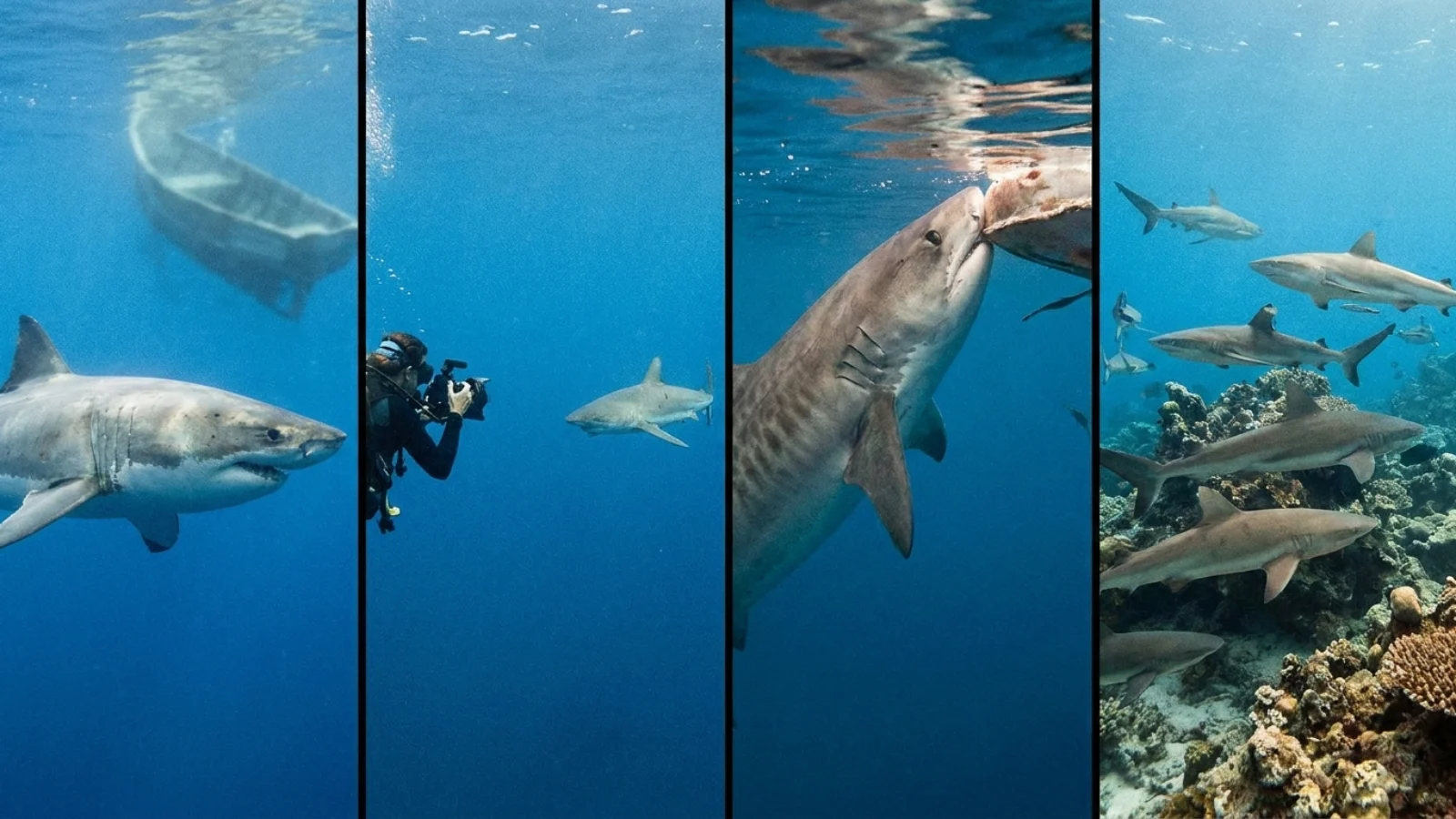
The attack record, species by species
The ISAF species table covers confirmed unprovoked bites from 1580 to the present and includes more than 35 species. Here are the main species it lists, with non-fatal and fatal unprovoked incidents.
| Species | Non-fatal | Fatal | Total |
|---|---|---|---|
| — | — | — | — |
| White shark | 292 | 59 | 351 |
| Tiger shark | 103 | 39 | 142 |
| Bull shark | 93 | 26 | 119 |
| Requiem sharks (Carcharhinus, unidentified) | 46 | 5 | 51 |
| Sand tiger | 36 | 0 | 36 |
| Blacktip | 35 | 0 | 35 |
| Wobbegongs | 31 | 0 | 31 |
| Hammerheads | 18 | 0 | 18 |
| Spinner | 16 | 0 | 16 |
| Oceanic whitetip | 12 | 3 | 15 |
| Blue shark | 9 | 4 | 13 |
| Shortfin mako | 9 | 1 | 10 |
| Lemon | 10 | 0 | 10 |
| Nurse | 9 | 0 | 9 |
Two patterns jump out. The first is how concentrated the deaths are: the white, tiger and bull sharks between them account for 124 of the 142 fatal incidents in the table. The second is that several species with a fearsome image, including hammerheads, sand tigers and lemon sharks, have never been linked to a confirmed fatal unprovoked bite. The total for all species listed is 949 confirmed unprovoked bites, 142 of them fatal, spread over more than four centuries.
Why the Big Three top the list
The ISAF itself gives three reasons why white, tiger and bull sharks dominate the record. They are large enough to cause serious injury. They often live in places where people go into the water. And they have teeth that shear rather than simply grip, so a single bite can do enormous damage. The museum also notes that most sharks longer than about 1.8 metres, or six feet, are capable of injuring a person, even when a bite is not a deliberate attempt to feed.
Each of the Big Three reaches people in a different way. White sharks hunt seals and sea lions along cool, temperate coasts, which are also prime surfing coasts in California, South Africa and southern Australia. Tiger sharks roam warm tropical and subtropical waters, including island coasts with steep drop-offs close to shore. Bull sharks thrive in warm, shallow, murky water near river mouths, harbours and estuaries, and they can travel far up rivers into fresh water. Each species overlaps with a different kind of human activity, and the attack record reflects that overlap as much as any difference in temperament.
The great white: the most dangerous shark by the numbers
The great white heads the list, and its record is concentrated in a handful of regions: California and Oregon, southern and western Australia, South Africa and, increasingly, the northwest Atlantic, where seal populations and white sharks have both recovered. In the ISAF’s 2025 worldwide summary, most of the year’s fatalities were attributed to white sharks, three in Australia and one in California.
Most great white bites on people look less like feeding than like investigation. A common pattern is a single powerful bite, often on a surfer at the surface, after which the shark lets go and does not return. One long-standing explanation is mistaken identity: from below, a swimmer or a person paddling a surfboard looks rather like a seal. A 2021 study in the Journal of the Royal Society Interface by Laura Ryan and colleagues tested this by processing video of seals, swimmers and surfers to match what a white shark’s retina would detect. Neither the motion cues nor the shapes differed significantly, which supports the idea that young white sharks in particular cannot easily tell the difference. Our great white size guide explains why a single bite from such a big animal is so dangerous.
The tiger shark: the generalist
Tiger sharks are among the least fussy predators in the sea. They eat fish, rays, sea turtles, seabirds, marine mammals and carrion, and their stomachs have yielded a famous collection of inedible objects. Their teeth, with sideways-pointing tips and heavy serrations, are built to cut through hard-shelled prey such as turtles. That combination of a broad diet, a big body and slicing teeth makes them dangerous when they do bite. The ISAF’s figure of 39 deaths from 142 bites gives the tiger shark one of the highest fatality rates of any species with a substantial record.
Tiger sharks are the main species of concern in Hawaii and in much of the tropical Pacific and Indian Ocean. We look at whether they deserve their reputation in our page asking are tiger sharks aggressive?, and compare them with the white shark in tiger shark vs great white.
The bull shark: the most aggressive temperament?
Many shark biologists and divers would nominate the bull shark if the question is about temperament rather than raw numbers. Its common name is said to come from its stocky shape, broad flat snout and unpredictable behaviour. It is the species most likely to be found in very shallow, murky water close to people, and it can live for long periods in fresh water, turning up in rivers and lakes far from the sea. One or more bull sharks may have been responsible for the Jersey Shore attacks of 1916, which helped inspire Peter Benchley’s novel Jaws.
The bull shark’s record of 119 confirmed unprovoked bites is probably an undercount. Bull sharks are requiem sharks, members of the genus Carcharhinus, and the ISAF warns that requiem sharks are hard to identify during an attack, so many of their bites are not attributed to the right species. Bull sharks are also often said to have unusually high testosterone levels, a claim we examine on our page about bull shark testosterone levels.
The oceanic whitetip: the shipwreck shark
On paper, the oceanic whitetip looks minor: just 15 confirmed unprovoked bites, three of them fatal. But this open-ocean shark has a reputation out of all proportion to its tally. Jacques Cousteau described it as “the most dangerous of all sharks”. It is slow-moving but bold, opportunistic and persistent, and it lives far from shore, where it rarely meets swimmers but readily meets people in the water after ships sink or aircraft come down.
That is where its reputation comes from. After the cruiser USS Indianapolis was torpedoed on 30 July 1945, survivors spent days in the water before being spotted on the fifth day, and according to survivor accounts sharks killed some of the crew, possibly many. During the same war, the steamship RMS Nova Scotia, carrying about 1,000 people, was sunk by a German submarine off South Africa, and sharks were again blamed for some deaths. Incidents like these are rarely recorded as individual confirmed bites, which helps explain why the whitetip’s ISAF count is so low. In 2010, a single oceanic whitetip was implicated in a series of bites on tourists in the Red Sea near Sharm El Sheikh, Egypt, which caused one death and four injuries. The species is now critically endangered after heavy fishing for its fins, and divers who meet it in places like the Red Sea and the Bahamas are advised to stay alert and keep it in view.
The surprising cases: blue sharks, makos and wobbegongs
A few species stand out once you look at fatality rates rather than totals. The blue shark has only 13 confirmed unprovoked bites, but four were fatal, a strikingly high proportion. Like the oceanic whitetip, the blue shark lives in the open ocean, and many of its incidents probably involved people in the water after accidents at sea, when help was far away. The shortfin mako, one of the fastest sharks, has 10 confirmed unprovoked bites and one death; it is better known for leaping out of the water when hooked, and any bite during capture counts as provoked.
At the other end of the scale are the wobbegongs, flattened carpet sharks of Australian reefs, with 31 bites and no deaths. Wobbegongs lie camouflaged on the bottom and bite when stepped on or handled, and they can hang on tenaciously, but they are not equipped to kill a person. Nurse sharks follow a similar pattern: almost all nurse shark bites happen when people grab, feed or harass a shark resting on the bottom.
Why the numbers can mislead
The ISAF itself stresses that identifying the shark in an attack is very difficult. Victims rarely get a clear look, and tooth fragments are seldom left in wounds. Easily recognised species such as white, tiger, sand tiger, hammerhead and nurse sharks are usually identified correctly, but the many similar-looking requiem sharks are not. The result is a list skewed toward species that are easy to name. If all requiem shark bites were correctly assigned, species such as the bull shark and the blacktip would probably rank higher, and sand tigers, hammerheads and nurse sharks would drop.
The record also depends on where people are. Florida typically records more shark bites than any other US state, though its 11 bites in 2025 were below its five-year average of 19, and most are minor bites on the hands and feet of surfers and waders, usually attributed to small requiem sharks such as blacktips. The museum suspects that blacktips cause many of these, but notes that the evidence is not conclusive. A species can top the list in one region simply because it is common in the surf there. We look at the Florida numbers in detail in our page on shark attacks in Florida.
Is any shark truly aggressive toward people?
Aggression, in the sense of an animal deliberately setting out to attack a person, is extremely rare in sharks. Most bites fall into a few categories. Some are investigative or mistaken bites, where a shark tests an unfamiliar object and lets go. Some are defensive, when a shark is cornered, stepped on, grabbed or harassed. Some are competitive, when a shark is drawn by bait, speared fish or feeding activity and bites in the confusion. Truly predatory attacks on people, where a shark treats a human as prey, are the rarest of all, even for the Big Three.
Context matters. The ISAF’s 2025 summary recorded 65 confirmed unprovoked bites worldwide and nine unprovoked deaths, in line with recent averages, at a time when hundreds of millions of people swim, surf and dive every year. Of those 2025 incidents, 46 percent involved swimming or wading, 32 percent surfing and board sports and 15 percent snorkelling or free-diving. You can see how the totals change year to year in our page on how many shark attacks happen each year.
How to reduce your risk
The species most likely to bite share predictable habits, which makes some simple precautions effective. Avoid swimming at dawn, dusk and night, when many sharks feed most actively. Stay out of murky water, river mouths and channels after heavy rain, which are favoured by bull sharks. Do not swim near people fishing, near bait, or near seal colonies and feeding birds. Avoid shiny jewellery and high-contrast clothing, which can resemble the flash of fish scales. Swim in groups and close to shore, where help is near. And never grab, feed or corner a shark, which turns even a placid species like a nurse shark into a biter.
So which shark is the most aggressive?
By the record, the great white is the most dangerous shark to people, with the tiger and bull sharks close behind. By temperament, many experts would argue for the bull shark. By reputation in the open ocean, the oceanic whitetip has earned its place. But the most important number is the smallest one: across more than 500 shark species and billions of hours spent in the sea, only a handful of species have killed anyone, and a typical year sees fewer than ten unprovoked deaths worldwide.
What is the most aggressive shark?
By attack records, the great white, followed by the tiger and bull sharks. Many experts consider the bull shark the most aggressive in temperament.
Which shark has killed the most people?
The white shark, with 59 fatal unprovoked bites in the International Shark Attack File.
What are the Big Three sharks?
The white, tiger and bull sharks, which cause most fatal unprovoked bites.
Why was the oceanic whitetip called the most dangerous shark?
Jacques Cousteau called it that because of its boldness and its role in deaths after shipwrecks.
Are hammerhead sharks aggressive?
Rarely toward people. The ISAF lists 18 unprovoked hammerhead bites and no deaths.
Are bull sharks more aggressive than great whites?
Many experts think so in temperament, but great whites cause more recorded bites and deaths.
How many people do sharks kill each year?
In 2025 the ISAF confirmed nine unprovoked deaths; the recent five-year average is about eight.
Which sharks are harmless to humans?
Most species, including the whale shark and basking shark, have no record of unprovoked bites.
- International Shark Attack File, Florida Museum of Natural History, “Species implicated in attacks” (unprovoked, 1580 to present).
- International Shark Attack File (2026), “Yearly worldwide summary” for 2025, Florida Museum of Natural History.
- Ryan, L.A. et al. (2021), “A shark’s eye view: testing the ‘mistaken identity theory’ behind shark bites on humans”, Journal of the Royal Society Interface.
Blane Perun has been exploring Earth’s oceans and marine life for over 25 years. Founder of TheSea.Org in 1999, underwater photographer, coral aquaculture pioneer, and explorer of 80+ countries.
About Blane Perun →