Plankton — Phytoplankton vs Zooplankton Explained
Plankton are organisms that drift with the water because they cannot swim against a current. The word comes from the Greek planktos, “wanderer” or “drifter”. Plankton is a lifestyle, not a family tree: it includes bacteria, single-celled algae, crustaceans, fish larvae and even jellyfish several feet across. Scientists split them into phytoplankton, which photosynthesise like plants, and zooplankton, the drifting animals that eat them. Phytoplankton and other marine photosynthesisers produce roughly half of Earth’s oxygen (NOAA), and one microbe, Prochlorococcus, makes up to 20% of the oxygen in the biosphere.
Plankton
What is plankton, exactly?
Plankton is any organism that lives in open water and is carried by currents faster than it can swim. That covers microbes a fraction of a micrometre across and lion’s mane jellyfish several feet wide.
“Plankton” describes how something lives, not what it is related to. A copepod, a diatom and a moon jelly are wildly different organisms, but all are drifters. The opposite lifestyle is nekton: animals such as fish, squid, sharks and whales that can swim against currents. Animals living on the bottom are benthos.
Plankton are not necessarily tiny or helpless. Many zooplankton swim actively, and some migrate hundreds of metres a day. They simply cannot beat the horizontal flow of the sea. Most plankton are microscopic, though, and a single drop of seawater can hold thousands of them.
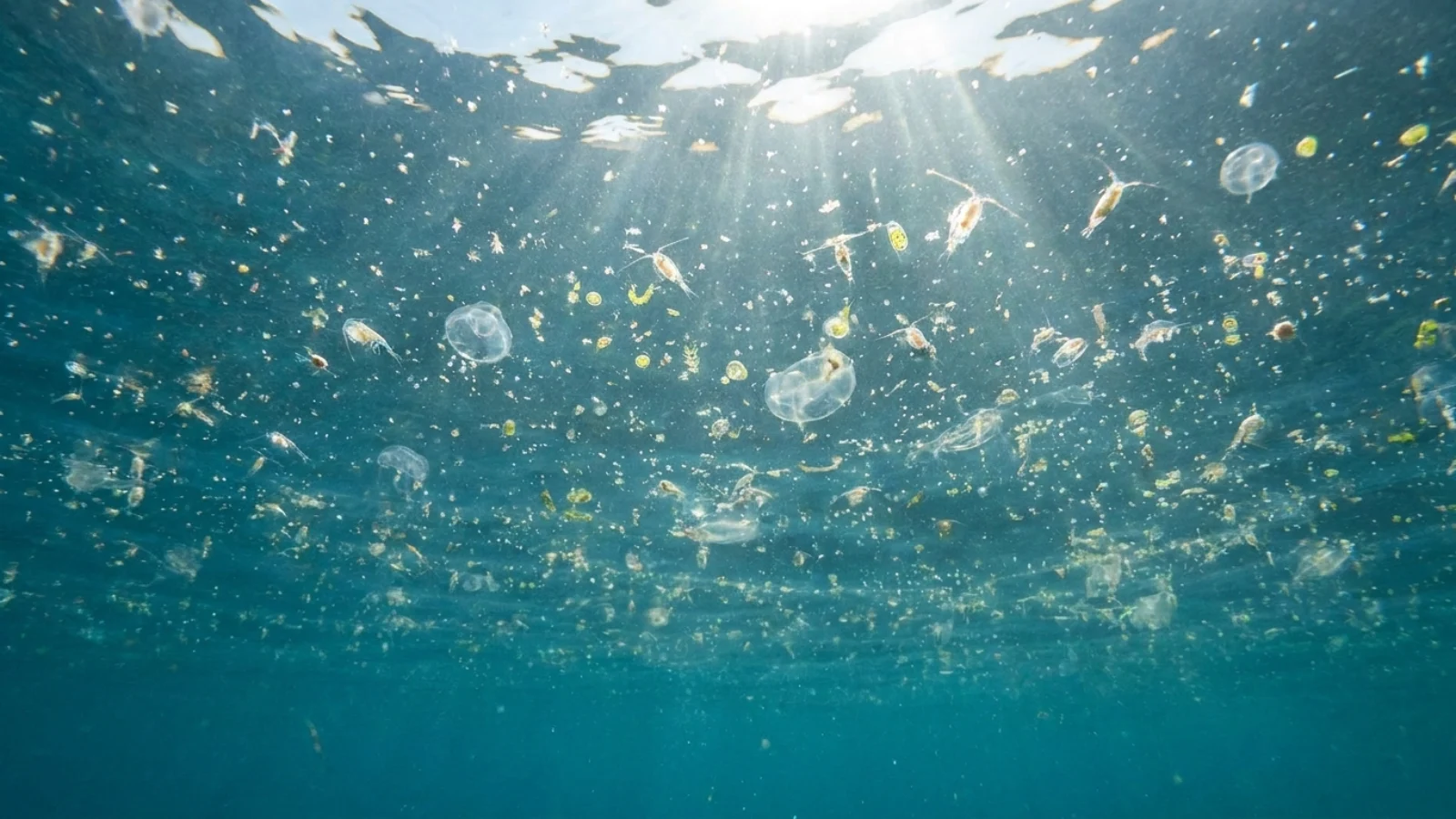
What is the difference between phytoplankton and zooplankton?
Phytoplankton make their own food from sunlight, like plants. Zooplankton are animals and animal-like drifters that must eat other organisms, starting with phytoplankton.
| Trait | Phytoplankton | Zooplankton |
|---|---|---|
| — | — | — |
| Energy source | Photosynthesis (sunlight + CO2) | Eat phytoplankton, other zooplankton, detritus |
| Examples | Diatoms, dinoflagellates, coccolithophores, cyanobacteria | Copepods, krill, larvae, jellies, salps |
| Where | Sunlit surface layer | Surface to the deep sea |
| Typical size | Mostly microscopic | Microscopic to several feet |
| Food web role | Primary producers | Grazers and predators, the link to fish and whales |
Phytoplankton need light, so they live in the sunlit upper layer. They range from cyanobacteria such as Prochlorococcus to glass-shelled diatoms, chalk-plated coccolithophores and dinoflagellates, some of which are bioluminescent and some of which cause red tides. In reef aquariums, live phytoplankton is dosed as food; see our phytoplankton for reef tanks guide.
Zooplankton include the most abundant animals on Earth. Copepods alone include more than 12,000 species, and Guinness World Records lists them as the most abundant animal type. Antarctic krill are estimated at about 379 million tonnes in total biomass (Atkinson et al. 2009).
How big are plankton? The size classes
Plankton span about seven orders of magnitude, from viruses under 0.2 µm to the largest jellyfish and siphonophores, which can stretch for metres. Scientists group them into size classes.
| Size class | Size range | Examples |
|---|---|---|
| — | — | — |
| Femtoplankton | < 0.2 µm | Marine viruses |
| Picoplankton | 0.2–2 µm | Bacteria, Prochlorococcus |
| Nanoplankton | 2–20 µm | Small flagellates, coccolithophores |
| Microplankton | 20–200 µm | Most diatoms and dinoflagellates |
| Mesoplankton | 0.2 mm–2 cm | Copepods, larvae |
| Macroplankton | 2–20 cm | Krill, arrow worms, small jellies |
| Megaplankton | 20–200 cm | Large jellyfish, salp chains |
The size-class boundaries come from the Bigelow Laboratory for Ocean Sciences. The biggest drifters push the definition: a lion’s mane jellyfish or a giant siphonophore is plankton because it cannot outswim a current, not because it is small.
Do plankton really make half of Earth’s oxygen?
Roughly. NOAA estimates that about half of Earth’s oxygen comes from the ocean, mostly from phytoplankton. The tiny cyanobacterium Prochlorococcus alone produces up to 20% of the oxygen in the biosphere.
There is a caveat that is usually left out. Marine life also consumes about the same amount of oxygen it produces, so the ocean’s net contribution to the air we breathe today is much smaller than its gross production. Our atmosphere’s oxygen built up over hundreds of millions of years. Still, without phytoplankton there would be no marine food web and far less carbon drawn down from the air. We cover this in more depth in the ocean as Earth’s oxygen source.
What are holoplankton and meroplankton?
Holoplankton drift for their whole lives. Meroplankton are only plankton for part of their life cycle, usually as eggs and larvae.
Copepods, krill, arrow worms, salps and many jellies are holoplankton. Meroplankton are the larvae of animals that later settle down or swim strongly: crabs, lobsters, oysters, sea urchins, corals and almost all bony fish. A blue crab or a grouper begins as a speck in the plankton. Our crab life cycle and crustacean larvae pages show how dramatic that change is.
That larval drift is how reef animals spread between islands. When a coral spawns, its larvae ride the currents for days to weeks before settling on new reef.
Why do plankton rise at night?
To feed in the rich surface water under cover of darkness, then sink before dawn to avoid predators that hunt by sight. This diel vertical migration is the largest routine migration of life on Earth.
The Woods Hole Oceanographic Institution estimates that about 10 billion tons of animals move up and down every day. Copepods, krill, salps, fish larvae, lanternfish and squid rise shortly before sunset, sometimes from more than 3,000 feet down, and begin sinking before sunrise. Even a passing cloud can shift deep zooplankton by up to 200 feet.
The migration is also a carbon pump. Zooplankton eat carbon-rich phytoplankton at the surface and carry it down when they descend, where it can stay locked away for hundreds to thousands of years. It is the main reason what eats plankton matters for the climate as well as for whales.
What are the main kinds of phytoplankton?
Four groups do most of the ocean’s photosynthesis, and each has a distinctive body plan.
Diatoms build their cell walls from silica, so each one lives inside a two-part glass box decorated with pores and ridges. They thrive in cool, nutrient-rich water and dominate the big spring blooms of temperate seas. Scientists estimate that diatoms carry out roughly a fifth of all photosynthesis on Earth. When they die, their glass shells can pile up on the seafloor and eventually form diatomaceous earth.
Coccolithophores cover themselves in tiny plates of calcium carbonate called coccoliths. The best-known species, Emiliania huxleyi, can bloom so densely that thousands of square miles of ocean turn milky white or turquoise, a sight easily visible from orbit. Over geological time, layers of coccoliths settled into chalk; the White Cliffs of Dover are made largely of them.
Dinoflagellates swim with two flagella and include both plant-like and predatory species, and some do both. They are responsible for most glowing seas and for many toxic blooms, and some live inside corals as the symbiotic algae that power reef growth.
Cyanobacteria are bacteria that photosynthesise. Prochlorococcus, the smallest known photosynthetic organism, was only identified in 1988 by Sallie Chisholm, Robert Olson and colleagues, even though it turned out to be among the most abundant living things on the planet. Its cousin Synechococcus is common in coastal water, and Trichodesmium forms long filaments that can pull nitrogen gas out of the water and turn it into fertiliser for the rest of the community.
What controls where phytoplankton grow?
Light and nutrients. Phytoplankton need sunlight, so they live in the upper layer of the sea, but they also need nitrogen, phosphorus, silica and trace metals that are usually richest in deeper water. The best places for plankton are where those two worlds meet.
Upwelling zones such as the coasts of Peru, California and northwest Africa bring cold, nutrient-laden water to the surface and support some of the richest fisheries on Earth. Temperate seas get a spring bloom when lengthening days warm the surface layer after winter storms have stirred nutrients up from below. In contrast, the middle of the great ocean gyres is clear and blue because the surface water is poor in nutrients, which makes these vast areas the marine equivalent of deserts.
Iron is the surprise ingredient. In parts of the Southern Ocean and the equatorial Pacific, nitrogen and phosphate are plentiful but phytoplankton stay scarce. In the late 1980s, oceanographer John Martin argued that a shortage of iron was holding them back, and later ship experiments that added iron to patches of sea did trigger blooms. Dust blown from deserts is one natural source of that iron.
How do satellites measure plankton from space?
Phytoplankton contain chlorophyll, which absorbs blue and red light and reflects green. Satellites measure the exact colour of the sea surface and convert it into estimates of chlorophyll, giving scientists a global picture of plant life in the ocean every few days.
Missions such as SeaWiFS, MODIS and VIIRS built a record of ocean colour spanning decades. NASA’s PACE satellite, launched on a Falcon 9 rocket on 8 February 2024, carries an Ocean Color Instrument that reads continuous wavelengths from the ultraviolet to the near-infrared. That finer colour detail lets scientists begin to tell different types of phytoplankton apart from orbit, and to watch harmful algal blooms as they form.
Satellites only see the upper layer of the sea, so their maps are checked against water samples and against robotic floats that carry their own light and chlorophyll sensors through the water column.
What role do marine viruses and bacteria play?
The smallest members of the plankton are also the most numerous. A single millilitre of seawater typically holds about a million bacteria and around ten times as many viruses, most of which infect bacteria and algae rather than anything larger.
Viruses act as a recycling service. When they burst a cell, its contents spill into the water as dissolved organic matter that bacteria then consume, releasing nutrients that phytoplankton can use again. Oceanographers call this the viral shunt, because it diverts carbon away from grazers and keeps it cycling near the surface.
Heterotrophic bacteria complete the loop. They feed on dissolved material leaked by plankton, and in turn are eaten by single-celled grazers, which are eaten by small zooplankton. This microbial loop moves a large share of the ocean’s carbon and nutrients long before a fish ever takes a bite.
How did plankton shape Earth’s history?
Photosynthetic microbes changed the planet long before animals existed. Cyanobacteria began releasing oxygen billions of years ago, and their activity eventually allowed oxygen to build up in the atmosphere, setting the stage for complex life.
Plankton also built rocks and fuels. Chalk and limestone are full of the shells of coccolithophores and foraminifera, diatomaceous earth comes from diatom skeletons, and much of the world’s oil and natural gas formed from plankton that sank into oxygen-poor seafloor mud and was buried and heated over millions of years. Geologists use the fossil shells of plankton to date rock layers and to reconstruct past ocean temperatures.
Are there plankton in lakes and rivers?
Yes. Freshwater has its own plankton, though the cast is different. Green algae, diatoms and cyanobacteria make up the phytoplankton of lakes and ponds, while water fleas, rotifers and freshwater copepods form much of the zooplankton.
Freshwater cyanobacteria cause the blue-green algae blooms that close lakes and canals in warm weather, and these blooms are unrelated to the marine dinoflagellates behind red tide. Lake plankton also follow seasons: many temperate lakes have a spring diatom bloom, a clear-water phase when grazers catch up, and a late-summer peak of cyanobacteria.
How can you study plankton at home or in class?
A simple plankton net made from fine fabric on a wire ring, a jar and a basic microscope are enough to start. Tow the net slowly from a dock or along the shore, then look at a drop of the catch on a slide.
Look for diatoms first: they appear as golden-brown boxes, chains and needles. Dinoflagellates spin as they swim, and many have a distinct groove around the middle of the cell. Many schools and citizen science projects collect samples this way to track seasonal changes and spot the early signs of harmful blooms. Keep a notebook of the date, water temperature and what you find, and over a year you will see the same seasonal succession that oceanographers record, with diatoms giving way to dinoflagellates as the water warms.
How can something so small feed the whole ocean?
Speed. Phytoplankton make up only a tiny fraction of the plant biomass on Earth, under 1 percent by the classic estimate of Christopher Field and colleagues in 1998, yet they account for close to half of all the carbon fixed by photosynthesis each year.
The trick is turnover. A forest stores its growth in trunks and roots for decades, while a diatom can divide once a day or faster when light and nutrients allow. Most of that new growth is eaten within days, so the standing crop at any moment is small even though the flow of energy through it is enormous. The ocean’s plant life is less a pasture than a conveyor belt, constantly rebuilt and constantly consumed.
That is also why plankton respond so quickly to change. A shift in winds, temperature or nutrient supply can show up in phytoplankton within days and in the animals that eat them within weeks.
Can plankton glow or be harmful?
Yes to both. Many dinoflagellates and zooplankton are bioluminescent, and a few phytoplankton species form harmful algal blooms that poison fish, shellfish and people.
The blue sparkle in a breaking wave or a kayak’s wake is plankton. In Puerto Rico’s Mosquito Bay, the dinoflagellate Pyrodinium bahamense reaches up to about 700,000 cells per gallon. On Florida’s Gulf coast, the dinoflagellate Karenia brevis forms red tide: a bloom of 100,000 or more cells per litre that kills fish and makes beachgoers cough. Most of these bloom-formers are microscopic algae, though not all phytoplankton are; see are phytoplankton algae?
For a closer look, see how big plankton is, from viruses to giant siphonophores, and plankton under a microscope.
What are plankton?
Plankton are organisms that drift with ocean or lake currents because they cannot swim against them. They include phytoplankton (photosynthetic) and zooplankton (animals), from viruses to large jellyfish.
What is the difference between phytoplankton and zooplankton?
Phytoplankton make their own food by photosynthesis, like plants. Zooplankton are animals or animal-like drifters that eat phytoplankton and each other.
Is plankton a plant or an animal?
Both, and neither. Plankton is a lifestyle. Phytoplankton are plant-like algae and cyanobacteria; zooplankton are animals such as copepods, krill and jellyfish.
How much oxygen do plankton produce?
NOAA estimates about half of Earth’s oxygen comes from the ocean, mostly from phytoplankton, and Prochlorococcus alone makes up to 20% of biosphere oxygen. Marine life also consumes about as much as it makes.
What is the smallest plankton?
Femtoplankton, mainly marine viruses, under 0.2 micrometres. The smallest photosynthetic organism is the cyanobacterium Prochlorococcus.
What is the biggest plankton?
Megaplankton, 20 cm and up. Lion’s mane jellyfish bells can top 2 m and some siphonophore colonies reach tens of metres, yet they count as plankton because they cannot swim against a current.
Are jellyfish plankton?
Yes. Most jellyfish are holoplankton: they drift with currents for their whole lives, even though they can pulse and steer.
What eats plankton?
Almost everything in the sea at some stage: copepods eat phytoplankton, and zooplankton feed fish, corals, jellyfish, whale sharks, manta rays, basking sharks and baleen whales.
Blane Perun has been exploring Earth’s oceans and marine life for over 25 years. Founder of TheSea.Org in 1999, underwater photographer, coral aquaculture pioneer, and explorer of 80+ countries.
About Blane Perun → All bioluminescence & plankton →