Hybrid Iguana — When Marine and Land Iguanas Cross
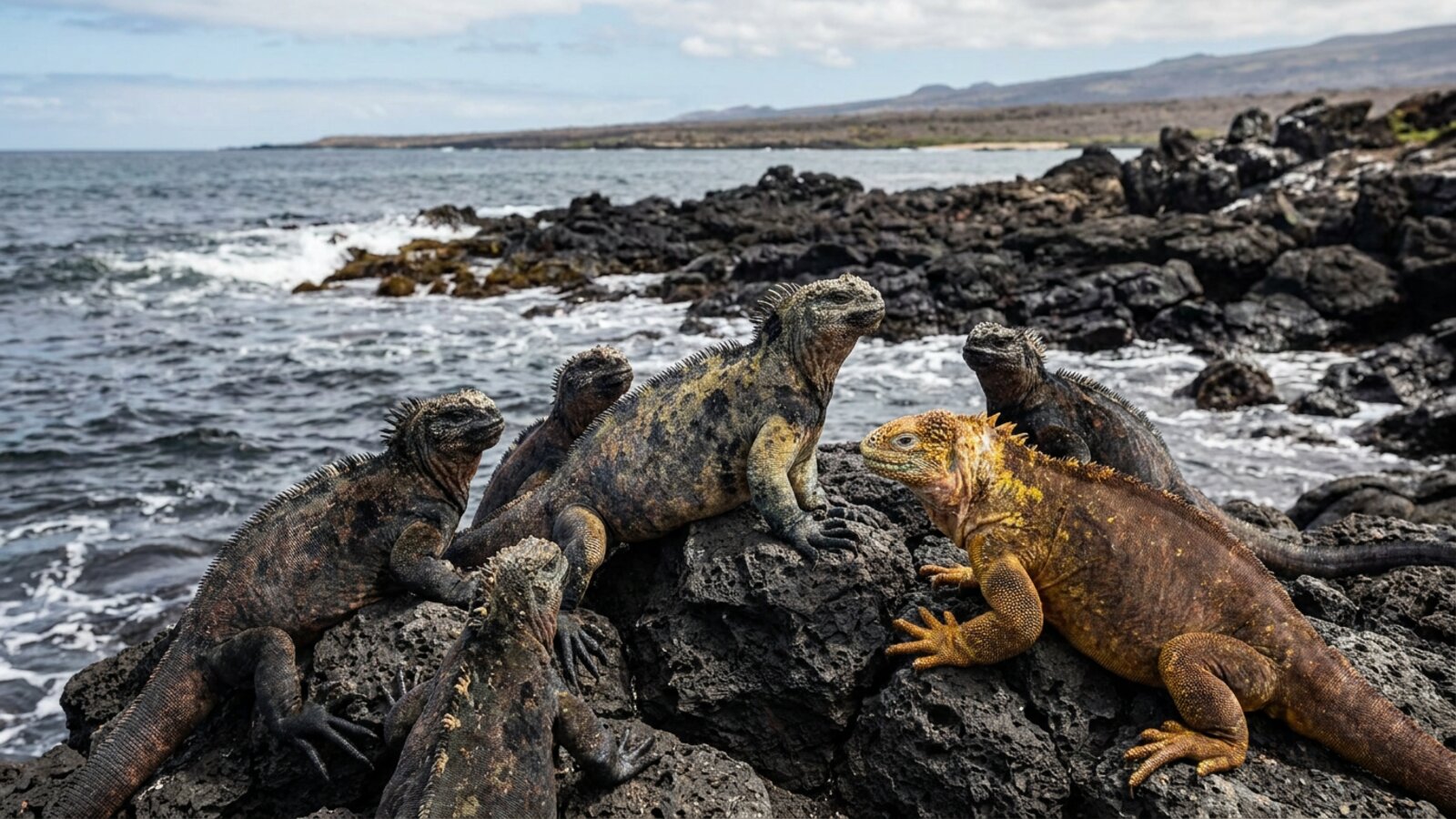
A hybrid iguana is the offspring of two different iguana species. The best-known are the Galápagos hybrids from South Plaza Island, produced when a male marine iguana (Amblyrhynchus cristatus) mates with a female Galápagos land iguana (Conolophus subcristatus). The first was found in 1981; about 20 were known by 2003 and only a handful are alive at any time. They are probably sterile. Elsewhere, hybridisation between invasive green iguanas and native species is a major conservation problem.
How do hybrid iguanas form?
On South Plaza, marine and land iguanas live side by side. DNA testing showed the hybrids have marine iguana fathers and land iguana mothers.
Male marine iguanas defend territories on the shore. On South Plaza, males forced inland by hunger can meet female land iguanas at the tail end of their breeding season (see below). More hybrids appeared after the severe 1997 El Niño, which killed about half the marine iguanas and pushed some inland. The first hybrid was spotted in 1981, and genetic confirmation came in a 1997 study by Kornelia Rassmann and colleagues.
Why do hybrids only appear on South Plaza?
South Plaza is tiny. The crescent-shaped island off the east coast of Santa Cruz covers only about 0.16 km² and rises about 23 m above the sea. It is a block of uplifted lava with cliffs along its south side and low, rocky shores to the north. The flat top is covered in Sesuvium, a succulent ground plant that turns from green in the rainy season to orange and purple in the dry season, and dotted with prickly pear cactus trees, Opuntia galapageia, that feed a dense colony of land iguanas. Around 1,000 sea lions use the shoreline, and swallow-tailed gulls and red-billed tropicbirds nest on the cliffs.
Elsewhere in the Galápagos, the two iguanas are kept apart by place and time. Land iguanas live in the dry interior and marine iguanas on the coast, and their short breeding seasons usually do not overlap. On South Plaza those barriers break down. Because the island is so narrow, no spot is far from the shore, so female land iguanas have nowhere to retreat when large, aggressive male marine iguanas come inland. There is also a slight overlap between the end of the land iguana’s breeding season and the start of the marine iguana’s, so a hungry male marine iguana that has moved inland can occasionally meet a female land iguana that is still receptive.
Hunger is what drives the males inland. In 1997 unusually warm water during a severe El Niño killed the red and green seaweed beds around the archipelago, and roughly half of the marine iguanas starved. Some survivors searched inland for plants, met land iguanas, and an unusually large number of hybrids followed. El Niño events can reduce marine iguana populations by as much as 90% on some islands, and during one two-year food shortage some adults even shrank by up to 20% in length, recovering their size when food returned. Each crash creates new opportunities for hybridisation.
The island itself is being restored. The cactus forest on South Plaza declined, possibly because of introduced rats, and in 2012 rats were eradicated from the island and cactus restoration began. More cactus means more food for land iguanas and for the hybrids that climb them.
What did the DNA tests show?
The 1997 study by Kornelia Rassmann, Fritz Trillmich and Diethard Tautz, published in the Journal of Zoology, began with a single unusual-looking iguana on Plaza Sur. At the time only one possible hybrid had been reported. The team compared nuclear ribosomal DNA, which is inherited from both parents, and found that the animal carried markers from both genera, confirming that it was a hybrid. They then sequenced its mitochondrial cytochrome b gene, which is inherited only through the mother, and found that it matched the land iguana. The mother was a land iguana, so the father must have been a marine iguana.
The same study looked for evidence that hybrids were breeding back into either parent species. In normal-looking marine and land iguanas on the island, the preliminary tests found no mixing of nuclear or mitochondrial markers. This is consistent with hybrids being sterile, or at least not passing their genes on, so each hybrid represents a single meeting between the two species.
How closely related are marine and land iguanas?
Close enough to produce live, healthy offspring, but more distant than most animals that hybridise. Early mitochondrial studies suggested that the marine iguana line split from the ancestor of the land iguanas about 8–10 million years ago. That is older than any of the Galápagos islands that exist today, so the split probably happened on islands that have since eroded and sunk beneath the sea. A genome-wide study by MacLeod and colleagues in 2015 put the split more recently, at around 4.5 million years ago, but still long enough for the two lineages to be placed in different genera, Amblyrhynchus and Conolophus.
That study also found that, although the marine iguana appears to be a single species, its island populations are genetically distinct and diverged from each other less than 50,000 years ago. Hybridisation between marine and land iguanas is extremely rare, but marine iguanas that swim between islands often hybridise with local populations. Within the Galápagos, then, hybridisation is not just a curiosity: it is part of how marine iguana populations exchange genes.
The parent species live very different lives. The Galápagos land iguana, of which there are an estimated 5,000–10,000, gets most of its water from prickly pear cactus, which makes up nearly 80% of its diet, including pads, flowers, fruit and even spines. Land iguanas take 8–15 years to mature, and females lay 2–20 eggs in a burrow about 50 cm deep, which hatch after 90–125 days. Marine iguanas, by contrast, dive for algae and return to the rocks to warm up in the sun. A hybrid that can climb cactus with its father’s sharp claws combines features of both.
What do hybrid iguanas look like?
They are intermediate between their parents: darker than land iguanas, with light speckles on the head and banding on the body, the land iguana’s robust head shape, and a slightly flattened tail like the marine iguana’s. They are noticeably different from either parent, and visiting naturalist guides sometimes point them out on South Plaza’s trail.
What do hybrid iguanas eat?
They inherited the long, sharp claws of their marine iguana fathers and have been seen climbing prickly pear cactus to feed on pads and fruit, something land iguanas usually wait to fall. Some sources report they may also feed on seaweed, though they have not been observed swimming to forage like marine iguanas.
Can hybrid iguanas reproduce?
They appear to be sterile, or at least no second-generation hybrids have been recorded. Marine and land iguanas diverged millions of years ago, probably on islands that are now submerged, which may explain why their offspring appear to be infertile.
Does the pink iguana hybridise too?
The Galápagos has a third land iguana that raises similar concerns. The pink land iguana, Conolophus marthae, lives only on Wolf Volcano in northern Isabela, in an area of about 25 km² at 600–1,700 m. Park rangers first saw pink iguanas there in 1986, but detailed study began only in 2000, and the species was formally described in 2009. It has a pinkish body with a few broad dark bands and a more complex head-bobbing display than the common land iguana. Estimates of when it split from the other land iguanas range from about 5.7 million years ago, based on early mitochondrial data, to about 1.5 million years in a more recent study.
Fewer than 200 mature pink iguanas remain, and the IUCN listed the species as Critically Endangered in 2012. Feral cats and black rats eat eggs and young, and Wolf Volcano erupted as recently as 2022. Because the ranges of pink and yellow land iguanas meet on the volcano, hybridisation is a possible threat: genetic evidence suggests that it has occurred, although its present extent is unknown.
How did land iguanas nearly disappear?
The land iguana’s own history shows how fragile island populations are. When Charles Darwin visited Santiago, then called James Island, in 1835, he wrote that his party could not for some time find a spot free of iguana burrows on which to pitch their tent. Introduced pigs, rats, cats and dogs later wiped out the Santiago population entirely.
On Baltra the species was saved almost by accident. In 1932 the Hancock expedition found Baltra’s iguanas numerous but thin, and moved about 70 of them to nearby North Seymour, where conditions looked better. During the Second World War a US air base was built on Baltra, and by 1954 the land iguanas there were extinct. The North Seymour animals became breeding stock for the Charles Darwin Research Station’s captive breeding program, which has since reintroduced land iguanas to Baltra and other islands. Today they are often seen on or near the runway at Baltra airport.
Why are green iguana hybrids so damaging in the Caribbean?
The 2015 study led by Vuillaume genotyped 59 Lesser Antillean iguanas, 47 green iguanas and 27 animals identified as hybrids by their appearance, using 15 microsatellite markers plus mitochondrial DNA. Every animal that looked like a hybrid proved to be a first- or second-generation hybrid or a backcross, and many others showed signs of longer-term mixing. The authors found no reproductive barrier between the two species. Male green iguanas are larger and appear to dominate, so in the places where green iguanas arrive, the native species is displaced and its genes are progressively replaced: it goes extinct through hybridisation rather than being killed off.
The pattern on the ground matches. The Lesser Antillean iguana, described by Laurenti in 1768 and now Critically Endangered, survives on Saint Barthélemy, Anguilla, Sint Eustatius, Guadeloupe, Dominica and Martinique. It has been lost from Sint Maarten, Saint Kitts, Nevis, Barbuda, Antigua, Marie-Galante and the Îles des Saintes. Green iguanas that washed ashore on Anguilla after Hurricane Luis in 1995 replaced the native population within about twenty years. Dominica, the species’ last major stronghold, received non-native iguanas hidden in hurricane-relief supplies after Hurricane Maria in 2017.
Telling the two apart in the field is the first step in removing invaders. Green iguanas have a large round scale below each ear and a striped tail, both missing in the Lesser Antillean iguana, and a morphometric study found 13 more differences, including the green iguana’s relatively longer tail. Lesser Antillean males have pink jowls and blue scales around the eyes.
Other native iguanas face the same threat. A 2022 study in ZooKeys of the horned iguana Iguana insularis from Saint Lucia and the Grenadines found high levels of green iguana DNA in the Saint Vincent population, signs of mixing on several Grenadine islands, and only one of the two remaining Saint Lucia populations still purebred. On Saint Barthélemy, Lesser Antillean iguanas have also suffered since 2011 from a severe skin disease caused by the bacterium Devriesea agamarum, previously known only from captive lizards.
Captive breeding is difficult. Lesser Antillean iguanas kept at Durrell, Chester Zoo, Memphis Zoo and San Diego, all from Dominica, have mated and laid eggs, but most eggs have been infertile. Durrell hatched one in 1997, eight in 2000 and eleven in 2016, and in 2018 four iguanas from Sint Eustatius went to Rotterdam Zoo for a breeding programme. In 2024 the species was moved to Annex II of the SPAW Protocol of the Cartagena Convention, which prohibits taking, killing or disturbing the animals.
Are other iguana hybrids a problem?
Yes. In the Caribbean, invasive green iguanas hybridise with the endangered Lesser Antillean iguana, threatening it with genetic swamping.
The Lesser Antillean iguana (Iguana delicatissima) has disappeared from several islands as green iguanas (Iguana iguana), introduced through the pet trade and as stowaways, spread and interbreed with it. A 2015 genetic study confirmed widespread hybridisation in the Lesser Antilles, and conservation programs now remove green iguanas and hybrids. In Florida, green iguanas are invasive, and in the pet trade, “hybrid iguanas” can also refer to crosses between rock iguanas or colour morphs of green iguanas.
| Hybrid | Parents | Concern |
|---|---|---|
| Galápagos hybrid | Marine × land iguana | Rare natural curiosity; likely sterile |
| Lesser Antilles hybrids | Green × Lesser Antillean iguana | Major threat to an endangered species |
| Captive rock iguana hybrids | Different Cyclura species | Discouraged; complicates conservation breeding |
Learn more about its father’s species in the marine iguana profile and what marine iguanas eat. A similar hybridisation problem affects the Cuban crocodile.
What is a hybrid iguana?
The offspring of two different iguana species, most famously male marine iguanas and female land iguanas on South Plaza, Galápagos.
Where can you see a hybrid iguana?
On South Plaza Island in the Galápagos, though only a few exist at any time.
Can hybrid iguanas breed?
They appear to be sterile.
What do hybrid iguanas eat?
Prickly pear cactus, which they climb to reach, and possibly seaweed.
Why are iguana hybrids a conservation problem?
Invasive green iguanas hybridise with the endangered Lesser Antillean iguana, eroding its genetic identity.
- Rassmann, K., Trillmich, F. & Tautz, D. (1997). Hybridization between the Galápagos land and marine iguana (Conolophus subcristatus and Amblyrhynchus cristatus) on Plaza Sur. Journal of Zoology 242(4). doi:10.1111/j.1469-7998.1997.tb05822.x
- Vuillaume, B. et al. (2015). Genetic evidence of hybridization between Iguana delicatissima and invasive Iguana iguana in the Lesser Antilles. PLoS ONE 10(6): e0127575.
- Galapagos Conservation Trust. Welcome to the hybrid zone.
- MacLeod, A. et al. (2015). Hybridization masks speciation in the evolutionary history of the Galápagos marine iguana. Proceedings of the Royal Society B. doi:10.1098/rspb.2015.0425
- Breuil, M. et al. (2022). Iguana insularis (Iguanidae) from the southern Lesser Antilles: an endemic lineage endangered by hybridization. ZooKeys 1086. doi:10.3897/zookeys.1086.76079
- Hellebuyck, T. et al. (2017). A virulent clone of Devriesea agamarum affects endangered Lesser Antillean iguanas (Iguana delicatissima). Scientific Reports. doi:10.1038/s41598-017-11874-x
- Wikipedia (accessed 8 Nov 2026): Hybrid iguana; Galápagos land iguana; Galápagos pink land iguana; Lesser Antillean iguana; South Plaza Island; Marine iguana.
Blane Perun has been exploring Earth’s oceans and marine life for over 25 years. Founder of TheSea.Org in 1999, underwater photographer, coral aquaculture pioneer, and explorer of 80+ countries.
About Blane Perun →More on Marine Reptiles →