Humpback Whale — The Singing Acrobat of the Open Ocean
What is a humpback whale?
The humpback whale is a large baleen whale famous for its very long flippers, knobbly head, acrobatic breaching and complex songs. Adults average about 49 ft (15 m) and 35 tons, and the species lives in every ocean.
Its scientific name means “big-winged New Englander,” after the flippers, which reach a quarter to almost a third of body length, the longest of any whale. The underside of each fluke has a black-and-white pattern as unique as a fingerprint, and researchers identify individual whales from tail photos.
How do humpback whales feed?
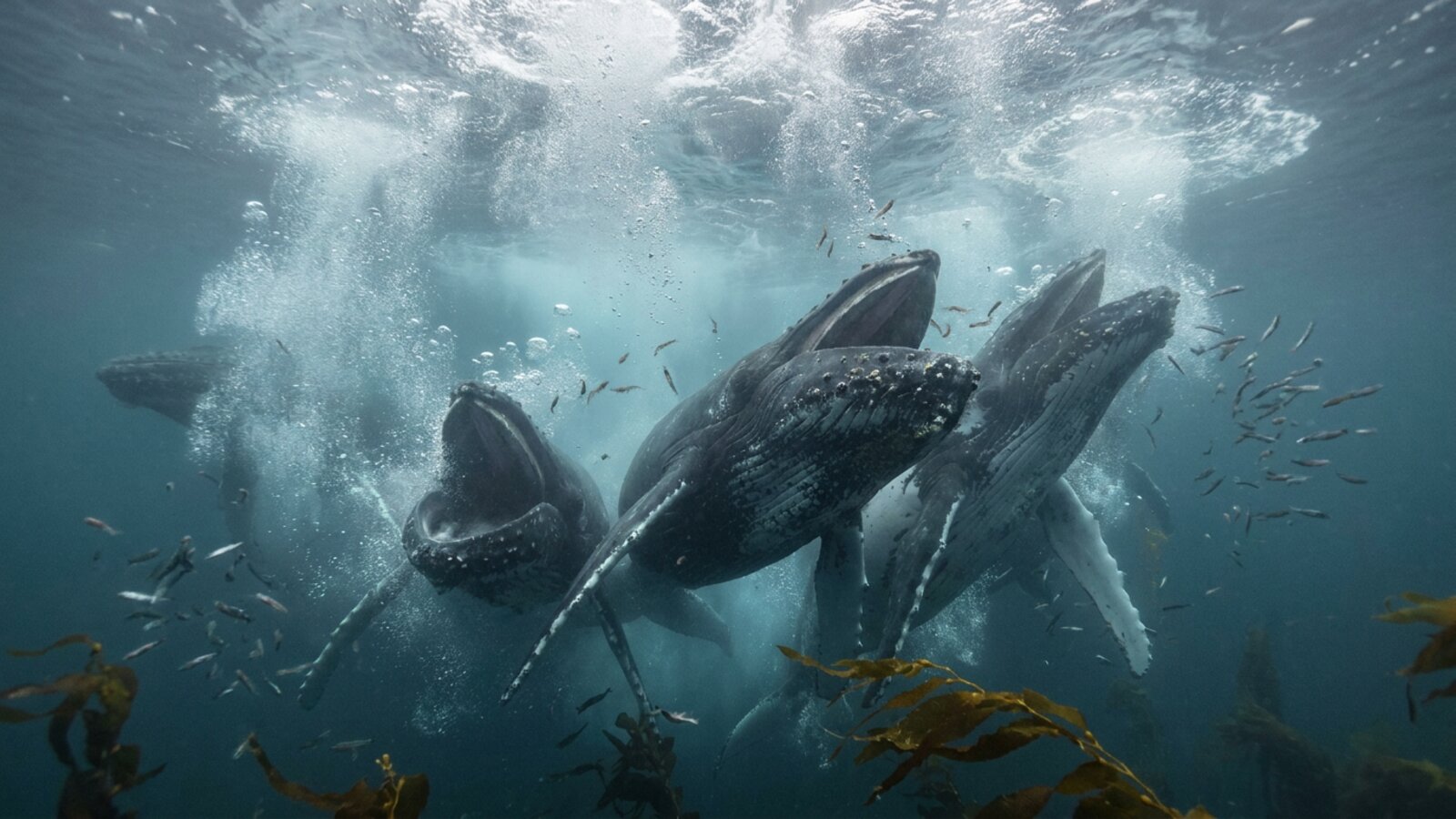
By engulfing krill and schooling fish such as herring, capelin and sand lance, up to about 1.5 tons of food a day in the feeding season. In some areas they hunt cooperatively with bubble nets.
In bubble-net feeding, one or more whales swim in a rising spiral beneath a school of fish, releasing a curtain of bubbles that herds the prey into a tight column. The whales then lunge upward through the center with mouths wide open. The behaviour is best known from Southeast Alaska, where groups coordinate with loud feeding calls. Humpbacks have 270–400 baleen plates per side, each about 30 in (76 cm) long.
How far do humpback whales migrate?
Some populations migrate about 5,000 miles between cold feeding grounds and warm breeding grounds, among the longest migrations of any mammal.
North Pacific humpbacks feed in Alaska and British Columbia and breed off Hawaii, Mexico, Central America and Japan. The Alaska-to-Hawaii trip, about 3,000 miles, can take as few as 36 days. Southern Hemisphere humpbacks feed around Antarctica and breed off Australia, Tonga, Brazil, southern Africa and elsewhere. Whales fast for much of the breeding season, living on stored blubber.
Why do humpback whales sing?
Only males sing, and mainly on the breeding grounds, so the song is thought to be a mating display, though exactly how it works is still debated.
A song is a structured sequence of themes lasting 10–20 minutes, repeated for hours. All males in a population sing roughly the same song, which changes gradually through the season, and new song types can spread from one population to another. The low-frequency parts can be heard about 20 miles away in deep water.
How do humpback whales reproduce?
Gestation is about 11–11.5 months; a calf is born at 10–16 ft and about 1.5 tons, nurses for 6–12 months on milk with 45–60% fat, and females usually calve every 2–3 years.
On the breeding grounds, competitive groups of 2 to 20 males chase a single female, slapping, charging and blowing bubble streams at each other. Females mature at around 5 years. See also do humpback whales travel in pods?
Are humpback whales endangered?
Not as a species anymore. In 2016 NOAA split humpbacks into 14 distinct population segments: nine are no longer listed under the Endangered Species Act, four are endangered and one is threatened.
Commercial whaling reduced some populations by more than 95 percent. In the North Pacific, more than 23,000 humpbacks were taken before protection in 1966. The endangered segments are Central America, the Western North Pacific, the Arabian Sea (perhaps as few as 80 whales) and Cape Verde/Northwest Africa; Mexico’s segment is threatened. Some Australian populations now exceed 20,000.
Today’s threats are entanglement in fishing gear, ship strikes, noise and shifts in prey driven by marine heatwaves. Recovery is real, but it isn’t guaranteed.
How to identify a humpback whale
A bushy blow, a small dorsal fin set on a low hump, an arched back before the dive and flukes lifted high: that sequence is classic humpback.
Up close the head is covered in fist-sized knobs called tubercles, each holding a single sensory hair follicle. The flippers are long, white or mottled on the underside and edged with bumps along the leading edge. Those bumps help the flipper grip the water and turn tightly, and engineers have studied them as a model for more efficient fan, turbine and wing designs. The body is mostly black or dark grey above, with variable white on the belly and the underside of the flukes.
| Whale | Dorsal fin | Flukes on dive | Other clues |
|---|---|---|---|
| Humpback | Small, on a hump | Usually lifted high, often showing white underside | Very long flippers, knobbly head |
| Gray whale | None; a row of knuckles | Often shown | Mottled grey skin with patches of barnacles |
| Fin whale | Taller, swept back, far down the back | Rarely shown | Long, sleek body; tall columnar blow |
| Right whale | None | Shown, smooth-edged | V-shaped blow, pale callosities on the head |
A guide to humpback behaviour
Humpbacks are the most surface-active of the large whales, which is a big part of their popularity. Common behaviours include:
- Breach: launching most of the body out of the water and crashing back down.
- Pec slap: rolling on the side and slapping a long flipper on the surface, sometimes repeatedly.
- Tail slap (lobtail): lifting the flukes and slapping them down hard, often heard from a distance.
- Peduncle throw: hurling the rear of the body sideways across the surface, often during competitive groups.
- Spyhop: rising vertically to bring the eyes above the water.
- Logging: resting motionless at the surface, often between breathing sequences.
- Fluke-up dive: raising the tail before a deeper dive, the moment photographers wait for.
Do humpback whales protect other animals from orcas?
Remarkably, yes. Scientists have documented many cases of humpbacks charging into attacks by mammal-hunting killer whales, sometimes when the victims were humpback calves but also when the orcas were hunting seals, sea lions or calves of other whale species. In some well-known accounts from Antarctica and the North Pacific, a seal was even seen resting on a humpback’s chest or belly while the whale fended off the orcas.
Why humpbacks do this is debated. One idea is that the response evolved to protect their own calves and is triggered by the sounds of an orca attack, whatever the target. Many adult humpbacks carry rake-like tooth scars on their flukes from orca encounters, a reminder that the conflict is real.
Why humpbacks matter to the ocean
Large whales do more than eat. Humpbacks feed at depth and often defecate near the surface, releasing iron and nitrogen into sunlit waters where they can fertilise phytoplankton, the base of the marine food web. This “whale pump” also moves nutrients horizontally as whales migrate between feeding and breeding grounds. When a whale dies and sinks, its carcass becomes a “whale fall” that can feed deep-sea communities for years. The recovery of humpback populations is therefore good news not just for the whales but for the productivity of the waters they use.
Watching humpback whales responsibly
Humpbacks are the backbone of the whale-watching industry. Typical seasons are December to April in Hawaii (peaking in mid-winter), May to September in Alaska, June to November along eastern Australia, July to October in Tonga, and January to April on the Silver Bank off the Dominican Republic.
Rules exist to keep both whales and people safe. In U.S. waters, federal regulations require vessels and people to stay at least 100 yards from humpbacks in Hawaii and Alaska, and similar approach limits apply in many other countries. A few places, such as Tonga and the Silver Bank, allow regulated in-water encounters with licensed operators. Choose operators who follow local guidelines, slow down near whales, never chase or box them in, and keep drones well away unless permitted.
In the Dominican Republic, the Silver Bank is one of the few places where you can legally snorkel with humpback whales.
How big is a humpback whale?
Adult females average about 49 ft (15 m) and 35 tons; males are slightly smaller.
What do humpback whales eat?
Krill and small schooling fish such as herring, capelin and sand lance, up to about 1.5 tons a day in the feeding season.
What is bubble-net feeding?
A cooperative hunting method in which humpbacks blow a spiral of bubbles to trap fish, then lunge up through the middle to feed.
Why do humpback whales sing?
Males sing, mostly on breeding grounds, so the song is thought to be a mating display.
How far do humpback whales migrate?
Some populations travel about 5,000 miles between feeding and breeding grounds.
Are humpback whales endangered?
Not as a whole. Of 14 populations, nine are no longer listed under the ESA, four are endangered and one is threatened.
How long do humpback whales live?
Estimates vary: Alaska’s fish and game department gives 40–50 years, while NOAA cites about 80–90.
Where can I see humpback whales?
Popular places include Hawaii, Alaska, Baja California, Tonga, eastern Australia, the Dominican Republic and New England.
- NOAA Fisheries, Humpback Whale species page (archived)
- Alaska Department of Fish and Game, Humpback Whale species profile
Blane Perun has been exploring Earth’s oceans and marine life for over 25 years. Founder of TheSea.Org in 1999, underwater photographer, coral aquaculture pioneer, and explorer of 80+ countries.
About Blane Perun →