Sport & Game Fish of Florida and the Gulf — Tarpon, Snook, Marlin, Mahi and the Fish Anglers Chase
A game fish is a species pursued mainly for sport on rod and reel rather than for commercial food value: fish that fight hard, jump, run, or test an angler’s skill. Florida and the Gulf of Mexico hold one of the richest game-fish assemblages on Earth, with tarpon, snook, redfish, bonefish and permit on the inshore flats and mangroves, goliath grouper, snapper, amberjack and cobia on reefs and wrecks, and marlin, sailfish, swordfish, mahi, wahoo and tuna in the blue water offshore. This guide covers the biology, world records, ranges and identification of 29 of them.
Which fish count as game fish in Florida and the Gulf?
There is no single legal list. “Game fish” is an angler’s term for species that fight hard and reward skill, and in Florida it covers everything from a 3-lb bonefish on a Keys flat to a 1,000-lb blue marlin in the Gulf Loop Current.
The International Game Fish Association (IGFA), founded in 1939 and headquartered in Dania Beach, Florida, keeps world records for hundreds of species, and Florida waters contribute a large share of the classic ones. What ties them together is behavior rather than taxonomy. Tarpon jump, bonefish run, permit refuse lures, snook pull for the mangroves, amberjack drag anglers back toward the wreck, and billfish combine size, speed and aerial acrobatics. Many are also excellent table fare, which is why the Florida Fish and Wildlife Conservation Commission (FWC) manages most of them with slot limits, seasons and bag limits rather than outright protection.
This section organizes them the way a Southwest Florida angler or diver actually meets them: by habitat zone, from the mangrove shoreline outward to the blue water. Each species profile uses the same dossier layout, with a range map, size meter and world-record panel, so you can compare a sheepshead and a swordfish on the same terms.
What game fish live on Florida’s flats and in the mangroves?
The shallow inshore zone, from mangrove islands to grass flats and passes, is where the Gulf coast is at its best, and where light tackle and fly anglers find the most demanding fish in the hemisphere.
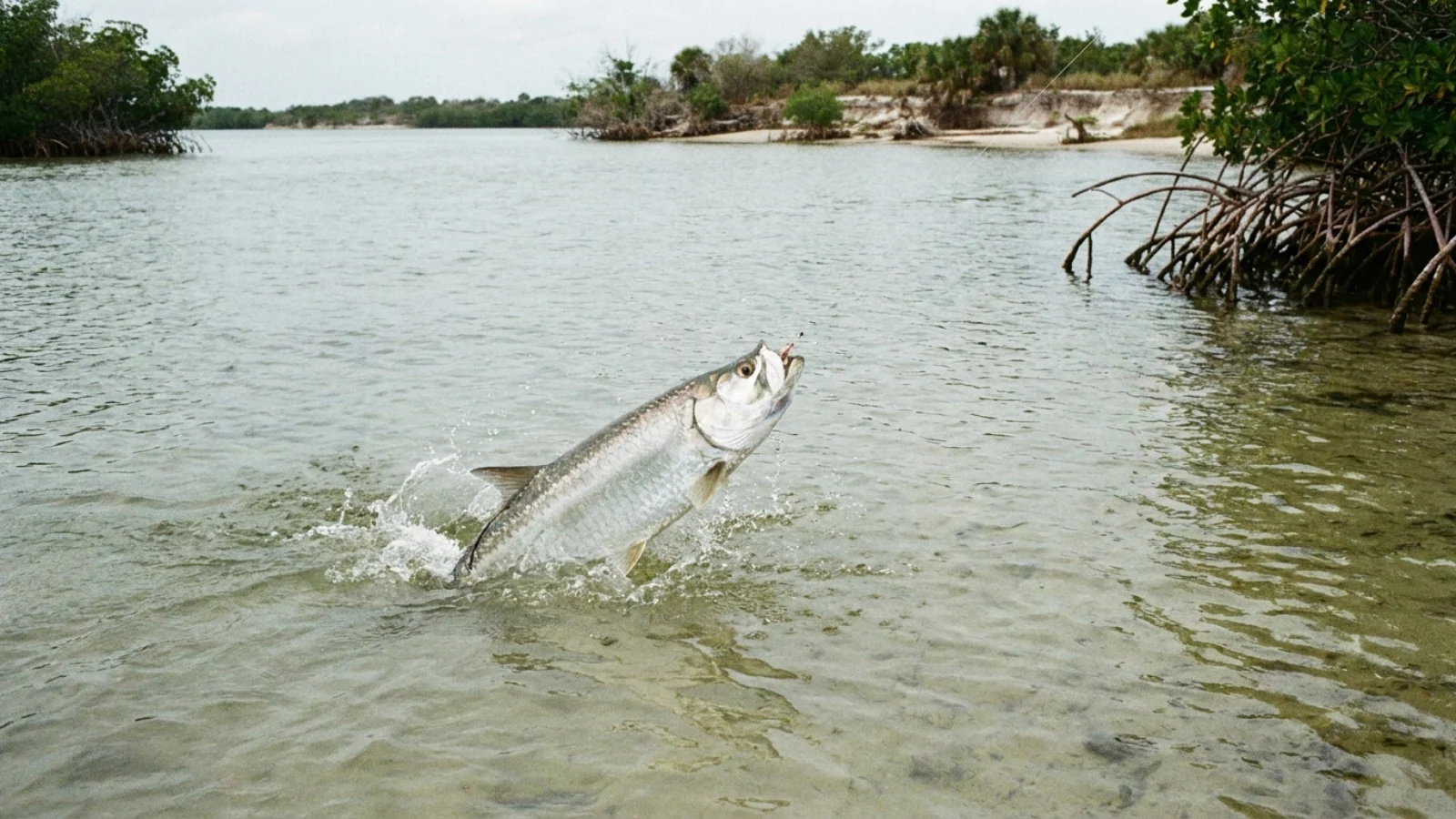
Snook are the signature fish of Southwest Florida: ambush predators that hold on mangrove roots, dock pilings and beach troughs, and that cannot tolerate cold water, which is why a hard freeze can kill them by the thousand. Redfish (red drum) tail on the grass flats with their backs out of the water, and the black spot near the tail is the field mark every child on the Gulf coast learns. Tarpon, the silver king, gather by the thousand in Boca Grande Pass each spring, gulp air from the surface with a modified swim bladder, and can live for more than 50 years.
Further south, the clear flats of the Florida Keys hold the “grand slam” trio: bonefish, permit and tarpon. Bonefish are catch-and-release only in Florida, and permit inside the Special Permit Zone are closely regulated. Around docks, bridges and seawalls you will meet sheepshead, the striped fish with startlingly human-looking teeth, and the wary mangrove snapper.
Which game fish live on Gulf reefs and wrecks?
The West Florida Shelf is a broad, gently sloping plain dotted with limestone ledges, artificial reefs and shipwrecks, and those structures concentrate the reef species that fill Florida’s fish markets and tournament boards.
The goliath grouper is the giant of this zone, reaching about 800 lb and gathering in spawning aggregations on wrecks each late summer. It is the clearest conservation success story in this section: fully protected from 1990, it recovered enough for FWC to reopen a small, tightly limited harvest in 2023. Red snapper are the Gulf’s most argued-over fish, with short federal seasons and an iconic deep-red color. Greater amberjack, nicknamed “reef donkeys,” are pure muscle, and cobia cruise alongside rays, turtles and sharks over the same bottom.
For the families behind these fish, see our overviews of groupers, snappers, jacks and barracudas, and our guide to the Florida reef tract.
What are the offshore and blue-water game fish?
Beyond the shelf edge, the Loop Current and Gulf Stream carry warm, clear water and floating sargassum, and with them the fastest and largest fish in this guide.
Mahi mahi shelter under weedlines and grow faster than almost any other fish. Wahoo and king mackerel are the toothy mackerels, built for speed. Yellowfin and Atlantic bluefin tuna both use the Gulf, and bluefin spawn there each spring. Then there are the billfish: sailfish off Stuart and the Palm Beaches every winter, blue marlin in the deep Gulf, the broadbill swordfish at night over the canyons, and in the Pacific the black and striped marlin. Our marlin overview and swordfish vs marlin comparison explain how to tell them apart.
How are Florida’s game fish managed?
Most Florida game fish are managed rather than protected: anglers can keep some fish, but within slot limits, bag limits and closed seasons set by the FWC in state waters and by federal managers offshore.
A slot limit, such as the 18–27-inch window for redfish, protects both small juveniles and the large, highly fecund breeders. Snook carry a slot of 28–33 inches on the Gulf coast, a separate snook permit, and seasonal closures that protect them during spawning and after cold snaps. At the far end of the scale, bonefish are catch-and-release only, and tarpon may be kept only with a $50 tag, one per angler per year, for a potential IGFA record. Regulations change frequently, so treat any limits mentioned in this section as background and check the current FWC rules before you keep a fish.
How to use this guide
Every profile below starts with a direct answer, then a species dossier with size, depth, lifespan, diet and IUCN status, followed by range, biology, record catches and a comparison table against related species.
For broader context, see the fastest animals in the ocean, our travel guides to Naples, Sanibel and the Florida Keys, and our article on scuba spearfishing.
What is the most popular game fish in Florida?
Inshore, the “big three” are snook, redfish and spotted seatrout, with tarpon the most prized trophy. Offshore, mahi mahi, sailfish, king mackerel and grouper/snapper dominate. Florida bills itself as the “Fishing Capital of the World” because it offers all of these within a short run of the same coast.
What is the biggest game fish in the Gulf of Mexico?
Atlantic blue marlin are the largest, with females exceeding 1,000 lb; the Atlantic all-tackle record is 1,402 lb from Brazil. Swordfish and Atlantic bluefin tuna also pass 1,000 lb. Among reef fish, the goliath grouper reaches about 800 lb.
What fish are catch-and-release only in Florida?
Bonefish are strictly catch-and-release. Tarpon are effectively catch-and-release: harvest is allowed only with a $50 tarpon tag, one per angler per year, and only in pursuit of an IGFA record. Goliath grouper were fully protected from 1990 until a small, lottery-based harvest reopened in 2023.
What is the difference between inshore and offshore fishing in Florida?
Inshore means bays, flats, mangroves, passes and beaches, typically in water under about 15 ft, targeting snook, redfish, tarpon, trout and sheepshead. Offshore means reefs, wrecks and the open Gulf or Atlantic beyond sight of land, targeting grouper, snapper, amberjack, mahi, tuna and billfish.
Who keeps fishing world records?
The International Game Fish Association (IGFA), founded in 1939 and headquartered in Dania Beach, Florida, maintains all-tackle and line-class world records under strict rules for tackle, weighing and witnesses.
What is the fastest game fish?
Sailfish, marlin and wahoo are usually named. Popular figures of 68 mph for sailfish and 80 mph for black marlin come from old reel-timing estimates; modern muscle studies suggest real burst speeds are far lower. See our guide to the fastest fish in the ocean.
When is the best season for game fish in Southwest Florida?
Tarpon peak from about April to July around Boca Grande and Charlotte Harbor; snook feed hardest in the warm months; redfish school on the flats in late summer and fall; sheepshead and pompano bite best in winter and early spring; offshore, kingfish run with spring and fall water temperatures.
Do I need a license to fish in Florida saltwater?
Yes, most anglers 16 and older need a Florida saltwater fishing license, and some species carry extra permits (snook, for example, needs a snook permit). Rules change often, so check FWC’s current regulations before you keep any fish.
The Surf-Zone Jack of the Gulf Beaches.
The Spotted Speedster of Florida Beaches.
The Fish That Plays Dead Under Buoys.
All 15 True Tunas Compared.
The 1,496-Lb Nova Scotia Bluefin.
Sailfish, Marlin and the Truth.
Blane Perun has been exploring Earth’s oceans and marine life for over 25 years. Founder of TheSea.Org in 1999, underwater photographer, coral aquaculture pioneer, and explorer of 80+ countries. Based in Southwest Florida, where tarpon, snook and redfish share the mangrove shorelines of the Gulf coast.
About Blane Perun → More on Sport & Game Fish →