Mahi Mahi — The Dolphinfish That Grows Faster Than Almost Any Fish in the Sea
Mahi mahi (Coryphaena hippurus), also called dolphinfish or dorado, is a brilliantly colored, fast-growing ocean fish of tropical and subtropical seas. It is a fish, not a dolphin. Adults typically weigh 15–30 lb and can reach about 2 m (6.5 ft); the IGFA world record is 87 lb, from Costa Rica in 1976. Mahi mature at just 4–5 months, rarely live beyond 4 years, and gather under floating sargassum weed and debris, which makes them one of the most popular offshore fish in Florida.
Mahi Mahi
Is mahi mahi a fish or a dolphin?
Mahi mahi is a fish. The common name “dolphinfish” predates the modern habit of calling marine mammals dolphins, and in Florida many anglers still simply call it “dolphin.”
Biologically, Coryphaena hippurus belongs to the small family Coryphaenidae, which contains only two species: the common dolphinfish and the smaller pompano dolphinfish (Coryphaena equiselis). Its closest relatives are the jacks and pompanos. The Hawaiian name mahi-mahi is usually translated as “very strong,” and Spanish speakers call it dorado, “golden,” after its color. The name confusion is so persistent that U.S. restaurants and seafood labels standardized on “mahi mahi” to reassure diners they are not eating a bottlenose dolphin.
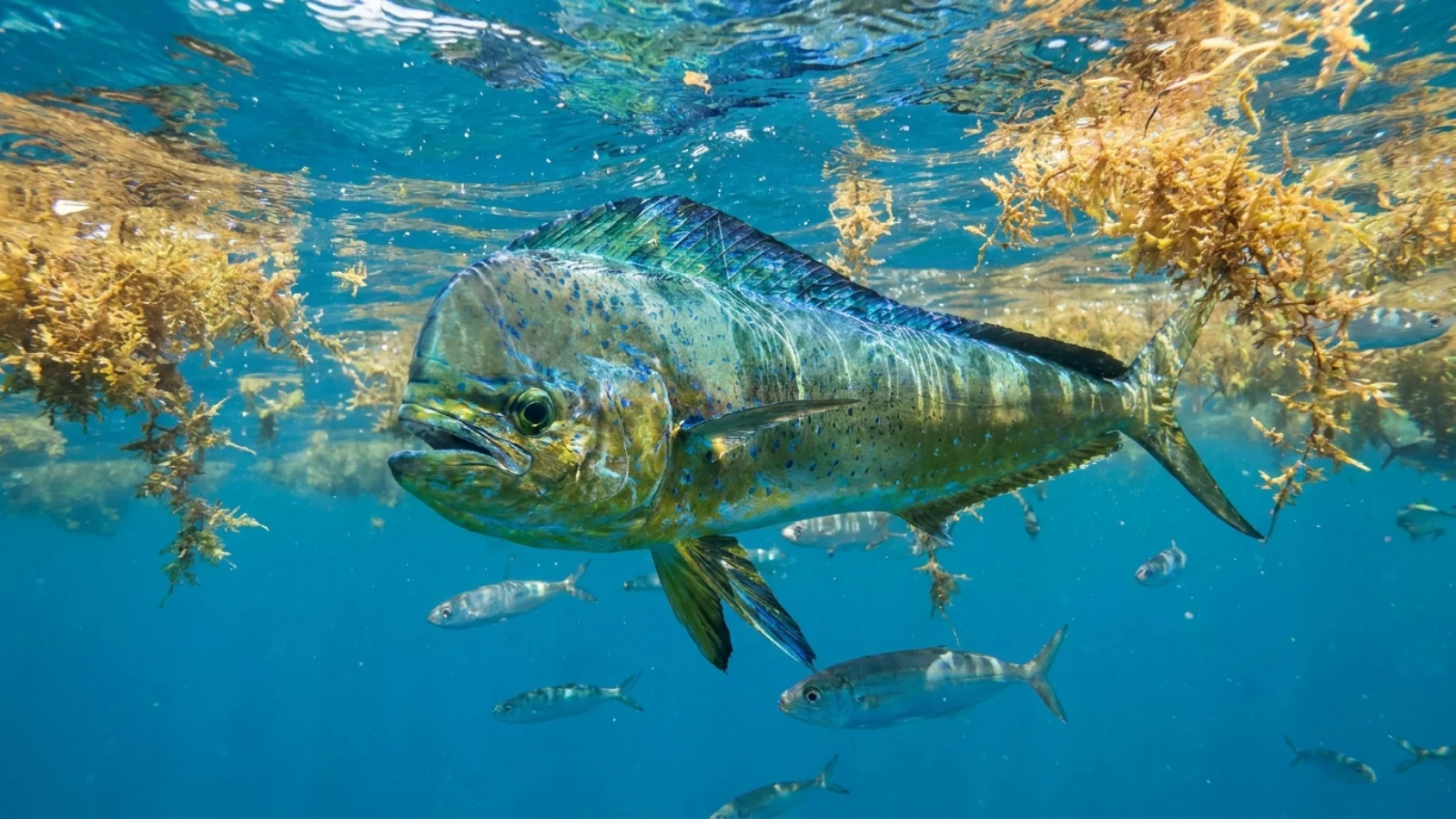
How do you identify a mahi mahi?
A long, compressed body that tapers from a blunt head to a deeply forked tail, a single dorsal fin running from the head almost to the tail, and colors no other fish in the open ocean matches.
Live mahi are metallic blue-green above and golden-yellow on the sides, scattered with small blue or dark spots. Males, called bulls, develop a tall, almost vertical forehead crest as they grow, while females, or cows, keep a rounded, sloping head. This makes mature mahi among the easiest fish to sex at a glance. The dorsal fin contains 55 to 66 soft rays, a useful way to tell the common dolphinfish from the pompano dolphinfish, which has fewer rays and a squarer tooth patch on the tongue.
The colors are under active nervous control. Feeding or excited fish flash electric blue, and some show dark vertical bars. After a fish dies the display collapses, and within minutes the body fades to a mottled gray-yellow, which is why photographs taken on the deck rarely match what an angler saw in the water.
How fast do mahi mahi grow?
Mahi are a textbook “live fast, die young” species. They reach maturity in months, spawn repeatedly, and rarely survive more than four years.
A mahi first spawns at around 20 cm long and 4 to 5 months old, and from then on it spawns many times a year, in pairs, in warm surface water. Larvae hatch at about 4 mm. Through its first year a fish can put on weight at a rate few other fish can match, so a 30-lb bull is often barely a year or two old. That rapid turnover is why scientists consider dolphinfish relatively resistant to fishing pressure compared with slow-growing species like goliath grouper or red snapper. It is also why many anglers have pushed for lower bag limits on the Atlantic coast: a fishery built on one- and two-year-old fish can change quickly when the season’s recruitment is poor.
Where do mahi mahi live?
Mahi live in warm open ocean around the globe, in the Atlantic, Indian and Pacific Oceans and the Mediterranean, generally in water above about 20°C.
In the western Atlantic they follow the Gulf Stream north each spring and summer, from the Caribbean and the Florida Straits past the Carolinas toward New England, then retreat south as water cools. In the Gulf of Mexico they ride the Loop Current and are common over the continental slope off Florida, Alabama, Louisiana and Texas. They are a surface-oriented species, recorded from the surface to about 85 m, and most of their life is spent in the top few meters.
Why do mahi gather under sargassum?
Floating objects are the oases of the open ocean, and mahi organize their lives around them.
Mats of golden Sargassum seaweed drifting in the Gulf Stream and Gulf host whole communities of small fish, crabs, shrimp and juvenile turtles. Young mahi use the weed for cover, while adults patrol the edges and the shade beneath to feed. Logs, buoys, lost nets and even floating pallets work the same way, and the fishery for mahi off South Florida is built on finding them. Larger bulls often roam more independently, hunting flying fish, which make up about a quarter of adult diet by weight. Other prey include triggerfish, juvenile tunas and billfish, squid and crabs.
Mahi are themselves prey for the biggest predators offshore: blue marlin, sailfish, yellowfin tuna, swordfish and sharks all eat them, and young mahi are taken by seabirds. A hooked mahi is often followed by the rest of its school, an old trick offshore anglers use to keep a school near the boat.
How does mahi mahi compare with other blue-water fish?
Mahi are smaller than the tunas and billfish they share water with, but they grow faster and reproduce sooner than any of them.
| Species | Record | Typical adult | Max age | Maturity | IUCN |
|---|---|---|---|---|---|
| Mahi mahi | 87 lb | 15–30 lb | ~4 yrs | 4–5 months | LC |
| Wahoo | 184 lb | 30–60 lb | ~9 yrs | ~1 year | LC |
| Yellowfin tuna | 443 lb | 40–150 lb | ~9 yrs | ~2 years | LC |
| King mackerel | 93 lb | 10–30 lb | ~24 yrs | 2–4 years | LC |
| Sailfish | 221 lb | 40–100 lb | ~13 yrs | ~2–3 years | VU |
When and where can you catch mahi mahi in Florida?
The best mahi fishing in Florida is off the Keys and the Atlantic coast from late spring through summer, along weedlines and temperature breaks at the edge of the Gulf Stream.
From Southwest Florida, mahi require a long run offshore into deeper Gulf water, where they are found in summer along weedlines and the edges of the Loop Current. Islamorada and Marathon in the Florida Keys are the classic launch points, because the Gulf Stream passes within a few miles. Check current FWC and federal bag and vessel limits before keeping fish; Atlantic limits were reduced in recent years in response to concerns about declining catches. For more pelagic species, see wahoo, sailfish and the Sport & Game Fish hub.
Is mahi mahi a dolphin?
No. Mahi mahi is a ray-finned fish in the family Coryphaenidae. The name “dolphinfish” or “dolphin” is old sailors’ usage and has nothing to do with the bottlenose dolphin, a marine mammal. Restaurants use “mahi mahi” partly to avoid that confusion.
How big do mahi mahi get?
Most adults weigh 15 to 30 lb, and fish over 50 lb are rare trophies. The species reaches about 2 m (6.5 ft). The IGFA all-tackle record is 87 lb, caught in the Gulf of Papagayo, Costa Rica, in 1976, and Florida’s state record is 77 lb 12 oz.
How fast do mahi mahi grow?
Extremely fast. Mahi reach sexual maturity at only 4 to 5 months old and about 20 cm long, and a fish can go from a few ounces to 30 lb or more within its first year. Few bony fish anywhere grow faster.
How long do mahi mahi live?
Usually 2 to 4 years. Four years is the commonly cited maximum, so the large bulls caught offshore are rarely more than two or three years old.
Why do mahi mahi change color?
Their skin contains pigment cells and light-reflecting cells under nervous control. Excited or feeding fish flash vivid blue, green and gold, and may show dark vertical bars; after death the colors fade to a dull gray-yellow within minutes.
Why are mahi found under sargassum and floating debris?
Floating sargassum and debris attract small fish, crabs and shrimp, and young mahi shelter there from predators. Adult mahi gather around these objects to feed, so anglers look for weedlines, logs and even floating pallets offshore.
When is mahi season in Florida?
Off the Florida Keys and the Atlantic coast, the peak is roughly April through August, as mahi move north with the Gulf Stream. In the Gulf, they are most common in late spring and summer along the Loop Current and offshore weedlines.
Is mahi mahi healthy to eat?
Mahi mahi is a lean, mild white fish and is considered a lower-mercury choice than swordfish, king mackerel or large tunas. Because it grows and reproduces so quickly, well-managed populations are generally considered resilient.
Blane Perun has been exploring Earth’s oceans and marine life for over 25 years. Founder of TheSea.Org in 1999, underwater photographer, coral aquaculture pioneer, and explorer of 80+ countries. Based in Southwest Florida, where tarpon, snook and redfish share the mangrove shorelines of the Gulf coast.
About Blane Perun → More on Sport & Game Fish →