Bonefish — The Gray Ghost of the Florida Keys Flats
The bonefish (Albula vulpes) is a silver, torpedo-shaped fish of shallow tropical flats, famous among anglers as the “gray ghost” because its mirror-like scales make it nearly invisible over sand. Western Atlantic bonefish reach about 77 cm (31 in) and 13–14 lb, though most Florida fish weigh 4–6 lb, and they can live 19 years or more. Bonefish root for crabs, shrimp and clams in water only inches deep, often with their tails breaking the surface. In Florida they have been strictly catch-and-release since 2013.
Bonefish
Why do anglers call bonefish the gray ghost?
Bonefish are nearly impossible to see. Their scales reflect the sand, sky and water so effectively that a school of fish over a white flat looks like moving shadows, and even experienced guides spot them by their wake, their tails or the puff of mud they kick up while feeding.
That near-invisibility is a survival tool. The flats where bonefish feed are only inches to a couple of feet deep, offering no cover from lemon sharks, blacktips and barracuda. A bonefish relies on camouflage while it feeds and on explosive speed when it is threatened. Hooked, it will run more than 100 yards in seconds, which is why the species became the foundation of saltwater fly fishing in the Florida Keys and the Bahamas in the mid-20th century.
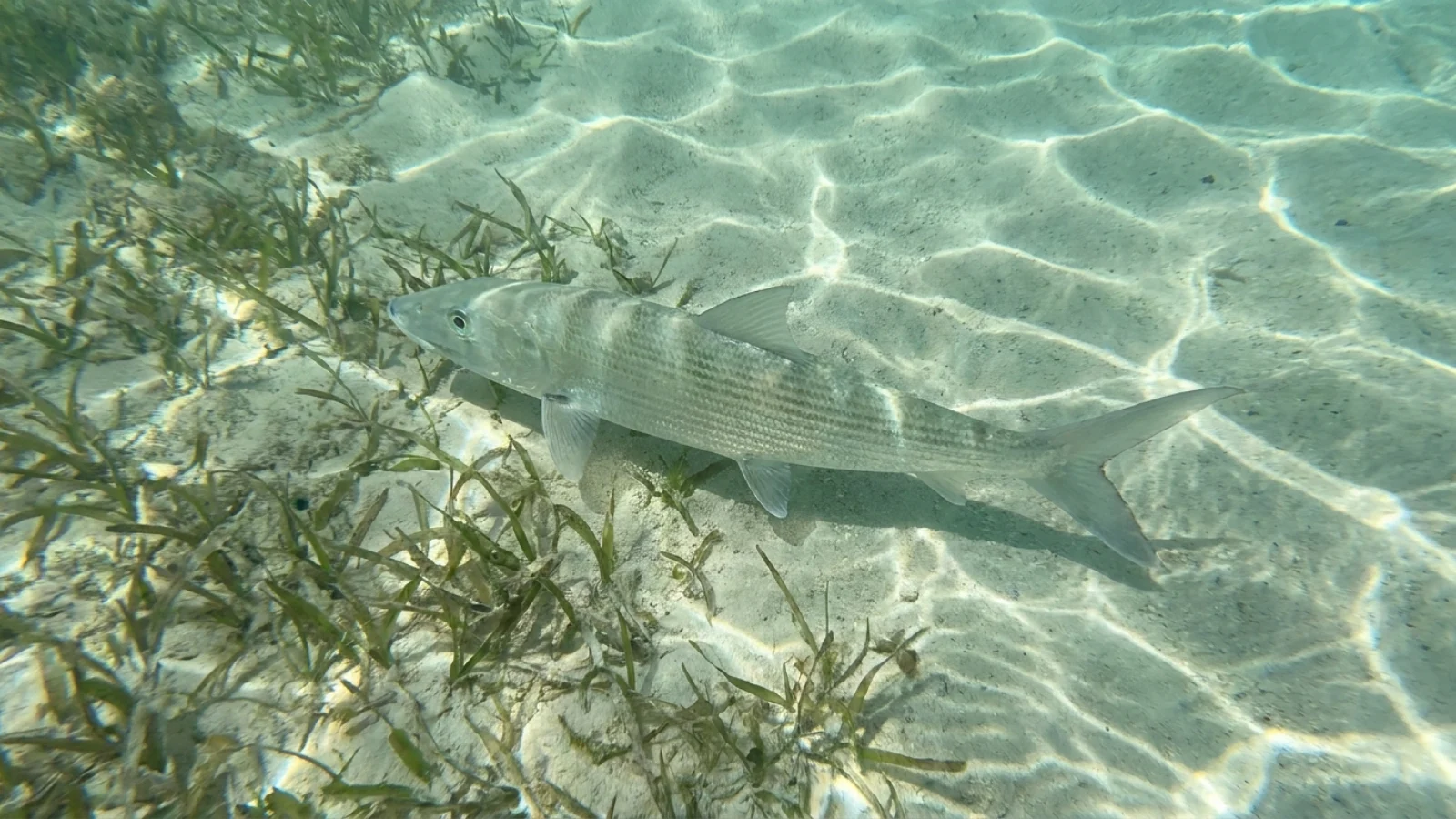
How do you identify a bonefish?
A silver, slightly rounded body, a forked tail, large reflective scales, and an unmistakable piglike snout with an underslung mouth that overhangs the lower jaw.
The back is bluish or greenish-silver, and faint dark lines run along the upper sides; on the flats, bonefish also show dark bars across the back that come and go. The mouth is built for rooting, not chasing: it points downward so the fish can tip nose-down into the bottom, blowing sand away to expose crabs and clams. Instead of sharp jaw teeth, bonefish crush prey between hard tooth plates on the tongue and the roof of the mouth. The bonefish has a close Pacific and Indian Ocean look-alike, and genetic studies have shown that what was long called one global bonefish is actually several species, which is why record fish from Africa and Hawaii can exceed the size of Atlantic fish.
What do bonefish eat?
Bonefish are bottom feeders that hunt by sight and smell, rooting in sand, mud and seagrass for crabs, shrimp, clams, snails, worms and small fish.
In South Florida their prey includes swimming crabs, snapping shrimp, clams, snails, polychaete worms and fish such as the gulf toadfish; Bahamian bonefish eat more bivalves. They feed on the incoming tide, pushing onto shallow flats as the water rises and retreating to channels and deeper edges as it falls. When a bonefish tips down to feed in very shallow water, its tail breaks the surface, and “tailing” fish glinting in the sun are the classic sight that flats anglers wait for.
Where do bonefish live?
Bonefish live in warm, shallow coastal water worldwide, but in the United States the heart of their range is Biscayne Bay and the Florida Keys.
In the western Atlantic, bonefish are most plentiful in South Florida, the Bahamas and Bermuda, and range through the Caribbean to Brazil. Strays turn up as far north as North Carolina and even New England. They use sand and grass flats, mangrove shorelines, channels and river mouths, and they can gulp air into their swim bladder, which lets them survive in warm, oxygen-poor shallows. On Florida’s Gulf coast, bonefish are uncommon north of the Keys; anglers around Naples, Marco Island and the Ten Thousand Islands are more likely to find the bonefish’s cousin, the tarpon.
How do bonefish reproduce?
Bonefish spawn offshore. Schools that feed separately on the flats gather into large pre-spawning aggregations, then move to deep water at the reef edge and spawn at night, usually around the new and full moons.
Tagging and tracking work led by Bonefish & Tarpon Trust scientists in the Bahamas revealed this pattern: hundreds or thousands of fish mass near shore, make short dives into deep water, and finally spawn after dark beyond the drop-off, where currents carry the eggs away from predators on the reef. Spawning peaks from about November through June. The larvae are leptocephali, transparent ribbon-like larvae that bonefish share only with eels and tarpon. A larva grows to about 63 mm, then shrinks to roughly half that length over 10 to 12 days as it metamorphoses into a tiny bonefish and settles in shallow nursery habitat.
How does the bonefish compare with the other grand-slam fish?
A flats “grand slam” means catching a bonefish, a permit and a tarpon on the same day. The three fish could hardly be more different.
| Species | IGFA record | Typical flats size | Lifespan | Florida rule | IUCN |
|---|---|---|---|---|---|
| Bonefish | 16 lb | 4–6 lb | 19+ yrs | Catch & release | NT |
| Permit | 60 lb | 15–30 lb | 20+ yrs | Size & bag limits, closed season in SPZ | LC |
| Tarpon | 286 lb 9 oz | 40–150 lb | 50+ yrs | Catch & release (tag for record) | VU |
Are bonefish endangered?
Bonefish are not endangered, but the IUCN classifies them as Near Threatened, and anglers and guides in the Florida Keys have reported a long decline since the 1980s and 1990s.
The causes are thought to include loss and degradation of mangrove and seagrass nursery habitat, declining water quality in Florida Bay and Biscayne Bay, cold snaps, and stress from handling. Florida responded in 2013 by making bonefish catch-and-release only and banning their sale. Researchers recommend keeping fish in the water, minimizing fight time, and avoiding release where sharks and barracuda are waiting, because a tired bonefish released near predators is often eaten within minutes.
Where can you see bonefish near Southwest Florida?
The closest reliable bonefish flats to Naples and Fort Myers are in the Florida Keys, from Islamorada through Marathon and the Lower Keys, about three hours’ drive.
Snorkelers and kayakers can see bonefish on many Keys flats without fishing at all, especially on calm mornings around a rising tide. For anglers, Islamorada calls itself the sport-fishing capital of the world, and Andros Island in the Bahamas is often named the bonefishing capital. See our guides to the Florida Keys and Key West, the other grand-slam fish permit and tarpon, and the Sport & Game Fish hub.
Why are bonefish called the gray ghost?
Their scales act like mirrors, reflecting the sand and water so the fish almost disappears over a flat. Anglers often see only a shadow or a nervous wake, which is why bonefish are nicknamed the gray ghost or ghost of the flats.
How big do bonefish get?
In Florida and the Bahamas, most bonefish weigh 4 to 6 lb, and anything over 8 lb is a trophy. The species reaches about 31 in and 13 to 14 lb in the western Atlantic. The IGFA all-tackle record is 16 lb, from Zululand, South Africa, in 1962.
Can you eat bonefish?
Bonefish are edible and eaten in parts of the Caribbean and Pacific, but they are extremely bony, and in Florida it is illegal to keep them: since 2013 they are catch-and-release only, and they may not be sold.
What do bonefish eat?
Crabs, shrimp, clams, snails, polychaete worms and small fish such as the gulf toadfish. They root in sand and mud with an underslung mouth and crush shells with tooth plates in the throat.
Where do bonefish spawn?
Bonefish gather in pre-spawning schools on the flats, then move to deep water near the reef drop-off, typically around new and full moons in winter and spring, and spawn at night. Currents carry the eggs and leptocephalus larvae away from shore.
Where can you catch bonefish in Florida?
Mainly in Biscayne Bay and the Florida Keys, from Key Biscayne to Key West. Bonefish are rare on Florida’s Gulf coast north of the Keys, so Southwest Florida anglers usually travel to Islamorada, the Middle Keys or the Bahamas.
Why are bonefish fast?
Speed is their main defense against sharks and barracuda in open, shallow water. A hooked bonefish can strip more than 100 yards of line in its first run.
How long do bonefish live?
Bonefish can live 19 years or more, which is unusually long for a fish of their size and one reason catch-and-release protection matters.
Blane Perun has been exploring Earth’s oceans and marine life for over 25 years. Founder of TheSea.Org in 1999, underwater photographer, coral aquaculture pioneer, and explorer of 80+ countries. Based in Southwest Florida, where tarpon, snook and redfish share the mangrove shorelines of the Gulf coast.
About Blane Perun → More on Sport & Game Fish →