Red Snapper — Gulf Biology, Seasons and the Lookalikes That Fool Anglers
The red snapper (Lutjanus campechanus), also called northern red snapper or Gulf red snapper, is a rosy-red reef fish of the Gulf of Mexico and the U.S. southeastern Atlantic. It lives over rock ledges, reefs, shipwrecks and oil platforms in about 10–190 m (30–620 ft) of water, commonly reaches 60 cm (24 in), and can exceed 50 lb and 57 years of age. It is one of the most valuable and tightly regulated fish in the Gulf, with short recreational seasons, and is listed as Vulnerable on the IUCN Red List.
Red Snapper
How do you identify a red snapper?
A deep-bodied, rosy-red fish with a red eye, a sharply pointed snout, a triangular, pointed anal fin and no dark spot (on adults) is a red snapper.
The color is a uniform pinkish to brick red, paler on the belly. Juveniles under about 30–35 cm carry a dark spot on the side below the front of the soft dorsal fin, which fades as they grow; on adults it is usually gone. Unlike the mangrove (gray) snapper, mutton and dog snappers, red snapper lack prominent canine teeth at the front of the upper jaw. Misidentification matters because seasons and limits differ by species, and several snappers are red.
| Species | Body | Eye | Key mark | Typical size |
|---|---|---|---|---|
| Red snapper | Deep, rosy red | Red | Pointed anal fin, no spot (adult) | 5–10 lb |
| Vermilion snapper | Slim, red with blue lines | Red | Yellow streaks, smaller | 1–2 lb |
| Lane snapper | Pink with yellow stripes | Red | Black spot, yellow lines | 1 lb |
| Silk snapper | Pink-red | Yellow | Yellow eye, deep water | 3–8 lb |
| Mutton snapper | Olive-red | Red | Black spot, blue face lines | 5–15 lb |
| Mangrove snapper | Gray-copper | Dark | Dark eye band, canines | 1–5 lb |
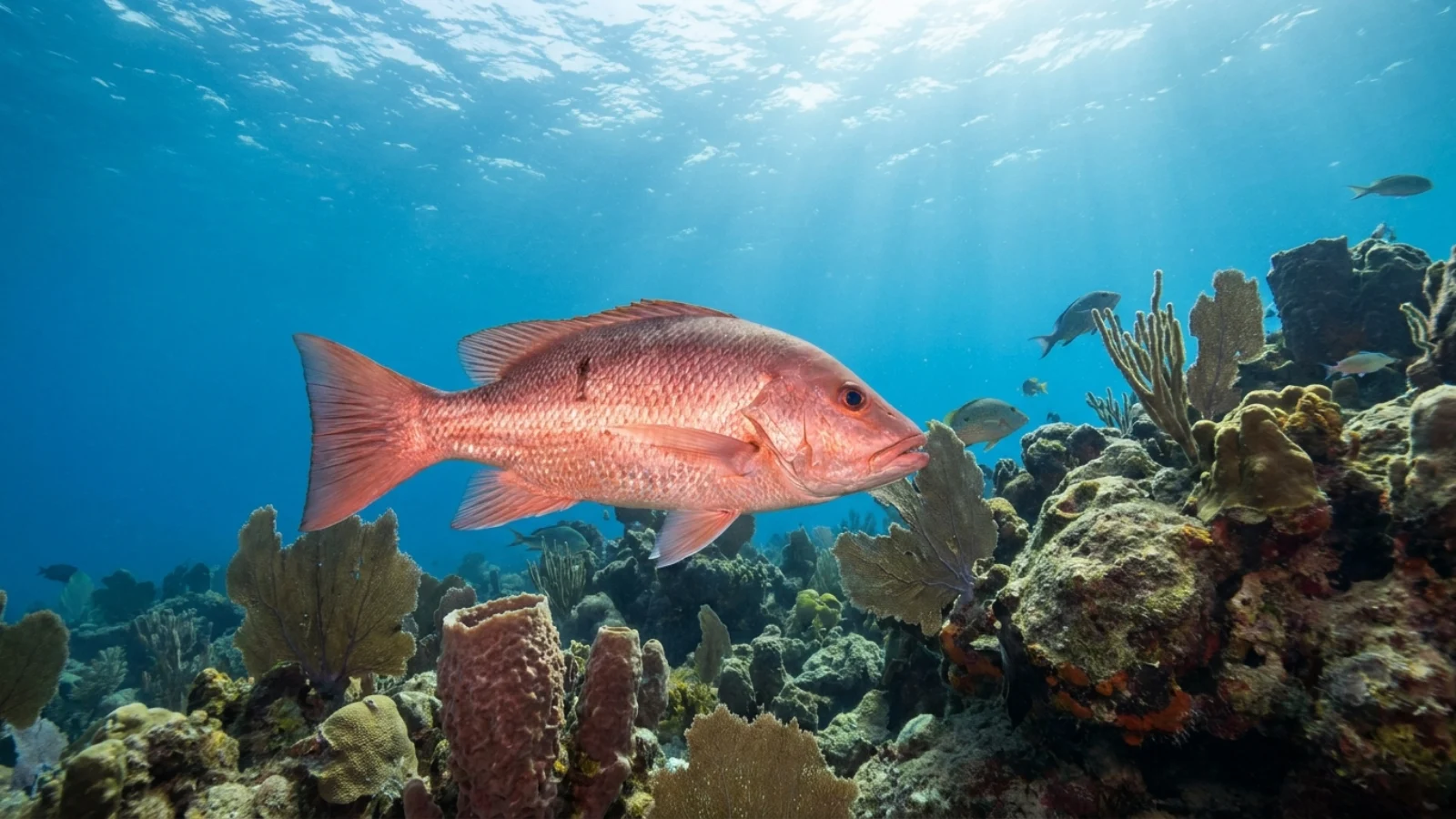
How big and how old do red snapper get?
Red snapper commonly reach 24 inches and about 10 lb, can grow past 39 inches and 50 lb, and have been aged to at least 57 years.
The IGFA all-tackle record weighed 50 lb 4 oz and was caught in the Gulf of Mexico off Louisiana in 1996. Fish over 40 lb have been taken several times, mostly from deep structure in the northern Gulf. Age is read from growth rings in the ear stones (otoliths), and those studies show that red snapper mature at 2 to 5 years but can keep growing and spawning for decades. Big, old females matter disproportionately: fecundity rises steeply with size, so a single large female produces many times more eggs than a small one, which is why rebuilding the age structure of the stock is central to its recovery.
Where do red snapper live?
Red snapper are bottom-associated fish of the Gulf of Mexico and the U.S. Atlantic coast, living over hard structure in 30 to 620 ft of water and most often between 30 and 200 ft.
Adults school by size over rocky ledges, ridges and natural reefs, and they gather in large numbers on artificial structure: shipwrecks, sunken vessels, concrete reef modules and the legs of oil and gas platforms. The northern Gulf, particularly off Alabama, the Florida Panhandle, Louisiana and Texas, holds the densest populations, and Alabama’s extensive artificial-reef zone is credited with building one of the most productive snapper fisheries in the region. Juveniles settle over open sand and mud, then move to oyster beds and low-relief habitat before recruiting to reefs.
Why is red snapper so heavily regulated?
Heavy fishing in the 20th century, plus the death of millions of juveniles as bycatch in shrimp trawls, drove Gulf red snapper to a fraction of historical levels by the 1980s.
The Gulf of Mexico Fishery Management Council introduced the first minimum size limit in 1984 and later split the quota between commercial and recreational sectors. A long rebuilding plan, individual fishing quotas for commercial boats, and turtle excluder and bycatch reduction devices on shrimp trawls have helped the stock grow. In 2018 and 2019, the independent Great Red Snapper Count, run by university scientists, estimated about 110 million red snapper age two and older in the Gulf, roughly three times the previous estimate, and led to larger quotas. Since 2020, each Gulf state manages its own private-angler season in both state and federal waters. The Atlantic stock remains more tightly restricted, with seasons often just a few days long.
How do red snapper reproduce?
Red snapper are broadcast spawners that release eggs over open bottom from late spring into early fall, with a peak in summer.
Females spawn repeatedly through the season, every few days, and a large female can release millions of eggs per year. The fertilized eggs and larvae drift in the plankton for about a month before settling to the bottom. Texas populations mature sooner and at smaller sizes than those off Louisiana and Alabama, one of several regional differences managers now account for.
How should anglers release red snapper?
Use a descending device. Red snapper caught from deep water suffer barotrauma, and federal rules require anglers to carry a descending device or venting tool so released fish survive.
A descending device clamps the fish’s lip and lowers it back to depth, where pressure recompresses the swim bladder; studies show it greatly improves survival over simply tossing fish back. Use circle hooks, minimize time out of water, and avoid releasing fish in front of sharks and dolphins, which in parts of the Gulf have learned to wait for released snapper. For related fish, see mangrove snapper, goliath grouper, the snapper family and our Sport & Game Fish hub.
How big do red snapper get?
Red snapper commonly reach about 24 in and 10 lb, and can grow to about 39 in. The IGFA all-tackle record is 50 lb 4 oz, caught in the Gulf of Mexico off Louisiana in 1996.
How long do red snapper live?
The oldest red snapper on record was at least 57 years old. Fish over 20 years old are uncommon today, but long life is one reason the species recovers slowly from overfishing.
How do you tell a red snapper from a vermilion snapper?
Red snapper are deeper-bodied with a red eye, a pointed anal fin and a uniformly rosy body. Vermilion snapper (beeliners) are slimmer and smaller, with rows of short blue lines and yellow streaks on the sides, and a protrusible upper jaw.
When is red snapper season in Florida?
Florida sets its own Gulf red snapper season for private anglers, usually a summer season starting around June plus additional fall days, while the South Atlantic season is typically only a few days in July. Dates change every year, so check FWC before you go.
Where do red snapper live?
Over hard bottom, rocky ledges, natural reefs, artificial reefs, shipwrecks and oil platforms in the Gulf of Mexico and along the U.S. Atlantic coast from the Carolinas to Florida, usually in 30 to 200 ft of water.
Are red snapper endangered?
They are listed as Vulnerable by the IUCN, reflecting heavy past overfishing. In U.S. waters the Gulf stock has been rebuilding under a federal plan, and the 2018–2019 Great Red Snapper Count estimated about 110 million fish age two and older in the Gulf.
Why do red snapper need descending devices?
Snapper reeled up from depth suffer barotrauma: their swim bladder expands and they cannot swim back down. Federal rules require anglers to have a descending device or venting tool ready so released fish can be returned to depth alive.
What do red snapper eat?
Adults eat small fish, crabs, shrimp, squid and other invertebrates, feeding mostly near the bottom around structure.
Blane Perun has been exploring Earth’s oceans and marine life for over 25 years. Founder of TheSea.Org in 1999, underwater photographer, coral aquaculture pioneer, and explorer of 80+ countries. Based in Southwest Florida, where tarpon, snook and redfish share the mangrove shorelines of the Gulf coast.
About Blane Perun → More on Sport & Game Fish →