Tulip Shell — The Snail-Eating Snails of Florida’s Grass Flats
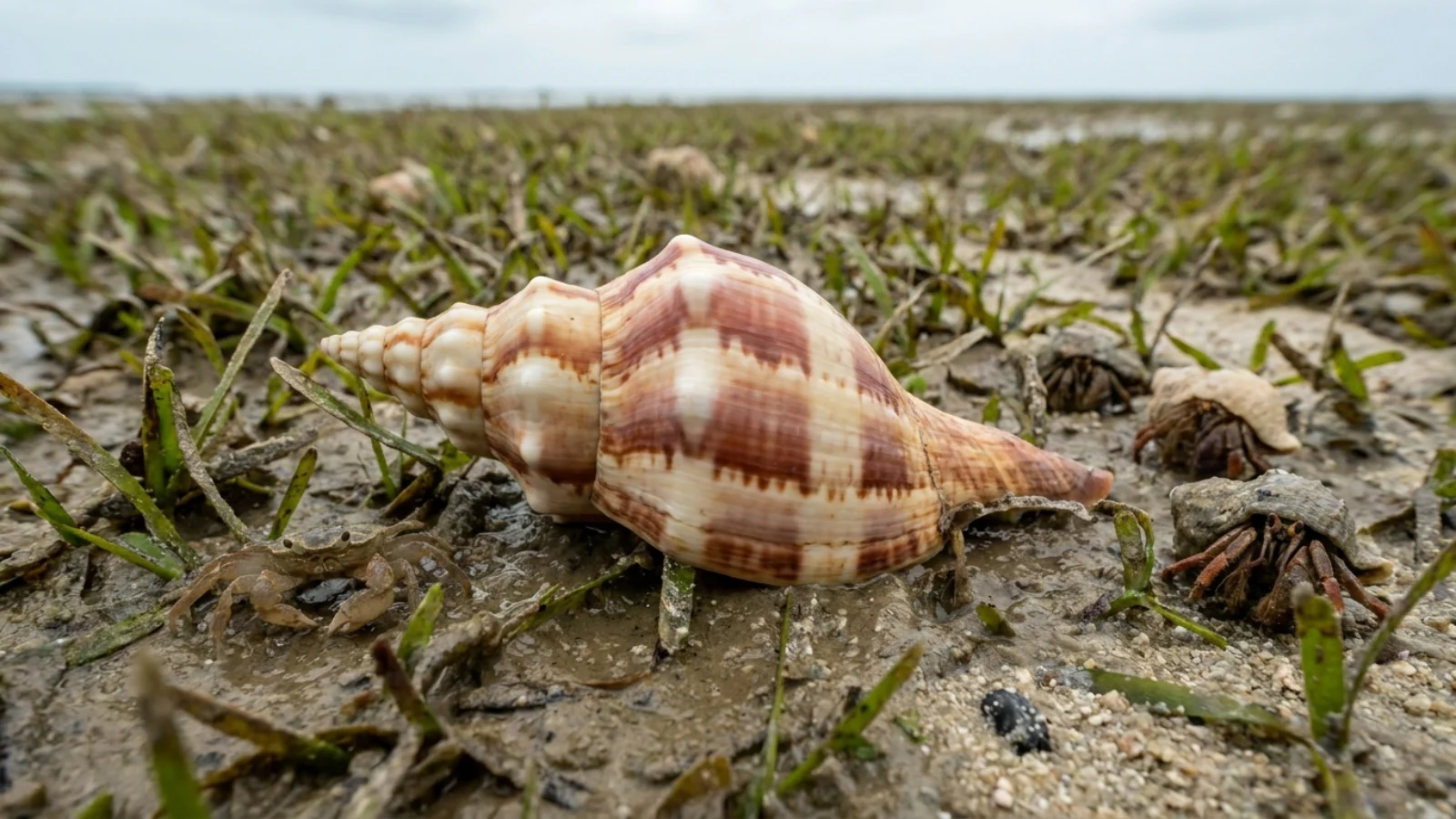
A tulip shell is the smooth, spindle-shaped shell of a predatory sea snail in the family Fasciolariidae, the same family as Florida’s giant horse conch. Florida has two well-known tulips: the banded tulip, up to about 10 cm, with thin, unbroken dark spiral lines, and the larger true tulip, up to about 25 cm, with broken lines and mottled color. Both live on sand and seagrass flats, eat other snails, and are favorite finds on Southwest Florida beaches.
How do you tell a banded tulip from a true tulip?
A banded tulip is smaller, with a smooth, pale shell crossed by thin, continuous dark spiral lines; a true tulip is larger, with mottled orange, brown or gray color and spiral lines that are broken or interrupted, plus fine ridges near the top of each whorl.
What do tulip snails eat?
Tulip snails are predators of other mollusks, especially snails; they attack whelks, other tulips and even small conchs, often by working their proboscis into the prey’s opening or prying it open with the shell lip.
Tulips are part of a striking food chain on Florida’s grass flats: tulips eat smaller snails and whelks, and the tulip’s giant relative, the horse conch, eats tulips. Researchers studying these flats have documented a whole hierarchy of snail-eating snails. Tulips lay clusters of flattened, vase-shaped egg capsules attached to shells or hard objects.
What is the horse conch?
The horse conch (Triplofusus giganteus) is the largest snail in North American waters, reaching about 60 cm, and in 1969 it became Florida’s official state shell; despite its name, it is a member of the tulip family, not a true conch.
Young horse conchs have a bright orange shell and animal, while adults become heavy and gray-brown, often covered with growth. They are major predators of whelks, tulips and other snails. Like all shells with living animals, they must be left alone in Lee County. Compare them with true conchs in our Conch Shell guide.
Where can you find tulip shells in Florida?
Tulip shells wash up on Gulf beaches from the Panhandle to Marco Island and are common on Sanibel, Captiva and Cayo Costa after winter cold fronts; live tulips are often seen on seagrass flats and in shallow bays.
Many beach tulips are occupied by hermit crabs, so look for legs and claws before you pick one up; see hermit-crab-habitat. For more Florida identification help, use our Types of Seashells table, and for timing, Shelling.
Banded tulips are one of the shells beginners and long-time shellers both love on our beaches. A fresh one with crisp lines and its glossy color intact is a highlight of any winter morning on the Sanibel and Marco shell lines.
| Shell | Family | Max size | Notes |
|---|---|---|---|
| Banded tulip | Fasciolariidae | ~10 cm | Common Florida beach find |
| True tulip | Fasciolariidae | ~25 cm | Larger, mottled, broken lines |
| Horse conch | Fasciolariidae | ~60 cm | Florida state shell (1969) |
| Pear whelk (look-alike) | Busyconidae | ~13 cm | Pear-shaped, low spire, fine lines |
More from the series: Lightning Whelk, murex shells, Best Shelling Beaches in Florida, gastropods.
What is a tulip shell?
The shell of a predatory sea snail in the family Fasciolariidae. Tulip shells are spindle-shaped with a long canal and are common in Florida.
What is the difference between a banded tulip and a true tulip?
Banded tulips are smaller with thin, unbroken spiral lines. True tulips are larger, with mottled color and many broken spiral lines.
What do tulip snails eat?
Other snails and mollusks, including whelks and other tulips.
How big do tulip shells get?
Banded tulips reach about 10 cm. True tulips can reach about 25 cm.
Is the horse conch a tulip?
It belongs to the same family, Fasciolariidae. The horse conch is Florida’s state shell and can reach about 60 cm.
Where can I find tulip shells?
On Florida Gulf beaches, especially Sanibel, Captiva, Cayo Costa, Naples and Marco Island after cold fronts, and alive on grass flats.
Do hermit crabs live in tulip shells?
Very often. Check every tulip for legs before picking it up; in Lee County you can’t take shells with hermit crabs inside.
Are tulip snails dangerous?
No. They are harmless to people.
Blane Perun has been exploring Earth’s oceans and marine life for over 25 years. Founder of TheSea.Org in 1999, underwater photographer, coral aquaculture pioneer, and explorer of 80+ countries. Based in Southwest Florida, home to some of the best shelling beaches in North America.
About Blane Perun → More on Seashells & Shelling →