Sailfish — Is the Sail-Finned Hunter Really the Fastest Fish in the Ocean?
The sailfish (Istiophorus platypterus) is often called the fastest fish in the ocean, credited with 68 mph (110 km/h). That figure comes from an old estimate based on line stripped from a reel, not a measurement. Studies of sailfish hunting and muscle physiology put their real burst speed far lower, likely under about 30 mph, though they remain among the quickest fish over short distances. Sailfish are slender billfish with an enormous, sail-like dorsal fin, typically 40–100 lb, and the Pacific record is 221 lb. In winter, Florida’s Atlantic coast off Stuart and Palm Beach is one of the world’s great sailfish grounds.
Sailfish
How fast is a sailfish, really?
The often-repeated speed of 68 mph traces back to fishing trials at the Long Key Fishing Camp in the Florida Keys in the early 20th century, where a hooked sailfish was timed taking line off a reel. That method measures the reel, not the fish.
Modern research tells a different story. A 2015 study that filmed sailfish attacking sardine schools off Mexico’s Yucatán coast recorded maximum speeds of only around 7–8 m/s (roughly 15–19 mph) during attacks, and a 2016 study of muscle contraction times in sailfish, marlin and other fast fish concluded that sailfish are physiologically limited to roughly 10–15 m/s (22–34 mph). That still makes them among the fastest fish over short bursts, alongside wahoo, marlin and tunas, but it means the 68 mph number belongs in the record books of myth. For the full ranking, see our guide to the fastest fish in the ocean.
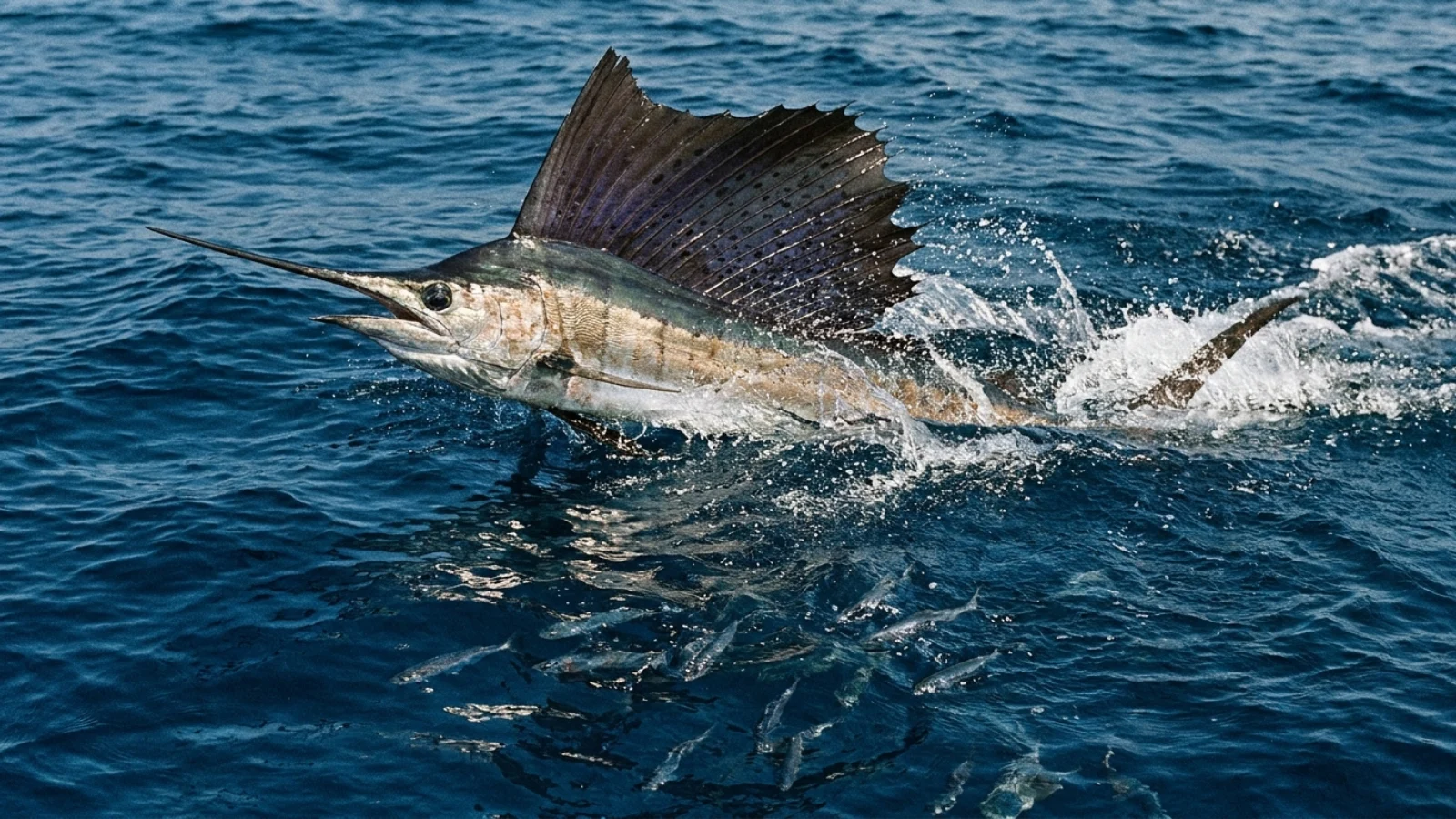
What is the sailfish’s sail for?
The sail is an enormous, blue-black dorsal fin, taller than the fish’s body is deep, which the sailfish raises and lowers at will.
When a sailfish swims fast, the sail folds flat into a groove along the back, along with the long pelvic fins, to reduce drag. It goes up when the fish slows to hunt, display or turn sharply. Researchers have suggested several functions: raising the sail makes the predator look larger, helps herd fish into a tight ball, and steadies the head so the bill can be swept through prey with minimal body movement. Sailfish also flash vivid colors while hunting, lighting up blue stripes and darkening the body, which may coordinate group hunting and confuse prey.
How do sailfish hunt?
Sailfish hunt in groups. They herd sardines and other schooling fish into a dense bait ball near the surface, then take turns slashing through it with their bills.
High-speed video shows that a sailfish inserts its bill into the school and whips it sideways or taps prey with tiny, rough denticles on the bill, injuring or stripping scales from one or two fish per attack. Injured fish fall out of the school and are picked off. Because each fish attacks in turn, the group benefits from a steady supply of wounded prey, and the attacks become more successful as the bait ball degrades. Diets include sardines, anchovies, ballyhoo, mackerel, jacks, juvenile mahi, flying fish and squid.
How big do sailfish get?
Sailfish grow quickly but stay much lighter than marlin. Most weigh 40 to 100 lb and measure 6 to 8 ft including the bill.
Pacific sailfish are larger than those in the Atlantic. Carl Stewart’s 221-lb fish from Santa Cruz Island in the Galápagos, Ecuador, caught in 1947, remains the IGFA all-tackle record, while the largest Atlantic fish have come from West Africa off Angola. Sailfish grow extremely fast in their first year, and tag-and-release programs have documented fish at liberty for more than a decade.
Where do sailfish live?
Sailfish live in tropical and subtropical waters of all oceans, often closer to shore than other billfish, and favor current edges, color changes and areas where bait concentrates.
Most authorities now treat Atlantic and Indo-Pacific sailfish as one species, Istiophorus platypterus, though Atlantic fish are smaller. Famous fisheries include Guatemala’s Pacific coast, Costa Rica and Panama, Isla Mujeres and Cancun (where winter sardine runs bring huge numbers), Kenya, and South Florida, where the Gulf Stream runs close to the beach and winter cold fronts push bait and sailfish south along the coast.
| Species | Record | Typical adult | Dorsal fin | IUCN |
|---|---|---|---|---|
| Sailfish | 221 lb (Pac.) | 40–100 lb | Huge sail, taller than body | VU |
| White marlin | 181 lb 14 oz | 40–80 lb | Rounded, moderately tall | LC |
| Striped marlin | 494 lb | 100–200 lb | Tall, pointed | LC |
| Blue marlin | 1,402 lb | 200–400 lb | Lower, pointed | VU |
Is the sailfish endangered?
The IUCN lists the sailfish as Vulnerable, reflecting declines driven by bycatch in tuna and swordfish longlines and coastal gillnets, particularly in the eastern Pacific and Indian Ocean.
In U.S. Atlantic waters, sailfish cannot be sold, and recreational anglers must use circle hooks with natural baits in billfish tournaments and meet a 63-inch minimum size to keep a fish. In practice, nearly every sailfish caught off Florida is released, and many are tagged. The western Atlantic stock is assessed by ICCAT as overfished but not currently subject to overfishing.
Where can you see sailfish in Florida?
The best sailfish water in Florida is the Atlantic coast from Fort Pierce and Stuart to Palm Beach, Miami and the Keys, from December through March.
From Southwest Florida, the nearest reliable winter sailfish are off the Keys and the southeast coast; in the Gulf, sailfish appear over deep water and along offshore weedlines in summer. See more billfish in marlin, swordfish vs marlin and the Sport & Game Fish hub.
How fast can a sailfish swim?
The famous 68 mph (110 km/h) figure is an old estimate from line peeling off a reel. Video studies of hunting sailfish recorded bursts of roughly 15 to 25 mph, and a muscle study concluded top speeds are unlikely to exceed about 22 to 34 mph. Sailfish are fast, but not as fast as the myth.
Why do sailfish have a sail?
The sail is raised during hunting and display. Sailfish lift it when approaching a bait ball, which helps herd prey and stabilizes the head so the bill can slash with precision. It folds into a groove on the back when the fish swims at speed.
How big do sailfish get?
Most sailfish weigh 40 to 100 lb and measure 6 to 8 ft including the bill, with a maximum of about 11 ft. The IGFA Pacific record is 221 lb, from Santa Cruz Island, Ecuador, in 1947; Atlantic fish are smaller, with a record of about 142 lb from Angola.
How do sailfish hunt?
Groups of sailfish surround schools of sardines or anchovies, taking turns to slash through the ball with their bills. Each strike injures one or two fish, which are then easy to catch. Their bills carry tiny tooth-like denticles that wear down over time.
Are there sailfish in Florida?
Yes. Florida’s Atlantic coast from Jupiter and Stuart to Miami and the Keys has a world-famous winter sailfish run, peaking from December to March, when cold fronts push bait south. Sailfish also occur in the Gulf, especially over deeper water.
Can you eat sailfish?
Sailfish are edible but tough and strong-tasting, and in Florida they are almost always released. Federal rules prohibit selling Atlantic sailfish and set a 63-inch minimum size for retention.
Is the sailfish endangered?
It is classed as Vulnerable on the IUCN Red List (2022), mainly because of bycatch in commercial longline and gillnet fisheries. Recreational fisheries release the great majority of fish.
Is sailfish the Florida state fish?
Yes. The Atlantic sailfish was designated Florida’s state saltwater fish in 1975. The largemouth bass is the state freshwater fish.
Blane Perun has been exploring Earth’s oceans and marine life for over 25 years. Founder of TheSea.Org in 1999, underwater photographer, coral aquaculture pioneer, and explorer of 80+ countries. Based in Southwest Florida, where tarpon, snook and redfish share the mangrove shorelines of the Gulf coast.
About Blane Perun → More on Sport & Game Fish →