Swordfish — The Broadbill With Heated Eyes and a 1,182-lb Record
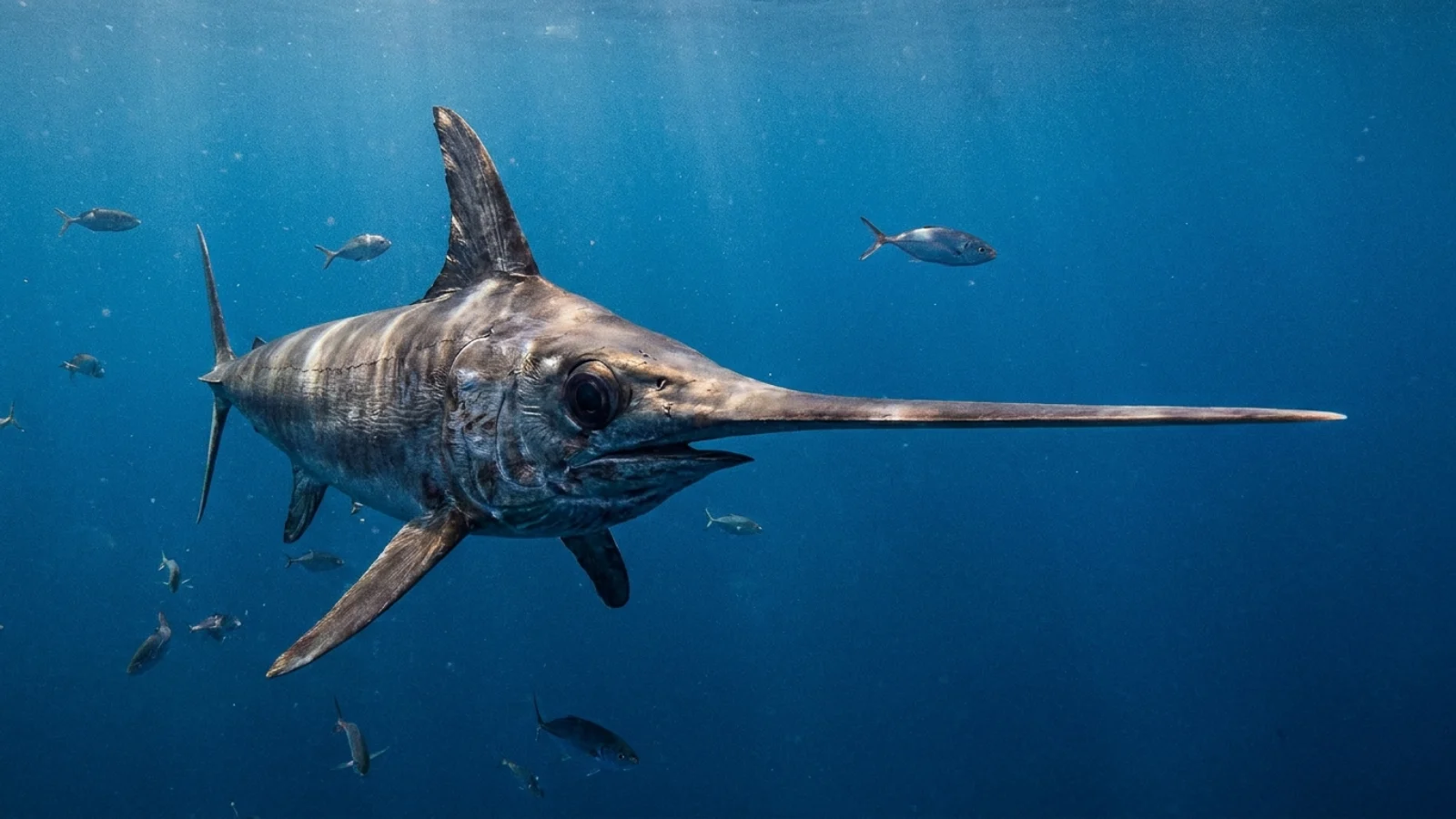
The swordfish (Xiphias gladius), or broadbill, is a large predatory billfish with a long, flat, sword-shaped bill, the only living member of the family Xiphiidae. Adults have no scales, teeth or pelvic fins. Swordfish range through tropical and temperate oceans worldwide, diving below 1,000 m by day and rising toward the surface at night, and they carry a special heater organ that warms their eyes and brain. They commonly weigh 50–200 kg, and the IGFA all-tackle record is 1,182 lb, caught off Iquique, Chile, in 1953.
Swordfish
How do you identify a swordfish?
The flat bill is the giveaway. A swordfish’s bill is broad and flattened like a blade and makes up about a third of its length, far longer and flatter than a marlin’s round spear.
Adult swordfish are built differently from every other billfish. They have no scales, no teeth and no pelvic fins, and the first dorsal fin is short, tall and rigid, more like a shark’s than a marlin’s folding sail. The body is dark bronze-purple to black above and silvery below, the eyes are enormous, and a single strong keel runs along each side of the tail base. Juveniles look very different, with scales, teeth, and a long continuous dorsal fin, and they lose these features as they grow. For a side-by-side look at the anatomy, see our swordfish vs marlin guide.
| Species | IGFA record | Bill | Scales | Pelvic fins | IUCN |
|---|---|---|---|---|---|
| Swordfish | 1,182 lb | Flat, very long | None (adult) | None | NT |
| Blue marlin | 1,402 lb | Round spear | Yes | Yes | VU |
| Black marlin | 1,560 lb | Round spear | Yes | Yes | DD |
| Striped marlin | 494 lb | Round spear | Yes | Yes | LC |
| Sailfish | 221 lb | Round, slender | Yes | Yes (long) | VU |
How big do swordfish get?
Swordfish are among the largest bony fish in the ocean, reaching about 4.5 m and more than 650 kg, although most adults landed today weigh 50 to 200 kg.
As in marlin, the giants are female. Male swordfish rarely exceed about 100 kg, while females grow larger and live longer, so nearly every fish over 300 lb is female. Louis Marron’s 1,182-lb swordfish, taken off Iquique, Chile, on May 7, 1953, has stood as the IGFA all-tackle record for more than seven decades. The Humboldt Current off Chile and Peru produced most of the great broadbill of that era, while today the largest rod-and-reel fish usually come from the Florida Straits, the Gulf of Mexico and the Pacific off Mexico.
Why do swordfish have heated eyes and brains?
Swordfish carry a heater organ, a modified eye muscle packed with mitochondria and insulated by fat, that warms the eyes and brain well above the temperature of the surrounding water.
By day a swordfish may hunt at 500 to over 1,000 m, where water can be below 10°C and light is almost gone. Cold slows the retina, so a cold-blooded fish would see fast-moving prey as a blur. Research published in Current Biology in 2005 showed that warming the swordfish retina improves its ability to detect rapid motion many times over. The swordfish’s eyes are also among the largest of any fish, about the size of a softball, so the predator combines a huge light-gathering lens with a warmed, fast-processing retina. Marlin and sailfish have similar heater tissue, but the swordfish’s is the most developed.
Where do swordfish live?
Swordfish occupy more of the ocean than almost any other billfish, from tropical seas to cool temperate waters at roughly 45° north and south, including the Mediterranean.
They favor areas where currents meet steep bottom: continental slopes, canyons and seamounts, and the edges of major currents such as the Gulf Stream and Humboldt Current. Spawning takes place in warm tropical and subtropical water, and in the North Atlantic the Caribbean, the Gulf of Mexico and the waters off South Florida are important spawning and nursery grounds. Each day swordfish make a vertical migration, descending to deep, dark water by day and rising to the upper layers at night, tracking the squid and lanternfish of the deep scattering layer.
What do swordfish eat?
Squid and fish. Swordfish are opportunistic predators that feed from the surface to the deep, and squid are among the most important prey worldwide.
Stomach studies record squid, mackerel, hake, barracuda, bluefish, herring, lanternfish and a range of deep-sea fishes, alongside crustaceans. The bill is used to slash sideways, wounding or stunning prey, a behavior documented in modern stomach-content and video studies. Adult swordfish have few natural predators beyond shortfin mako sharks and killer whales, and there are records of makos found with swordfish bills embedded in them, so the bill is also a defense. The swordfish is in turn a top predator of squid; see what eats squid.
Are swordfish endangered?
No. Swordfish are classed as Near Threatened on the IUCN Red List, and the North Atlantic stock is a rare fisheries success story.
By the late 1990s, longline fishing had driven North Atlantic swordfish to low levels, with the average landed fish shrinking sharply. Quotas set by ICCAT, U.S. closure of nursery areas off Florida and in the Gulf to longlining, and a consumer campaign called “Give Swordfish a Break” helped the stock recover, and it was declared rebuilt in 2009. The South Atlantic and Mediterranean stocks have fared worse. Because swordfish are large, long-lived predators, they carry high mercury levels, and the FDA advises pregnant women and young children not to eat them.
How do Florida anglers catch swordfish?
South Florida pioneered daytime deep-drop swordfishing, sending baits 1,500 ft or deeper along the edge of the Florida Straits, while traditional night drifting near the surface still works in the Keys and the Gulf.
The Florida Straits between Miami, the Keys and the Bahamas concentrate swordfish close to shore, which is why Miami, Islamorada and Key West became the world centers of the daytime fishery. The Gulf of Mexico’s deep slope off the Panhandle and Louisiana also holds broadbill. Recreational anglers need a federal HMS permit and must follow minimum size and retention rules. Explore more billfish in our marlin guide, the sailfish profile and the Sport & Game Fish hub.
How big do swordfish get?
Swordfish reach about 4.5 m (15 ft) and more than 650 kg. Most fish caught today weigh 50 to 200 kg. The IGFA all-tackle record is 1,182 lb, caught by Louis Marron off Iquique, Chile, on May 7, 1953.
What is the difference between a swordfish and a marlin?
Swordfish have a long, flat bill, no scales, no pelvic fins and a short, rigid dorsal fin; they are the only species in the family Xiphiidae. Marlin have a shorter, round bill, scales, pelvic fins and a long dorsal fin that folds into a groove, and belong to Istiophoridae.
Do swordfish use their sword to stab prey?
Not usually. Swordfish slash sideways with the bill to injure or stun squid and fish, then swallow them. Prey found in swordfish stomachs often bear slash wounds rather than puncture wounds.
Why do swordfish have heated eyes?
A heater organ made of modified eye muscle warms the eyes and brain well above the surrounding water. Warm retinas process movement much faster, which helps swordfish detect fast prey in the cold, dark water hundreds of meters down.
How deep do swordfish dive?
Satellite tags show swordfish routinely spend the day at depths of 500 to more than 1,000 m and rise toward the surface at night, following the vertical migration of squid and lanternfish.
Are there swordfish off Florida?
Yes. The Florida Straits off Miami and the Keys are one of the world’s best swordfish grounds, with a daytime deep-drop fishery that sends baits 1,500 ft or deeper. The eastern Gulf also holds swordfish along the continental slope.
Are swordfish endangered?
No. The IUCN lists the swordfish as Near Threatened. The North Atlantic stock, heavily overfished by the 1990s, was declared rebuilt in 2009 after strict quotas and the closure of nursery areas, but some southern stocks remain overfished.
Is swordfish safe to eat?
Swordfish is widely eaten, but as a large, long-lived predator it accumulates mercury. The FDA advises pregnant women and young children to avoid it.
Blane Perun has been exploring Earth’s oceans and marine life for over 25 years. Founder of TheSea.Org in 1999, underwater photographer, coral aquaculture pioneer, and explorer of 80+ countries. Based in Southwest Florida, where tarpon, snook and redfish share the mangrove shorelines of the Gulf coast.
About Blane Perun → More on Sport & Game Fish →