Wahoo — The Razor-Toothed Speedster of the Blue Water
The wahoo (Acanthocybium solandri) is a long, slender, fast predatory fish of tropical and subtropical oceans, the largest member of the mackerel family after the tunas. It has an iridescent blue back with vertical tiger-like bars, a pointed, beak-like snout and rows of razor-sharp, triangular teeth. Wahoo typically weigh 30–60 lb, reach about 2.5 m (8 ft), and the IGFA record is 184 lb. Famous for scorching first runs, they are often listed among the fastest fish in the ocean, with bursts estimated near 50 mph.
Wahoo
How do you identify a wahoo?
A torpedo-shaped body far longer and slimmer than a tuna’s, an iridescent electric-blue back, 24 to 30 vertical blue-black bars, a long beak-like snout and a mouthful of flat, triangular teeth.
The first dorsal fin is long and low, with 23 to 27 spines, running about a third of the body length. The tail is a stiff, narrow crescent, and small finlets line the back and belly before it. The bars glow when the fish is excited and fade within minutes of death. The wahoo’s closest lookalike, the king mackerel, has a much shorter first dorsal fin, lacks bars as an adult and has a distinctive dip in its lateral line. Unlike kingfish and other mackerels, the wahoo’s upper jaw is not protrusible; the jaws work like a pair of serrated shears.
| Species | IGFA record | Typical catch | Pattern | First dorsal | IUCN |
|---|---|---|---|---|---|
| Wahoo | 184 lb | 30–60 lb | Vertical blue bars | Long, 23–27 spines | LC |
| King mackerel | 93 lb | 10–30 lb | Plain silver (adult) | Short | LC |
| Spanish mackerel | 13 lb | 1–4 lb | Yellow spots | Short, black front | LC |
| Cero mackerel | 17 lb 2 oz | 2–8 lb | Yellow stripe + spots | Short | LC |
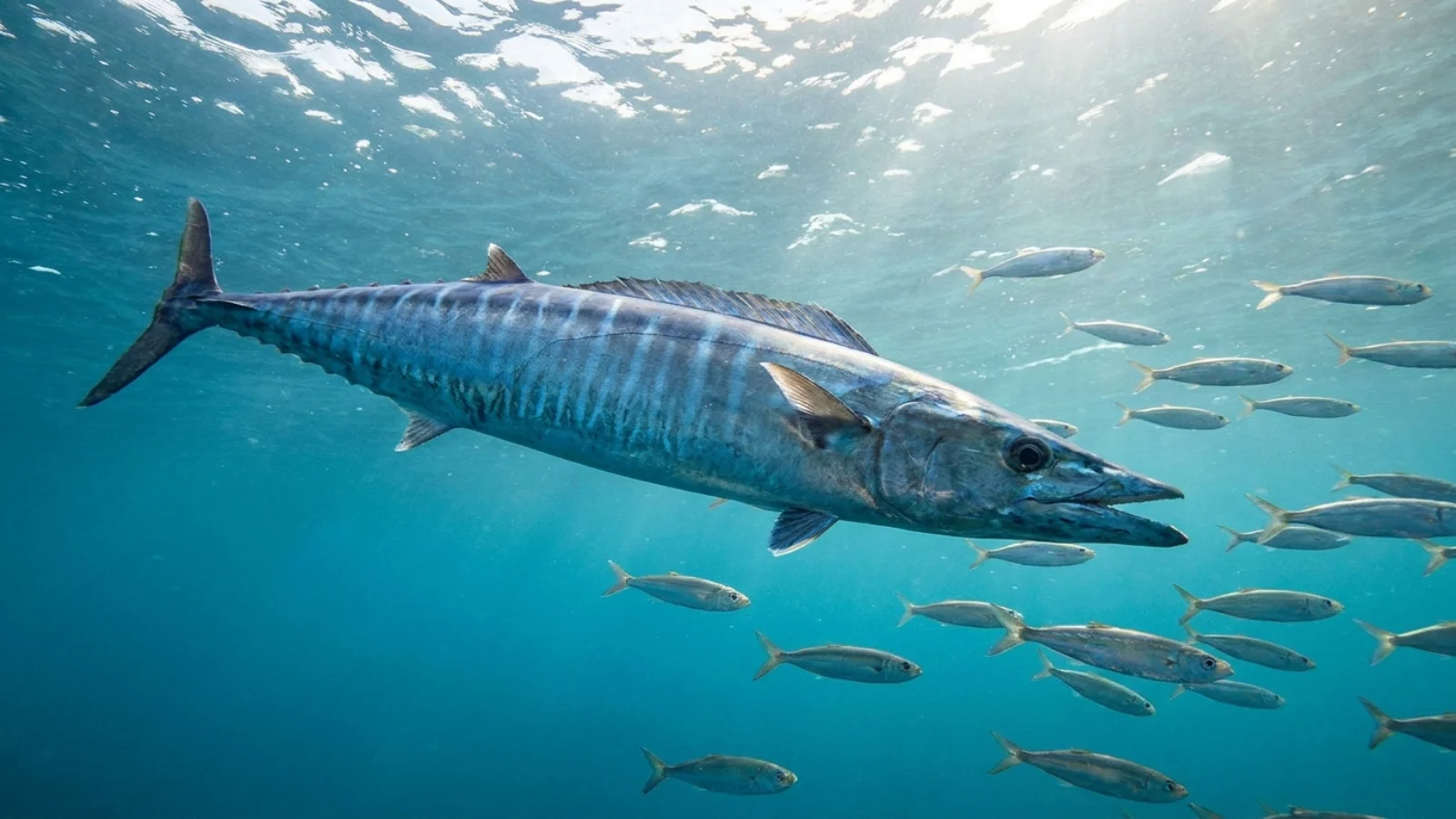
How fast is a wahoo?
Wahoo regularly appear in lists of the fastest fish, with bursts commonly quoted at about 48 to 50 mph. The famous figure dates to measurements in the 1960s that timed fish taking line from a reel.
As with sailfish, reel-based estimates are now viewed with caution, and the true top speed of a free-swimming wahoo has not been precisely measured. What is not in doubt is the wahoo’s design for speed: a rigid, streamlined body, fins that fold into grooves, a high-aspect-ratio tail and powerful red muscle. Studies of wahoo physiology show they also have very high gill surface area and metabolic rates, more like tunas than typical mackerels. Anglers describe the first run of a big wahoo as the fastest thing they have ever felt on a reel.
Where do wahoo live?
Wahoo live in tropical and subtropical waters of all oceans, including the Caribbean and the Gulf of Mexico, usually in clear, warm water.
They favor structure in the open ocean: steep drop-offs, seamounts, offshore banks, the edges of currents like the Gulf Stream, and floating debris and weedlines that also hold mahi. Unlike tunas, wahoo are often solitary or travel in small, loose groups, although fall and winter concentrations around the Bahamas, Bermuda and the Florida Keys produce excellent fishing. Satellite tagging has shown that wahoo can move long distances but also spend extended periods around productive structure.
What do wahoo eat?
Wahoo are fish-eaters first: small tunas, mackerels, flying fish, jacks, butterfish and squid make up most of their diet.
Their hunting method is simple and devastating. A wahoo accelerates into a fish and slices it in half with its serrated teeth, then turns back to eat the pieces. Anglers frequently reel in baits or even hooked fish bitten cleanly in two. Wahoo are in turn eaten by large sharks, blue marlin and other billfish.
How fast do wahoo grow and reproduce?
Wahoo grow quickly and mature young, reaching spawning size in about a year and growing to 30 lb or more within two years.
They spawn over a long season in warm water, releasing large numbers of eggs, and most wahoo live only five to nine years. Like mahi, this fast pace of life makes them relatively resilient to fishing, and the IUCN lists the species as Least Concern. In U.S. Atlantic and Gulf waters, recreational anglers are limited to two wahoo per day.
Where can you catch wahoo off Florida?
The most consistent Florida wahoo fishing is along the Gulf Stream off the Florida Keys and Palm Beach, especially from late fall to early spring, and over deep Gulf ledges and oil platforms.
From Southwest Florida, wahoo require long runs to deep water, but they are taken over the Florida Middle Grounds and the deep ledges of the eastern Gulf. See also king mackerel, fastest fish in the ocean and the Sport & Game Fish hub.
How fast can a wahoo swim?
Wahoo are commonly credited with bursts of about 48 to 50 mph (77–80 km/h), based on mid-20th-century measurements of fish taking line from a reel. Their slender body, stiff crescent tail and retractable fins make them among the fastest fish in the sea over short distances.
Are wahoo teeth dangerous?
Yes. Wahoo have rows of flat, triangular, serrated teeth that slice through monofilament line and can badly cut fingers. Anglers use wire leaders and handle landed fish with care.
How big do wahoo get?
Most wahoo caught weigh 30 to 60 lb, and fish over 100 lb are trophies. The IGFA all-tackle record is 184 lb, a mark shared by two fish caught off Mexico’s Baja peninsula in 2005.
What is the difference between a wahoo and a king mackerel?
Wahoo have a long, beak-like snout, a long first dorsal fin with many spines, vertical blue bars and an upper jaw that does not hinge up when the mouth opens. King mackerel have a shorter snout, a short first dorsal fin, an abrupt dip in the lateral line, and no bars as adults.
Is wahoo good to eat?
Yes. Wahoo has firm, white, mild flesh and is sold in Hawaii as ono, which means “delicious” or “good to eat.”
Where do wahoo live?
In tropical and subtropical waters worldwide, usually near drop-offs, seamounts, current edges and floating debris. In Florida they are caught off the Keys, Palm Beach and over deep Gulf ledges.
When is wahoo season in Florida?
Wahoo are caught year-round, but the best fishing in the Florida Keys and Bahamas is typically late fall through early spring, with many anglers favoring the days around the full moon.
Are wahoo endangered?
No. The IUCN lists the wahoo as Least Concern. Its fast growth, early maturity and wide range make it relatively resilient.
Blane Perun has been exploring Earth’s oceans and marine life for over 25 years. Founder of TheSea.Org in 1999, underwater photographer, coral aquaculture pioneer, and explorer of 80+ countries. Based in Southwest Florida, where tarpon, snook and redfish share the mangrove shorelines of the Gulf coast.
About Blane Perun → More on Sport & Game Fish →