Tripletail — The Fish That Plays Dead Under Buoys and Floating Debris
The Atlantic tripletail (Lobotes surinamensis) is a deep-bodied, mottled brown-to-gold fish named for its rounded dorsal and anal fin lobes, which sit so far back that the fish appears to have three tails. It is famous for floating on its side at the surface beside crab-trap buoys, channel markers, pilings and drifting sargassum, mimicking a dead leaf or debris to ambush prey. Most weigh 2–15 lb, and the IGFA record is 42 lb 5 oz. Tripletail occur in warm coastal waters worldwide; in Florida they carry an 18-inch minimum and a 2-fish limit.
Atlantic Tripletail
How do you identify a tripletail?
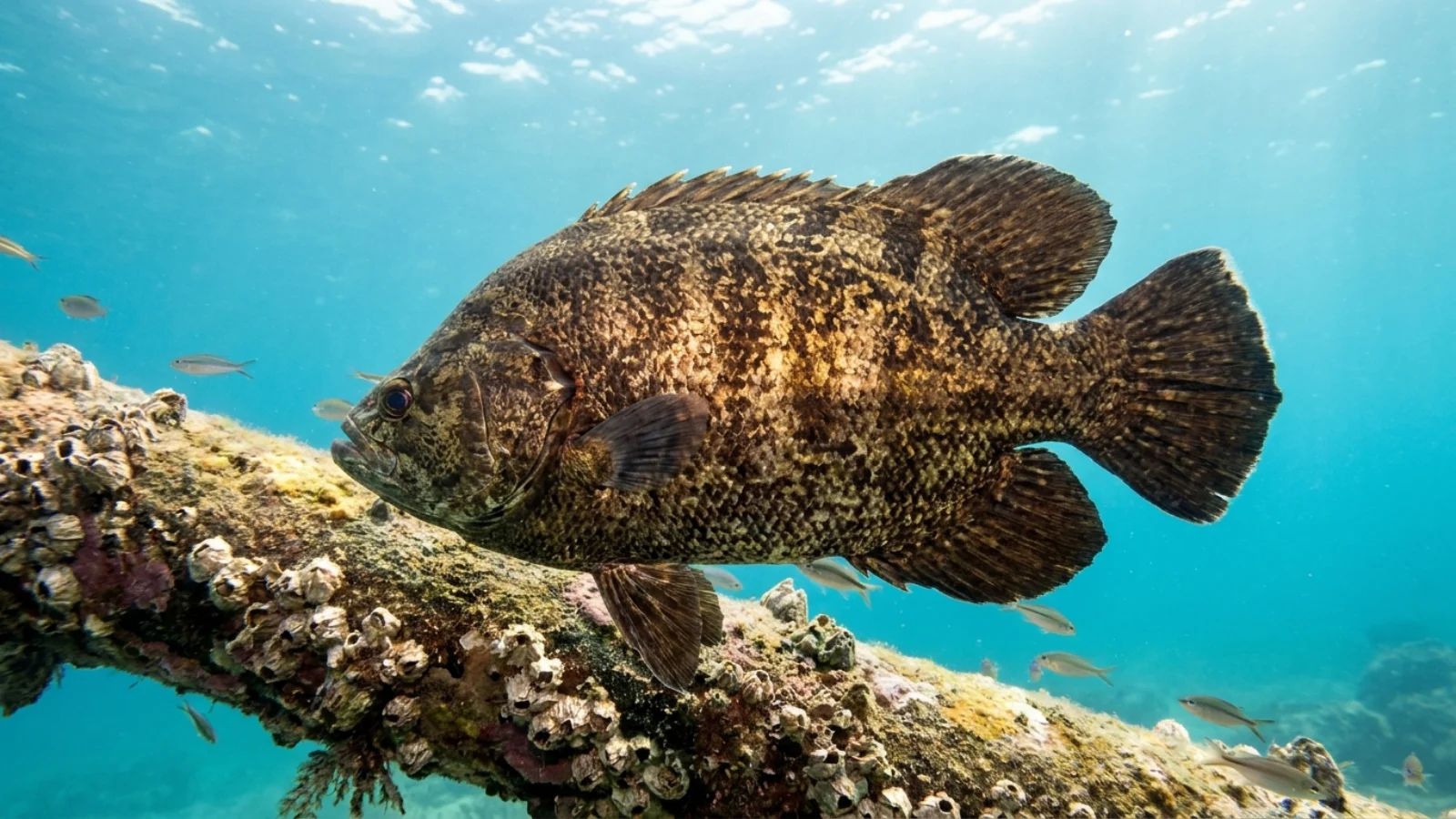
A deep, compressed, almost bass-like body, a concave head profile, small eyes, a rough mottled skin of brown, gold, gray or black, and three rounded “tails”: the soft dorsal lobe, the anal lobe and the true tail.
Color varies dramatically with the background, from bright yellow under sargassum to dark brown beside a black buoy, and individual fish change color in seconds. Juveniles are mottled yellow-brown and drift on their sides like fallen mangrove leaves. Tripletail are not closely related to bass or grouper; their family, Lobotidae, contains only a handful of species worldwide.
Why do tripletail play dead?
Tripletail are sit-and-wait predators that use floating objects as both cover and bait. By lying on their side at the surface they look like debris, and prey that gathers under floating objects swims straight to them.
This is the same principle that draws mahi mahi and cobia to weedlines and buoys, but the tripletail takes it further with active mimicry. Juvenile batfish in the Indo-Pacific use a similar dead-leaf disguise, one of many marine animals, from fish to the leaf sheep sea slug, that borrow the look of plants. Anglers exploit the habit by idling along crab-trap lines and channel markers, scanning for the dark, tilted shape next to each float.
Where do tripletail live?
The Atlantic tripletail is found in warm coastal waters on both sides of the Atlantic and in the Mediterranean, including the Gulf of Mexico and Caribbean; closely related tripletails live in the Indo-Pacific.
In U.S. waters, tripletail range north to the Chesapeake Bay and Massachusetts in summer but are most common from the Carolinas around Florida to Texas. They use bays, estuaries, passes and nearshore Gulf waters, sometimes entering brackish rivers. In Southwest Florida, the stone-crab trap lines off Naples, Marco Island and Charlotte Harbor are prime tripletail territory from spring through fall.
What do tripletail eat?
Shrimp, crabs and small fish that shelter under floating objects or drift past on the tide.
A tripletail lying beside a buoy will often turn upright and rush a passing shrimp or crab, then drift back into position. Anglers present live shrimp under a cork upcurrent of the fish so it drifts naturally past.
Where can you see tripletail in Southwest Florida?
Look along stone-crab trap lines, channel markers and floating weed in calm, clear conditions from spring through fall.
See also cobia, sheepshead, mahi mahi and the Sport & Game Fish hub.
Why do tripletail float on their sides?
It is camouflage. Lying on its side at the surface, a mottled brown or gold tripletail looks like a dead leaf, a piece of wood or a clump of weed. Small fish and shrimp that seek shelter under floating objects swim close, and the tripletail ambushes them. The posture may also hide it from predators.
Why is it called a tripletail?
Its soft dorsal and anal fins have large, rounded lobes set far back on the body, level with the tail fin. Seen from the side, the fish looks like it has three tails.
How big do tripletail get?
Most are 2 to 15 lb and 15 to 25 inches; fish over 20 lb are rare. The IGFA all-tackle record is 42 lb 5 oz, from Zululand, South Africa, in 1989.
Where can you find tripletail in Florida?
Around crab-trap buoys, channel markers, pilings, bridges and floating sargassum or debris, along both coasts. On the Gulf coast they are common from spring through fall, especially along stone-crab trap lines.
Are tripletail good to eat?
Yes. Tripletail have firm, white, mild flesh and are highly regarded as table fare. Florida allows two per angler with an 18-inch minimum total length.
Can tripletail change color?
Yes. They shift from light yellow-gold to dark brown or almost black within seconds to match their surroundings, which helps the floating-leaf disguise.
Blane Perun has been exploring Earth’s oceans and marine life for over 25 years. Founder of TheSea.Org in 1999, underwater photographer, coral aquaculture pioneer, and explorer of 80+ countries. Based in Southwest Florida, where tarpon, snook and redfish share the mangrove shorelines of the Gulf coast.
About Blane Perun → More on Sport & Game Fish →