Amberjack — The Reef Donkey of Gulf Wrecks and Ledges
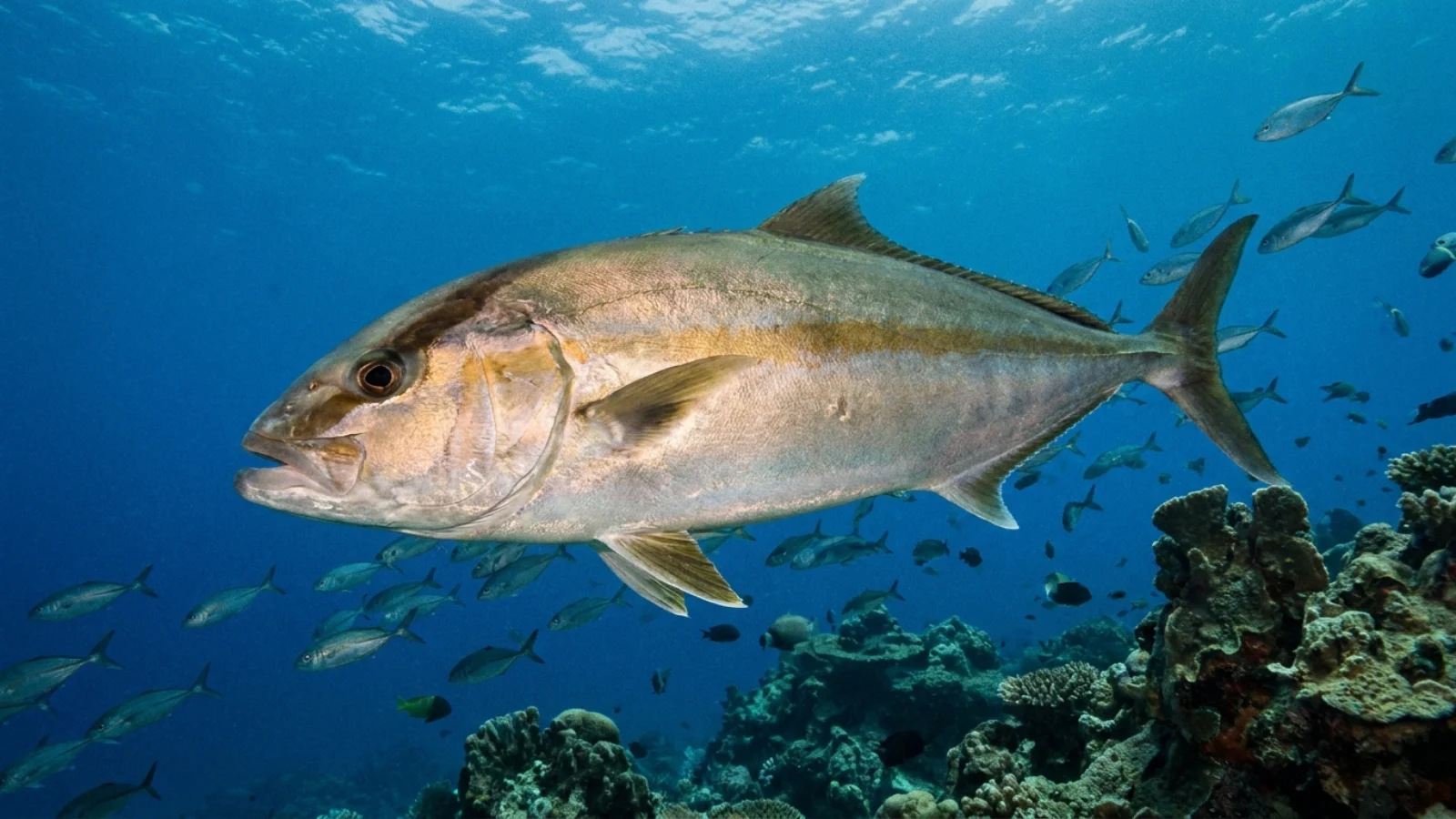
The greater amberjack (Seriola dumerili) is the largest member of the jack family, a powerful, brassy-silver fish with an amber stripe along its side and a dark diagonal band through the eye. It schools around wrecks, reefs, ledges and oil rigs in 18–75 m (60–250 ft) of water, typically weighs 20–40 lb, and can exceed 150 lb; the IGFA record is 155 lb 12 oz. Its habit of diving straight back into structure when hooked earned it the nickname “reef donkey.” Gulf of Mexico amberjack are tightly managed because the stock is overfished.
Greater Amberjack
How do you identify a greater amberjack?
Look for a long, powerful, brassy-silver body, an amber or yellow stripe running from the snout to the tail, a dark diagonal band through the eye, and a low second dorsal fin.
The eye band, called a nuchal bar, runs from the top of the head down through the eye and is darkest when the fish is excited. The tail is deeply forked, and there are no scutes, the hard scales lining the tail of many other jacks. Greater amberjack share wrecks with three close relatives, and anglers must tell them apart because size and bag limits differ.
| Species | Max size | Body | Second dorsal fin | Key mark |
|---|---|---|---|---|
| Greater amberjack | 155 lb (record) | Long, moderately compressed | Low | Amber stripe, eye band |
| Almaco jack | ~130 lb | Deep, compressed | Tall, sickle front | Steeper eye band |
| Lesser amberjack | ~10 lb | Small, deep | Low | Large eye, eye band |
| Banded rudderfish | ~10 lb | Small | Low | Dark bars as juvenile |
How big do amberjack get?
Greater amberjack are the largest jacks in the world, with most fish 20 to 40 lb, frequent fish over 60 lb, and a record of 155 lb 12 oz.
Larry Trott’s record fish came from Challenger Bank off Bermuda in 1981, and Bermuda, the Gulf and the Atlantic off the Carolinas and Florida still produce big fish. Females grow larger than males. Amberjack grow fast in the first few years, then slow, and most fish caught in the Gulf today are under ten years old.
Where do amberjack live?
Greater amberjack are found in warm seas around the world, and in the western Atlantic from Nova Scotia to Brazil, including the Gulf of Mexico, where they are a defining fish of offshore wrecks and rigs.
Adults school around high-relief structure, shipwrecks, artificial reefs, rocky ledges and oil and gas platforms, mostly in 60 to 250 ft of water, though they range deeper. Juveniles live under floating sargassum in the open Gulf and Atlantic before settling on reefs. Off Southwest Florida, amberjack are a staple of offshore wreck and ledge fishing beyond about 100 ft, and the Panhandle’s dense artificial reef zones off Destin and Panama City are among the best amberjack grounds in the country.
What do amberjack eat?
Amberjack are aggressive predators of fish, squid and crustaceans, feeding around the structure they live on and in the water column above it.
Blue runners, round scad, bonito, sardines and squid are favorites, which is why live baits jigged or dropped over wrecks are the classic method. Amberjack often rise in a school to inspect anything new, including divers, circling close with curiosity. They also host one of the oddities of Gulf fishing: the “spaghetti worms” found in the tail meat of larger fish, larval tapeworms whose adult stage lives in sharks.
Why are Gulf amberjack so heavily regulated?
The Gulf of Mexico greater amberjack stock has been assessed as overfished for many years, and despite repeated rebuilding plans it has been slow to recover.
Managers have responded with a large minimum size, a one-fish recreational limit, short open seasons and a spring closure during the spawning period. The South Atlantic stock is in better condition. Because seasons and size limits change frequently, anglers should check NOAA Fisheries and FWC before keeping an amberjack, and use descending devices for fish released from depth.
Where can you find amberjack off Southwest Florida?
Offshore wrecks, artificial reefs and rock ledges in 100 ft of water or more off Naples, Fort Myers and Sarasota reliably hold amberjack, along with the Florida Middle Grounds farther north.
Divers often see them swirling over wrecks at mid-depth. For related species, see jacks, cobia, red snapper and the Sport & Game Fish hub.
Why are amberjack called reef donkeys?
Because of how they fight. A hooked amberjack does not run in open water; it dives straight down into the wreck or reef it came from and pulls with stubborn, relentless power, often cutting the line on structure.
How big do greater amberjack get?
Most are 20 to 40 lb, and fish over 100 lb are caught occasionally. The IGFA all-tackle record is 155 lb 12 oz, caught at Challenger Bank, Bermuda, in 1981.
Are amberjack good to eat?
Yes, the firm white flesh is good, especially from smaller fish. Large amberjack may contain harmless “spaghetti worm” parasites in the tail meat, which are usually trimmed out. In some tropical areas big reef jacks can carry ciguatera toxin.
What are the worms in amberjack?
They are larval tapeworms that live in the muscle near the tail, completing their life cycle in sharks. They are not harmful to people once the fish is cooked, but most anglers cut them out.
What is the difference between greater amberjack and almaco jack?
Almaco jacks have a deeper, more compressed body, a taller, sickle-shaped front of the second dorsal and anal fins, and a more steeply angled eye band. Greater amberjack are longer and slimmer, and the second dorsal fin is low.
Where do amberjack live?
Worldwide in warm seas. In the Gulf of Mexico and off Florida they school around wrecks, artificial reefs, ledges and oil and gas platforms, usually in 60 to 250 ft of water.
When is amberjack season in the Gulf?
Gulf greater amberjack have short federal seasons, typically including part of spring before spawning closures and a fall opening, with a large minimum size and one-fish limits. Seasons change frequently, so check NOAA and FWC rules.
How long do amberjack live?
Greater amberjack can live about 15 to 17 years, maturing at three to four years old.
Blane Perun has been exploring Earth’s oceans and marine life for over 25 years. Founder of TheSea.Org in 1999, underwater photographer, coral aquaculture pioneer, and explorer of 80+ countries. Based in Southwest Florida, where tarpon, snook and redfish share the mangrove shorelines of the Gulf coast.
About Blane Perun → More on Sport & Game Fish →