Tuna Species — All 15 True Tunas, From Bluefin to Bullet Tuna
There are 15 species of true tuna, the tribe Thunnini within the mackerel family Scombridae, grouped into five genera: Thunnus (8 species, including bluefin, yellowfin, bigeye and albacore), Katsuwonus (skipjack), Euthynnus (3 little tunas), Auxis (frigate and bullet tunas) and Allothunnus (slender tuna). They range from the Atlantic bluefin, which can exceed 1,500 lb, to the bullet tuna at around 1 lb. Off Florida and in the Gulf, the common species are blackfin, yellowfin, skipjack and little tunny, with bluefin and bigeye offshore.
The True Tunas
What are the 15 tuna species?
The true tunas form the tribe Thunnini in the mackerel family. Here are all 15, from largest to smallest, with IGFA records where they exist.
| Species | Scientific name | Record / max size | Range | IUCN |
|---|---|---|---|---|
| Atlantic bluefin (FL offshore) | Thunnus thynnus | 1,496 lb | N. Atlantic, Med. | LC |
| Pacific bluefin | Thunnus orientalis | 907 lb 6 oz | N. Pacific | NT |
| Yellowfin (FL) | Thunnus albacares | 443 lb | Tropical oceans | LC |
| Bigeye (FL offshore) | Thunnus obesus | 435 lb (Pacific) | Tropical oceans | VU |
| Southern bluefin | Thunnus maccoyii | ~370 lb | Southern oceans | EN |
| Albacore | Thunnus alalunga | 88 lb 2 oz | Temperate & tropical | LC |
| Longtail | Thunnus tonggol | 79 lb 2 oz | Indo-W. Pacific | DD |
| Blackfin (FL) | Thunnus atlanticus | ~49–50 lb | W. Atlantic | LC |
| Skipjack (FL) | Katsuwonus pelamis | 46 lb 5 oz | Tropical oceans | LC |
| Little tunny (FL “bonito”) | Euthynnus alletteratus | ~37 lb | Atlantic, Med. | LC |
| Kawakawa | Euthynnus affinis | 33 lb 3 oz | Indo-Pacific | LC |
| Black skipjack | Euthynnus lineatus | ~20 lb | E. Pacific | LC |
| Slender tuna | Allothunnus fallai | ~1 m | Southern oceans | LC |
| Frigate tuna | Auxis thazard | ~65 cm | Tropical oceans | LC |
| Bullet tuna | Auxis rochei | ~50 cm max | Tropical oceans | LC |
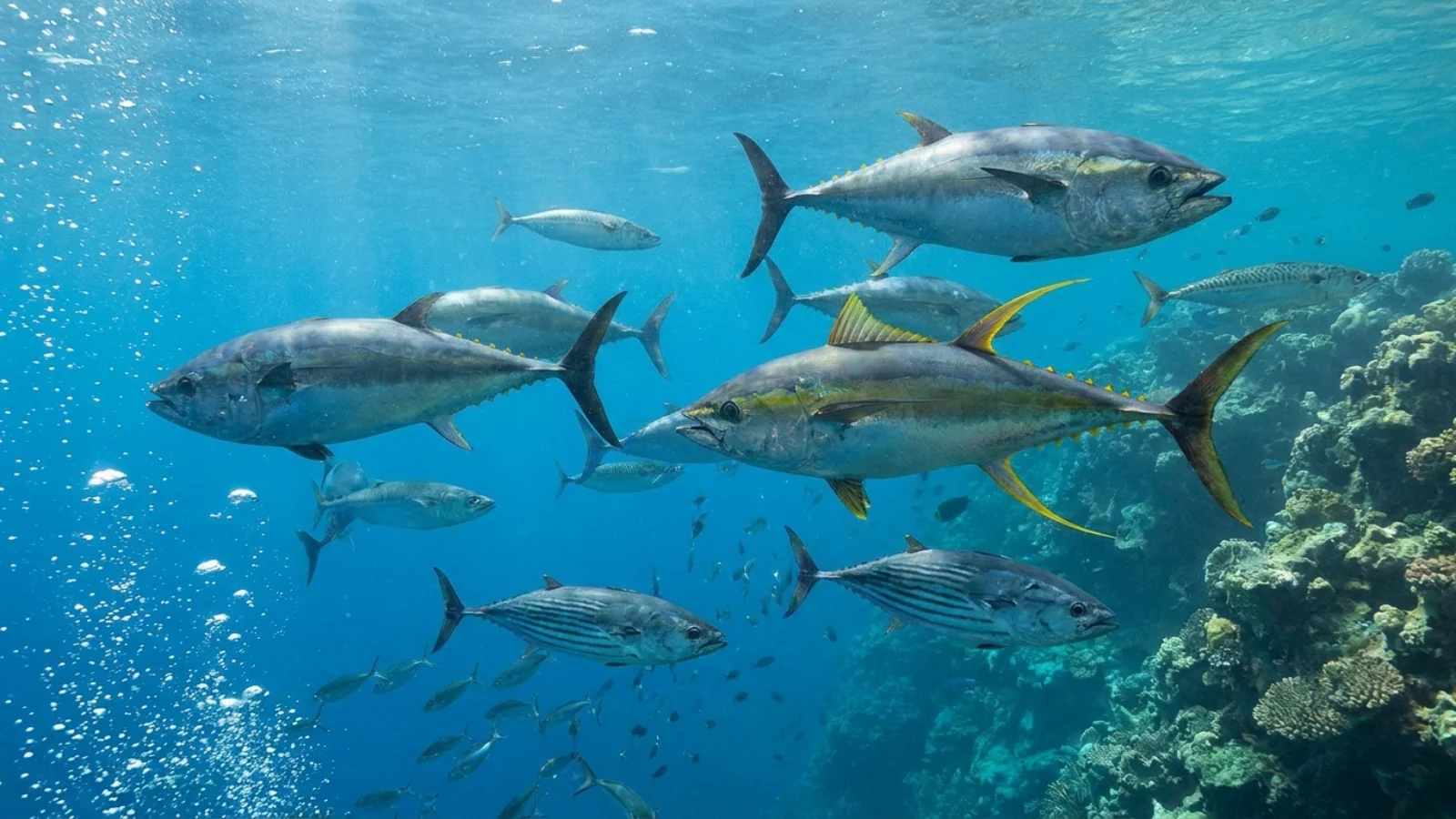
Many fish called “tuna” are not true tunas. The dogtooth tuna of the Indo-Pacific reefs belongs to the bonito tribe, and fish markets sometimes sell other scombrids under tuna names. True tunas share a set of traits: a torpedo body, small finlets behind the dorsal and anal fins, keels on the tail base, fins that fold into grooves, and some ability to keep muscle warmer than the water.
Which tuna species live in Florida and the Gulf?
Four tunas are common in Florida waters: blackfin, little tunny, skipjack and yellowfin. Atlantic bluefin and bigeye pass through offshore.
The blackfin tuna is the signature Florida tuna, abundant off the Keys and Southeast Florida, typically 5 to 20 lb, with dusky finlets and a bronze side stripe. The little tunny, called bonito in Florida and false albacore farther north, crashes bait along the beaches and reefs, and is recognized by wavy dark lines on the back and a few dark spots under the pectoral fin. Skipjack show dark stripes on the belly and are common offshore. Yellowfin dominate the deepwater rig fishery of the north-central Gulf, while Atlantic bluefin spawn in the Gulf each spring.
How are tunas built for speed?
Tunas are among the most efficient swimmers in the ocean, with a rigid body, a narrow tail stalk with keels, and a crescent-shaped tail that beats rapidly while the body stays almost still.
Their fins fold into grooves to reduce drag, and they must swim constantly, ramming water over their gills to breathe. Much of their muscle is dark red, rich in myoglobin, and arranged close to the backbone, where countercurrent heat exchangers keep it warm. That warmth, most developed in the bluefins, lets tunas hunt in cold water and sustain high speeds over long migrations.
Which tuna species are threatened?
The IUCN’s 2021 reassessment found improvement for several tunas thanks to tighter quotas: Atlantic bluefin moved from Endangered to Least Concern, and southern bluefin from Critically Endangered to Endangered.
Bigeye remain Vulnerable and Pacific bluefin Near Threatened. Skipjack, the backbone of the canned-tuna industry, is abundant and fast-growing. Regional fisheries management organizations, such as ICCAT in the Atlantic, set quotas, and some stocks, such as Indian Ocean yellowfin, remain a concern.
Where can you learn more about individual tunas?
Read our full species profiles for the two tunas that matter most in the Gulf, and the story of the biggest tunas ever weighed.
See bluefin tuna, yellowfin tuna, largest tuna ever caught and the Sport & Game Fish hub.
How many types of tuna are there?
Fifteen true tuna species are recognized in the tribe Thunnini: eight in the genus Thunnus, one skipjack, three Euthynnus little tunas, two Auxis frigate and bullet tunas, and the slender tuna.
What is the biggest tuna species?
The Atlantic bluefin tuna, which can exceed 3 m and 680 kg. The IGFA all-tackle record is 1,496 lb from Nova Scotia (1979). The Pacific bluefin is second, with a 907-lb 6-oz record from New Zealand.
What is the smallest tuna?
The bullet tuna (Auxis rochei), which usually measures 20 to 35 cm and weighs around 1 to 2 lb.
What tuna species live in Florida?
Blackfin tuna, skipjack and little tunny (locally called bonito) are the most common near Florida. Yellowfin occur in deeper water, especially in the Gulf and off the Keys, and Atlantic bluefin and bigeye pass offshore.
What kind of tuna is in canned tuna?
“Light” canned tuna is mostly skipjack, sometimes with yellowfin; “white” or “albacore” tuna is albacore. Skipjack is the most heavily caught tuna in the world.
Which tuna species are endangered?
On the IUCN Red List (2021), the southern bluefin is Endangered, the bigeye is Vulnerable and the Pacific bluefin is Near Threatened. The Atlantic bluefin, yellowfin, albacore and skipjack are Least Concern.
Is a bonito a tuna?
Not strictly. True bonitos (genus Sarda) are in a related tribe, Sardini. In Florida, though, anglers call the little tunny (Euthynnus alletteratus), a true tuna, “bonito,” and elsewhere it is called false albacore.
Blane Perun has been exploring Earth’s oceans and marine life for over 25 years. Founder of TheSea.Org in 1999, underwater photographer, coral aquaculture pioneer, and explorer of 80+ countries. Based in Southwest Florida, where tarpon, snook and redfish share the mangrove shorelines of the Gulf coast.
About Blane Perun → More on Sport & Game Fish →