Snook — Southwest Florida’s Mangrove Ambusher
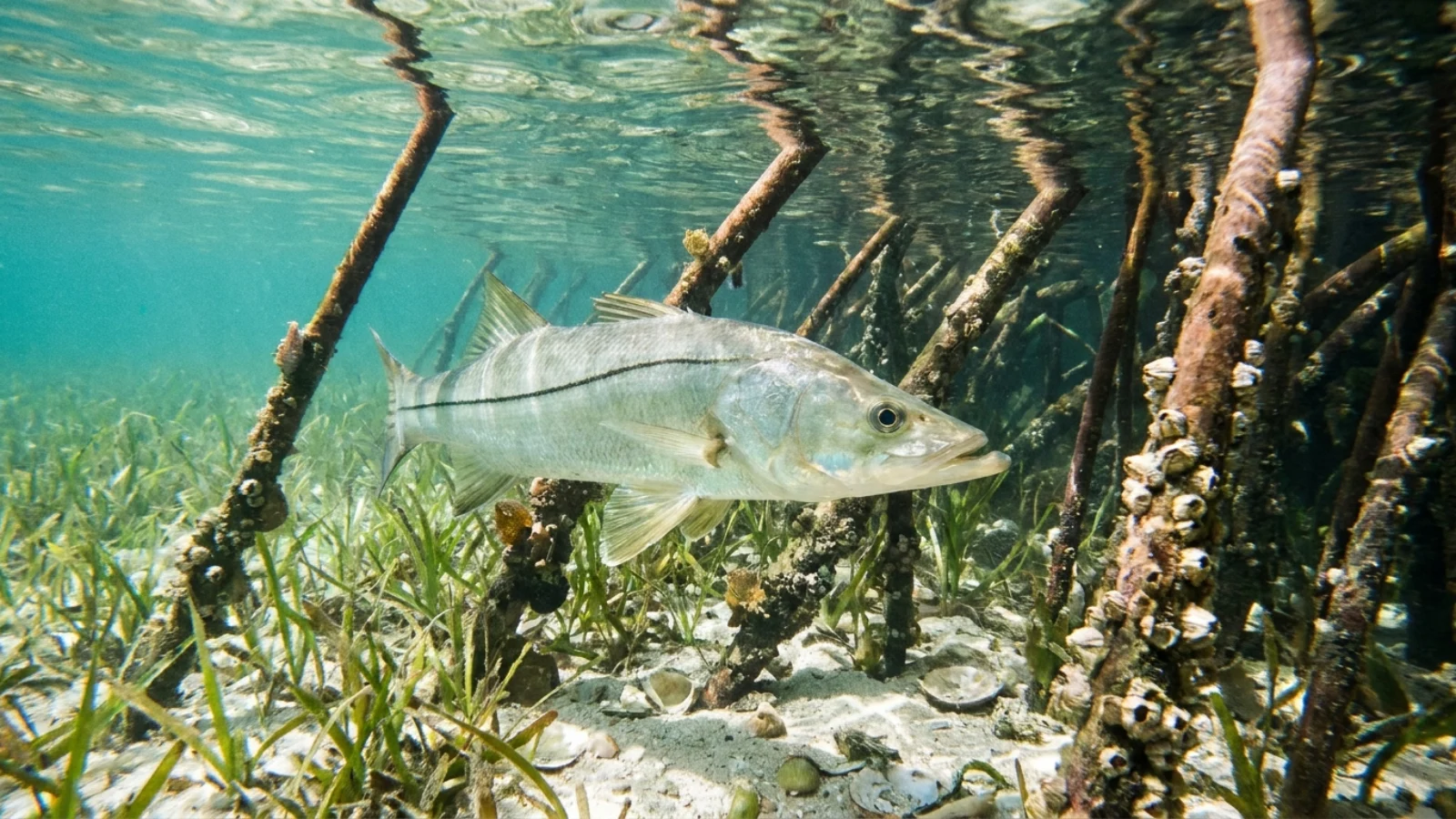
The common snook (Centropomus undecimalis) is a silver, pike-shaped inshore fish with a bold black lateral line, a sloping forehead and a jutting lower jaw. It is an ambush predator of mangrove shorelines, docks, bridges, passes and beaches in South and Central Florida, where it typically weighs 5–20 lb. Snook are protandrous hermaphrodites, starting life as males and often becoming females, and they are highly cold-sensitive: severe freezes can kill them by the thousand. The IGFA record is 53 lb 10 oz, and in Florida snook carry a slot limit and require a snook permit.
Common Snook
How do you identify a snook?
A long, silver, pike-like body, a sloping forehead with a protruding lower jaw, two separate dorsal fins, a yellowish forked tail and, above all, the jet-black lateral line that gives snook the nickname “linesider.”
The back is olive to golden-brown, darkening in tannic backcountry water. Florida has four snook species. The common snook is by far the largest and most widespread; the fat snook is deeper-bodied; the tarpon snook has an upturned, tarpon-like face; and the swordspine snook is the smallest, with a long second anal spine. Only the common snook regularly exceeds 10 lb.
| Species | Max size | Distinguishing feature | Typical habitat |
|---|---|---|---|
| Common snook | ~53 lb | Long body, large size | Mangroves, passes, beaches |
| Fat snook | ~5 lb | Deep body, small scales | Brackish creeks |
| Tarpon snook | ~3 lb | Upturned face, compressed body | Freshwater & brackish canals |
| Swordspine snook | ~1 lb | Long second anal spine | Mangrove creeks |
How do snook hunt?
Snook are ambush predators. They hold in the current beside structure, mangrove roots, dock pilings, bridge shadows or beach troughs, and explode on baitfish swept past.
At night, dock lights attract shrimp and baitfish, and snook gather in the shadow line, making a distinctive “pop” as they suck in prey at the surface. Their diet includes pilchards, pinfish, mullet, threadfin herring, shrimp and crabs. Snook move with the seasons: in winter they retreat up rivers, canals and deep residential channels where water stays warmer, and in summer they move to passes and beaches to spawn. Walk the Gulf beaches of Naples or Marco Island at dawn in July and you can often see snook cruising the first trough within a few feet of the sand.
Why do snook change sex?
Common snook are protandrous hermaphrodites: all snook mature first as males, and a portion of them later transition into females.
The switch usually happens at around 20 to 30 inches, though it varies with population and conditions. The result is that small snook are mostly males and big snook are mostly females. Florida’s slot limit protects both groups: it spares small males and, crucially, the largest females, which produce the most eggs. Snook spawn in summer, roughly May through September, in passes, inlets and along beaches on outgoing tides, and the larvae drift back into mangrove and seagrass nurseries.
Where do snook live?
Common snook range from Central Florida through the Gulf of Mexico, Caribbean and Central America to Brazil, but they are limited by cold. In Florida, they are abundant south of Tampa Bay and Cape Canaveral.
Southwest Florida is the heart of Florida snook country. The mangrove estuaries of Charlotte Harbor, Pine Island Sound, Estero Bay, Naples Bay, Rookery Bay and the Ten Thousand Islands, along with every pass and beach between them, hold some of the best snook populations anywhere. Snook tolerate fresh water, and fish are found far up rivers like the Caloosahatchee and Peace, and in canals and spring-fed rivers in winter.
Why are snook so closely regulated?
Snook are slow to recover from heavy harvest and cold kills, and they are enormously valuable to Florida’s recreational economy, so the state manages them conservatively.
Florida made snook a game fish in 1957, banning commercial sale. Today anglers need a saltwater license plus a snook permit to keep one, and fish must fall within a slot, 28 to 33 inches on the Gulf coast, with one fish per day during open seasons. After the January 2010 cold kill, FWC closed snook harvest statewide; Gulf harvest stayed closed until 2013. Red tide in 2018 led to further temporary closures in Southwest Florida. Researchers also stock hatchery-raised snook in some estuaries. Seasons are set regionally and change often, so check FWC before keeping a fish.
Where can you see snook in Southwest Florida?
The easiest place to see snook is along the Gulf beaches in summer, when they cruise the trough within feet of shore, and under lighted docks and bridges after dark.
The beaches of Naples, Vanderbilt and Marco Island, the passes of Sanibel and Captiva, and the backcountry of the Ten Thousand Islands are all prime snook water. For neighbors in the same habitat, see tarpon, redfish, mangrove snapper and the Sport & Game Fish hub.
How big do snook get?
Most snook caught are 5 to 20 lb and 20 to 36 in. Fish over 30 lb are rare trophies. The IGFA all-tackle record is 53 lb 10 oz, caught at Parismina Ranch, Costa Rica, in 1978.
Why are snook called linesiders?
For the bold black lateral line that runs from the gill cover to the tail, the easiest field mark for any snook.
Do snook change sex?
Yes. Common snook are protandrous hermaphrodites: they mature first as males, and many later transform into females, typically at larger sizes. This is why the biggest snook are almost all female.
Why do snook die in cold weather?
Snook are tropical fish. They become stressed when water falls below about 60°F and can die when it drops into the low 50s or below for several days. The January 2010 cold snap killed huge numbers in Florida, and FWC closed the fishery to harvest for over two years.
What is the snook slot limit in Florida?
On the Gulf coast, including Southwest Florida, snook must be 28 to 33 inches total length to keep, one per angler per day, with a Florida snook permit, during open seasons. Atlantic regions use a 28–32 inch slot. Seasons and rules vary by region, so check FWC.
When is snook season in Southwest Florida?
Harvest seasons are set regionally by FWC and have changed in recent years; snook are typically closed to harvest during winter and during the summer spawning season. Catch-and-release fishing is allowed year-round.
Can you eat snook?
Yes, snook is a mild, white, highly regarded fish, but it cannot be sold in Florida; it is a game fish only. Remove the skin, which has a soapy taste.
Where do snook live?
In Florida, from about Cape Canaveral and Tampa Bay southward, and along both coasts of Central America and the Caribbean to Brazil. They live in mangrove estuaries, rivers, bays, passes and along beaches.
Blane Perun has been exploring Earth’s oceans and marine life for over 25 years. Founder of TheSea.Org in 1999, underwater photographer, coral aquaculture pioneer, and explorer of 80+ countries. Based in Southwest Florida, where tarpon, snook and redfish share the mangrove shorelines of the Gulf coast.
About Blane Perun → More on Sport & Game Fish →