Redfish — The Red Drum and the Mystery of Its Tail Spot
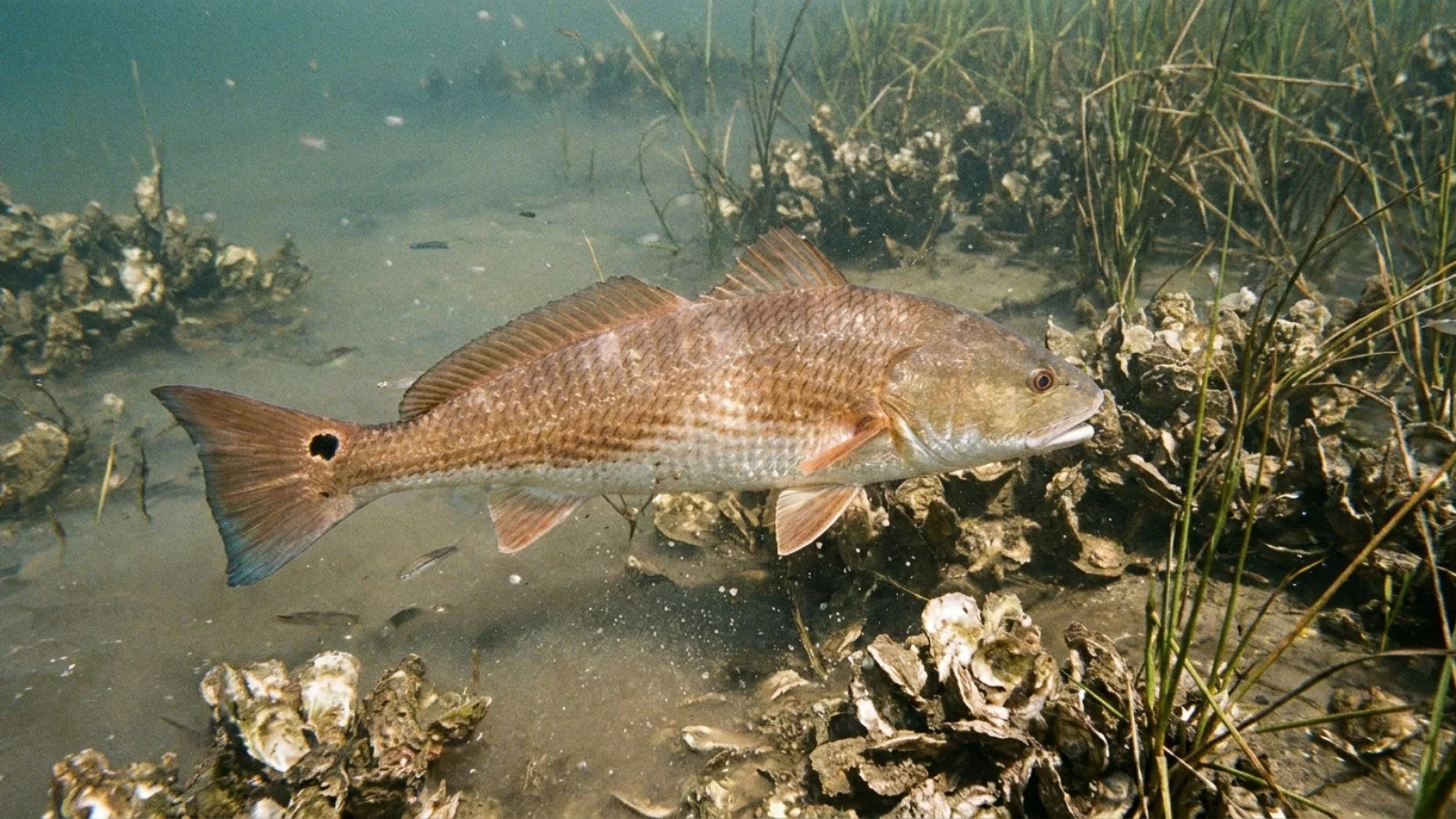
A redfish is the red drum (Sciaenops ocellatus), a copper-bronze member of the drum and croaker family found along the U.S. Atlantic and Gulf coasts. It is recognized by one or more black spots near the base of the tail, which likely act as false eyes to misdirect predators. Inshore “slot” redfish weigh about 3–10 lb, while big breeding “bull reds” offshore can top 40 lb; the IGFA record is 94 lb 2 oz. Redfish can live more than 40 years, and in Florida they are a protected game fish that cannot be sold.
Redfish (Red Drum)
Why do redfish have a black spot on the tail?
The tail spot is almost certainly a false eye. By placing a dark, eye-like mark at the back of the body, the redfish invites predators to strike its tail rather than its head, which can mean the difference between losing a piece of fin and being eaten.
Eyespots are common across fish, butterflies and other animals, and experiments with predatory fish show that attacks are often directed at eye-like markings. For a redfish feeding in water barely deep enough to cover its back, with dolphins, sharks, ospreys and herons overhead, a moment’s misdirection is valuable. The spot also explains a quirk that anglers love: no two redfish are spotted quite alike. Most have one spot on each side, many have two or several, and occasional “leopard” reds carry dozens. The pattern usually differs on the left and right sides of the same fish, and fish with no spots at all are rare.
How do you identify a redfish?
A long, copper-to-bronze body, a sloping head with an underslung mouth, a squared-off tail and at least one black spot at the tail base.
Color varies with habitat: redfish from clear Gulf beaches and passes look silvery-bronze, while fish from tannic backcountry creeks and the mangrove rivers of the Ten Thousand Islands are deep copper. The mouth points down, adapted to rooting for crabs and shrimp, and there are no chin barbels, which separates redfish from their close relative the black drum. Juveniles, known as “puppy drum,” look like slimmer versions of adults.
| Species | Key mark | Mouth | Record | Lifespan | IUCN |
|---|---|---|---|---|---|
| Red drum (redfish) | Tail spot(s), copper body | Underslung, no barbels | 94 lb 2 oz | 40+ yrs | LC |
| Black drum | Chin barbels, gray, deep body | Underslung, barbels | 113 lb 1 oz | ~60 yrs | LC |
| Spotted seatrout | Black spots on back and tail | Terminal, canine teeth | 17 lb 7 oz | ~15 yrs | LC |
| Snook | Black lateral line | Large, protruding lower jaw | 53 lb 10 oz | ~20 yrs | LC |
How big do redfish get?
Inshore redfish typically weigh 3 to 10 lb, and the spawning-size “bull reds” of the passes and nearshore Gulf commonly weigh 20 to 40 lb.
The IGFA all-tackle record, 94 lb 2 oz, was caught by David Deuel at Avon on North Carolina’s Outer Banks in 1984, and the Outer Banks and Virginia’s barrier islands still produce the largest fish. In the Gulf, bull reds in the 30s and 40s are routinely caught and released around the mouths of Tampa Bay, Charlotte Harbor, the Mississippi Delta and the Louisiana marshes. Redfish grow fast at first, reaching the 18-inch slot in about two years, then slow down, adding length over decades.
Where do redfish live?
Red drum range along the U.S. coast from Massachusetts to Florida and around the Gulf of Mexico to northern Mexico, with the greatest numbers in the Gulf and the Carolinas.
Juveniles and slot-size fish live in estuaries: seagrass flats, salt marshes, oyster bars, mangrove shorelines and tidal creeks. They tolerate a huge range of salinity, from nearly fresh water to hypersaline lagoons. As they mature, redfish leave the estuaries and join large offshore schools of bull reds that roam the nearshore Gulf and Atlantic, sometimes visible as copper-colored acres of fish at the surface. In Southwest Florida, redfish are a core species of Pine Island Sound, Charlotte Harbor, Estero Bay, the backcountry around Naples and Marco Island, and the Ten Thousand Islands.
How do redfish spawn?
Redfish spawn in late summer and fall near inlets, passes and in nearshore waters, usually around dusk, and males announce themselves by drumming.
Males contract sonic muscles against the swim bladder to produce a deep drumming sound that can be heard through a boat hull. A single large female can release millions of eggs over a season. The eggs float, and incoming tides carry the eggs and larvae into the estuaries, where they settle in seagrass and marsh nurseries. Because spawning depends on adult fish surviving many years, protecting bull reds is central to redfish management.
How did the redfish come back from overfishing?
In the 1980s, chef Paul Prudhomme’s “blackened redfish” became a national sensation, and commercial purse seiners began netting entire offshore spawning schools in the Gulf.
The collapse was rapid. Federal managers closed the Gulf’s federal waters to red drum harvest, Florida banned commercial harvest and sale in 1988 and declared redfish a game fish, and other Gulf states followed. Slot limits now protect both small juveniles and the large breeders. Florida, Texas and South Carolina also raise juvenile red drum in hatcheries for stock enhancement. Today redfish are abundant across much of their range, although Florida has tightened rules in some regions after red tide events and has made parts of the Indian River Lagoon catch-and-release only.
Where can you see redfish in Southwest Florida?
Look on shallow grass flats and oyster bars on a low, rising tide, especially in fall, when schools of redfish push onto the flats to feed.
Pine Island Sound, Charlotte Harbor, Estero Bay and the Ten Thousand Islands are all prime redfish water, and kayakers and paddleboarders often see tailing fish without any fishing gear. The severe 2017Red tide events in 2018 and 2023 killed many redfish along this coast, and FWC temporarily made redfish catch-and-release in affected regions.ndash;2019 red tide killed many redfish along this coast, and FWC made redfish, snook and spotted seatrout temporarily catch-and-release in the affected Southwest Florida regions while stocks recovered. For more inshore fish, see snook, tarpon, sheepshead and the Sport & Game Fish hub.
Why do redfish have a spot on their tail?
The black spot near the tail is thought to be an eyespot, or false eye. Predators tend to strike at the head, and a convincing “eye” at the wrong end may lead them to attack the tail instead, giving the redfish a chance to escape. Laboratory studies support the idea that predators are misdirected by such spots.
Is a redfish the same as a red drum?
Yes. Redfish, red drum, channel bass, spottail bass and puppy drum (for juveniles) are all names for Sciaenops ocellatus. “Redfish” is also used for unrelated fish elsewhere, such as the Atlantic rosefish of New England.
How many spots does a redfish have?
Most have one spot on each side near the tail, but many have two or several, and some have dozens. Fish with no spots occur but are rare. The number of spots differs between the two sides of the same fish.
How big do redfish get?
Inshore redfish typically weigh 3 to 10 lb, while spawning-size bull reds commonly weigh 20 to 40 lb. The IGFA all-tackle record is 94 lb 2 oz, caught at Avon, North Carolina, on the Outer Banks in 1984.
How long do redfish live?
Red drum can live more than 40 years. Most of the large bull reds in offshore spawning schools are well over a decade old.
Why do redfish make a drumming sound?
Males contract special sonic muscles against the swim bladder, producing a low drumming or croaking sound, especially during spawning season. The sound is how the drum family got its name.
What is the redfish slot limit in Florida?
Florida allows redfish between 18 and 27 inches total length, one per angler per day, with vessel limits that vary by region, and some areas such as the Indian River Lagoon are catch-and-release only. Commercial harvest and sale have been banned since 1988.
What happened to redfish in the 1980s?
The “blackened redfish” restaurant craze created huge commercial demand, and purse-seine fleets targeted offshore spawning schools in the Gulf. Federal and state managers closed the commercial fishery, Florida made redfish a game fish, and stocks recovered.
Blane Perun has been exploring Earth’s oceans and marine life for over 25 years. Founder of TheSea.Org in 1999, underwater photographer, coral aquaculture pioneer, and explorer of 80+ countries. Based in Southwest Florida, where tarpon, snook and redfish share the mangrove shorelines of the Gulf coast.
About Blane Perun → More on Sport & Game Fish →