Marlin — Blue, Black and Striped Marlin Compared
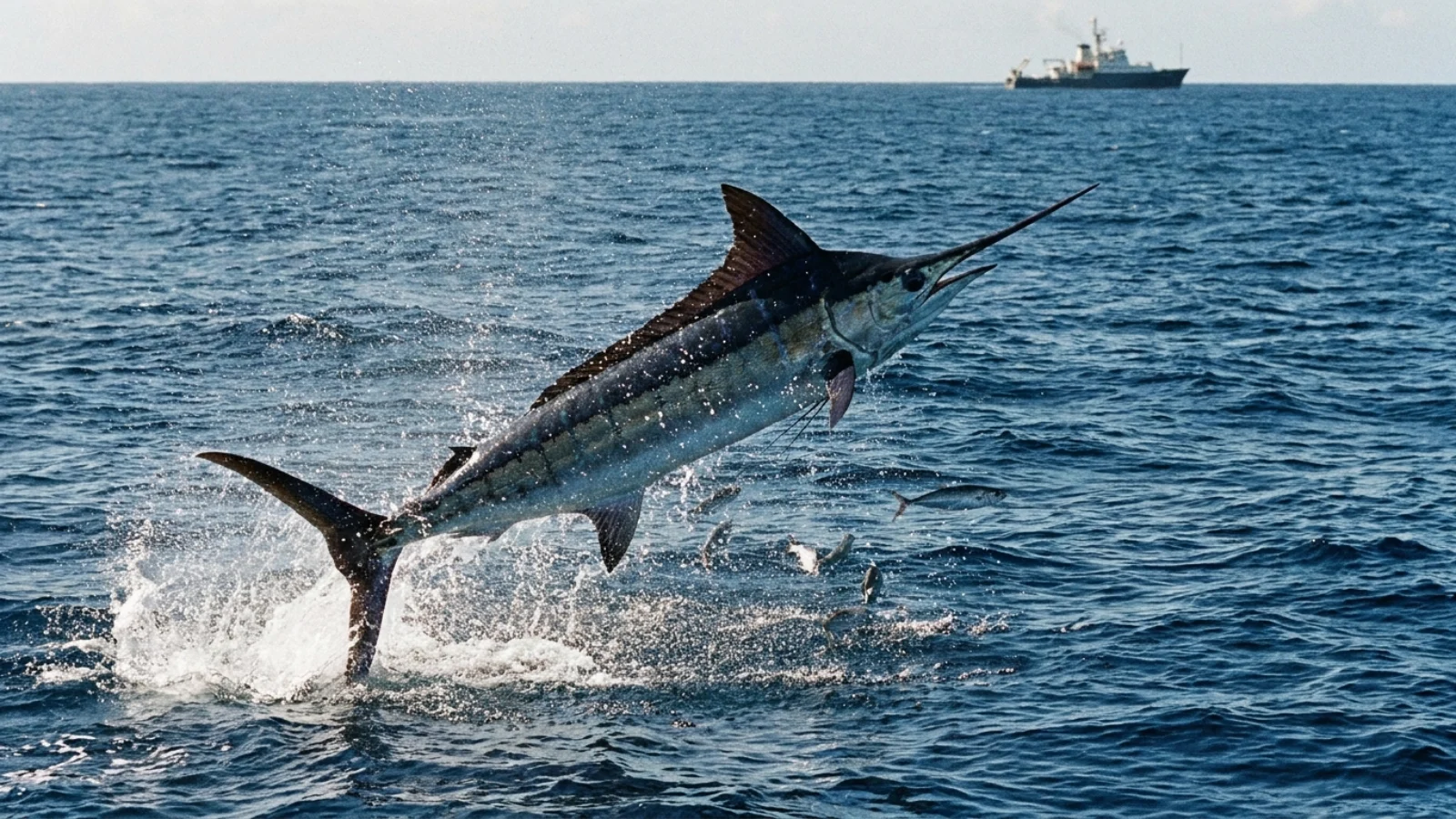
A marlin is a large, fast ocean predator in the billfish family Istiophoridae, recognized by its long, rounded spear-like bill, tall front dorsal fin and crescent tail. There are four widely recognized species: the blue marlin (Makaira nigricans), black marlin (Istiompax indica), striped marlin (Kajikia audax) and white marlin (Kajikia albida). The largest exceed 1,000 lb, and the IGFA all-tackle record is a 1,560-lb black marlin caught off Peru in 1953. Marlin roam the tropical and warm-temperate open ocean, including the Gulf of Mexico and the Gulf Stream off Florida.
Marlin
How many species of marlin are there?
Four marlin species are widely recognized, all in the billfish family Istiophoridae alongside the sailfish and spearfish. Some authorities split the blue marlin into Atlantic and Indo-Pacific species, which would make five.
The blue marlin (Makaira nigricans) is the classic big-game marlin of the Atlantic, Gulf of Mexico and, in most modern treatments, the Indo-Pacific too. The black marlin (Istiompax indica) lives in the Indian and Pacific Oceans and is the only marlin whose pectoral fins are rigid and cannot be folded flat against the body. The striped marlin (Kajikia audax) is the most acrobatic and the most strongly striped, also restricted to the Indo-Pacific. The white marlin (Kajikia albida) is the smallest, an Atlantic species prized off the U.S. mid-Atlantic coast, the Bahamas and the Gulf.
The genus names reflect real anatomical splits: Kajikia marlin are slimmer, with a tall front dorsal fin roughly as high as the body is deep, while Makaira and Istiompax are heavy-bodied with a comparatively lower dorsal fin. Spearfish, the small cousins of marlin, have a very short bill, and the sailfish is set apart by its enormous sail-like dorsal fin.
| Species | Record weight | Typical adult | Ocean | Key field mark | IUCN |
|---|---|---|---|---|---|
| Blue marlin | 1,402 lb (Atl.) | 200–400 lb | Atlantic, Indo-Pacific | Cobalt stripes, pointed dorsal | VU |
| Black marlin | 1,560 lb | 250–500 lb | Indo-Pacific | Rigid pectoral fins | DD |
| Striped marlin | 494 lb | 100–200 lb | Indo-Pacific | Tall dorsal, bold stripes | LC |
| White marlin | 181 lb 14 oz | 40–80 lb | Atlantic | Rounded dorsal tip, spots on fin | LC |
| Sailfish | 221 lb (Pac.) | 40–100 lb | Worldwide tropics | Huge sail-like dorsal | VU |
How big do marlin get?
Marlin are among the largest bony fish in the sea. Blue and black marlin regularly exceed 500 lb, and fish over 1,000 lb, known to anglers as “granders,” are caught every year somewhere in the world.
Size in marlin is overwhelmingly a female trait. Male blue marlin rarely exceed about 300 lb, while females can pass 1,000 lb, so almost every grander ever weighed has been a female. The heaviest marlin on rod and reel remains Alfred Glassell Jr.’s 1,560-lb black marlin from Cabo Blanco, Peru, in 1953, a record that has stood for more than 70 years. Commercial longliners have reported heavier fish, but those are not record-eligible.
Where do marlin live?
Marlin are creatures of warm, clear, blue water. They follow temperature fronts, current edges and concentrations of bait across the tropical and subtropical oceans, and some make migrations measured in thousands of miles.
In the Atlantic, blue marlin range from roughly New England and the Azores south to Brazil and West Africa, with famous fisheries off Bermuda, the Bahamas, Puerto Rico, the Canary Islands, Madeira and Brazil. In the Gulf of Mexico they ride the Loop Current, gathering around deep canyons and offshore oil and gas platforms off Louisiana, Mississippi, Alabama and the Florida Panhandle. In the Pacific, Kona in Hawaii, Cabo San Lucas, Panama, Australia’s Great Barrier Reef (the world capital for big black marlin) and New Zealand are the marquee grounds.
How do marlin hunt with their bills?
The bill is a weapon for stunning, not spearing. Marlin charge into tightly packed schools of fish or squid and slash sideways with rapid head movements, injuring or disorienting prey that they then turn and swallow.
Underwater video of striped marlin and sailfish off Mexico shows the same sequence: a group of billfish herds a bait ball, individuals take turns slashing through it, and stunned fish fall out of formation. Stomach contents across species are dominated by skipjack and other small tunas, mackerels, mahi mahi, flying fish and squid; blue marlin over 1,000 lb have been found with yellowfin tuna of 100 lb or more inside them. The occasional marlin found with its bill driven into a boat hull, a sea turtle or another fish is usually the result of a high-speed charge gone wrong.
Marlin also carry a remarkable piece of physiology. Like swordfish and sailfish, they have a heater organ: a modified eye muscle packed with mitochondria that warms the brain and eyes above the temperature of the surrounding water. This keeps vision sharp and fast-reacting when a marlin dives into cold water below the thermocline to hunt.
How do marlin reproduce?
Marlin are broadcast spawners. Females release millions of tiny eggs into warm surface water, where they are fertilized externally and drift with the plankton.
A large female blue marlin may release several million eggs in a single spawning, and she spawns multiple times per season. Larvae hatch at only a few millimeters long, with no visible bill, and grow at extraordinary speed, among the fastest growth rates recorded for any bony fish. Known spawning areas include waters around the Bahamas and Caribbean for Atlantic blue marlin, the Coral Sea for black marlin, and the warm western Pacific for striped marlin. The overwhelming majority of eggs and larvae are eaten, which is why adult marlin are so few relative to their prey.
Are marlin endangered?
No marlin is listed as Endangered, but blue marlin are classed as Vulnerable on the IUCN Red List and several stocks are overfished, chiefly through bycatch on tuna and swordfish longlines.
Recreational fishing now has a relatively small impact. In the United States, Atlantic billfish cannot be sold, tournament anglers release the great majority of fish, and circle hooks are required in many billfish tournaments because they hook fish in the jaw and improve survival. Tag-and-release programs run since the 1950s have revealed trans-oceanic movements and long lifespans. The bigger threat is commercial longlining for tuna and swordfish, which catches marlin incidentally across all oceans, and the International Commission for the Conservation of Atlantic Tunas (ICCAT) still assesses Atlantic blue and white marlin as overfished.
Where can you see or catch marlin near Florida?
From Southwest Florida, the nearest reliable blue marlin water is a long run west and south toward the Loop Current, or a trip across to the Florida Keys and Bahamas.
Off the Keys, blue and white marlin are encountered along the edge of the Gulf Stream in spring and summer, while the northern Gulf ports of Destin, Orange Beach and Venice, Louisiana hold the big summer billfish tournaments. The Bahamas, particularly Bimini, where Hemingway fished in the 1930s, remain a short hop for blue marlin. For the full set of Florida game fish, return to our Sport & Game Fish hub, or compare marlin with their closest relatives in swordfish vs marlin and our guide to the fastest fish in the ocean.
What is the biggest marlin ever caught?
The IGFA all-tackle record is a 1,560-lb black marlin caught by Alfred Glassell Jr. off Cabo Blanco, Peru, on August 4, 1953. The largest Atlantic blue marlin record is 1,402 lb 2 oz from Vitória, Brazil (1992), and the Pacific blue marlin record is 1,376 lb from Kona, Hawaii (1982).
What is the difference between a marlin and a swordfish?
Marlin have a round, spear-like bill, scales, pelvic fins and a long dorsal fin that can fold down. Swordfish have a much longer, flat, sword-shaped bill, no scales or pelvic fins as adults, and a short, rigid dorsal fin. They are in different families: Istiophoridae for marlin, Xiphiidae for swordfish.
Are there marlin in the Gulf of Mexico?
Yes. Atlantic blue marlin and white marlin both live in the Gulf, especially along the Loop Current and over deep canyons and oil-rig structures off Louisiana, Mississippi and the Florida Panhandle. Summer tournaments out of Orange Beach, Destin and Venice regularly weigh blue marlin over 500 lb.
How fast can a marlin swim?
Figures of 50 to 80 mph are widely repeated but come from old estimates of line pulled off a reel. Studies of billfish muscle contraction suggest true burst speeds are probably closer to 22–34 mph. Marlin are still among the fastest fish over short distances.
Can you eat marlin?
Marlin is eaten in Japan, Hawaii and parts of the Pacific, but in the United States the sale of Atlantic-caught marlin is prohibited, and nearly all recreational marlin are released. Large marlin also accumulate mercury, so health agencies advise limiting consumption.
Why do marlin have a bill?
The bill is a hunting tool. Marlin swim into schools of fish or squid and slash sideways with the bill to stun or injure prey, then turn and swallow it. The bill is not normally used to spear prey, despite the popular image.
How long do marlin live?
Female blue marlin have been aged to about 27 years and males to about 18 years. Lifespans for other marlin are less certain but are believed to be in the 10–20-year range.
Are marlin endangered?
Not as a group. On the IUCN Red List, blue marlin is Vulnerable, black marlin is Data Deficient, and striped and white marlin are Least Concern. Several regional stocks are overfished, mainly because of longline bycatch.
Blane Perun has been exploring Earth’s oceans and marine life for over 25 years. Founder of TheSea.Org in 1999, underwater photographer, coral aquaculture pioneer, and explorer of 80+ countries. Based in Southwest Florida, where tarpon, snook and redfish share the mangrove shorelines of the Gulf coast.
About Blane Perun → More on Sport & Game Fish →