Largest Tuna Ever Caught — The 1,496-Pound Nova Scotia Bluefin and the Records Behind It
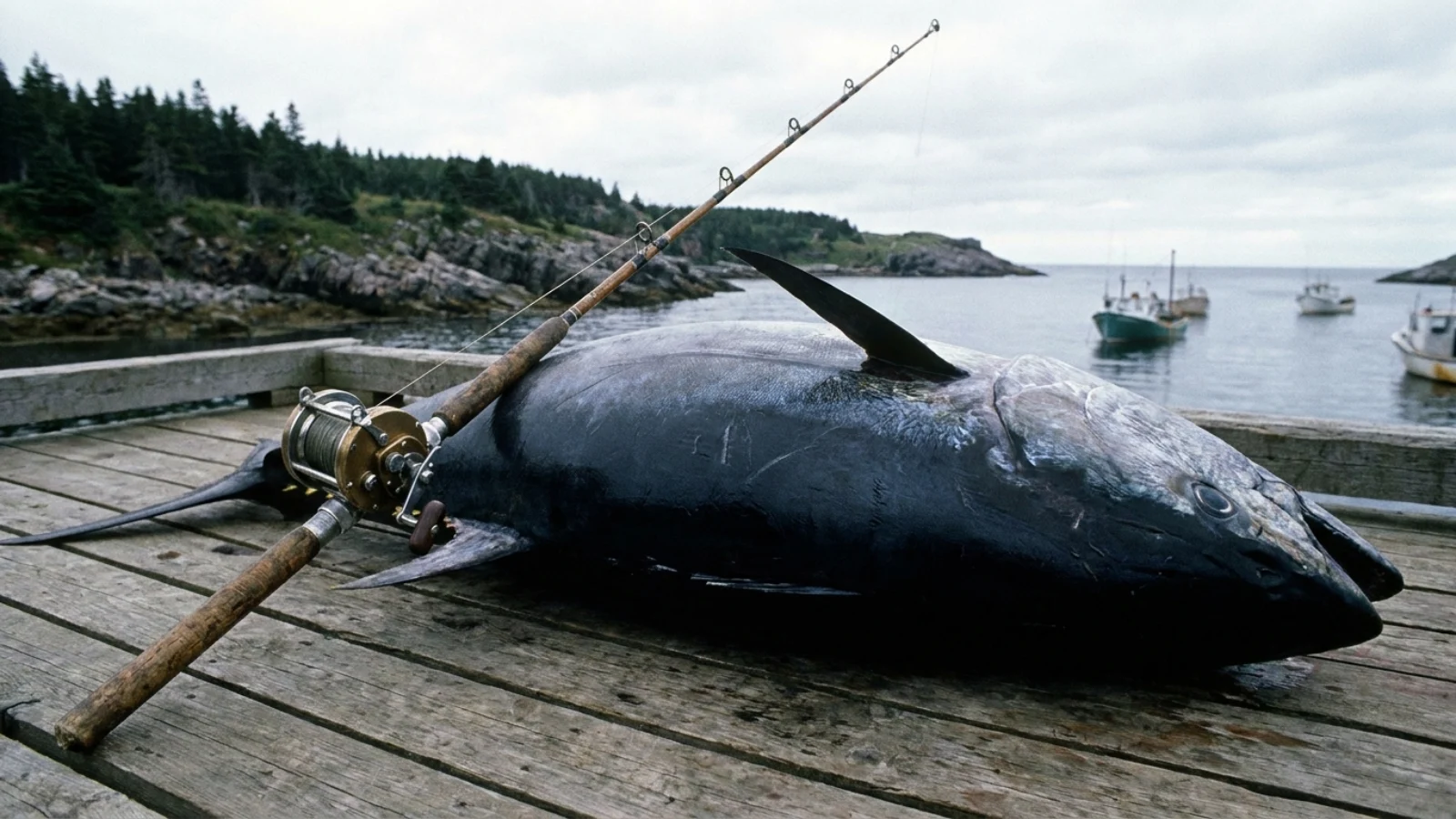
The largest tuna ever caught on rod and reel is a 1,496-lb (678.6 kg) Atlantic bluefin tuna landed by Ken Fraser off Aulds Cove, Nova Scotia, Canada, on October 26, 1979. It remains the International Game Fish Association (IGFA) all-tackle world record more than 45 years later. The largest Pacific bluefin on record is 907 lb 6 oz (New Zealand, 2014), and the largest yellowfin is 443 lb (Baja California, 2024). Commercial fisheries have reported bluefin of similar size, but none heavier has been verified.
The Fraser Bluefin
Who caught the largest tuna ever?
Ken Fraser, fishing off Aulds Cove, Nova Scotia, on October 26, 1979, landed a 1,496-lb Atlantic bluefin tuna, the heaviest tuna ever caught on rod and reel and still the IGFA all-tackle world record.
Aulds Cove sits at the Strait of Canso, the narrow channel separating Cape Breton Island from mainland Nova Scotia. In the 1970s, giant bluefin gathered there each autumn to feed on herring and mackerel, and the area produced several of the largest bluefin ever weighed. Fraser’s fish, at roughly 680 kg, approaches the maximum size biologists recognize for the species. Only one fish heavier than it has ever been accepted as an IGFA all-tackle record: the 1,560-lb black marlin from Peru in 1953.
What are the records for every tuna species?
The IGFA keeps all-tackle records for each tuna species. Atlantic bluefin dwarf the rest, with the Pacific bluefin a distant second.
| Species | Record | Location | Year |
|---|---|---|---|
| Atlantic bluefin | 1,496 lb | Aulds Cove, Nova Scotia | 1979 |
| Pacific bluefin | 907 lb 6 oz | Three Kings Islands, New Zealand | 2014 |
| Yellowfin | 443 lb | Lower Banks, Baja California | 2024 |
| Bigeye (Pacific) | 435 lb | Cabo Blanco, Peru | 1957 |
| Bigeye (Atlantic) | 392 lb 6 oz | Gran Canaria, Spain | 1996 |
| Albacore | 88 lb 2 oz | Gran Canaria, Spain | 1977 |
| Longtail | 79 lb 2 oz | Montague Island, Australia | 1982 |
| Skipjack | 46 lb 5 oz | La Gomera, Spain | 2020 |
Where are the biggest tuna caught today?
Today’s giant bluefin come mainly from Canada’s Gulf of St. Lawrence, Prince Edward Island and Nova Scotia, from New England, and from the eastern Atlantic off Ireland and Norway, where recovering stocks have brought back fish of 600 to 900 lb.
Prince Edward Island and the Gulf of St. Lawrence run catch-and-release charter fisheries for giants, and Ireland and Norway have seen a revival of large bluefin after decades of absence. In the Pacific, New Zealand produced the 907-lb record, and the long-range fleet out of San Diego regularly lands Pacific bluefin and yellowfin over 300 lb.
What is the most expensive tuna ever sold?
At Tokyo’s New Year auction in January 2019, a 278-kg (612-lb) Pacific bluefin sold for about 333.6 million yen, around $3 million, the highest price ever paid for a single fish.
The buyer, sushi restaurant owner Kiyoshi Kimura, has repeatedly paid record sums for the first bluefin of the year, a ceremonial purchase that brings publicity more than profit. Ordinary bluefin prices are far lower, but the market’s appetite for fatty toro is what drove the global overfishing of bluefin in the late 20th century.
Could the 1,496-lb record ever be broken?
Possibly. Atlantic bluefin stocks have recovered strongly since ICCAT’s recovery plan began in 2007, and fish over 1,000 lb are again caught occasionally in Canada and Europe.
A new record would have to be landed under strict IGFA rules for tackle, unassisted fighting and certified scales. Read more in our bluefin tuna profile, the tuna species guide and the Sport & Game Fish hub.
What is the biggest tuna ever caught?
Ken Fraser’s 1,496-lb Atlantic bluefin, caught off Aulds Cove, Nova Scotia, on October 26, 1979, is the largest tuna ever recorded on rod and reel and the IGFA all-tackle record.
How big can bluefin tuna get?
Atlantic bluefin can reach about 3.3 m (11 ft) and more than 680 kg (1,500 lb). Fish over 1,000 lb were taken regularly off Nova Scotia, Prince Edward Island and New England in the late 20th century.
What is the largest Pacific bluefin tuna ever caught?
The IGFA record Pacific bluefin weighed 907 lb 6 oz and was caught by Donna Pascoe off the Three Kings Islands, New Zealand, in 2014, a record for a woman angler as well.
What is the largest yellowfin tuna ever caught?
The IGFA all-tackle yellowfin record is 443 lb, caught by Earl Gill IV on the Lower Banks off Baja California, Mexico, on November 11, 2024, beating the previous 427-lb record.
What is the most expensive tuna ever sold?
In January 2019, a 278-kg (612-lb) Pacific bluefin sold at Tokyo’s Toyosu market New Year auction for about 333.6 million yen, roughly $3 million at the time, bought by sushi chain owner Kiyoshi Kimura.
Why hasn’t the 1979 bluefin record been broken?
Giant bluefin numbers fell sharply after the 1970s due to heavy commercial fishing, and the biggest, oldest fish became rare. Even as stocks recover, a fish over 1,500 lb remains an extraordinary rarity.
Are there giant tuna in Florida?
Giant bluefin pass through the Florida Straits and spawn in the Gulf of Mexico in spring, but they are protected from targeted fishing there. Florida’s everyday tunas are blackfin and, offshore, yellowfin.
Blane Perun has been exploring Earth’s oceans and marine life for over 25 years. Founder of TheSea.Org in 1999, underwater photographer, coral aquaculture pioneer, and explorer of 80+ countries. Based in Southwest Florida, where tarpon, snook and redfish share the mangrove shorelines of the Gulf coast.
About Blane Perun → More on Sport & Game Fish →