Spanish Mackerel — The Spotted Speedster of Florida’s Beaches and Piers
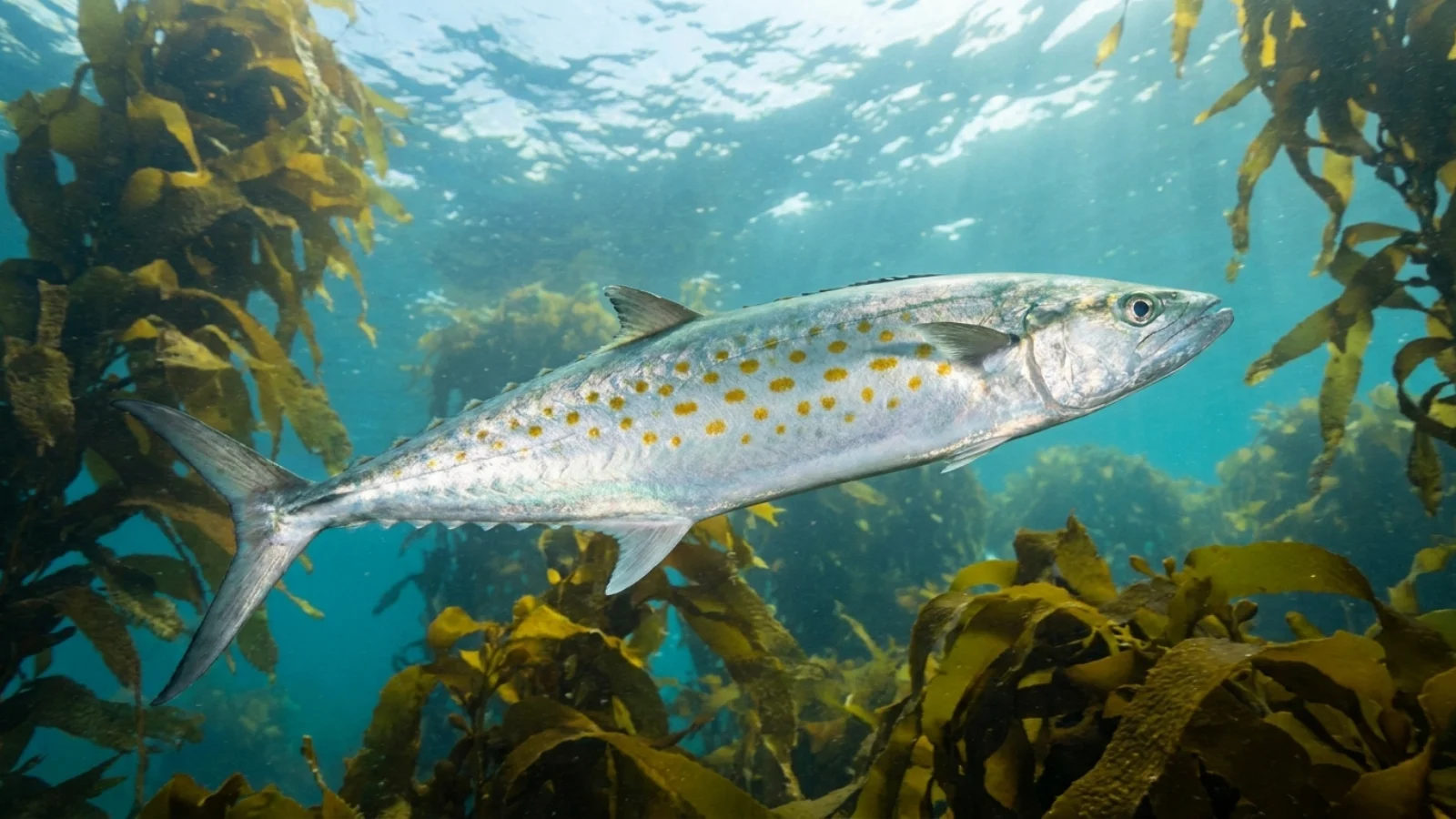
The Atlantic Spanish mackerel (Scomberomorus maculatus) is a slender, silver, fast-swimming fish of the mackerel family, marked with rows of golden-yellow oval spots and no side stripe. It schools along beaches, piers, passes and nearshore reefs from the Carolinas to the Gulf of Mexico, chasing baitfish with sharp, triangular teeth. Most weigh 1–4 lb, and the IGFA record is 13 lb. Spanish mackerel run Florida’s coast in spring and fall, and in state waters carry a 12-inch fork-length minimum and a 15-fish bag limit.
Spanish Mackerel
How do you identify a Spanish mackerel?
A long, compressed, silver body with an olive or blue-green back, three or so rows of round to oval gold spots on the sides, no stripe, and a black patch at the front of the spiny first dorsal fin.
Two relatives cause confusion in Florida. Young king mackerel also have spots, but their lateral line drops abruptly below the second dorsal fin, while a Spanish mackerel’s slopes gently. Cero mackerel have spots plus a yellow-bronze stripe along the side. All three share the knife-edge teeth and forked tails of the genus Scomberomorus.
| Species | IGFA record | Typical catch | Markings | Lateral line |
|---|---|---|---|---|
| Spanish mackerel | 13 lb | 1–4 lb | Gold spots only, black dorsal front | Gentle slope |
| King mackerel | 93 lb | 10–30 lb | Plain silver (spots on juveniles) | Sharp dip |
| Cero | 17 lb 2 oz | 2–8 lb | Spots plus bronze stripe | Gentle slope |
Where do Spanish mackerel live?
Spanish mackerel range from about Cape Cod to Mexico’s Yucatán Peninsula, including the whole Gulf of Mexico, and are most abundant off Florida.
They are a nearshore species, schooling along beaches, around piers and jetties, in passes and inlets, and over nearshore reefs and wrecks, usually in clear water above about 70°F. In Southwest Florida, the Naples Pier, the Fort Myers Beach pier, the passes and the nearshore artificial reefs fill with Spanish mackerel during spring and fall. In winter, much of the population concentrates off South Florida.
What do Spanish mackerel eat?
Small schooling fish: anchovies, glass minnows, scaled sardines, threadfin herring and menhaden, plus some shrimp and squid.
Spanish mackerel hunt in fast-moving schools, slashing through bait balls near the surface. Diving terns and pelicans over a patch of nervous water are the classic giveaway. Their speed and sharp teeth mean small, shiny lures retrieved fast work best, and anglers use wire or heavy fluorocarbon to avoid cut-offs.
How do Spanish mackerel grow and reproduce?
Spanish mackerel grow fast and mature young, usually by age one or two, and spawn in nearshore waters from spring through summer.
Females release eggs in multiple batches over a long season. Most fish live only a few years, though individuals of 11 or 12 years have been aged. After overfishing by gill nets in the 1980s, the stock recovered under federal and state management, and Florida’s 1995 constitutional ban on entangling nets in nearshore waters helped further.
Where can you catch Spanish mackerel in Southwest Florida?
Piers, passes and nearshore reefs in spring and fall, especially on clean, moving tides with bait present.
See also king mackerel, wahoo, pompano and the Sport & Game Fish hub.
How do you tell a Spanish mackerel from a king mackerel?
Spanish mackerel have bright gold spots, a black patch at the front of the first dorsal fin, and a lateral line that slopes gently. Young king mackerel can also have spots, but their lateral line drops sharply below the second dorsal fin, and the first dorsal fin has no black front.
How big do Spanish mackerel get?
Most are 1 to 4 lb and 14 to 22 in. Fish over 6 lb are big, and the IGFA all-tackle record is 13 lb, caught at Ocracoke Inlet, North Carolina, in 1987.
What is the difference between Spanish mackerel and cero mackerel?
Cero mackerel have a bronze-yellow stripe running along the side in addition to spots. Spanish mackerel have spots only. Cero are more common around reefs in South Florida and the Keys.
When do Spanish mackerel run in Florida?
They follow water temperature, moving north along Florida’s coasts in spring (roughly March to May) and south in fall (October to December), when schools crash bait along beaches and piers.
Are Spanish mackerel good to eat?
Yes, when very fresh. The meat is oily and flavorful and is best grilled, broiled or smoked soon after catching; it does not freeze as well as leaner fish.
What is the Spanish mackerel limit in Florida?
In Florida state waters the minimum is 12 inches fork length with a daily bag of 15 per angler. Check FWC for current rules.
Do Spanish mackerel have teeth?
Yes, sharp, flattened, triangular teeth that can cut monofilament line, so anglers use light wire or heavy fluorocarbon leaders.
Blane Perun has been exploring Earth’s oceans and marine life for over 25 years. Founder of TheSea.Org in 1999, underwater photographer, coral aquaculture pioneer, and explorer of 80+ countries. Based in Southwest Florida, where tarpon, snook and redfish share the mangrove shorelines of the Gulf coast.
About Blane Perun → More on Sport & Game Fish →