Cobia — The Shark-Shaped Fish That Follows Rays and Turtles
The cobia (Rachycentron canadum) is a large, fast-growing predatory fish and the only living member of its family, Rachycentridae. With a long, dark-brown body, a broad flat head and a dark lateral stripe, it is often mistaken for a shark or a giant remora. Cobia commonly weigh 20–50 lb, can exceed 100 lb, and the IGFA record is 135 lb 9 oz. They are famous for following manta rays, stingrays, sea turtles and sharks, and for a spring migration along Florida’s Gulf coast. Cobia are also one of the world’s leading farmed marine fish.
Cobia
How do you identify a cobia?
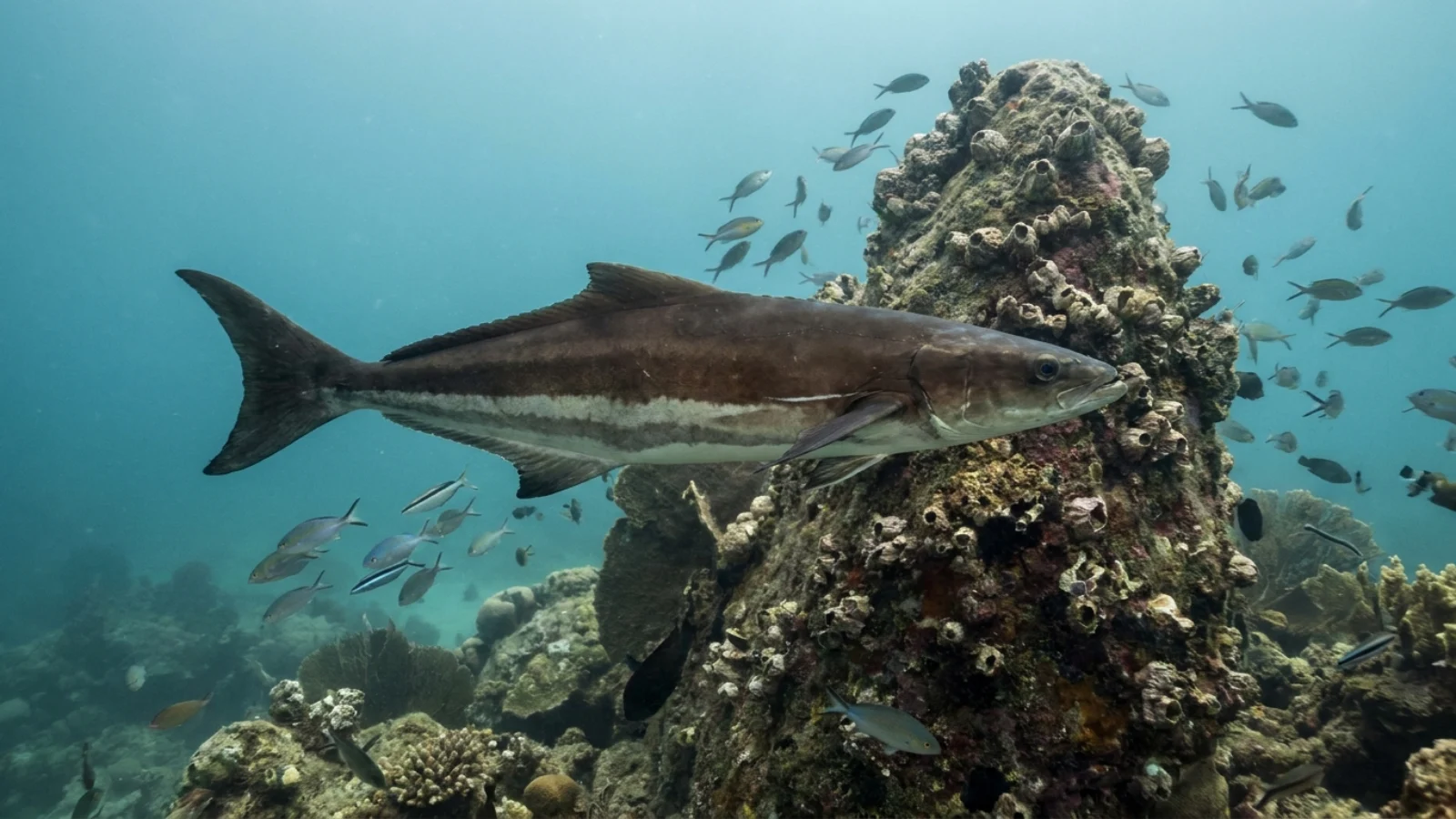
A long, torpedo-shaped, dark-brown body, a broad, flattened head with a protruding lower jaw, a dark stripe from snout to tail, and a row of 6 to 9 short, separate spines in front of the dorsal fin.
The pale stripes bordering the dark lateral band are strongest in young fish and fade with age. The tail is crescent-shaped in adults and rounded in juveniles. Swimming lazily near the surface beside a ray, a cobia’s brown back and high dorsal fin really do look like a shark’s, and newcomers often mistake them for one. Remoras share the shape and color but carry a sucking disc on the head, which cobia lack.
| Species | Group | Key mark | Max size | Behavior |
|---|---|---|---|---|
| Cobia | Bony fish (Rachycentridae) | Spiny first dorsal, dark stripe | 135 lb 9 oz record | Shadows rays & turtles |
| Remora | Bony fish (Echeneidae) | Sucking disc on head | ~2 ft | Attaches to hosts |
| Bull shark | Shark | Gill slits, no spines | 500+ lb | Coastal predator |
| Lemon shark | Shark | Two near-equal dorsals | 400+ lb | Flats & reefs |
Why do cobia follow rays, turtles and sharks?
Cobia are opportunists. Big animals moving over the bottom flush crabs, shrimp and small fish, and they also offer a moving piece of structure to hide behind.
Divers see cobia shadowing manta rays, cownose and southern stingrays, loggerhead turtles, sharks and whale sharks, often swimming just above or behind their host. Cobia also gather around fixed structure: channel markers, buoys, wrecks, oil platforms and piers. Sight-casting to cobia on the backs of migrating rays is one of the classic spring fisheries of the northern Gulf.
How big do cobia get?
Cobia commonly weigh 20 to 50 lb and reach about 2 m and well over 100 lb at maximum. The IGFA record, 135 lb 9 oz, came from Shark Bay, Western Australia, in 1985.
Females grow larger and live longer than males, and most of the biggest fish caught during the spring runs are female. Cobia grow remarkably fast: wild fish can pass 10 lb in their first year, and growth in captivity is faster still.
Where do cobia live?
Cobia live in warm and subtropical seas worldwide, except the eastern Pacific, including the western Atlantic from Massachusetts to Argentina, the Gulf of Mexico and the Caribbean.
In U.S. waters, they move seasonally. Fish that winter off South Florida and in the deeper Gulf migrate north along the Gulf coast in late winter and spring, passing Southwest Florida and reaching the Panhandle beaches of Destin, Panama City and Pensacola by spring, where towers on boats help anglers spot them. On the Atlantic coast, cobia move north toward the Carolinas and Chesapeake Bay, a key spawning area.
What do cobia eat?
Crabs top the menu, especially swimming crabs, which is why some fishermen call cobia “crab-eaters.” They also eat squid, eels, small fish and shrimp.
Cobia feed opportunistically near the bottom and at the surface, often around the animals they follow. Their curious nature is famous: cobia will swim up to inspect boats, divers and lures, and a cobia that has refused every bait may suddenly strike a jig dropped in front of it.
Are cobia overfished?
Cobia are listed as Least Concern globally, but U.S. Atlantic and Gulf managers have tightened rules after signs of declining catches and size.
Florida reduced daily limits and raised minimum sizes in recent years, and federal Gulf managers followed. Because cobia are large, slow to mature relative to their growth and easy to sight-fish during migration, managers watch them closely. At the same time, cobia aquaculture has grown in Asia and the Americas, supplying markets with farmed fish.
Where can you see cobia in Southwest Florida?
Look around channel markers, buoys, nearshore wrecks and rays along the beaches in late winter and spring, when cobia migrate north along the Gulf coast.
They also gather around offshore wrecks and reefs year-round. See also tripletail, amberjack, king mackerel and the Sport & Game Fish hub.
Is a cobia a shark?
No. Cobia are bony fish, the only species in the family Rachycentridae. Their long, dark body, flat head and habit of cruising near the surface make them look like sharks, and their dorsal stripe and shape also resemble a giant remora.
Why do cobia follow rays and turtles?
Large animals stir up crabs, shrimp and small fish from the bottom and provide cover, so cobia shadow manta rays, stingrays, sea turtles, sharks and even whale sharks to pick off disturbed prey. Anglers sight-fish for cobia by looking for rays and turtles.
How big do cobia get?
Most cobia caught weigh 20 to 50 lb. Fish over 80 lb are uncommon, and the IGFA all-tackle record is 135 lb 9 oz, from Shark Bay, Western Australia, in 1985.
When do cobia migrate along Florida?
On the Gulf coast, cobia move north along the beaches roughly from February through April toward the Panhandle, where the spring run is famous. On the Atlantic side, fish move north from South Florida toward the Carolinas and Chesapeake Bay in spring and early summer.
Are cobia good to eat?
Yes. Cobia have firm, white, mild flesh and are a top-quality food fish, which is why they are now widely farmed.
What do cobia eat?
Crabs are a favorite, which is where the nickname “crab-eater” comes from, along with squid, eels, small fish and shrimp.
What are the cobia regulations in Florida?
Florida manages cobia with a minimum fork length and a one-fish-per-angler limit plus vessel limits, which were tightened in recent years. Check FWC’s current rules before keeping one.
How fast do cobia grow?
Very fast. Wild cobia can reach 10 lb or more in their first year, and farmed fish reach market size of around 4–6 kg in about a year, one reason cobia are popular in aquaculture.
Blane Perun has been exploring Earth’s oceans and marine life for over 25 years. Founder of TheSea.Org in 1999, underwater photographer, coral aquaculture pioneer, and explorer of 80+ countries. Based in Southwest Florida, where tarpon, snook and redfish share the mangrove shorelines of the Gulf coast.
About Blane Perun → More on Sport & Game Fish →