Megalodon Jaw — How Big Was It and Could It Swallow a Person?
No real megalodon jaw has ever been found. Shark jaws are made of cartilage, which rarely fossilises, so every megalodon jaw on display is a reconstruction built around fossil teeth and scaled from the great white shark. Large individuals probably had jaws roughly 2 m across, lined with around 250 or more teeth in several rows. Bite force has been estimated at about 108,000 to 182,000 newtons, and a 2022 3D model suggests a 16 m megalodon could swallow prey up to about 8 m long. So yes: a person would have been a single mouthful.
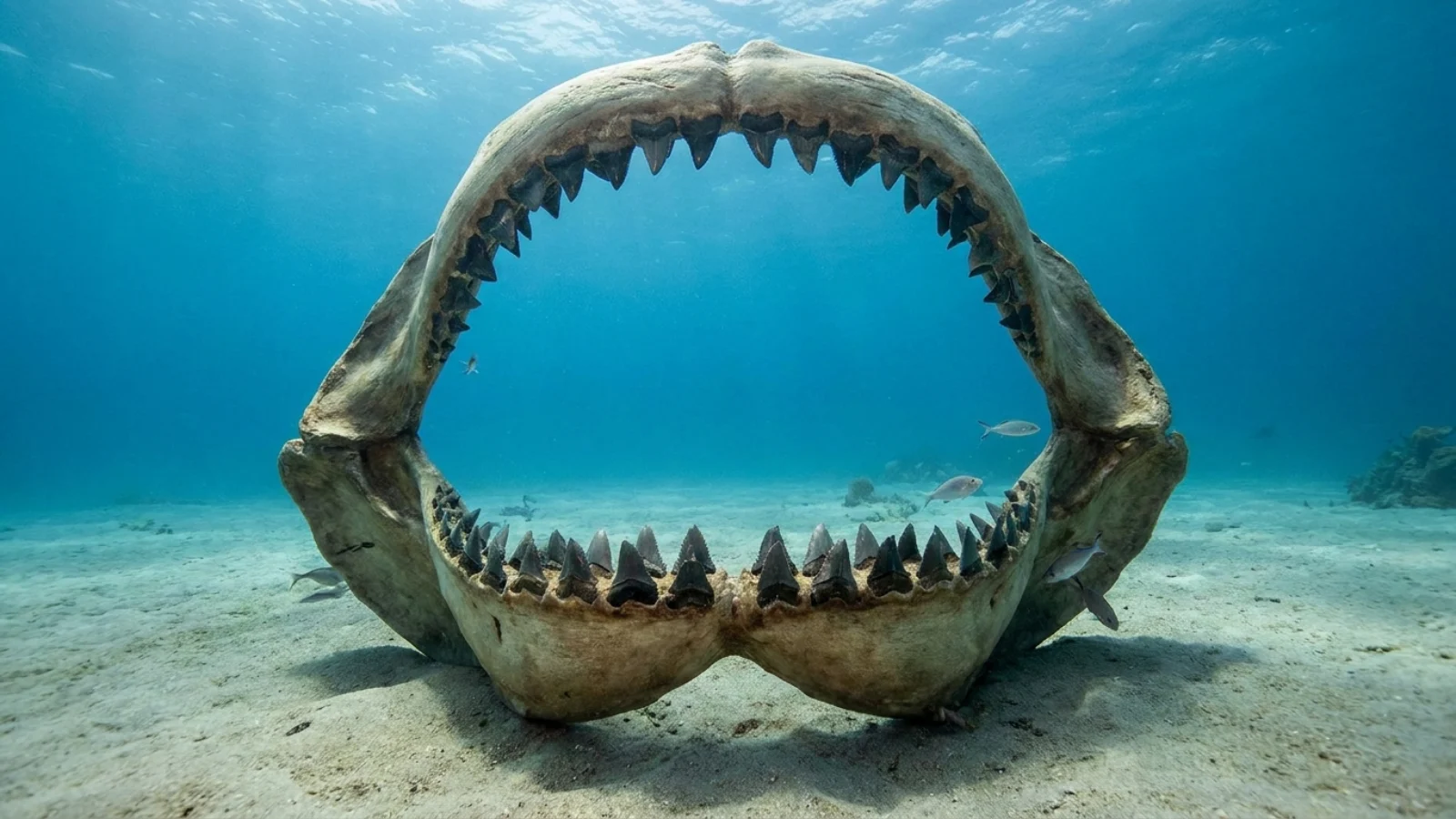
A cartilage jaw roughly 2 m wide, rebuilt from teeth, armed with about 250 serrated teeth and driven by one of the strongest bites ever estimated.
How big was the megalodon jaw?
The honest answer starts with a surprise: nobody has ever dug up a megalodon jaw. Megalodon, Otodus megalodon, was a shark, and like every shark its skeleton was built of cartilage rather than bone. Cartilage is light and flexible, and it usually rots away long before it can turn to stone. What survives of megalodon is almost entirely its teeth, a few sets of vertebrae and some fossil droppings.
That means every megalodon jaw you have ever seen, in a museum, an aquarium or a documentary, is a reconstruction. Builders start with the teeth, arrange them in the order they would have sat in life, and then shape a jaw around them using the proportions of living relatives, chiefly the great white shark. The size of the jaw therefore depends on two things: how big the teeth were, and how confident the builder is in the comparison with the great white.
Working that way, researchers have suggested that the jaws of large megalodon spanned roughly 2 m across. Display reconstructions are often larger, because the frame that holds the teeth, the gums and the gaping posture all add to the overall size. The famous jaw assembled by the fossil hunter Vito Bertucci, for example, stands about 2.7 m tall and 3.4 m wide in its frame. For the body that carried such a jaw, see how big was megalodon?
Why are there no fossil megalodon jaws?
Shark cartilage is not quite as soft as the cartilage in a human nose or ear. The surfaces of shark jaws are reinforced with tiny hexagonal plates called tesserae, crystal blocks of calcium salts arranged as a mosaic. In the jaws of large sharks such as tiger sharks, bull sharks and great whites there can be two or three layers of these plates or more, and the jaws of a large great white may have up to five. That reinforcement gives the jaw much of the strength of bone.
Even so, a tessellated cartilage jaw is a fragile thing to fossilise. When a shark dies, the connective tissue decays, the tesserae scatter and the jaw falls apart. The teeth, by contrast, are made of hard, highly mineralised tissue and are shed constantly throughout life, so a single megalodon could leave thousands of teeth on the seafloor over its lifetime. That is why megalodon teeth are among the most common large fossils in the world while its jaws are unknown. Our guide to megalodon teeth in Florida covers where those teeth turn up today.
The best non-tooth fossils are vertebrae. A partial column from Belgium, held by the Royal Belgian Institute of Natural Sciences, preserves around 150 vertebral centra from a single animal, and another partial column of 20 centra came from the Gram Formation in Denmark. Those vertebrae help estimate body length and age, but they say little directly about the shape of the head or the jaw.
How do scientists rebuild a megalodon jaw?
The key evidence is the associated dentition: a set of teeth found together, apparently from a single shark. In 1989 a nearly complete set of megalodon teeth was discovered in Saitama, Japan, and another nearly complete associated dentition came from the Yorktown Formation in the eastern United States. That second set became the basis of the jaw reconstruction at the Smithsonian’s National Museum of Natural History.
Because the teeth were found together, scientists could see how their size and shape changed from the front of the mouth to the back. In 1996 that information was combined into an artificial dental formula for megalodon. The formula, written 2.1.7.4 over 3.0.8.4, counts the teeth in one side of the upper and lower jaw by type: anterior teeth at the front, an intermediate tooth, lateral teeth along the sides and small posterior teeth at the back of the mouth.
Builders then use that formula as a template. Isolated teeth from collections are sorted into positions by their shape. Front teeth are tall, broad and nearly symmetrical, standing almost perpendicular to the jaw. Teeth further back become shorter and lean increasingly towards the corner of the mouth. The upper intermediate tooth, labelled A3, is fairly symmetrical but sits in a position that technically makes it an upper anterior.
Once the teeth are placed, the jaw cartilage is modelled around them using the great white as a guide. This is the step that introduces most of the uncertainty. If megalodon’s jaw was thicker, blunter or proportionally deeper than a great white’s, the reconstruction will be off, even if every tooth is in the right place.
What went wrong with the first megalodon jaw?
The first attempt to reconstruct a megalodon jaw was made in 1909 by Bashford Dean of the American Museum of Natural History. Dean built a gaping jaw large enough for people to stand inside it, and the reconstruction became one of the most photographed fossil displays of the early twentieth century.
The problem was that Dean had overestimated the size of the cartilage in both the upper and lower jaws, making the reconstruction too tall. Because body length was estimated from the size of the jaw, the error carried over to the whole animal: at the time, it was hypothesised that megalodon could have approached 30 m in length, a figure no modern study supports.
Dean’s mistake was not carelessness. He had few complete dentitions to work from, the proportion of the front teeth to the side teeth was not well understood, and the idea of using a modern shark as a scaling model was still in its infancy. His jaw is a reminder that reconstructions are hypotheses, and that the most dramatic version of an extinct animal is often the least accurate.
How many teeth did megalodon have?
Like all sharks, megalodon did not have a single set of teeth. Shark teeth are embedded in the gums rather than fixed into sockets in the jaw. Behind each working tooth sit rows of replacements growing in a groove on the inside of the jaw, moving forward like a conveyor belt as the front teeth wear, break or fall out.
Estimates of the total count vary with how many replacement rows are included. Megalodon has been described as having over 250 teeth in its jaws spread across five rows, and some descriptions of reconstructed jaws give around 276. Only the front row or two were in use at any one time. The rest were waiting their turn.
How often megalodon replaced its teeth is unknown, but living sharks give a sense of the scale. Tooth replacement in modern sharks varies from once every 8 to 10 days to once every several months, and some species lose 30,000 or more teeth in a lifetime. Water temperature matters: nurse sharks replace teeth faster in warm water than in cold. If megalodon followed the same pattern, a single individual living for decades would have shed many thousands of teeth, which helps explain why its fossils are so common.
How big were megalodon’s teeth?
Megalodon teeth can measure over 180 mm, about 7.1 in, in slant height, the diagonal length from the tip of the crown to the bottom of the root. They are the largest teeth of any known shark. Typical diagnostic features include a broad triangular crown, fine serrations along both cutting edges, no side cusplets in adult teeth and a distinct V-shaped band, called the bourlette, where the crown meets the root.
Truly enormous teeth are rare. When the Bertucci jaw went to auction in 2011, it held 182 fossil teeth, of which four were over 7 in long, and the auction house’s natural history director said that there were probably fewer than ten such teeth known in existence. The Florida collector Gordon Hubbell owns an upper anterior tooth with a maximum height of 18.4 cm, one of the largest specimens reported.
Tooth size is also the main way of estimating body length. Several methods compare megalodon teeth with great white teeth of known position, and a 2021 method by Victor Perez, Ronny Leder and Teddy Badaut uses the combined width of the crowns along the jaw, reconstructed from associated dentitions. Using their largest tooth, they estimated a maximum body length of about 20 m, with an error of roughly 3.5 m either way.
How wide could megalodon open its mouth?
Gape, the angle and width of the open mouth, is one of the hardest features to reconstruct, because it depends on the shape of the jaw joint and the muscles, neither of which fossilise. Studies have suggested that megalodon may have been able to open its mouth to about a 75 degree angle, while the reconstruction at the Smithsonian is posed at roughly 100 degrees.
Living lamniform sharks such as the great white have jaws that are not attached directly to the braincase. As in rays and skates, the jaws are slung beneath the skull by ligaments and cartilage, which lets the upper jaw swing forward during a bite. A great white lifts its snout, drops its lower jaw and thrusts the upper jaw forward so that the teeth bite into prey rather than sliding off it. Megalodon was a member of the same order, so it is reasonable to assume it fed the same way, although the exact degree of protrusion is unknown.
That moving jaw matters when you picture a megalodon attack. The open mouth would not simply have been a fixed cavern. The jaws would have pushed forward and outward as they closed, increasing their reach and driving the front teeth deep into the prey before the shark began to shake its head.
Could megalodon swallow a person?
Almost certainly, yes. In 2022 Jack Cooper, John Hutchinson, Catalina Pimiento and colleagues built the first three-dimensional model of a whole megalodon, published in Science Advances. They used the Belgian vertebral column, scans of teeth from the United States and the body shape of a great white from South Africa to model a 16 m shark with a mass of more than 61 tonnes.
Their model gave the shark a stomach volume of almost 10,000 litres and suggested that it could eat prey up to about 8 m long whole, roughly the size of a modern killer whale. A meal of that size might have sustained it for about two months. A human, at 1.5 to 2 m, would have been far below that limit. A large megalodon would not have needed to bite a person at all; it could have engulfed one in a single gulp.
Of course, the question is hypothetical. Megalodon disappeared about 3.6 million years ago, millions of years before humans existed, and it had no interest in animals as small as we are when whales were available. But as a measure of scale, the comparison is useful. The mouth of an adult megalodon was large enough to take whole animals that a great white would have to tear apart.
How hard could the megalodon jaw bite?
In 2008 a team led by Stephen Wroe built a three-dimensional computer model of a great white’s jaws and estimated that a large great white could bite with a force exceeding about 1.8 tonnes, the highest known for any living species. In the same work they suggested that forces may have been an order of magnitude greater in megalodon. Scaling the great white model up to megalodon’s estimated body mass, they placed its bite force between 108,514 and 182,201 newtons in a bite at the back of the jaw, compared with about 18,216 newtons for the largest great white.
The study also showed something less intuitive. Cartilage jaws bend much more than bone jaws under load, yet the researchers found that the effective bite force was not greatly reduced by that flexibility. They also noted that sharks shake their heads sideways while feeding, which would have amplified the force felt by the prey beyond the figure for a simple closing bite. Our comparison of megalodon vs great white puts those numbers side by side.
Bite force estimates for extinct animals should always be read as ranges. They depend on body mass, which is itself uncertain for megalodon, and on the assumption that megalodon’s jaw muscles were arranged like those of a scaled-up great white.
What did the jaw do to whale bones?
The best evidence for what megalodon’s jaws could do comes from its prey. Fossil whale bones from many sites carry deep gashes and gouges that match megalodon teeth, and megalodon teeth have been found lying beside the chewed remains of whales, sometimes embedded in them.
One undescribed Miocene baleen whale about 9 m long preserves bite marks on the ribs and other tough, bony parts of the chest. Researchers interpreted this as evidence that megalodon attacked the heart and lungs, using its thick, robust teeth to bite through bone, rather than targeting the soft belly as great whites often do. Other small whales show compression fractures consistent with being rammed from below before they were eaten.
The jaw was also capable of breaking the jaws of other predators. A tooth from a small fossil sperm whale found in a phosphate mine in North Carolina carries bite marks on its root, which suggests that a megalodon or its ancestor Otodus chubutensis bit hard enough through the whale’s head to break its jaw.
Were megalodon’s teeth built for its bite?
For decades the evolution of the megatooth lineage was read as a straightforward story. Over millions of years the teeth became wider, lost their side cusplets and gained fine serrations, changes that were thought to adapt the sharks for cutting into marine mammals rather than gripping fish.
In 2021, Antonio Ballell and Humberto Ferrón tested that story with finite element analysis, a method engineers use to see how structures carry stress. They modelled the anterior, lateral and posterior teeth of five otodontid species under vertical and sideways loads. Contrary to expectation, the more recent species, including megalodon, showed higher average stress, not lower. The authors concluded that the trend in tooth shape probably arose as a by-product of selection for larger body size, rather than as an adaptation that made each tooth mechanically better.
That does not mean megalodon’s teeth were ineffective. A serrated, triangular tooth the size of a hand, mounted in a jaw driven by more than 100,000 newtons, was more than capable of slicing through blubber and bone. It simply means the shape of the teeth may say more about how megalodon grew than about exactly what it ate.
Where can you see a megalodon jaw?
Reconstructed megalodon jaws are on display in several museums and aquariums. The Smithsonian’s National Museum of Natural History in Washington, D.C., built its jaw on the associated Yorktown dentition. Vito Bertucci, a jeweller turned fossil hunter, spent nearly two decades collecting teeth and built several jaws, some of which went on display at the American Museum of Natural History and the National Aquarium in Baltimore. Bertucci died in 2004 while searching for teeth in a river in Georgia, and his largest jaw was offered at auction in 2011 with a minimum bid of $625,000.
The Calvert Marine Museum in Maryland and the Iziko South African Museum display a full skeletal reconstruction by Michael Gottfried and colleagues, 11.3 m long and representing a mature male. Standing beside one of these jaws remains the best way to grasp the scale of the animal, with the caveat that the cartilage you are looking at is educated guesswork built around very real teeth.
Has a real megalodon jaw ever been found?
No. Megalodon’s jaws were cartilage, which rarely fossilises. All displayed jaws are reconstructions built from fossil teeth.
How wide was a megalodon jaw?
Large individuals probably had jaws about 2 m across. Display frames such as the Bertucci jaw are larger, about 2.7 by 3.4 m.
How many teeth did megalodon have?
Roughly 250 or more, arranged in several rows, with only the front rows in use at any one time.
Could megalodon swallow a human?
Yes. A 2022 3D model suggests a 16 m megalodon could swallow prey up to about 8 m long whole.
How strong was the megalodon bite?
A 2008 study estimated 108,514 to 182,201 newtons, roughly six to ten times the largest great white’s estimated bite.
Why was the first megalodon jaw so big?
Bashford Dean’s 1909 reconstruction oversized the jaw cartilage, which led to inflated body length estimates of up to 30 m.
How wide could megalodon open its mouth?
Estimates suggest a gape of about 75 degrees; the Smithsonian reconstruction is posed at about 100 degrees.
Where can I see a megalodon jaw?
Reconstructions are displayed at the Smithsonian, the American Museum of Natural History and the National Aquarium in Baltimore, among others.
- Wroe, S. et al. (2008), “Three-dimensional computer analysis of white shark jaw mechanics: how hard can a great white bite?”, Journal of Zoology.
- Cooper, J.A. et al. (2022), “The extinct shark Otodus megalodon was a transoceanic superpredator: inferences from 3D modeling”, Science Advances; University of Zurich/Swansea University news release.
- Perez, V.J., Leder, R.M. & Badaut, T. (2021), “Body length estimation of Neogene macrophagous lamniform sharks derived from associated fossil dentitions”, Palaeontologia Electronica.
- Ballell, A. & Ferrón, H.G. (2021), “Biomechanical insights into the dentition of megatooth sharks”, Scientific Reports.
- Live Science (2011), “World’s largest shark jaws up for auction”; EarthDate, “Earth’s Largest Shark”.
Blane Perun has been exploring Earth’s oceans and marine life for over 25 years. Founder of TheSea.Org in 1999, underwater photographer, coral aquaculture pioneer, and explorer of 80+ countries.
About Blane Perun →