Basilosaurus — The Serpent-Shaped Whale Once Mistaken for a Sea Reptile
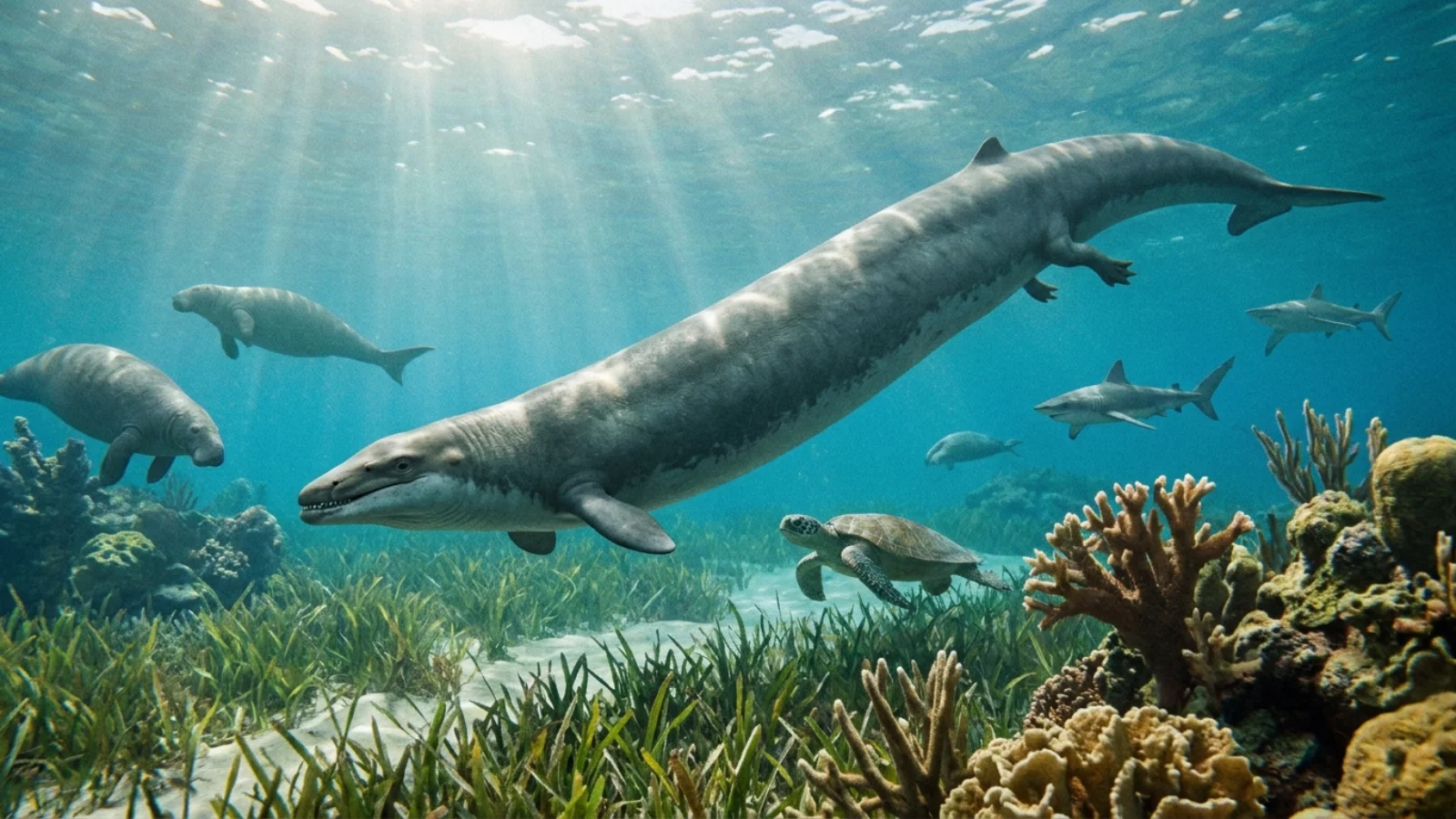
Basilosaurus was an early whale that lived in warm seas about 40 to 34 million years ago, during the Eocene. It reached about 18 m or more, with a remarkably long, serpentine body built from stretched-out vertebrae, and it still had tiny hind legs, feet and toes left over from its land-mammal ancestors. The name means “king lizard”: Richard Harlan named it in 1834 thinking it was a giant sea reptile, before Richard Owen showed in 1839 that it was a mammal. Basilosaurus cetoides is the state fossil of Alabama; its relative Basilosaurus isis comes from Egypt’s Wadi Al-Hitan.
Basilosaurus
Was Basilosaurus a reptile or a whale?
A whale. The “lizard” in its name is a 19th-century mistake. Its double-rooted teeth, recognised by Richard Owen in 1839, proved it was a mammal.
The first Basilosaurus fossil, a single vertebra, turned up in Louisiana in 1832. Richard Harlan, who received more bones including material from Clarke County, Alabama, named the animal Basilosaurus, “king lizard”, in 1834, believing he had a giant marine reptile like the ones being dug out of English cliffs. Owen examined the teeth and saw they had two roots, a mammalian trait, and proposed renaming it Zeuglodon cetoides. Under the rules of zoological naming the first name stands, so the whale is stuck with a lizard’s name. “Zeuglodon” survives as an informal common name.
How big was Basilosaurus?
About 18 m long and possibly more. It was the longest of the basilosaurid whales, and most of that length was a long, slender trunk and tail.
Guinness World Records lists Basilosaurus cetoides as the longest basilosaurid, at up to 18 m and possibly more. The Encyclopedia of Alabama gives 60 to 70 feet (18–20 m). The University of Michigan team that excavated a complete B. isis in Egypt also gave about 18 m. Its unusual length came from greatly elongated vertebral bodies in the chest and front of the tail, which gave the animal its serpent-like outline. That body plan is unlike any living whale.
Did Basilosaurus have legs?
Yes, tiny ones. Skeletons of Basilosaurus isis from Egypt have a pelvis and reduced but well-formed hind legs, feet and toes, only a few inches long and useless for walking.
These legs are among the best evidence that whales evolved from land mammals. Philip Gingerich of the University of Michigan found the first Basilosaurus feet at Wadi Al-Hitan in 1989. With an 18 m body, those little hind limbs could not have helped with swimming. Their function, if any, is still debated. What is not debated is what they represent: the last remnant of the legs whale ancestors walked on.
What did Basilosaurus eat?
Large fish and other vertebrates. It was the top predator of its warm, shallow seas.
The Encyclopedia of Alabama describes it as a predator that likely ate larger fish and other vertebrates. At Wadi Al-Hitan, Basilosaurus lived alongside the smaller whale Dorudon, whose site has unusually many juvenile skeletons, suggesting Dorudon calved in shallow water. For a later and much bigger toothed whale predator, see Livyatan.
Where have Basilosaurus fossils been found?
In the US Gulf Coastal Plain, especially Alabama, Mississippi and Louisiana, and in Egypt.
In Alabama, fossils come from Choctaw County, near the towns of Melvin and Fail, and Clarke County, in late Eocene rocks of the Jackson Group: the Pachuta Marl and Shubuta Clay in western Alabama and the Ocala Limestone further east, which extends into Florida. The Melvin-Fail composite skeleton has been on display at the Smithsonian since 1910. Egypt’s Wadi Al-Hitan produced the first complete skeleton of B. isis. Basilosaurus is Alabama’s official state fossil.
| Animal | Group | Lived | Length |
|---|---|---|---|
| — | — | — | — |
| Basilosaurus | Whale | 40–34 Ma | ~18 m+ |
| Livyatan | Whale | 9.9–8.9 Ma | 11.5–17.5 m |
| Mosasaurus | Reptile | 82–66 Ma | ~12 m |
| Elasmosaurus | Reptile | 80.6–77 Ma | ~10.3 m |
Is Basilosaurus an ancestor of modern whales?
It is part of the story but an odd part. Philip Gingerich, who excavated the Egyptian skeletons, calls Basilosaurus “an enigma of whale evolution”.
Basilosaurids sit at an important point in whale history: fully marine, with flippers, but still carrying hind legs. Its smaller neighbour Dorudon looked much more like a modern whale, while Basilosaurus’s stretched, eel-like body is unlike anything alive today. For the living descendants of that story, see our whales guide and the comparison of megalodon and the blue whale. And for why Basilosaurus is sometimes wrongly listed as a marine reptile, see largest marine reptile.
Why were Basilosaurus bones once used as furniture?
In the early 1800s the vertebrae were so common in parts of the American South that farmers treated them as building material. Bones turned up in Louisiana and Alabama were propped in fireplaces as andirons, and many were burned or broken before anyone thought to send them to a scientist. Two judges, Henry Bry in Ouachita Parish, Louisiana, and John Creagh in Clarke County, Alabama, eventually shipped vertebrae to the American Philosophical Society in Philadelphia. Bry noted that rain had sent a hillside of shells sliding downhill to expose the skeleton, and he believed more bones were still buried there.
Richard Harlan’s first reading of the material went wrong in more than one way. He took one tooth for part of a wedge-shaped Pinna shell, and from a single large vertebra he guessed the animal was at least 24 to 30 m long. When Richard Owen checked the specimens in London in 1839 he saw the double roots on the cheek teeth and linked them to whales, but at first he thought the animal might have been a plant-eater like a sea cow. Harlan accepted the new name Zeuglodon cetoides, though, as above, the older name won in the end.
What was the Hydrarchos “sea serpent”?
The most famous Basilosaurus display was a hoax. In July 1845 the German-born showman Albert Koch opened an exhibit at Niblo’s Garden in New York featuring Hydrarchos, a “sea serpent” skeleton his posters claimed was more than 114 feet long and weighed at least 400,000 pounds. Koch had dug up bones in Alabama and strung together vertebrae from at least five Basilosaurus cetoides skeletons, then added paddles made from fossil shells. The naturalist Jeffries Wyman pointed out the obvious signs of forgery, but the show still toured the East Coast and Europe. The Hydrarchos bones ended up in Germany and were destroyed by Allied bombing in the Second World War. A second, smaller skeleton Koch assembled was lost in the Great Chicago Fire of 1871. The long, serpent-like spine that made the hoax believable is also why Basilosaurus is still sometimes suggested as an explanation for sea-serpent sightings, an idea paleontologists reject because nothing like it appears in the fossil record after the Eocene.
How much did Basilosaurus weigh?
Mass estimates vary widely because nobody can weigh a whale that has been dead for 35 million years. A 1998 study put Basilosaurus cetoides at more than 5.8 tonnes and B. isis at nearly 6.5 tonnes. A 2025 study came out far heavier, estimating an 18.35 m B. cetoides at about 15 tonnes. Both figures may be reasonable for different assumptions about how thick the body was around that long trunk. Body-length figures also differ by species: roughly 17 to 20 m for B. cetoides and 15 to 18 m for B. isis.
How was the Basilosaurus skeleton built?
Reconstructions from three Egyptian skeletons give B. isis about 70 vertebrae: 7 in the neck, 18 in the chest, 20 in the lower back and hip region and 25 in the tail. An older 1936 estimate by Remington Kellogg had put the total at 58. The bodies of the vertebrae from the chest back to the front of the tail were greatly lengthened, and the bones were filled with marrow and possibly partly hollow. A small tail fluke was probably present, though it likely helped only with up-and-down movement.
How big were the hind legs?
In a 16 m B. isis the hind limbs measured only about 35 cm, roughly two percent of the body length. The ankle bones were fused, each foot had just three toes, and the pelvis was not attached to the spine, so the legs could not have carried any weight. Bones that small and that loosely anchored could not have pushed the animal through the water either. Whatever their exact use, they show a body plan caught partway between the walking ancestors of whales and the legless whales of today.
How did Basilosaurus swim?
Its long, flexible trunk points to eel-like swimming, with waves passing along the body mainly in the vertical plane, as Philip Gingerich has argued, and perhaps some side-to-side movement as well. The back muscles appear to have been relatively weak and the limb bones were dense and heavy, which suggests it was not built for long-distance cruising or deep dives. Many researchers picture it hunting at or near the surface, in contrast with its smaller relative Dorudon, which is thought to have been a diver.
How strong was the Basilosaurus bite?
A 2015 study led by Eric Snively used computer models of the skull and the damage seen on Dorudon skulls to work out how hard it could bite. Their answer was no less than 16,400 newtons, with more than 20,000 newtons possible. That is in the same range as large crocodiles and alligators. The teeth were differentiated like those of land mammals: pointed incisors and canines at the front, and high-crowned, double-rooted cheek teeth further back. In B. isis the tooth count on each side was three incisors, one canine, four premolars and two molars above, with three molars below. Teeth like these could seize and cut prey rather than simply grip it.
What did Basilosaurus actually eat?
Stomach contents give direct answers. Remains preserved inside B. cetoides include fish and large sharks. An elderly male B. isis from Egypt held bones of Dorudon and of the fish Pycnodus mokattamensis. Juvenile Dorudon skulls from Wadi Al-Hitan carry bite marks that match Basilosaurus teeth, which suggests it hunted young Dorudon around the shallow bays where they were born. Basilosaurus was not always the one doing the eating: a complete skeleton found in Egypt in 2015 shows signs of scavenging by the large shark Otodus sokolovi, which may also have hunted it.
Could Basilosaurus echolocate?
Probably not. Modern toothed whales use a fatty organ in the forehead, the melon, to focus the clicks they use for echolocation, and the Basilosaurus skull has no room for one. Its brain was also small for its body compared with living whales. Its hearing was already adapted to water, though. The skull is asymmetrical, as in modern toothed whales, which a 2011 study linked to directional hearing underwater through a fat-filled channel in the lower jaw, and the middle and inner ear were enclosed in a dense bony capsule partly cushioned by air sinuses. It could probably tell where a sound came from, but not build a picture of its surroundings from echoes.
Where else has Basilosaurus been found?
B. cetoides comes from the southeastern United States, including Louisiana, Alabama and Mississippi. It is the state fossil of both Alabama and Mississippi. B. isis is known from Wadi Al-Hitan and the Qasr el-Sagha area in Egypt and from the Wadi Esh-Shallala Formation in Jordan. Fossils from England, Poland, Ukraine, the Caucasus, Pakistan and South Australia were once named as Basilosaurus or Zeuglodon species, but they have since been moved to other genera or treated as too incomplete to identify. Since Elwyn Simons and Philip Gingerich began work in Egypt in the 1980s, more than 500 archaeocete skeletons have been recorded there, most of them B. isis or Dorudon atrox.
Where does Basilosaurus turn up in books and television?
Basilosaurus has a long cultural history for an animal most people have never heard of. Herman Melville mentioned it in Moby-Dick in 1851, only a few years after Koch’s Hydrarchos tour, when the debate over whether it was a reptile or a whale was still fresh. In the 2000s the BBC gave it starring roles in the documentary series Walking with Beasts and Sea Monsters, where it was shown as the top predator of Eocene seas. Those programmes helped fix the image of a snake-like whale in the public mind, and they explain why it is so often listed, wrongly, alongside mosasaurs and plesiosaurs as a “marine reptile”. In reality it belongs on the whale family tree, a side branch that reached enormous size and then vanished without leaving any living relatives.
Why did Basilosaurus die out?
Its fossil record ends around 35 to 33.9 million years ago, close to the Eocene–Oligocene extinction event. Proposed causes for that event include volcanic activity, asteroid impacts and a cooling climate, and cooling in particular may have reshaped ocean currents and cut the supply of prey. Basilosaurus left no descendants. The seas that followed were filled instead by the Neoceti, the group that includes every living toothed and baleen whale.
Was Basilosaurus a dinosaur or a reptile?
Neither. Basilosaurus was an early whale, a mammal. Its name, “king lizard”, came from Richard Harlan’s 1834 mistake in thinking it was a marine reptile.
How big was Basilosaurus?
About 18 m long and possibly more, making it the longest basilosaurid whale. Some sources give 18 to 20 m.
When did Basilosaurus live?
About 40 to 34 million years ago, in the middle to late Eocene.
Did Basilosaurus have legs?
Yes. Basilosaurus isis from Egypt had tiny, non-functional hind legs with feet and toes, a remnant of whales’ land-mammal ancestry.
What did Basilosaurus eat?
Large fish and other vertebrates; it was a top predator of warm, shallow Eocene seas.
Where are Basilosaurus fossils found?
In the US Gulf Coastal Plain, especially Alabama, and at Wadi Al-Hitan in Egypt. The Smithsonian has displayed an Alabama skeleton since 1910.
What is Alabama’s state fossil?
Basilosaurus cetoides, the serpent-shaped Eocene whale.
What does Basilosaurus mean?
“King lizard”. Richard Owen later proposed the name Zeuglodon after showing it was a mammal, but the original name has priority.
Blane Perun has been exploring Earth’s oceans and marine life for over 25 years. Founder of TheSea.Org in 1999, underwater photographer, coral aquaculture pioneer, and explorer of 80+ countries.
About Blane Perun → All prehistoric sea creatures →