Prehistoric Crocodiles — From Deinosuchus to Purussaurus
Prehistoric crocodiles were far more varied than the semi-aquatic ambush predators alive today. The crocodile line, the crocodylomorphs, began in the Late Triassic as small, long-legged land animals. Later relatives included the thalattosuchians, true sea crocodiles with flippers and shark-like tails; notosuchians that walked on land and in some cases ate plants; and freshwater giants such as Sarcosuchus, Deinosuchus and the Miocene caiman Purussaurus, estimated at about 10 to 12.5 m. Some lineages lasted until humans arrived, such as Quinkana in Australia and Voay in Madagascar.
The crocodile line tried almost every lifestyle a reptile can have, from sprinting on land to giving birth at sea, before settling on the river-bank ambush we know today.
What were prehistoric crocodiles?
Crocodiles, alligators, caimans and gharials are the last survivors of a much larger group called the crocodylomorphs. This group includes all the crocodilians and their extinct relatives, and it was the only branch of the wider crocodile-line archosaurs, the pseudosuchians, to survive the extinction at the end of the Triassic about 201 million years ago. Its fossil record stretches back more than 200 million years.
During the Mesozoic and early Cenozoic, crocodylomorphs were far more diverse than they are now. Living crocodilians are all semi-aquatic ambush predators with a broadly similar body plan, but their prehistoric relatives included land runners, ocean swimmers, burrowers, plant-eaters and giants. A 2019 study of crocodylomorph skull shape by Pedro Godoy found a strong link between skull shape, body size and lifestyle, and showed that land-living forms, especially the notosuchians, had the greatest variety of skull shapes of all.
This article tours that diversity, from the Triassic to the age of humans. For how crocodiles relate to dinosaurs, see are crocodiles dinosaurs?
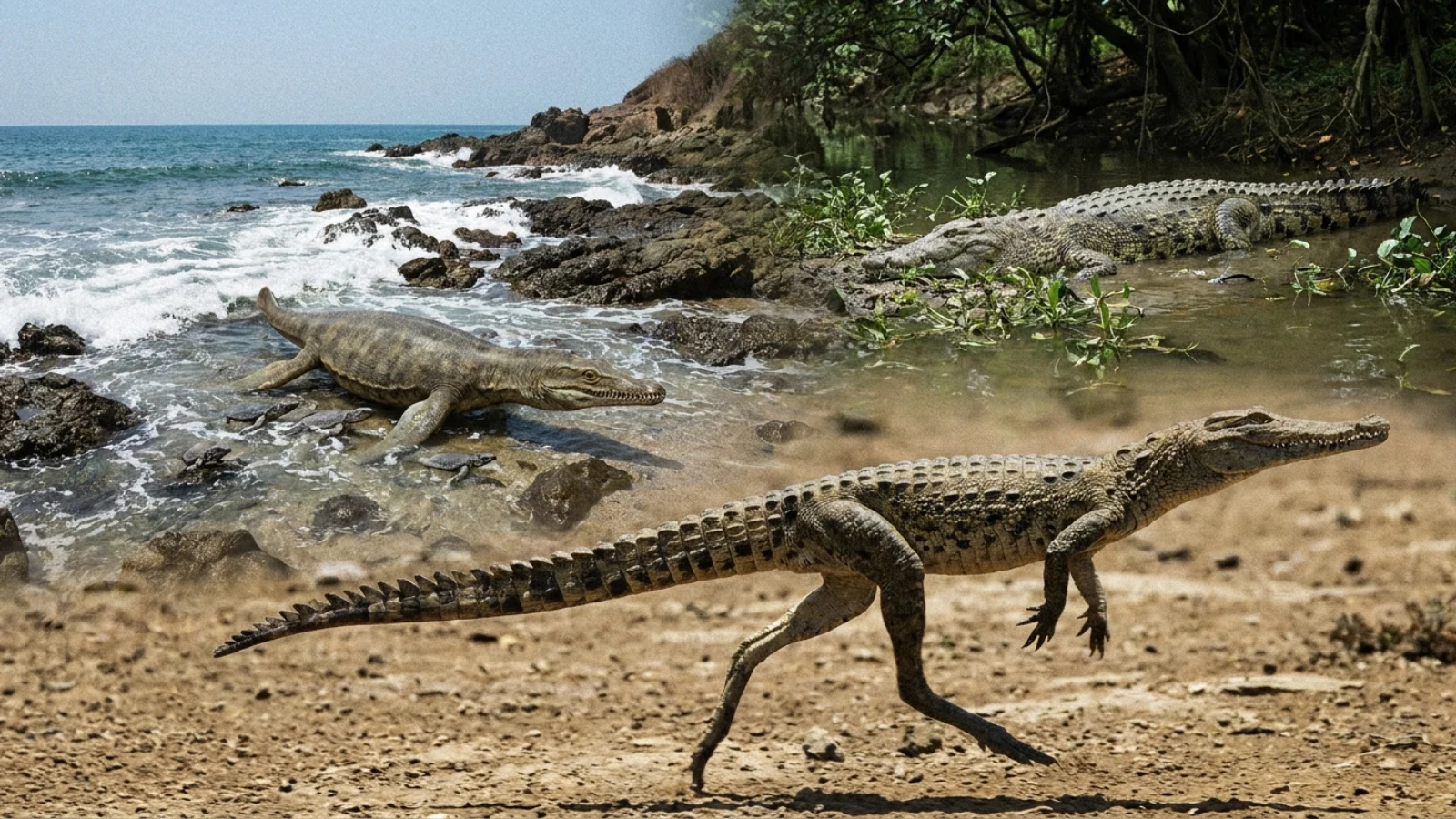
What did the first crocodiles look like?
Nothing like a crocodile. The earliest crocodylomorphs were small, lightly built, active animals that lived on land. A good example is Terrestrisuchus gracilis, from near the very end of the Late Triassic in Wales and southern England. It was a slender, long-legged predator originally estimated at 49 to 76 cm long, although those estimates may be based on juveniles.
Terrestrisuchus lived on a chain of tropical, low-lying islands that made up southern Britain at the time, alongside similarly small dinosaurs and abundant lizard-like rhynchocephalians. Many of its fossils come from fissures in the limestone of those islands, which formed caves and sinkholes that trapped and preserved small reptiles.
These early forms, often grouped as “sphenosuchians”, walked upright with their legs beneath the body, much more like a greyhound than a modern crocodile. The sprawling, belly-sliding gait of living crocodiles and their semi-aquatic habits came later, as some descendants took to the water.
Were there crocodiles in the sea?
Yes, and some were more fully marine than any crocodile alive today. The thalattosuchians, a group of crocodylomorphs from the Early Jurassic to the Early Cretaceous, are often called marine crocodiles or sea crocodiles, although they are not members of the modern crocodilian group. They had a worldwide distribution and came in two main kinds.
The teleosauroids looked superficially like gharials, with long snouts and bony back armour, and were not greatly specialised for open-ocean life. The largest named member was Machimosaurus rex from Tunisia, estimated at up to 7.15 m long with a skull 155 cm long, making Machimosaurus the largest known crocodyliform of the Jurassic. It had blunt teeth, and fossil turtles from Switzerland and Germany carry bite marks and even embedded broken Machimosaurus teeth, showing that it cracked open turtle shells.
The metriorhynchids went much further. They were the only group of archosaurs to become fully adapted to the sea, with forelimbs turned into small paddles, a shark-like tail fluke and smooth, scaleless skin like that of ichthyosaurs and plesiosaurs. They lost the bony armour of other crocodiles and were almost certainly unable to move on land.
Did sea crocodiles give birth to live young?
The evidence suggests that metriorhynchids did, which would make them unique among archosaurs. Their limbs were unsuited to walking on land, and their hip opening was unusually tall, a feature also seen in other fully aquatic reptiles known to give live birth.
The strongest evidence is a fossil of a pregnant female Dakosaurus from the Late Jurassic Plattenkalk limestone of Bavaria, Germany, which preserves the complete skeleton of a newborn with small paddle-like forelimbs like those of the adults. Living crocodiles all lay eggs on land, so the metriorhynchids represent a remarkable evolutionary experiment.
Dakosaurus itself was a formidable predator, a large metriorhynchid with serrated teeth flattened from side to side, suited to cutting up big prey. Its name means “biter lizard”. One species from Argentina, Dakosaurus andiniensis, had such a short, tall snout that press reports nicknamed it “Godzilla”. For the other great reptiles of those seas, see our guide to prehistoric marine reptiles.
Were there crocodiles that ate plants?
Yes. The notosuchians were a group of mainly southern crocodylomorphs that lived on land during the Jurassic and Cretaceous, and some lineages may have survived into the Middle Miocene. They evolved a range of feeding habits, including herbivory, omnivory and hypercarnivory on land, and some had mammal-like teeth, armadillo-like bands of armour or pig-like snouts.
The best-known plant-eater is Simosuchus clarki from the Late Cretaceous of Madagascar, a small animal about 0.75 m long when fully grown. It had an unusually short, deep skull and teeth shaped like maple leaves, features that have led many palaeontologists to regard it as a herbivore. Several well-preserved specimens, collected by the Mahajanga Basin Project, cover most of the skeleton.
Imagine a crocodile relative with a snub nose and leaf-shaped teeth, browsing on plants beside dinosaurs. That was Simosuchus, and it shows how far the crocodile body plan could stray from the riverbank.
What was the BoarCroc?
Kaprosuchus saharicus, nicknamed “BoarCroc”, is known from a single nearly complete skull from the Upper Cretaceous Echkar Formation of Niger. It was described in 2009 by Paul Sereno and Hans Larsson in a monograph on Saharan crocodyliforms that also included the “DuckCroc” Anatosuchus and the “PancakeCroc” Laganosuchus.
The skull is 507 mm long, with a lower jaw of 603 mm, and it carries three sets of tusk-like teeth projecting above and below the jaws, a pattern seen in no other known crocodyliform. Its name means “boar crocodile”. It also had large, rough horns at the back of the skull. Its eyes faced partly forward rather than sitting on top of the head, which has been taken as evidence that it hunted on land rather than lurking in the water like living crocodiles.
Which prehistoric crocodiles hunted dinosaurs?
Two giants of the Cretaceous are famous for this. Sarcosuchus imperator, the “SuperCroc” of Africa, lived about 112 million years ago in the rivers of what is now the Sahara, and was one of the largest crocodylomorphs ever. Our profile of Sarcosuchus covers its size and how it grew.
In North America, Deinosuchus, the “terror crocodile”, lived along the shores of the Western Interior Seaway in the Late Cretaceous. It was a giant relative of alligators, and bite marks on dinosaur bones suggest that it attacked or scavenged large dinosaurs. See our full profile of Deinosuchus.
Other Cretaceous forms were stranger still. Stomatosuchus inermis, from Egypt, grew to an estimated 10 m and had a long, flattened skull up to 2 m long with lid-like jaws lined with small conical teeth. Its lower jaw may have been toothless and may have supported a pelican-like throat pouch for scooping up fish. The only specimen, collected by Ernst Stromer in 1911, was destroyed in an Allied bombing raid on Munich in 1944, and only photographs remain.
What was the biggest prehistoric crocodile after the dinosaurs?
After the dinosaurs disappeared, crocodilians produced new giants. The most famous is Purussaurus, a giant caiman that lived in South America during the Miocene. Its fossils come from the Brazilian and Peruvian Amazon, Colombia, Panama and Venezuela, and the genus is named after the Purus River in Brazil, where it was first found.
The largest known skull of Purussaurus brasiliensis is 1,453 mm long. From it, one estimate puts the animal at about 10.3 m long and 5.16 tonnes, while another gives about 12.5 m, with a range of 9.9 to 15.8 m, and about 8.4 tonnes. Either way, it was one of the largest crocodilians that ever lived, and it was a top predator of the Miocene wetlands of northern South America. The record books are compared in largest crocodile ever.
What other giant crocodiles lived in Miocene South America?
The Miocene wetlands of South America held a whole community of giant crocodilians. Alongside Purussaurus lived Mourasuchus, a giant caiman with a broad, flat, very long skull described as duck-like. Its skulls reach about 1.1 m long, and researchers have suggested that it fed by gulping or straining large numbers of small prey, such as invertebrates, molluscs, crustaceans and small fish, rather than seizing big animals.
There were also gharial relatives. Gryposuchus, a long-snouted gavialid known from Argentina, Colombia, Venezuela, Brazil and Peru, includes the species G. croizati, estimated at about 10 m long. Its type specimen, a rostrum collected along the Pauini River in Brazil in 1912, was probably destroyed in the 1943 bombing of Hamburg.
Having several giant crocodilians with very different skulls in the same ecosystem suggests they divided up the food: Purussaurus taking large animals, Gryposuchus fish and Mourasuchus small prey in bulk. Living gharials, the descendants of that slender-snouted line, are profiled in our gharial article.
Was Rhamphosuchus the largest crocodile?
For a long time it was claimed to be. Rhamphosuchus crassidens, the “beak crocodile”, was a gavialid of the Pliocene known from the Siwalik Hills of Pakistan and India and the Sindh region of Pakistan. Based on incomplete teeth and skulls, it was traditionally estimated at 15 to 18 m long, which would have made it the largest crocodilian of all.
A more recent study suggests it was 8 to 11 m long, large but not a record. The story is a common one in palaeontology: early size estimates for fragmentary giants tend to shrink as more careful methods are applied, which is why figures for Rhamphosuchus, Purussaurus and Deinosuchus should always be read as ranges.
Did prehistoric crocodiles live alongside humans?
Some did. In Australia, a group of crocodilians called the mekosuchines dominated the region for most of the Cenozoic. They first appear in the Eocene and survived until the arrival of humans: in the Pleistocene in Australia, and within the Holocene on the Pacific islands of Fiji, New Caledonia and Vanuatu. One of the last species, Mekosuchus inexpectatus of New Caledonia, may have been at least partly tree-climbing.
The best-known mekosuchine is Quinkana, which lived in Australia from about 28 million to about 10,000 years ago. It had long legs and serrated, blade-like teeth, and is thought to have been one of the top land predators of Pleistocene Australia, estimated at about 3 m long and 200 kg. Its name comes from the Quinkans, spirits in Gugu-Yalanji mythology.
In Madagascar, the horned crocodile Voay robustus survived into the Holocene. It had prominent horn-like projections at the back of its skull, a deeper snout than a Nile crocodile and robust limbs, and it reached about 5 m in length. It may have disappeared in the wave of extinctions that took the elephant birds and Malagasy hippos after humans arrived on the island, about 2,000 years ago.
Why are modern crocodiles so similar?
The living crocodilians are the survivors of a group that once filled dozens of different roles. The thalattosuchians had vanished by the Early Cretaceous. Most notosuchians disappeared at or soon after the end of the Cretaceous. The mekosuchines and Voay disappeared with the arrival of humans. What remains is a single lifestyle: large, armoured, semi-aquatic predators that ambush prey at the water’s edge.
That lifestyle has proven extraordinarily durable. Crocodilians survived the extinction 66 million years ago that killed the non-avian dinosaurs, and they are still found through the tropics and subtropics. The saltwater crocodile is the largest living reptile, but it would have been mid-sized beside Purussaurus or Sarcosuchus. The prehistoric record is a reminder that the familiar crocodile is just one of many ways the crocodile line has tried to make a living.
What was the biggest prehistoric crocodile?
Candidates include Sarcosuchus, Deinosuchus and Purussaurus, all estimated at roughly 10 to 12 m; exact figures vary by study.
Were prehistoric crocodiles dinosaurs?
No. They were crocodylomorphs, on the crocodile side of the archosaur family tree, separate from the dinosaurs.
Were there crocodiles in the ocean?
Yes. Thalattosuchians lived in Jurassic and Early Cretaceous seas, and metriorhynchids had flippers, tail flukes and probably gave live birth.
Did any crocodiles eat plants?
Yes. Simosuchus, a small notosuchian from Late Cretaceous Madagascar, had leaf-shaped teeth suited to plant food.
How old are crocodiles?
The crocodile line, Crocodylomorpha, dates back more than 200 million years to the Late Triassic.
What is the BoarCroc?
Kaprosuchus, a Late Cretaceous crocodyliform from Niger with three sets of boar-like tusks, probably a land hunter.
When did the last prehistoric crocodiles die out?
Some survived into the Holocene, including mekosuchines on Pacific islands and Voay in Madagascar.
Was Rhamphosuchus 18 m long?
Older estimates said 15 to 18 m, but a more recent study suggests about 8 to 11 m.
- Wikipedia (Kiwix 2023 snapshot): “Crocodylomorpha”, “Terrestrisuchus”, “Thalattosuchia”, “Metriorhynchidae”, “Machimosaurus”, “Dakosaurus”, “Notosuchia”, “Simosuchus”, “Kaprosuchus”, “Stomatosuchus”, “Purussaurus”, “Mourasuchus”, “Gryposuchus”, “Rhamphosuchus”, “Mekosuchinae”, “Quinkana”, “Voay”.
- Godoy, P.L. (2019), “Crocodylomorph cranial shape evolution and its relationship with body size and ecology”, bioRxiv preprint.
- Sereno, P.C. & Larsson, H.C.E. (2009), Cretaceous crocodyliforms from the Sahara, ZooKeys.
Blane Perun has been exploring Earth’s oceans and marine life for over 25 years. Founder of TheSea.Org in 1999, underwater photographer, coral aquaculture pioneer, and explorer of 80+ countries.
About Blane Perun →