Sarcosuchus — SuperCroc of the Cretaceous Rivers
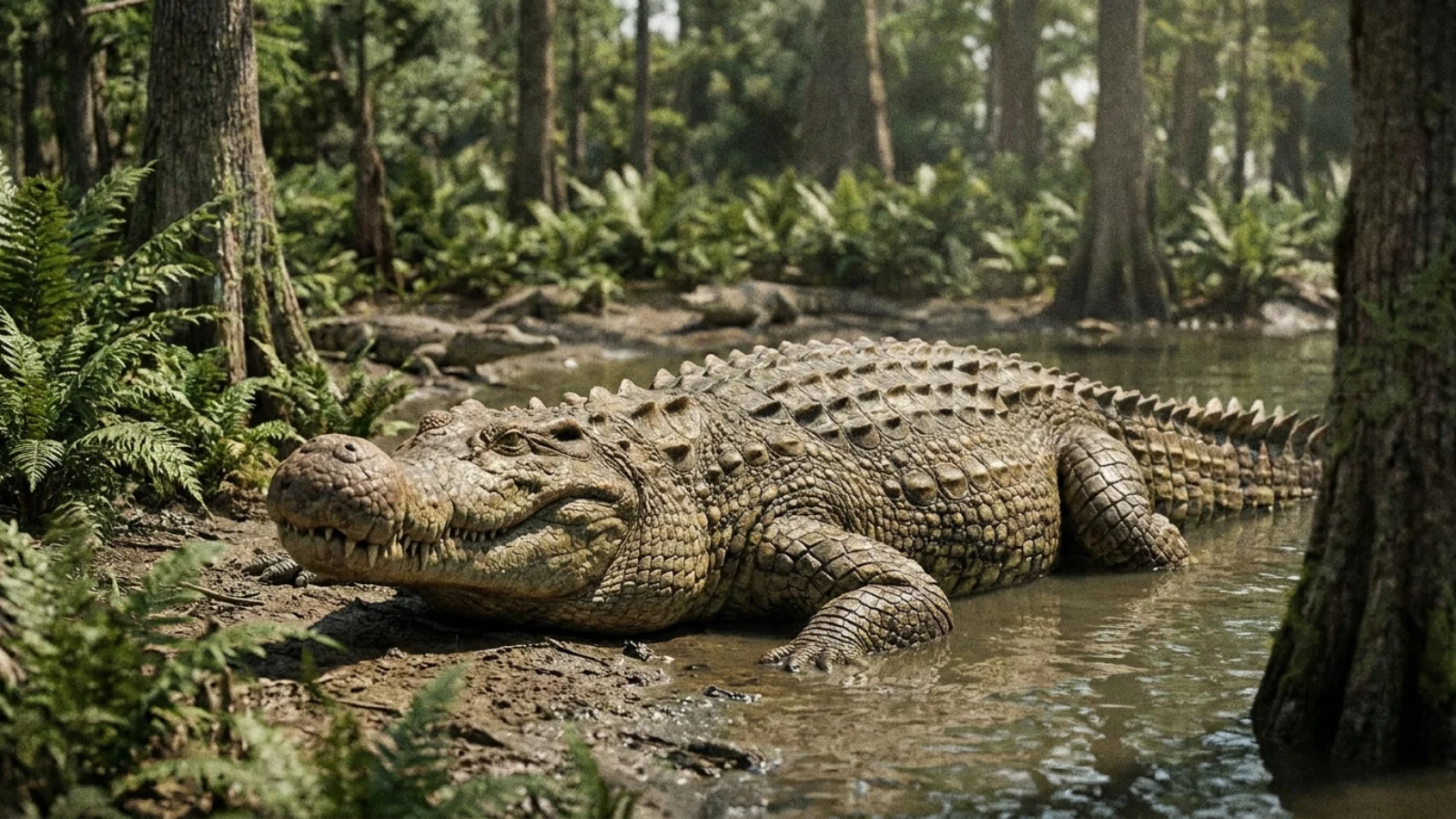
Sarcosuchus imperator, known as SuperCroc, was one of the largest crocodile-like reptiles that ever lived. It inhabited rivers in what is now the Ténéré Desert of Niger during the Early Cretaceous, roughly 130 to 112 million years ago. Paul Sereno’s team estimated the largest individuals at about 11 to 12 m and 8 tonnes in 2001, while a 2019 reassessment suggested about 9 to 9.5 m and 3.5 to 4.3 tonnes. It had a long snout ending in a bulbous swelling called a bulla, 66 upper and 62 lower teeth, and armour from neck to mid-tail.
Sarcosuchus imperator means “flesh crocodile emperor”. The species was named in 1966 from a nearly complete skull found in Niger in 1964.
What was Sarcosuchus?
Sarcosuchus was a giant crocodyliform, a crocodile-like reptile belonging to a branch of the crocodile line that is only distantly related to living crocodiles and alligators. It lived in the Early Cretaceous, when Africa and South America were still splitting apart and the Sahara was a green landscape of rivers, lakes and forests.
The best-known species, Sarcosuchus imperator, comes from the Elrhaz Formation in the Ténéré Desert of Niger, where the rocks preserve an ancient river system. A second species, S. hartti, is known from northeastern Brazil, from remains first collected in the 1860s and recognised as belonging to Sarcosuchus in 1977. Fragmentary material has also been reported from Morocco, Tunisia and possibly Libya and Mali.
Sarcosuchus became famous in 2001, when Paul Sereno of the University of Chicago and colleagues published a detailed description of new fossils in the journal Science, and National Geographic presented the animal to the world as “SuperCroc”. The nickname has stuck, and Sarcosuchus is now one of the best-known prehistoric crocodylians.
How big was Sarcosuchus?
Sarcosuchus was enormous, but its size has been revised downwards as methods have improved. In 2001, Sereno and colleagues estimated that the largest specimen belonged to an animal around 11 to 12 m long and weighing about 8 tonnes. Those figures made it the largest crocodyliform then known, and Guinness World Records still lists Sarcosuchus as the largest crocodyliform ever.
In 2019, Haley O’Brien and colleagues used a different method, based on the relationship between head size and body size in living crocodilians and on the dimensions of the brain case, which is less affected by snout length. They estimated the largest Sarcosuchus at about 9 m and 3.45 tonnes, with an upper limit of about 9.5 m and 4.3 tonnes. The revision reflects the fact that Sarcosuchus had an unusually long snout, which inflates body-length estimates based on skull length alone.
Even at 9 m, Sarcosuchus was far larger than any living crocodile. The largest saltwater crocodile ever reliably measured, Lolong, was 6.17 m. Our article on the largest crocodile ever recorded compares Sarcosuchus with other giants.
How was Sarcosuchus discovered?
The story of Sarcosuchus began with French expeditions to the Sahara. Between 1946 and 1959, the palaeontologist Albert-Félix de Lapparent led expeditions that recovered fragments of skulls, vertebrae, teeth and bony scutes of a giant crocodylian from Cretaceous rocks in Algeria and Niger.
In 1964, a team from the French Atomic Energy Commission (CEA) working in the Gadoufaoua region of Niger found a nearly complete skull. In 1966, France de Broin and Philippe Taquet named the animal Sarcosuchus imperator, using that skull as the holotype, the reference specimen for the species.
Much of what we know about the animal’s body comes from Sereno’s expeditions to Niger in 1997 and 2000. His teams recovered several new skulls, about half of a skeleton, and hundreds of bones and teeth, allowing the first detailed reconstruction of the whole animal. These fossils showed the full shape of the skull, the armour and the growth of the animal, and made Sarcosuchus one of the best-known giant crocodyliforms.
What did Sarcosuchus look like?
The skull of Sarcosuchus was long and fairly narrow, with the snout making up about 75% of its length. The upper jaw overhung the lower one, creating an overbite, and the teeth were stout and conical. Each side of the upper jaw held 35 teeth and each side of the lower jaw 31, for a total of 132.
The most distinctive feature was the bulla, a hollow, bulbous expansion at the tip of the snout, around the nostrils. All known adult skulls have it, so it was not limited to one sex, unlike the ghara of male gharials. Its function is unknown. Suggestions include an organ for producing or amplifying sounds, a role in smell, or display. The eyes sat on top of the skull and pointed slightly upwards, allowing the animal to watch the surface while mostly submerged.
Sarcosuchus was heavily armoured. Its bony osteoderms formed a continuous shield from the neck to the middle of the tail, more extensive than in living crocodiles. This armour would have protected it from rivals and predators but may also have reduced the flexibility of its back.
What did Sarcosuchus eat?
The diet of Sarcosuchus is debated. Its relatives, the pholidosaurids, were mostly slender-snouted fish eaters, and Sarcosuchus‘s long snout suggests fish were important. Its rivers were full of large fish, including the coelacanth Mawsonia and the ray-finned Lepidotes, and young Sarcosuchus almost certainly ate fish.
Sereno and colleagues argued that adult Sarcosuchus, with its broad snout base, sturdy teeth and great size, was a generalist predator like the Nile crocodile, able to take large land animals at the water’s edge, including dinosaurs. The Elrhaz Formation preserves many dinosaurs, such as the iguanodontian Ouranosaurus, the sauropod Nigersaurus and the spinosaurid Suchomimus, which would have come to the rivers to drink.
A biomechanical study in 2014 suggested that Sarcosuchus may not have been able to perform the death roll that living crocodiles use to dismember large prey, which would argue against a diet of very large animals. No dinosaur bones with confirmed Sarcosuchus bite marks have yet been described, so its taste for dinosaurs remains plausible but unproven.
How long did it take Sarcosuchus to grow?
By counting growth rings in the osteoderms of a subadult specimen, Sereno’s team estimated that Sarcosuchus took about 50 to 60 years to reach adult size. This is much longer than living crocodilians take to mature.
Sereno proposed that Sarcosuchus achieved its great size not by growing faster than living crocodiles but by extending the period of rapid juvenile growth, continuing to grow quickly for decades. A similar pattern has been proposed for Deinosuchus, which may have taken more than 35 years to reach adult size, as described in our Deinosuchus article.
The method works because bone growth slows each year during a period of stress, such as a dry season, leaving a dense line in the bone, much like a tree ring. In living crocodilians these lines are laid down once a year, and researchers assume the same was true of Sarcosuchus, which lived in a seasonal tropical climate. A long growth period would mean that full-sized Sarcosuchus were old animals, and that young animals spent many years at smaller sizes, competing with other predators and vulnerable to attack.
What was the world of Sarcosuchus like?
The Elrhaz Formation of Niger records a humid, tropical landscape of broad rivers, floodplains and forests about 112 million years ago. The rivers held large fish, turtles and other crocodyliforms, including smaller species with very different lifestyles, such as the dog-like Araripesuchus and the duck-faced Anatosuchus.
Dinosaurs were abundant. The spinosaurid Suchomimus, a fish-eating theropod with a crocodile-like snout, shared the rivers with Sarcosuchus, and the two may have competed for fish. The sail-backed Ouranosaurus and the broad-mouthed sauropod Nigersaurus grazed nearby. The predatory dinosaur Kryptops also lived in the area.
In Brazil, S. hartti lived in a shallow lake environment in the Recôncavo Basin. The presence of related species on both sides of the young South Atlantic reflects the fact that Africa and South America were still close together in the Early Cretaceous.
How do scientists estimate the size of an extinct crocodile?
Complete skeletons of giant crocodyliforms are almost never found, so palaeontologists have to estimate body size from parts. The most common starting point is the skull, because skulls are distinctive, often well preserved and closely related to body size in living crocodilians. Researchers measure the skull, then use the ratio of skull length to total length in a living species to calculate the length of the extinct animal.
The problem is that the result depends heavily on which living species is used. A long-snouted animal like Sarcosuchus has a skull that is long for its body, so using the proportions of a short-snouted crocodile makes it look far bigger than it was. The famous overestimate of Deinosuchus at 15 m came partly from this kind of mismatch.
To get around this, newer studies use measurements that are less affected by snout shape, such as the width of the skull at the back or the width of the braincase, or the size of limb bones and vertebrae. They also take into account how closely related the extinct animal is to each living species. The 2019 study by O’Brien and colleagues used this kind of approach, which is why its estimates for Sarcosuchus are smaller than the original ones. Size estimates for giant extinct crocodylians will probably keep changing as new fossils and methods appear.
Why did giant crocodyliforms like Sarcosuchus disappear?
Sarcosuchus is known from rocks up to about 112 million years old, and no later fossils have been found. Why it disappeared is unknown. The Early Cretaceous world was changing: Africa and South America were separating, new seaways were opening and climates and river systems were shifting. Any of these changes could have affected a large river predator that needed big rivers and plenty of prey.
Competition may also have played a part. Later in the Cretaceous, other crocodyliforms and large predatory dinosaurs, including spinosaurids, occupied similar roles in African rivers. Giant animals with slow growth and long generation times are generally vulnerable to environmental change, because their populations recover slowly from losses.
What is clear is that gigantism in crocodile-line reptiles was not a one-off. It evolved again and again, in different families and on different continents, whenever large rivers, coastal wetlands and abundant prey made it possible.
How is Sarcosuchus related to modern crocodiles?
Sarcosuchus is not a direct ancestor of living crocodiles. It is usually placed in the family Pholidosauridae, a group of long-snouted crocodyliforms that lived in rivers, coasts and seas from the Jurassic to the Cretaceous, outside the crown group Crocodylia that contains all living crocodiles, alligators and gharials. Its closest relative within that family is thought to be Terminonaris, a long-snouted crocodyliform from North America.
A 2019 study placed Sarcosuchus closer to the dyrosaurids, a group of marine crocodyliforms that survived the extinction of the dinosaurs, within a larger group called Tethysuchia. Many tethysuchians lived in coastal and marine environments, which helps explain why crocodyliforms like Sarcosuchus are covered in the story of prehistoric sea creatures.
Giant size evolved several times in crocodile-line reptiles: in Sarcosuchus in Africa and South America, in Deinosuchus in North America and in Purussaurus, a giant caiman, in the Miocene Amazon. Our article are crocodiles dinosaurs? explains where all these animals fit on the family tree.
Sarcosuchus vs Deinosuchus: which was bigger?
The two most famous giant crocodylians were probably similar in size. Recent estimates put the largest Sarcosuchus at about 9 to 9.5 m and the largest Deinosuchus at about 10.5 m, but the uncertainty in both estimates is large. Older estimates of 11 to 12 m for both animals are now considered too high by many researchers.
They differed in time, place and lifestyle. Sarcosuchus lived about 112 million years ago in African and South American rivers, while Deinosuchus lived 82 to 73 million years ago on the coasts of North America. Sarcosuchus had a longer, narrower snout, suggesting more fish in its diet, while Deinosuchus had a broad, heavy skull with crushing teeth, suited to turtles and large prey.
Neither was a dinosaur, and neither was a direct ancestor of living crocodiles, but both were among the largest predators of their time on land or in fresh water.
How big was Sarcosuchus?
Estimates range from about 9 to 9.5 m and 3.5 to 4.3 tonnes (2019) to about 11 to 12 m and 8 tonnes (2001).
When did Sarcosuchus live?
About 130 to 112 million years ago, in the Early Cretaceous.
Where was Sarcosuchus found?
Mainly in the Elrhaz Formation of Niger, with other remains from Morocco, Tunisia and a second species from Brazil.
Did Sarcosuchus eat dinosaurs?
Possibly. Its size and teeth suggest it could, but no dinosaur bones with confirmed Sarcosuchus bite marks are known.
Is Sarcosuchus the biggest crocodile ever?
It is one of the largest crocodyliforms. Guinness lists it as the largest; Deinosuchus and Purussaurus were similar in size.
Was Sarcosuchus a crocodile?
It was a crocodyliform, a crocodile-like relative, but not a true crocodile and not an ancestor of living crocodiles.
What was the bump on Sarcosuchus’s nose?
A hollow bulla at the snout tip. Its purpose is unknown; it may have been used for sound, smell or display.
Why is Sarcosuchus called SuperCroc?
National Geographic popularised the nickname in 2001, when Paul Sereno’s team described new fossils.
- Sereno, P.C. et al. (2001), “The giant crocodyliform Sarcosuchus from the Cretaceous of Africa”, Science 294.
- O’Brien, H.D. et al. (2019), “Crocodylian head width allometry and phylogenetic prediction of body size in extinct crocodyliforms”, Integrative Organismal Biology.
- de Broin, F. & Taquet, P. (1966), original description of Sarcosuchus imperator.
- Guinness World Records: largest crocodyliform ever.
- Wikipedia/Wikiwand, “Sarcosuchus” (discovery, anatomy, classification).
Blane Perun has been exploring Earth’s oceans and marine life for over 25 years. Founder of TheSea.Org in 1999, underwater photographer, coral aquaculture pioneer, and explorer of 80+ countries.
About Blane Perun →