Deinosuchus — The ‘Terror Crocodile’ That Ate Dinosaurs
Deinosuchus was one of the largest crocodylians that ever lived, a giant relative of alligators that hunted the coasts, estuaries and river mouths of North America between about 82 and 73 million years ago. The biggest western animals reached around 10 m (33 ft) and several tonnes, while eastern animals were smaller. Its heavy skull carried blunt, crushing teeth the size of bananas, and fossil bite marks show that it ate sea turtles and, at least sometimes, dinosaurs.
Deinosuchus means “terrible crocodile”, from the Greek deinos (terrible) and souchos (crocodile). The genus was named by W. J. Holland in 1909.
What was Deinosuchus?
Deinosuchus was a giant crocodylian of the Late Cretaceous, the last age of the dinosaurs. It lived in North America during the Campanian stage, from about 82 to 73 million years ago, a time when the continent was split in two by a shallow inland sea, the Western Interior Seaway. The western landmass is known as Laramidia and the eastern one as Appalachia, and Deinosuchus lived on the coasts of both.
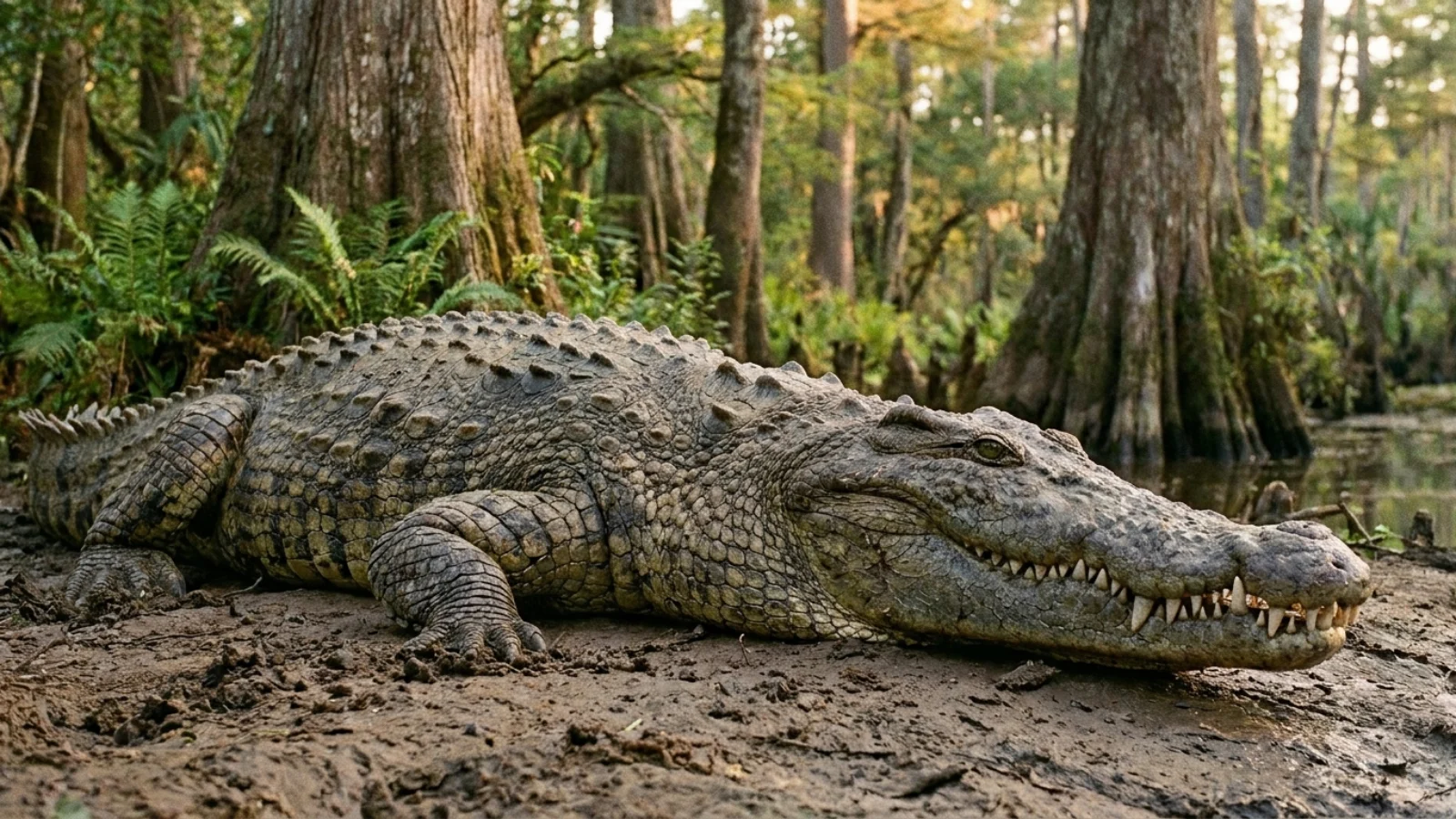
It looked broadly like a gigantic alligator, with a long, broad skull, a slightly bulbous snout tip and heavy, crushing teeth at the back of the jaws. Its back was covered with thick, pitted bony plates, or osteoderms, which are among its most commonly found fossils. These plates were unusually deep and rough, unlike those of modern crocodilians.
Deinosuchus is not a dinosaur. It belongs to the crocodile-line branch of the archosaurs, the same lineage as living crocodiles and alligators, while dinosaurs belong to the bird line. Our article are crocodiles dinosaurs? explains how the two groups are related.
How big was Deinosuchus?
Deinosuchus was huge, but its exact size has been debated for decades because no complete skeleton has been found. The first reconstruction, by Edwin Colbert and Roland Bird in 1954, gave it a length of about 15 m, based on a skull reconstructed with the proportions of a Cuban crocodile. That reconstruction is now considered inaccurate, and the animal was almost certainly much smaller.
Later estimates have generally fallen between about 8 and 12 m for the largest individuals. In 1999 Gregory Erickson and Christopher Brochu estimated lengths of 8 to 10 m and weights of 2.5 to 5 tonnes. David Schwimmer proposed in 2002 that the largest western animals reached 12 m and about 8.5 tonnes. A 2005 study by James Farlow and colleagues estimated a total length of about 10.6 m from a skull 147.5 cm long.
The most recent large analysis, by Walter and colleagues in 2025, estimated a maximum length of about 10.5 m for the western species, D. riograndensis, and about 7.6 m for the eastern species, D. schwimmeri, with average adult lengths of about 5.8 m and 4.8 m. In other words, most Deinosuchus were the size of a big saltwater crocodile, while the largest were nearly twice as long. Our article on the largest crocodile ever compares it with other giants.
What did Deinosuchus look like?
The skull of Deinosuchus was long and broad, proportionally longer than the skulls of modern crocodilians. The tip of the snout was slightly expanded, and the nostrils sat in a bulbous opening at the front. Each upper jaw held about 23 teeth, and each lower jaw at least 22. The teeth at the front were pointed for gripping, while those at the back were blunt and robust, ideal for crushing hard prey.
The body was covered with bony osteoderms, which were deeper and more heavily ornamented with pits and grooves than in living crocodilians. These plates would have protected the animal and helped support the body, and they are useful to scientists because their growth rings record the animal’s age. The legs were probably short and sprawling, as in modern crocodilians, and the tail long and powerful for swimming.
Life restorations usually show Deinosuchus as a dark, alligator-like animal lying in wait in shallow coastal water. That picture is broadly consistent with the fossils, although the colour and many details of its soft anatomy are unknown.
What did Deinosuchus eat?
Deinosuchus was an apex predator of coastal ecosystems, and its diet was probably broad. Much of the evidence comes from bite marks on fossil bones. In 1996, David Schwimmer and G. Dent Williams described turtle shells, especially of the side-necked sea turtle Bothremys, with bite marks matching Deinosuchus teeth. The blunt rear teeth were well suited to cracking turtle shells, and turtles were probably a major part of the diet.
The most famous evidence is of predation on dinosaurs. Schwimmer reported tooth marks on the tail vertebrae of hadrosaurs, the duck-billed dinosaurs that were common in Late Cretaceous North America, and in 2010 Jesper Milàn and colleagues described a leg bone of a tyrannosauroid with bite marks attributed to Deinosuchus. These marks may come from predation or from scavenging, but they show that Deinosuchus fed on dinosaurs at least sometimes.
Like modern crocodiles, Deinosuchus probably also ate large fish, sharks and any other animal it could ambush at the water’s edge. Schwimmer suggested that eastern Deinosuchus fed mostly on turtles and fish, while the larger western animals took more dinosaurs.
What was North America like when Deinosuchus lived?
During the Campanian, sea levels were much higher than today, and a shallow sea, the Western Interior Seaway, stretched from the Gulf of Mexico to the Arctic, dividing North America into two landmasses. The climate was warm, with no permanent ice at the poles, and coastal plains along both shores of the seaway and along the Atlantic coast were covered in swamps, marshes, river deltas and forests.
These coasts were rich in life. Duck-billed hadrosaurs, horned dinosaurs and tyrannosaurs lived on the coastal plains. The rivers and estuaries held gars, bowfins, sharks and rays, and the seas held mosasaurs, plesiosaurs, sea turtles and giant fish. Deinosuchus sat at the top of the coastal food web, in the zone where land, river and sea met, which gave it access to prey from all three.
Large mosasaurs dominated the open sea, and big sharks such as Cretoxyrhina and Squalicorax also patrolled these waters. Where the seaway met the land, however, the giant crocodylian was the predator to fear. Our guide to prehistoric marine reptiles covers the ocean side of this world.
How strong was Deinosuchus’s bite?
Deinosuchus had one of the strongest bites of any animal known. Estimates range widely, from about 18,000 newtons proposed by Schwimmer to more than 100,000 newtons estimated by Gregory Erickson and colleagues in 2012, using a scaling relationship between body size and bite force in living crocodilians. For comparison, the strongest bite ever measured in a living animal, a saltwater crocodile, is about 16,400 newtons.
The higher estimate depends on the assumption that Deinosuchus followed the same relationship between size and bite force as living species, and on its estimated body size. Even the lower estimates show that a large Deinosuchus could have crushed turtle shells and broken the bones of medium-sized dinosaurs. Our page on alligator bite force explains how bite force is measured in living crocodilians.
Where did Deinosuchus live?
Deinosuchus fossils have been found in at least a dozen US states. In the east, on the ancient landmass of Appalachia, they come from New Jersey, Delaware, North Carolina, South Carolina, Georgia, Alabama and Mississippi. In the west, on Laramidia, they come from Texas, New Mexico, Utah, Wyoming and Montana. Possible remains have also been reported from northern Mexico and Colorado.
Eastern Deinosuchus were more abundant, and their fossils are often found in coastal deposits along the ancient shoreline. Western animals were rarer but reached larger sizes. In both regions, Deinosuchus lived in estuaries, coastal marshes, bays and river mouths, where fresh and salt water mixed. Some fossils are found in marine sediments, suggesting that it could enter the sea.
The southeastern United States is especially rich in Deinosuchus fossils. Sites near Columbus, Georgia, and in Alabama have produced many teeth, osteoderms and bones, and David Schwimmer of Columbus State University has studied them for more than 40 years. No Deinosuchus fossils are known from Florida, which was mostly under the sea during the Late Cretaceous.
How many species of Deinosuchus were there?
The classification of Deinosuchus has a complicated history. The first remains, two large teeth from North Carolina, were described by Ebenezer Emmons in 1858, who assigned them to a different reptile. The genus Deinosuchus was named in 1909 by W. J. Holland, based on osteoderms and vertebrae collected in Montana in 1903 by John Bell Hatcher and T. W. Stanton, as the species D. hatcheri.
Giant crocodylian bones collected in 1940 by an American Museum of Natural History expedition in the Big Bend area of Texas were later named Phobosuchus riograndensis and eventually assigned to Deinosuchus. In 2020, Adam Cossette and Christopher Brochu reviewed all the material in the Journal of Vertebrate Paleontology. They concluded that D. hatcheri was too incomplete to be useful, recognised D. riograndensis for the western animals and named a new species, D. schwimmeri, for the eastern animals, in honour of David Schwimmer.
Not everyone agrees. Some researchers think the eastern and western animals belong to a single species. The 2025 study by Walter and colleagues kept the two species separate, and a petition to the International Commission on Zoological Nomenclature has been submitted to settle the formal naming.
Was Deinosuchus an alligator?
Deinosuchus is often described as a giant alligator, and for about 25 years most analyses placed it as an early member of the alligatoroids, the group that includes alligators and caimans. That interpretation was based on features of the skull and teeth.
In 2025, Walter and colleagues proposed a different view. Their analysis placed Deinosuchus outside the crown group Crocodylia altogether, as an older branch of eusuchians, the broader group that contains modern crocodilians and their closest extinct relatives. If correct, Deinosuchus would be a cousin of all living crocodilians rather than an early alligator. The debate is ongoing, and the alligator label remains common in popular writing.
Either way, Deinosuchus shows that giant body size evolved independently several times among crocodile-line reptiles, in Sarcosuchus in Africa, in Purussaurus in South America and in Deinosuchus in North America.
How long did Deinosuchus live?
Growth rings in the osteoderms of Deinosuchus allowed Erickson and Brochu to estimate its growth rate in 1999. Their analysis suggested that it took more than 35 years to reach adult size and that individuals could live for more than 50 years. Rather than growing much faster than living crocodilians, Deinosuchus appeared to reach its great size by growing for a longer time.
That conclusion depends on the assumption that each growth ring represents one year, as in living crocodilians. Schwimmer noted that this assumption is reasonable but not certain for an extinct animal. More recent studies of growth in giant crocodylians suggest that the picture may vary between species and populations.
Modern American alligators, the closest familiar comparison, reach adult size in roughly 10 to 15 years and many stop growing soon after, so Deinosuchus would have kept growing for two or three times as long. A long, slow growth strategy would have had consequences. Young Deinosuchus would have spent many years as smaller animals, exposed to predators and competing for food, before becoming the dominant predators of their coastal habitats.
Can you see Deinosuchus in a museum?
Yes. Deinosuchus fossils and casts are displayed in several American museums. In 2026, the Tellus Science Museum in Cartersville, Georgia, unveiled a life-size skeleton replica of Deinosuchus schwimmeri, produced over two years by David Schwimmer and Triebold Paleontology using high-resolution 3D scans. The museum describes it as the first scientifically accurate, fully mounted D. schwimmeri skeleton replica.
The American Museum of Natural History in New York holds the famous Big Bend skull reconstruction from 1954, which helped make Deinosuchus famous even though its proportions were wrong. Big Bend National Park in Texas, where much of the western material was found, displays Deinosuchus fossils in its Fossil Discovery Exhibit.
For Florida readers, the nearest major Deinosuchus sites are in Georgia and Alabama, within a day’s drive. Florida itself has an extraordinary fossil record of much younger marine animals, including megalodon teeth, which our guide to megalodon teeth in Florida covers.
Was Deinosuchus a dinosaur?
No. It was a crocodylian, on the crocodile-line branch of the archosaurs, although it lived alongside dinosaurs and sometimes ate them.
How big was Deinosuchus?
Most adults were about 5 to 6 m long. The largest western animals reached about 10 m, according to recent estimates.
Did Deinosuchus eat dinosaurs?
Yes, at least sometimes. Bite marks attributed to it are known on hadrosaur vertebrae and a tyrannosauroid leg bone.
When did Deinosuchus live?
About 82 to 73 million years ago, in the Campanian stage of the Late Cretaceous.
Where did Deinosuchus live?
In coastal and estuarine habitats across North America, from New Jersey and Georgia to Texas and Montana.
Is Deinosuchus bigger than Sarcosuchus?
They were probably similar in size. Both reached roughly 9 to 10 m or more at their largest.
Was Deinosuchus an alligator?
It has long been classed as an early alligator relative, but a 2025 study placed it outside the modern crocodilian group. The question is debated.
Are there Deinosuchus fossils in Florida?
No. Florida was mostly under the sea in the Late Cretaceous. The nearest sites are in Georgia and Alabama.
- Cossette, A.P. & Brochu, C.A. (2020), “A systematic review of the giant alligatoroid Deinosuchus from the Campanian of North America”, Journal of Vertebrate Paleontology 40(1): e1767638.
- Erickson, G.M. & Brochu, C.A. (1999), “How the ‘terror crocodile’ grew so big”, Nature 398.
- Schwimmer, D.R. (2002), King of the Crocodylians: The Paleobiology of Deinosuchus, Indiana University Press.
- Erickson, G.M. et al. (2012), bite-force scaling in crocodilians, PLoS ONE.
- Columbus State University / ScienceDaily (15 April 2026): D. schwimmeri replica at the Tellus Science Museum.
- Wikipedia, “Deinosuchus” (summary of size estimates incl. Farlow et al. 2005; Walter et al. 2025).
Blane Perun has been exploring Earth’s oceans and marine life for over 25 years. Founder of TheSea.Org in 1999, underwater photographer, coral aquaculture pioneer, and explorer of 80+ countries.
About Blane Perun →