Is Megalodon Still Alive? — What the Fossils, the Ocean and the Scientists Say
No. Megalodon (Otodus megalodon) is extinct. A 2019 study led by Robert Boessenecker of the College of Charleston re-examined the fossil record and concluded that its youngest trustworthy fossils are close to 3.6 million years old, from the closing stage of the early Pliocene. London’s Natural History Museum uses the same date as the latest point at which megalodon could have survived. A shark that big, which shed thousands of teeth in its lifetime and lived in warm coastal waters, could not go unnoticed: as the museum’s Emma Bernard puts it, if it still lived, “we would know about it.”
Is there any evidence megalodon is alive today?
None. There are no recent teeth, no bodies, no bite marks on modern whales and no credible sightings. Every megalodon tooth ever dated is millions of years old.
That last point matters most. Sharks lose teeth constantly: the Natural History Museum notes that sharks lose a set every one to two weeks and may get through up to 40,000 in a lifetime, and a megalodon’s mouth held around 276 working teeth. A living population would be scattering fresh teeth across the sea floor, and we would be finding them in trawls and sediment cores. Instead, every megalodon tooth collectors find is a fossil, at least 3.6 million years old.
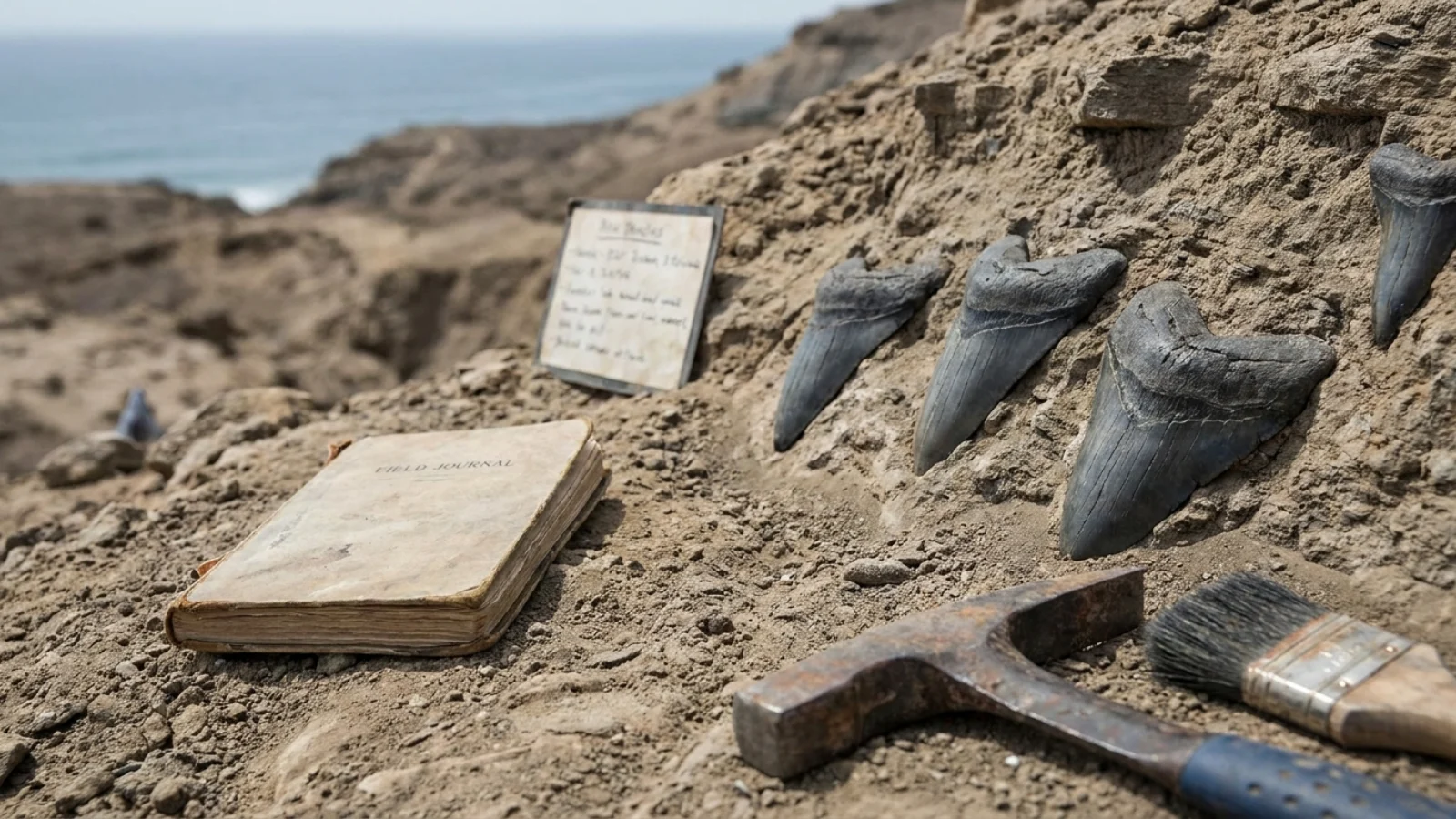
When did megalodon go extinct?
At least 3.6 million years ago, at the end of the early Pliocene. That is about a million years earlier than the 2.6 million years that used to be quoted.
Boessenecker’s team, which included researchers from the New Jersey State Museum, the California Academy of Sciences and the San Diego Natural History Museum, examined every fossil occurrence of megalodon in the densely sampled rocks of California and Baja California, then vetted a worldwide dataset, correcting many dating problems. Their 2019 paper in PeerJ concluded the extinction “must have happened at least one million years earlier than previously determined.” The species itself had a long run before that. The oldest teeth date back roughly 23 million years, while Shimada and colleagues at DePaul University, writing in 2025, put its span at about 15 to 3.6 million years ago.
| Estimate | Date | Source |
|---|---|---|
| — | — | — |
| Older estimate | ~2.6 Ma | End of the Pliocene |
| Revised | ~3.6 Ma | Boessenecker et al. 2019, PeerJ |
| Earliest fossils | ~23 Ma | Natural History Museum London |
Could megalodon be hiding in the deep sea?
No. Megalodon was a warm-water shark that depended on coastal nursery areas and large prey near the surface. The cold, food-poor deep sea is the opposite of what it needed.
The Natural History Museum describes megalodon as a warm-water species, and the main explanation for its extinction is that global cooling shrank its tropical habitat. An animal that died out because the surface ocean got too cold could not retreat into water near freezing in the deep sea. Big sharks also have big appetites: the Shimada team estimated a 24.3 m individual at about 94 tonnes. The deep sea does hold surprises, like the frilled shark or the giant squid, but those are animals adapted to the deep, not 50-tonne warm-water predators.
What killed megalodon?
Probably a combination: a cooling climate, the loss of shallow coastal nurseries as sea levels fell, and competition from the great white shark.
The Natural History Museum lists three linked factors. Global cooling reduced tropical habitat and prey. As ice formed and sea levels dropped, megalodon lost coastal pupping grounds. And great whites, whose diet overlapped with megalodon’s, became competitors. Boessenecker’s team argued that great whites with serrated teeth appeared about 6 million years ago in the Pacific and spread worldwide by about 4 million years ago, and that the few hundred thousand years in which the two species overlapped, between about 4 and 3.6 million years ago, gave the newcomer enough time to spread and push megalodon aside. They rejected the idea of a sudden catastrophe such as a supernova.
Where did the “megalodon is still alive” myth come from?
Mostly from television and films. In 2013, Discovery’s Shark Week aired “Megalodon: The Monster Shark Lives”, a dramatized special with actors playing scientists hunting a living 67-foot megalodon off South Africa.
The program ended with a disclaimer that some events and characters were dramatized, while adding that “sightings of ‘Submarine’ continue to this day.” Scientists were blunt. Shark ecologist David Shiffman said Discovery was “perpetuating this utter nonsense”, and Peter Klimley called the program “irresponsible”, “just making something up to just scare people”. Shiffman also worried that frightened viewers might support campaigns against real sharks, which are already in trouble. Our page on Mega Shark vs Giant Octopus covers another megalodon film, and megalodon vs the blue whale deals with its real size.
What is the closest living thing to megalodon?
No living shark is a close relative, but the great white shark is the most similar in lifestyle: a large predator whose diet overlapped with megalodon’s. Under the currently favored view, great whites are not closely related to megalodon.
The Florida Museum of Natural History notes that the great white is thought to descend from the extinct Carcharodon hastalis, and not from megalodon. Megalodon belonged to a different family, the Otodontidae, which left no living descendants. See prehistoric sharks for megalodon’s family tree and great white shark for its modern stand-in.
How do scientists decide that an animal is extinct?
For a living species, extinction is declared after years of failed searches. For a fossil species like megalodon, the question is different: when did the last one die, given that only a tiny fraction of individuals ever became fossils? Paleontologists answer it in two steps. First they find the youngest fossils that can be dated reliably. Then they ask how far beyond that point the species might have survived without leaving a trace.
That second step matters because of a bias known as the Signor-Lipps effect, named after the paleontologists Philip Signor and Jere Lipps. The last fossil of any species is almost never the last individual. Fossilisation is rare, rocks of the right age are not exposed everywhere, and collectors have searched some regions far more than others. The true extinction date therefore always falls somewhat later than the youngest fossil, and statistical methods exist to estimate how much later.
Why do scientists give two different extinction dates?
Because two well-known studies used different methods and different data. In 2014 Catalina Pimiento, then at the Florida Museum of Natural History, and Christopher Clements of the University of Zurich applied a technique called Optimal Linear Estimation to the youngest megalodon records. It models the gaps between the last few occurrences and projects forward to the most likely end point. Their answer was about 2.6 million years ago, close to the start of the Pleistocene ice ages.
Five years later, Robert Boessenecker’s team took the opposite approach and went back to the rocks themselves. They found that many of the youngest records had been dated poorly, and once those were removed the last confident occurrences were about 3.6 million years old. Both figures still appear in books and museum labels. The gap between them is about a million years, but neither comes anywhere near the present. Whichever study you prefer, the last megalodon died long before the first humans walked the Earth.
Were megalodon teeth ever dated to the Ice Age?
Yes, once, and the claim is still repeated online. In 1875 the British research ship HMS Challenger, during the first great oceanographic expedition, dredged two large shark teeth from the deep sea floor south of Tahiti. In 1959 Wladimir Tschernezky estimated their age from the thickness of the manganese dioxide crust that had grown over them. His figures were about 24,000 and 11,000 years, which would mean megalodon was alive during the last ice age.
The figures did not hold up. The manganese growth rates Tschernezky relied on came from older radium-based measurements that later proved far too fast, so his ages were much too young. A crust also records only the time since it began forming, not the full age of the object underneath. The decisive evidence is the company the teeth kept: they came up with teeth of Carcharodon hastalis and Parotodus benedenii, sharks whose fossils are limited to the Miocene and Pliocene. In context, the Challenger teeth are millions of years old, like every other megalodon tooth.
What about the giant shark seen off Australia in 1918?
This is the best-known modern sighting story. The Australian naturalist David Stead recorded that in 1918 crayfishermen working the deep-water grounds near Broughton Island, off Port Stephens in New South Wales, refused to go back to sea for several days. They said an enormous shark had carried off their crayfish pots, lines and all. One man claimed it was 300 feet long at least, and others compared it to the length of the wharf, about 115 feet.
Stead took the fear seriously but called the lengths absurd, and he published the account decades later in his 1963 book Sharks and Rays of Australian Seas. No body, tooth or photograph was ever produced. Size estimates made from a small boat, by frightened people, of an animal mostly under the water are notoriously unreliable. A large great white or a whale shark seen in poor light can look far bigger than it is. A single story with no physical evidence cannot outweigh a fossil record in which every tooth is millions of years old.
Doesn’t the coelacanth prove that “extinct” animals can turn up alive?
It proves that some can, which is why the question deserves a real answer. The coelacanth was known only from fossils and thought to have died out around the time of the dinosaurs, until a fisherman’s catch reached Marjorie Courtenay-Latimer at the East London museum in South Africa in 1938. Biologists call animals like this Lazarus taxa: species that vanish from the fossil record and later reappear.
The comparison breaks down quickly, though. A coelacanth grows to about 2 m, lives in small numbers in caves on steep rocky slopes, and rarely comes near fishing gear. It also had a good reason to be missing from younger rocks, because its deep habitat seldom produces fossils. Megalodon is the opposite case. It was one of the largest predators that ever lived, it left fossils on every continent except Antarctica, and it shed teeth by the thousand. A species that conspicuous does not drop out of the record for 3.6 million years and then carry on unseen. Our coelacanth page tells the full story of the 1938 discovery.
Could big sharks still be undiscovered?
Smaller ones, yes. The megamouth shark was unknown to science until 1976, when one became tangled in the sea anchor of a US Navy vessel off Oahu, Hawaii. It reaches about 5 m and feeds on plankton in deep water, rising toward the surface at night. Since then only a few hundred have been recorded worldwide. New species of lanternshark, catshark and dogfish are still being described every few years.
But every recent discovery has been a deep-water animal that is small, rare or harmless to people. Megalodon would be none of those. It hunted large marine mammals near the surface, so whales and dolphins would carry its bite marks and stranded carcasses would show wounds no living shark could make. None have ever been found. Fishing fleets, satellite tags, whale surveys and millions of recreational divers watch the coastal ocean every day, which is where a megalodon would have to hunt.
Could a warm-bodied shark survive in cold deep water?
Not for long. A 2023 PNAS paper led by Michael Griffiths of William Paterson University, measured isotopes in fossil teeth and estimated that megalodon kept an average body temperature of about 27 degrees Celsius. Keeping a body that warm costs a great deal of energy, which has to come from a steady supply of fat-rich prey.
The deep ocean offers almost the reverse. Below about 1,000 m the water is usually just a few degrees above freezing, and food arrives mostly as marine snow drifting down from above. Deep-sea sharks cope by being slow, cold-bodied and thrifty with energy. A huge warm-bodied hunter would lose heat quickly and starve. The idea of a megalodon living in the abyss asks one animal to have the body of a surface predator and the lifestyle of a deep-sea scavenger at once.
Is it true that we have explored only a small part of the ocean?
It is true that most of the sea floor has not been mapped in high detail. The Seabed 2030 project, which tracks this work, reported in 2024 that about a quarter of the global sea floor had been mapped to modern standards. That figure is often used as an argument that anything could be hiding down there.
Mapping, however, is not the same as watching. Large animals that breathe air or hunt near the surface are seen all the time, and the creatures that do stay hidden are those that never leave the deep. The animals that sustained megalodon, such as whales, seals and large fish, are among the most closely studied in the sea. If something were killing them in large numbers, researchers would know. Our page on how much of the ocean is explored looks at what the mapping figures do and do not mean.
What did the film The Meg get wrong?
The Meg (2018) was based on Steve Alten’s 1997 novel Meg. Its plot depends on a warm layer of water hidden beneath a cold layer at the bottom of the Mariana Trench, sealing in a population of megalodons for millions of years. No such layer exists. Hydrothermal vents do warm the water close to them, but only close to the vents themselves; the trench floor as a whole is near freezing and food is scarce.
The film also shows a single shark with no population behind it. A species cannot survive as one or two individuals; it needs enough breeding adults to avoid inbreeding and to replace those that die. For megalodon, that would mean a breeding population of very large sharks, every one of them eating like a surface predator. Entertaining as it is, the film works only as fiction, and its makers never presented it as anything else.
What evidence would change scientists’ minds?
Something physical, and something fresh. A shark tooth that had not mineralised, still contained organic material, and could be radiocarbon dated to the recent past would be taken very seriously. So would a carcass, a clear photograph with an object of known size beside the shark, or DNA from a sample of sea water that matched no known species and sat near the otodontid line.
None of that exists. Environmental DNA surveys now sample sea water across the world’s oceans, and they routinely pick up traces of rare sharks and whales, yet nothing resembling megalodon has appeared. Until it does, the scientific answer stays the same: megalodon is a fossil, and its story ended millions of years ago.
Is megalodon still alive in 2026?
No. Megalodon went extinct at least 3.6 million years ago, and there is no evidence of any living megalodon.
When did megalodon go extinct?
The youngest well-dated fossils are roughly 3.6 million years old (Boessenecker and colleagues, PeerJ, 2019). A 2014 statistical estimate put the end nearer 2.6 million years ago.
Could megalodon live in the Mariana Trench?
No. A warm-bodied hunter of whales and seals could not keep itself fed or warm in a trench that sits near freezing, and no deep-sea expedition has turned up a single recent tooth.
Why did megalodon go extinct?
Likely a combination of global cooling, the loss of coastal nursery areas as sea levels fell, and competition with great white sharks.
Was Megalodon: The Monster Shark Lives real?
No. The 2013 Discovery Shark Week program was a dramatized special with actors playing scientists. Scientists criticised it as misleading.
Did megalodon ever share the sea with great white sharks?
For a short spell. Serrated-toothed great whites arose around 6 million years ago, had reached most oceans by roughly 4 million years ago, and shared the seas with megalodon until its last fossils some 3.6 million years ago.
How do we know megalodon is extinct?
Every megalodon tooth ever found is a fossil at least 3.6 million years old. A living population would shed thousands of new teeth, and none have been found.
What is the closest living relative of megalodon?
It has no close living relatives; its family, the Otodontidae, is extinct. The great white is similar in lifestyle but is not closely related.
Blane Perun has been exploring Earth’s oceans and marine life for over 25 years. Founder of TheSea.Org in 1999, underwater photographer, coral aquaculture pioneer, and explorer of 80+ countries.
About Blane Perun → All prehistoric sea creatures →