What Did Megalodon Eat? — Bite Marks on Whale Bones
Megalodon ate marine mammals, especially small and medium-sized whales, but it was an opportunist that took almost anything large enough to be worth catching. Fossil whale bones carry its bite marks, and its teeth are found beside chewed whale skeletons. It also ate dolphins, seals, sea cows, sea turtles, large fish and other sharks. Young megalodon ate mostly fish and smaller prey in warm coastal nurseries. A 2025 zinc isotope study of 18-million-year-old teeth concluded that megalodon fed throughout the food web rather than specialising on whales.
A whale-eater by reputation, a generalist by evidence: adults took whales, dolphins, seals and big fish, juveniles took fish, turtles and sea cows.
What did megalodon eat?
Megalodon, Otodus megalodon, lived from roughly 20 million years ago (some fossils suggest earlier) until about 3.6 million years ago, and for most of that time it was the largest predatory shark in the sea. Its reputation is that of a whale-killer, and the evidence shows that reputation is deserved. But whales were not the whole menu. Megalodon also ate dolphins, porpoise-sized toothed whales, seals, sea cows, sea turtles, large fish and other sharks, and what it ate changed as it grew and from one region to another.
Nobody can watch a megalodon feed, so everything we know about its diet comes from indirect evidence. Four lines of evidence matter most: bite marks on the bones of its prey, megalodon teeth found with or inside those bones, the chemistry of its teeth, and the shape and size of the shark itself. Each tells part of the story, and together they produce a picture of an apex predator that was more flexible than its reputation suggests.
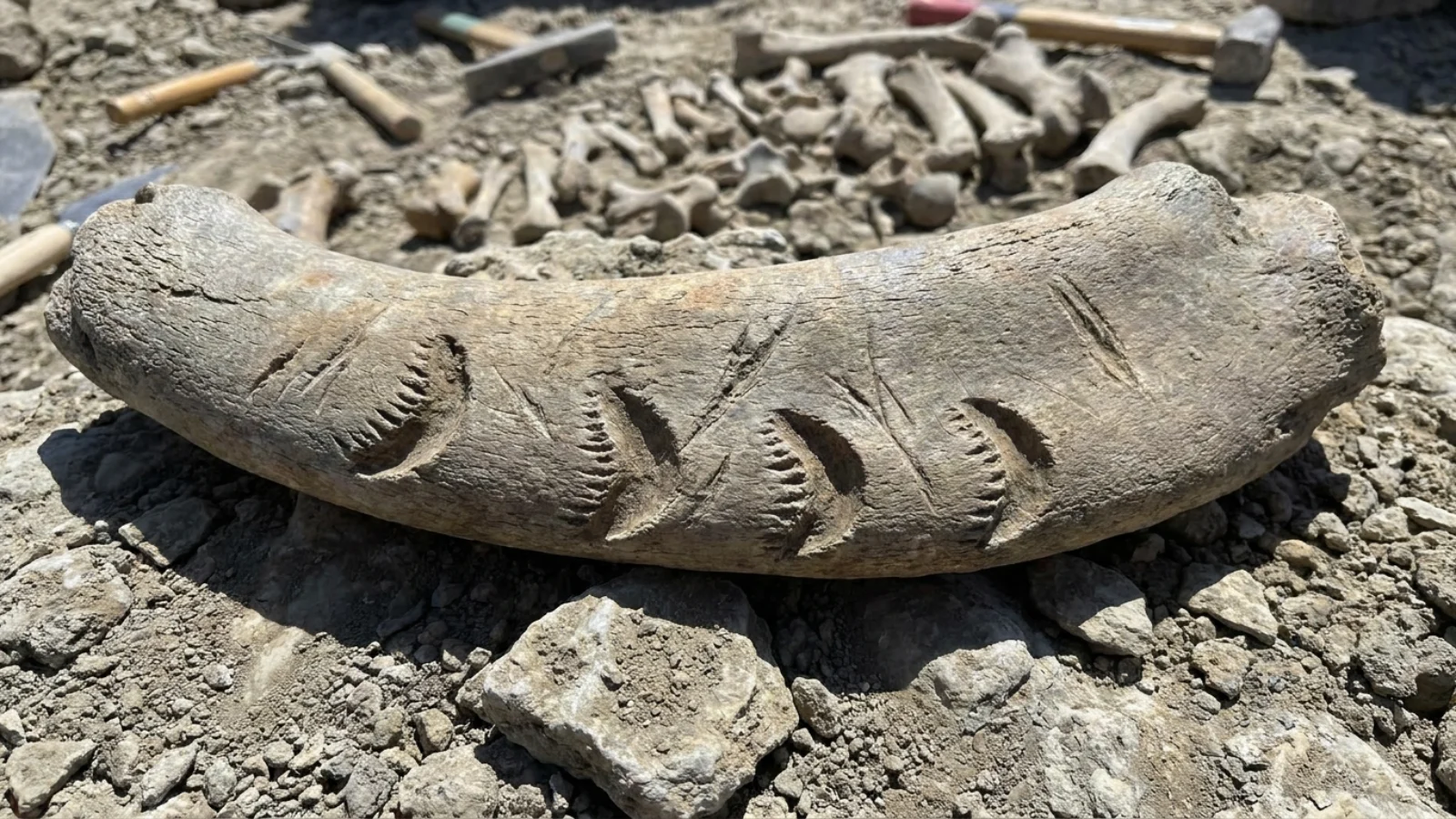
How do scientists know what megalodon ate?
The most direct evidence is bite marks. When a large shark bites a whale, its serrated teeth score the bone, leaving parallel grooves, gouges and sometimes punctures. Many fossil whale bones have been found with deep gashes most likely made by megalodon teeth, and excavations have revealed megalodon teeth lying close to the chewed remains of whales, sometimes in direct association with them. When the size and spacing of the marks match megalodon teeth, and no other predator of the right size lived in the same place, the identification is strong.
The second line of evidence is chemistry. The hard enameloid of shark teeth traps elements and isotopes that come from food. Because some isotope ratios shift predictably with each step up the food chain, they can reveal how high in the food web an animal fed. These methods cannot name individual prey species, but they show whether megalodon fed at the top of the food chain or ranged across several levels.
The third line is fossil droppings. Coprolites attributed to megalodon are spiral-shaped, suggesting that its intestine contained a spiral valve like those of modern lamniform sharks. One Miocene coprolite from Beaufort County, South Carolina, measures 14 cm. Coprolites confirm that megalodon digested food much as living sharks do, though they rarely preserve identifiable prey.
Finally, there is ecology. Where megalodon teeth are common, the fossil record usually also contains abundant marine mammals. Juvenile megalodon teeth tend to occur where small whales and dolphins were plentiful, and adult teeth where larger whales lived.
Did megalodon eat whales?
Yes, and whales were its signature prey. Fossil evidence shows that megalodon attacked many kinds of cetaceans: dolphins, small whales, cetotheres, squalodontids (the extinct “shark-toothed dolphins”), sperm whales, bowhead whales and rorquals, the group that today includes blue, fin and humpback whales.
The timing makes sense. Marine mammals reached their greatest diversity during the Miocene, with more than 20 recognised genera of baleen whales compared with only six living today. Many of those Miocene baleen whales were small or medium-sized, far smaller than a modern blue whale. That abundance of mid-sized, slow-moving whales was an ideal food supply for a giant shark, and the rise of megalodon tracks the diversification of marine mammals in the fossil record.
Whales offered one great advantage: blubber. A whale’s fat layer is extremely rich in energy, and for an animal with megalodon’s energy needs, a single whale could provide a huge return on one successful attack.
Which whales did megalodon target?
It is tempting to imagine megalodon fighting whales its own size, but the evidence points to smaller prey. In 2017 Alberto Collareta, Olivier Lambert and colleagues studied bite marks on marine mammal bones from the late Miocene Pisco Formation of Peru, one of the richest fossil whale sites in the world. They found that adult megalodon there seem to have targeted mainly cetotheres, small baleen whales 2.5 to 7 m long, and other prey smaller than themselves, rather than large whales of their own size class.
This fits a general pattern among large predators. Hunting prey much smaller than yourself is safer and more reliable than tackling animals that can fight back. A 10 to 15 m shark taking a 5 m whale is roughly comparable, in relative terms, to a great white taking a seal.
That said, megalodon could tackle larger animals. During the Pliocene, larger whales appeared, and numerous fossil flipper bones and tail vertebrae of large whales from that epoch carry megalodon bite marks. Researchers have interpreted these as evidence that megalodon would first disable a large whale by biting its flippers or tail, then return to kill and feed on it. Some bite marks on large whale bones may also come from scavenging, because a giant shark would not have ignored a floating carcass.
Did megalodon hunt sperm whales?
It appears so, at least occasionally. The Miocene seas held several kinds of predatory sperm whales with large teeth in both jaws, including the giant Livyatan of Peru and smaller species. A fossil tooth of an undetermined sperm whale about 4 m long, closely resembling the genus Acrophyseter, was found in the Nutrien Aurora Phosphate Mine in North Carolina with bite marks on its root.
The position of those marks suggests that a megalodon or its ancestor Otodus chubutensis bit the whale’s head hard enough to break its jaw. Scavenging cannot be ruled out entirely, but the jaw is not a nutritious part of a whale, so the marks are more consistent with a deliberate attack on the head of a dangerous prey animal. It is the first known record of a fight between a sperm whale and an otodontid shark.
Fossil teeth of other predatory sperm whales from Lee Creek Mine, North Carolina, suggest that these whales reached 8 to 10 m and lived only about 25 years. That short lifespan, very different from the decades lived by similarly sized killer whales today, has been taken as a sign that these whales were themselves preyed upon by larger predators such as megalodon or Livyatan.
Did megalodon eat seals, sea cows and turtles?
Yes. In addition to whales, megalodon is thought to have taken seals, sirenians (sea cows such as dugongs and manatees) and sea turtles. Many of these animals lived in the same warm, shallow coastal waters that young megalodon used as nurseries, which is where much of this prey was probably eaten.
Sea cows were slow, large and rich in fat, which made them an attractive target. Sea turtles, protected by their shells, required a bite strong enough to crush or shear through bone, something even a young megalodon would have had. Seals, which appeared and diversified during the Miocene, would have been taken much as great whites take them today.
For a closer look at megalodon’s whale-eating rivals, read about the raptorial sperm whale Livyatan, and for the giant shark’s place among its contemporaries, see our prehistoric sharks guide.
Did megalodon eat fish and other sharks?
Megalodon was piscivorous as well as a mammal-hunter. It would have eaten large fish and other sharks, particularly when it was young. Sharks are generally opportunistic feeders, and nothing about megalodon’s anatomy suggests it would have passed up a large tuna or a smaller shark.
Megalodon probably also had a tendency towards cannibalism, as many living sharks do. Large sharks regularly bite smaller members of their own species, and in sharks with intrauterine development the largest embryos may eat their siblings before birth. Shimada and colleagues have suggested that this embryonic cannibalism may have driven megalodon’s gigantism, by favouring ever-larger young and, in turn, larger mothers.
What did baby megalodon eat?
Megalodon’s diet changed as it grew, a pattern called an ontogenetic shift. Pups were born in warm, shallow coastal waters with abundant food and some protection from predators. Nursery sites have been identified in the Gatún Formation of Panama, the Calvert Formation of Maryland, the Bone Valley Formation of Florida and the Canary Islands.
In those nurseries, young megalodon commonly preyed on fish, sea turtles, dugongs and small cetaceans. As they grew, they moved offshore and took increasingly large whales. Even newborn megalodon were large: estimates of size at birth range from about 2 m to about 3.9 m, depending on the study. That is already as long as many adult sharks today, and big enough to take sizable prey from birth.
Young megalodon occasionally tackled surprisingly large animals. A rib from an ancestral blue or humpback whale from the Pliocene bears three tooth marks apparently from a shark 4 to 7 m long, which researchers suspect was a juvenile megalodon. The bone shows signs of healing, so the whale survived. The record suggests that young megalodon tested their luck on prey much larger than themselves, and did not always win.
How much did megalodon need to eat?
A giant body needs a giant food supply. In 2022 Jack Cooper and colleagues built a three-dimensional model of a 16 m megalodon weighing more than 61 tonnes and estimated that an individual of that size would need about 98,175 kcal per day, roughly 20 times more than an adult great white.
The same model suggested a stomach volume of almost 10,000 litres, enough to swallow prey up to about 8 m long whole. After a meal of that size, a megalodon could theoretically go for about two months before feeding again, which would have allowed it to cross ocean basins between prey patches.
Megalodon’s high energy needs were linked to its body temperature. A 2023 study by Michael Griffiths and colleagues used isotope methods to show that megalodon was warmer than the surrounding water and warmer than other sharks living alongside it. A warm body allows faster swimming and quicker reactions, useful for catching warm-blooded prey, but it is expensive. Megalodon had to keep eating, and eating well, to stay alive.
Was megalodon at the top of the food chain?
Two isotope studies tackled this question from different angles. In 2022 Emma Kast, Michael Griffiths, Sora Kim and colleagues measured nitrogen isotopes in organic matter trapped inside the enameloid of megatooth shark teeth, a method they first tested against tooth collagen. Very high values in Miocene and Pliocene megalodon teeth showed that it occupied a higher trophic level than is known for any marine species, extinct or living. The study also found that the megatooth lineage reached its highest trophic level before it reached its peak body size.
High trophic level does not have to mean narrow diet, however. In 2025 Jeremy McCormack, Kenshu Shimada and an international team published a zinc isotope study of about 18-million-year-old teeth, mostly from Sigmaringen and Passau in Germany, deposited when a shallow estuary less than 200 m deep ran along the edge of the Alps. They compared megalodon with animals at every level of that ancient food web: sea bream that ate mussels, snails and crustaceans; requiem sharks and early dolphins and whales; sand tiger sharks; and the giant sharks at the top.
Megalodon and Otodus chubutensis did sit at the top. But megalodon’s values were not very different from those of animals lower down, and teeth from Passau suggested more low-level prey than teeth from Sigmaringen. The authors concluded that megalodon was a flexible generalist that ate marine mammals and large fish as well as prey from lower levels, depending on availability. As McCormack put it, “They were not concentrating on certain prey types, but they must have fed throughout the food web.”
How did megalodon catch its prey?
Bite marks reveal hunting tactics as well as diet. Modern great whites usually attack seals and sea lions from below and behind, often targeting the soft underside. Megalodon bite marks on a 9 m Miocene baleen whale suggest a different approach: bites to the rib cage and other bony parts of the chest, consistent with attacks aimed at the heart and lungs. Megalodon’s thick, robust teeth were well suited to biting through bone.
Small whales may have been attacked differently. Some fossil cetothere bones show compression fractures, suggesting that the whale was rammed from below with great force before being killed and eaten. And as noted above, the bitten flippers and tail vertebrae of large Pliocene whales suggest that megalodon disabled big prey before finishing it.
Taken together, the evidence points to a hunter that adjusted its technique to its prey, much as great whites hunt seals differently from the way they scavenge whales. Our article on the megalodon jaw explains how its bite was built.
Did megalodon’s diet cause its extinction?
Diet is central to most explanations of megalodon’s disappearance about 3.6 million years ago. By the end of the Miocene many small baleen whales had gone extinct, and the survivors may have been faster and harder to catch. Whales also shifted towards cold polar waters, where megalodon may not have been able to follow. The extinction of megalodon correlates with the decline of many small baleen whale lineages, and it may have become coextinct with species such as the dwarf cetothere Piscobalaena nana.
Competition mattered too. Great white sharks, which spread worldwide in the early Pliocene, are also generalists, and the 2025 zinc study suggested that their overlapping diets may have contributed to megalodon’s decline. The full debate is covered in why did megalodon go extinct? The irony is that a broad diet, usually an advantage, could not save a predator that needed so much food every day.
What did megalodon mainly eat?
Marine mammals, especially small and medium-sized baleen whales and dolphins, plus seals, sea cows, turtles and large fish.
Did megalodon eat blue whales?
Not modern-sized ones. Giant blue whales evolved after megalodon. It did bite ancestral rorquals, including a healed rib from a blue or humpback ancestor.
Did megalodon eat great white sharks?
There is no direct evidence, but megalodon ate other sharks and the two species competed for prey in the Pliocene.
What did baby megalodon eat?
Mostly fish, plus sea turtles, dugongs and small cetaceans in warm coastal nursery waters.
How much did megalodon eat per day?
A 2022 model estimated about 98,000 kcal per day for a 16 m megalodon, about 20 times an adult great white.
Was megalodon a picky eater?
No. A 2025 zinc isotope study found it was an opportunistic generalist that fed throughout the food web.
Did megalodon eat sperm whales?
Apparently, yes. A fossil sperm whale tooth from North Carolina bears bite marks from a megalodon or its ancestor.
How do we know megalodon ate whales?
From bite marks on fossil whale bones, megalodon teeth found with whale skeletons and isotope chemistry of its teeth.
- McCormack, J. et al. (2025), “Miocene marine vertebrate trophic ecology reveals megatooth sharks as opportunistic supercarnivores”, Earth and Planetary Science Letters; Goethe University Frankfurt release; Smithsonian Magazine coverage.
- Kast, E.R. et al. (2022), “Cenozoic megatooth sharks occupied extremely high trophic positions”, Science Advances.
- Collareta, A. et al. (2017), “Did the giant extinct shark Carcharocles megalodon target small prey? Bite marks on marine mammal remains from the late Miocene of Peru”, Palaeogeography, Palaeoclimatology, Palaeoecology.
- Cooper, J.A. et al. (2022), Science Advances; Griffiths, M.L. et al. (2023), PNAS; Shimada, K. et al. (2025), Palaeontologia Electronica.
Blane Perun has been exploring Earth’s oceans and marine life for over 25 years. Founder of TheSea.Org in 1999, underwater photographer, coral aquaculture pioneer, and explorer of 80+ countries.
About Blane Perun →