Ammonites — Spiral Fossils and Their Living Relatives
An ammonite is an extinct shelled cephalopod, a marine mollusc related to today’s squid, octopus and cuttlefish, that lived inside a coiled, chambered shell. Ammonoids first appeared more than 400 million years ago (estimates range from about 415 to 450 million years), and died out in the end-Cretaceous extinction 66 million years ago, alongside the non-avian dinosaurs. Most shells were a few centimetres across, but the giant Parapuzosia seppenradensis has an incomplete specimen 1.8 m across, and the Natural History Museum in London estimates a complete shell could have reached 2.5–3.5 m. Their abundance and rapid evolution make ammonite fossils one of geology’s best tools for dating rocks.
Ammonites
What is an ammonite, and what was inside the shell?
An ammonite was a squid-like animal living in the outermost chamber of a coiled, chambered shell. As it grew, it built a new, larger chamber and sealed off the old one behind it.
The sealed chambers were filled with gas and fluid, regulated through a thin tube that ran back through every chamber. By adjusting that balance, an ammonite could control its buoyancy, and it moved by jet propulsion, squirting water much like a squid does. Reconstructions show eight to ten arms reaching out of the shell opening. Like modern cephalopods, ammonites had a radula, a tongue-like ribbon of tiny teeth, to break up food.
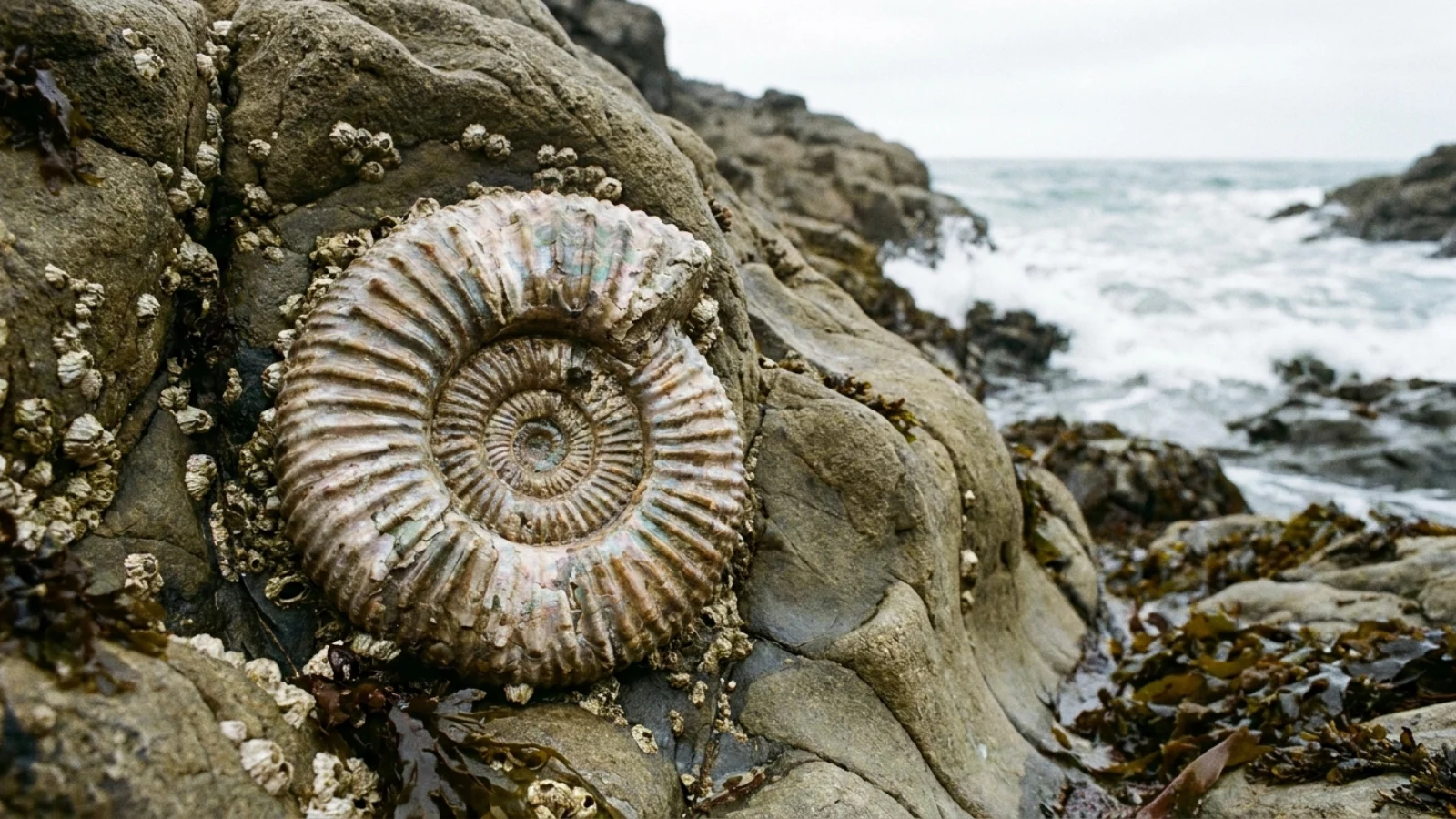
The shell walls that separated the chambers are called septa, and where each wall met the outer shell it left a wavy line called a suture. Among the true ammonites of the Jurassic and Cretaceous those sutures became wildly intricate, fern-like patterns, which made the shell light but strong. On a polished fossil the sutures are often the most beautiful thing about it.
Are ammonites related to the nautilus?
They look alike, but ammonites are thought to be more closely related to squid, octopus and cuttlefish. The nautilus belongs to a separate, ancient branch of shelled cephalopods.
This catches people out because the living nautilus is the obvious lookalike: a coiled, chambered shell with a tentacled animal inside. But the Natural History Museum in London explains that ammonites are thought to be closer to the coleoids, the group that includes squid, octopus and cuttlefish, and that they probably had eight arms rather than the many tentacles of a nautilus. Our Q&A on whether nautiluses are ammonites goes into the differences, and prehistoric cephalopods and orthocones cover the older shelled forms.
| Feature | Ammonite | Nautilus |
|---|---|---|
| — | — | — |
| Status | Extinct, 66 Ma | Living |
| Closest relatives | Squid, octopus, cuttlefish | Its own ancient lineage |
| Sutures | Often complex, frilled | Simple, gently curved |
| Arms | Probably 8 | Many tentacles |
How big were ammonites?
Most ammonites were palm-sized or smaller, but a few Late Cretaceous species grew shells as wide as a person is tall, or wider.
The record holder is Parapuzosia seppenradensis. The famous specimen found in Germany in 1895 is incomplete and is reported at about 1.7–1.8 m across. How big a complete shell would have been is contested: the Natural History Museum in London estimates 2.5–3.5 m, while Live Science’s report on the 2021 study gives about 1.8 m for the largest shells. A 2021 study in PLOS One led by Christina Ifrim traced how these giants evolved about 80 million years ago in the Late Cretaceous; its smaller relative Parapuzosia leptophylla reached about 1 m. At the other end of the range, many ammonites never got past 2.5 cm.
In many species the shells come in two sizes. Collectors and researchers interpret the large shells (macroconchs) as females and the smaller ones (microconchs) as males, so two very different-looking fossils from the same rock can be the same species.
Why are ammonites important to geologists?
Because they are index fossils. Ammonites were common, lived worldwide and evolved quickly, so each species occupies a narrow slice of time.
If the same ammonite species turns up in rocks on two continents, those rocks are about the same age. That simple idea lets geologists correlate rock layers around the world and date rarer fossils found alongside them. The Late Cretaceous ammonite Placenticeras meeki in the University of Colorado Museum’s collection, from Colorado’s Pierre Shale, is a typical example from the vast inland sea that once covered much of the western United States.
What ate ammonites?
Large fish and marine reptiles, especially mosasaurs, which left bite marks on ammonite shells.
Ammonite shells punctured by rows of conical tooth marks are well-known fossils from the Western Interior Seaway. They match the jaws of mosasaurs, the giant marine lizards such as Mosasaurus and Tylosaurus that shared their seas.
How do you identify an ammonite fossil?
Look for a flat, tightly coiled spiral, often with ribs, and if the shell is worn, the wavy suture lines of the internal walls.
- Coiling: most ammonites are a flat spiral in one plane. Some later forms uncoiled into hooks or straight shapes.
- Ribs and knobs: many species have radiating ribs, keels or rows of knobs, and these are key to identifying species.
- Sutures: where the outer shell has worn away, look for wavy lines. Complex, frilly sutures say ammonite; simple curves suggest a nautiloid.
- Size dimorphism: a large and a small ammonite from the same bed may be female and male of one species.
- Look-alikes: coiled snail shells spiral upward in a cone and lack internal chambers; fossil nautiloids have simple sutures.
Where can you find ammonite fossils?
England’s Jurassic Coast is the classic site. At Charmouth and Lyme Regis in Dorset, ammonites about 200 million years old weather out of Lower Jurassic rocks.
The Charmouth Heritage Coast Centre runs a fossil collecting code. The key points: collect from the loose material on the beach, not from the cliffs; do not dig into the cliffs without permission; record scientifically important finds with the centre or at fossilcodes.org; and offer an important specimen to an accredited UK museum before selling it. Check the centre’s daily tide and safety advice before you go, because some days there is no safe time on the beach.
In the United States, Late Cretaceous ammonites come from the marine shales of the old Western Interior Seaway, such as the Pierre Shale. Wherever you look, the rule is the same as for megalodon teeth and fossil shark teeth: know the local rules before you collect.
Why did ammonites go extinct?
They died out in the end-Cretaceous mass extinction 66 million years ago, along with mosasaurs, plesiosaurs and the non-avian dinosaurs.
Ammonoids had already come through earlier mass extinctions, but not this one, although a few species lingered briefly into the Paleogene in the Western Interior Seaway. The nautiloids made it through. The Natural History Museum suggests two reasons: nautiluses live deeper, where conditions were less disrupted than in shallow seas, and their larger hatchlings were less dependent on the tiny plankton that collapsed. That is why we still have the nautilus but no ammonites.
What did ammonites actually eat?
For a long time the honest answer was that nobody knew. Ammonite jaws turn up as fossils, but stomach contents almost never do, so diets were inferred by comparison with the nautilus and with squid. That changed in January 2011, when a Franco-American team led by Isabelle Kruta of the Muséum National d’Histoire Naturelle in Paris, working with Neil Landman of the American Museum of Natural History, Paul Tafforeau of the European Synchrotron Radiation Facility and Fabrizio Cecca and Isabelle Rouget of the Université Pierre et Marie Curie, published a study of Baculites in Science.
Baculites was a straight-shelled ammonite, and the three specimens the team scanned came from South Dakota, collected on museum expeditions to the Great Plains. They are 70 to 80 million years old. Using synchrotron X-ray microtomography, which builds a 3D image without cutting the fossil open, the researchers reconstructed the jaws and the radula, the ribbon of teeth inside the mouth. The radula teeth turned out to be very slender, shaped from sabre-like to comb-like, and the tallest cusp was just 2 mm high.
One specimen had died mid-meal. Inside its mouth were a tiny larval snail and three tiny crustaceans, one of them cut in two. Because those animals appear nowhere else on the fossil, the team concluded they were food rather than scavengers that arrived after death. Cecca called it the first direct evidence of how these uncoiled ammonites fed, and Rouget said it showed ammonites occupied a different niche in the food chain than scientists had assumed.
That finding has a bearing on the extinction story told further down this page. If many ammonites lived on plankton, then the collapse of plankton after the asteroid impact would have cut off their food supply. Landman put it plainly: the loss of their food source probably contributed to the extinction of ammonites. The 2011 reports gave the extinction date as 65.5 million years ago, the figure in use at the time; the boundary is now usually dated to about 66 million years. The team also suggested that the great spread of ammonites in the Early Jurassic may have tracked a radiation of plankton.
None of this means every ammonite was a plankton feeder. The group lasted hundreds of millions of years and included thousands of species with very different shells and jaws, so the older picture of ammonites taking small fish and crustaceans still fits many of them. What the Baculites study did was prove that at least some ammonites fed far lower in the food web than the large, active hunter often shown in illustrations.
Why do some ammonites look straight or hooked?
Not every ammonite was a flat spiral. Paleontologists use the word heteromorph for the ammonites whose shells partly or completely uncoiled, and the Late Cretaceous was full of them. Baculites, the plankton eater above, grew a long, nearly straight cone. The European Synchrotron Radiation Facility’s description of the animal has its soft body in the largest, final segment, with the older segments emptied and filled with gas for buoyancy, so that it floated with the opening facing down.
Other heteromorphs were stranger still. Didymoceras and its relatives are common in the middle Campanian Baculites scotti Zone of the U.S. Western Interior, and a study by William James Kennedy of the Oxford University Museum of Natural History with William A. Cobban and Glenn R. Scott described several new species there, including Didymoceras wrighti and Didymoceras jorgenseni. Those shells were distinctive enough that the authors used them to split the scotti Zone into two subzones, a lower Didymoceras binodosum Subzone and an upper Didymoceras jorgenseni Subzone.
How precisely can ammonites date a rock?
Very precisely, at least in the right place. The index-fossil idea described above works best where a sequence of ammonite species can be tied to volcanic ash beds, which can be dated with radioactive isotopes. The Western Interior of North America is one of those places. Its Late Cretaceous ammonite zones were calibrated by dating numerous ash beds, and a 2019 conference abstract by Joshua Slattery and colleagues reported that those zones last about 0.5 million years each, give or take 0.2 million years.
Elsewhere the resolution is coarser. The same abstract found that the ammonite zones of the U.S. Atlantic and Gulf Coastal Plains, 14 zones in each region, range from 0.3 to 3.3 million years long, with an average of 1.2 million years. The difference has more to do with how complete the rock record is, and how many ash beds are available, than with the ammonites themselves. Even so, a resolution of half a million years, for rocks around 70 to 80 million years old, is far finer than most other fossils can provide.
What is ammolite?
Ammolite is a gemstone made from the shell of an ammonite. It comes from the Bearpaw Formation of southern Alberta, Canada, laid down in the Campanian stage of the Late Cretaceous, roughly 72 to 84 million years ago, and is mined along the St. Mary River and nearby rivers near Lethbridge. The main sources are the disk-shaped ammonites Placenticeras meeki and Placenticeras intercalare, with the straight Baculites compressus contributing to a lesser degree.
The colour is not pigment. The shell was built of aragonite, the same mineral as mother-of-pearl, and in Bearpaw ammonites the stacked aragonite platelets survived, thin enough to split light by interference, the same effect that colours a soap bubble. Fine pieces show red, orange, yellow, green and gold. Reds and greens are the most common because the finer layers that produce blue and violet are more fragile, so those colours are rarer and sell for more. That survival is unusual: in most fossil ammonites the original shell has been replaced by calcite or pyrite, which is why ammolite counts among the few gemstones of biological origin, along with amber and pearl.
It is soft for a gem, with a hardness of about 3.5 to 4.5, and its thin colour layer is fragile. Much ammolite jewellery is therefore assembled. Doublets back a thin slice with a stronger material, and triplets add a clear cap of synthetic spinel, quartz or glass on top, which raises the surface hardness to about 7 to 8 on the Mohs scale. Assembled stones should be disclosed as such when sold.
Sources disagree on when the jewellery trade gave ammolite official gemstone status. One account, from a Canadian fossil writer, says the World Jewellery Confederation (CIBJO) recognised it in 1981, the year commercial mining began; a Canadian ammolite dealer gives 2004. The trade name ammolite was coined by the Alberta company Korite, the dominant producer, and the City of Lethbridge named ammolite its official gemstone in 2007.
Why were ammonites called snakestones?
Long before anyone knew what they were, people needed a story for coiled stone shells. The best known in England comes from Whitby on the Yorkshire coast. According to the Natural History Museum in London, the seventh-century abbess Saint Hilda (614 to 680) had to rid the area of snakes before she could found her abbey, and her spell turned them to stone and threw them from the cliff tops. Another version credits a beheading curse by Saint Cuthbert, which explained why the stone snakes had no heads.
Victorian fossil sellers improved on the legend by carving snake heads onto ammonites, which made them easier to sell. Three ammonites with snake heads still appear on Whitby’s coat of arms, and one of the most common ammonites in the local Early Jurassic rocks is named Hildoceras bifrons in Hilda’s honour. Keynsham in Somerset had a similar tale, in which Saint Keyna turned the local serpents to stone through prayer.
The beliefs were not only English. The name ammonite itself traces back to the horns of Ammon, the ram-horned god linked by the Greeks to Jupiter, and ammonites were once used as protection against snakebite. In Hindu tradition, black stones containing ammonites, called saligrams, are associated with Vishnu and are mentioned in Sanskrit texts a little over 2,200 years old; true saligrams come only from the Gandaki River valley in Nepal and northern India. In China, the eleventh-century scholar Su Sung wrote about horn stones and admitted that nobody knew what animal had been turned to stone. Among the Blackfoot people of North America, ammonites were buffalo stones, iniskim, used in ceremonies to call bison herds, and in Germany’s Harz Mountains farmers dropped them into milk pails to restore a cow’s milk.
When did ammonites go extinct?
About 66 million years ago, in the end-Cretaceous mass extinction that also ended the non-avian dinosaurs, mosasaurs and plesiosaurs.
Are ammonites related to squid?
Yes. Ammonites were cephalopods, and the evidence places them closer to squid, octopus and cuttlefish than to the living nautilus.
How big did ammonites get?
Most were small, but Parapuzosia seppenradensis has an incomplete specimen about 1.8 m across, and the Natural History Museum estimates a complete shell may have been 2.5 to 3.5 m.
Where does the name ammonite come from?
From the Egyptian god Ammon, who was shown with ram’s horns. The coiled shells were thought to resemble rams’ horns.
How old are ammonite fossils?
Between more than 400 and 66 million years old. The ammonites on England’s Jurassic Coast at Charmouth and Lyme Regis are about 200 million years old.
What is the difference between an ammonite and a nautilus?
Ammonites are extinct, usually had complex frilled sutures, and were closer to squid and octopus. Nautiluses are alive today, have simple sutures, and belong to a separate ancient lineage.
Can I collect ammonites on the Jurassic Coast?
Yes, under the local fossil collecting code: collect loose fossils from the beach, do not dig into the cliffs without permission, and record important finds with the Charmouth Heritage Coast Centre.
Why are ammonites used to date rocks?
They were abundant, widespread and evolved fast, so each species marks a short span of time. Finding the same species in two places shows the rocks are the same age.
Blane Perun has been exploring Earth’s oceans and marine life for over 25 years. Founder of TheSea.Org in 1999, underwater photographer, coral aquaculture pioneer, and explorer of 80+ countries.
About Blane Perun → All prehistoric sea creatures →