Plesiosaurs — Long Necks, Four Flippers and Live Birth in the Mesozoic Seas
A plesiosaur is an extinct marine reptile with a broad, flat body, a short tail and four long, wing-like flippers. Plesiosaurs appeared in the latest Triassic, about 203 million years ago, and died out in the end-Cretaceous extinction 66 million years ago. Adults ranged from about 1.5 m to roughly 15 m. Some, the classic long-necked forms, had up to 76 neck vertebrae; others, the pliosaurs, had big heads on short necks. They breathed air, swam by “flying” underwater with all four flippers, gave birth to live young, and were not dinosaurs.
Plesiosaurs
What did plesiosaurs look like?
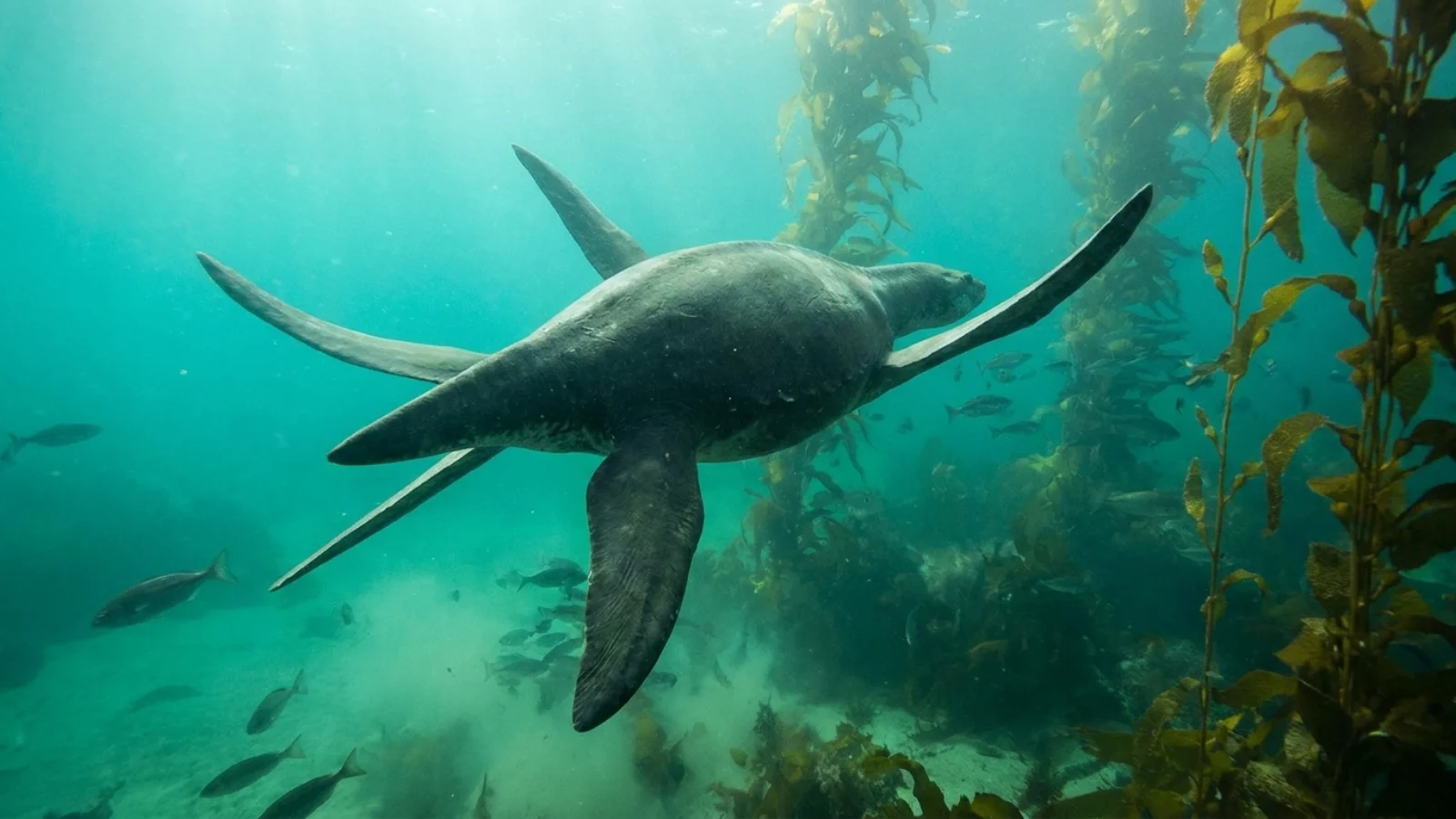
A plesiosaur has been described as a turtle threaded through a snake: a broad, flat body with a short tail and four big flippers, and in the classic forms a long neck with a small head.
That description fits Plesiosaurus itself, the genus that gives the group its name. Britannica gives it as about 4.5 m long, with a broad, flat body and a relatively short tail. But plesiosaurs came in two broad body plans, and they evolved back and forth between them more than once:
- Plesiosauromorphs: long neck, small head, needle-like teeth. The extreme is Elasmosaurus with 72 neck vertebrae, beaten only by Albertonectes with 76.
- Pliosauromorphs: short neck, huge elongated head and massive teeth. These are the pliosaurs, including Liopleurodon and Kronosaurus.
How big were plesiosaurs?
From about 1.5 m to about 15 m. The biggest were the short-necked pliosaurs, and even their sizes have been revised downward.
The giant end of the range has a history of inflation. A 17 m estimate for Pliosaurus rossicus has been revised to 12.7 m or less, and a 2023 estimate gave 11.8 m. The most famous overestimate of all, the 25 m Liopleurodon of the BBC’s Walking with Dinosaurs, is covered on our Liopleurodon page.
How did plesiosaurs swim?
By flying underwater with their flippers, rather like sea lions and sea turtles, and they used all four.
How four flippers worked together has been argued about for a century. D.M.S. Watson proposed a rowing stroke in 1924; Jane Robinson revived the idea of underwater flight in 1975; Frey and Riess (1982) suggested a powered downstroke with an unpowered recovery; and Lingham-Soliar (2000) argued only the front pair did the work. The most direct test came from Luke Muscutt in 2017, who built a robotic plesiosaur and found that the rear flippers were actively used and boosted propulsive force by about 60%. No living animal swims with four equal wings, which is part of what makes plesiosaurs so odd.
Could a plesiosaur raise its neck like a swan?
No. Studies of the vertebrae show plesiosaurs could not hold the neck up in the swan-like pose of old paintings and Loch Ness photos.
Tall spines on top of the vertebrae limited how far the neck could bend upward, and the joints between vertebrae limited side-to-side swing. Storrs (1993) and Zammit and colleagues (2008) both concluded the swan-like pose was impossible. The neck was moderately flexible, not a stiff rod: Zammit’s team estimated a maximum range for elasmosaurids of 87–155° upward, 75–177° downward and 94–176° sideways, depending on how much cartilage sat between the bones. Most articulated skeletons are found with straight or gently curved necks. The long neck most likely let the animal approach schools of fish without its bulky body spooking them first.
Did plesiosaurs lay eggs or give birth?
They gave birth to live young. A 78-million-year-old Polycotylus from Kansas preserves a single large embryo inside its mother.
The fossil was collected in 1987 on the Bonner Ranch in Logan County, Kansas, and studied by Robin O’Keefe of Marshall University and Luis Chiappe of the Natural History Museum of Los Angeles County. Their 2011 paper in Science described a mother about 4.7–5 m long carrying one juvenile about 1.5 m long. A single, big baby is a dolphin-like strategy rather than a turtle-like one, and the authors suggested plesiosaurs may have had maternal care and social lives more like modern dolphins than like other reptiles. That makes sense for an animal with flippers that could never haul out on a beach to lay eggs.
Who discovered the first plesiosaur?
Mary Anning, the fossil collector of Lyme Regis, found the first complete plesiosaur skeleton, Plesiosaurus dolichodeirus, in 1823.
The Natural History Museum in London describes it as the first complete, articulated plesiosaur skeleton ever found. The great French anatomist Georges Cuvier at first suspected it was a fake or a composite of two animals, because the neck seemed impossibly long. He changed his mind after seeing drawings published by William Daniel Conybeare, and later had a specimen bought for the Paris museum. Anning had already uncovered a roughly 5 m ichthyosaur with her brother around 1812; see our ichthyosaur page. For collecting at Lyme Regis and Charmouth today, see the fossil code notes on our ammonite page.
What did plesiosaurs eat, and why did they swallow stones?
Long-necked plesiosaurs ate fish and cephalopods; the big pliosaurs took larger prey, including other reptiles. Many plesiosaurs swallowed stones, called gastroliths, for reasons still debated.
One plesiosaur specimen contained 253 stones, and an elasmosaurid had 47 stones weighing about 13 kg. Whether the stones helped grind food or acted as ballast is unresolved, and the total weight seems too small to change buoyancy much in an animal of that size.
Were plesiosaurs warm-blooded?
Possibly partly. Oxygen isotopes suggest body temperatures of about 27–34 °C, higher than the surrounding water.
Bone structure in their ancestors points to raised metabolism, and one 2018 study proposed bird-like metabolic rates, although that is disputed. The middle-ground interpretation is that plesiosaurs held their bodies warmer than the sea without being fully warm-blooded like mammals. The same question has been asked of mosasaurs and ichthyosaurs.
Is the Loch Ness monster a plesiosaur?
No. The neck could not hold the head up like a swan, Loch Ness is too small and food-poor to support a breeding population, the loch only formed about 10,000 years ago, and the last plesiosaur fossils are over 66 million years old.
Plesiosaurs did reach fresh water in places, and their fossils turn up on every continent including Antarctica, so the Loch Ness idea is understandable. But there is no fossil evidence of any plesiosaur after the end-Cretaceous extinction, and the scientific community rejects the survival hypothesis. Our pages on prehistoric marine reptiles and the largest marine reptile cover the other sea reptiles.
| Group | Lived | Swam with | Body |
|---|---|---|---|
| — | — | — | — |
| Plesiosaurs | 203–66 Ma | Four flippers | Broad, short tail |
| Ichthyosaurs | Triassic–Cretaceous | Tail fluke | Dolphin-shaped |
| Mosasaurs | Late Cretaceous | Tail fluke | Lizard-like |
Where does the name plesiosaur come from?
The word joins two Greek roots, plesios, “near to”, and sauros, “lizard”. The first genus, Plesiosaurus, was named in 1821, two years before Mary Anning’s complete skeleton showed what the whole animal looked like,. By 1835 the animals were distinctive enough to be ranked as an order of their own, Plesiosauria. Since then more than a hundred valid species have been described, from Jurassic shales in Europe to Cretaceous rocks in Kansas and Australia.
Where did plesiosaurs come from?
Plesiosaurs belong to the Sauropterygia, a group of marine reptiles that had already spread through Triassic seas before the first true plesiosaurs appeared. The oldest plesiosaur known from material good enough to name a genus is Rhaeticosaurus mertensi, from Rhaetian rocks at the very end of the Triassic in Germany, and it was probably an early pliosaurid. Other very early members include Thalassiodracon hawkinsii and Eoplesiosaurus antiquior, both from the Hettangian, the first stage of the Jurassic.
That timing matters. Plesiosaurs were already present before the end-Triassic extinction around 201 million years ago and then became especially common through the Jurassic. A surprising detail is that early pliosaurids still had fairly long necks. The famous big-headed, short-necked look came later in that lineage, which is one reason the old split into “long-necked plesiosaurs” and “short-necked pliosaurs” is now treated as a description of body shape rather than of family trees.
The main plesiosaur families
The German specialist Sven Sachs summarises plesiosaur diversity in a handful of major groups, each with its own time span:
Pliosauridae ran from the latest Triassic into the early Late Cretaceous. Its big-skulled branch, the Thalassophonea, arose in the Middle Jurassic and includes Liopleurodon and Pliosaurus; the Cretaceous-only brachauchenines, the line that produced Kronosaurus, lasted from the Hauterivian to the Turonian.
Rhomaleosauridae were mostly large animals, most diverse in the Early Jurassic and in decline by the Middle Jurassic, with Borealonectes russelli from the Callovian among the last.
Microcleididae were small Early Jurassic plesiosauroids, mainly from the Toarcian, with tall spines on their vertebrae and in some cases more than 30 or 40 neck vertebrae.
Cryptoclididae lived from the Middle Jurassic into the Early Cretaceous and are best known from the Oxford Clay of England, the same rocks that yield Liopleurodon. The youngest secure record is Abyssosaurus nataliae from the Hauterivian of Russia.
Elasmosauridae appear only in the Cretaceous and form the most diverse plesiosauroid radiation, found almost worldwide. They had hyper-elongated necks, often with more than 50 vertebrae, and one late branch, the aristonectines, lived mainly in the Southern Hemisphere at the very end of the period.
Leptocleididae were an Early Cretaceous group, and some of them, such as Brancasaurus brancai, lived in brackish or fresh water.
Polycotylidae were Cretaceous animals with large heads and short necks that look superficially like pliosaurs, even though they sit on the long-necked side of the family tree. Most of their fossils come from North America, including the pregnant Polycotylus described above.
Polycotylids are the clearest example of the back-and-forth evolution mentioned earlier. Starting from long-necked ancestors, they arrived at a pliosaur-like body independently.
What did plesiosaur skin look like?
Until recently, almost nothing. Bones say little about the surface of an animal, and fossilised skin is exceptionally rare. That changed in 2025, when Miguel Marx of Lund University and colleagues published an analysis in Current Biology of a 183-million-year-old plesiosaur from near Holzmaden in southern Germany, now displayed at the Urwelt-Museum Hauff.
The specimen preserves two different kinds of skin. Around the tail it is smooth, while along the rear edges of the flippers it carries small scales. The researchers suggest the smooth, streamlined skin helped the animal swim fast after fish and squid-like prey, while the scales may have given the flippers some protection or grip when the animal moved over rough seafloor. Thin sections of the skin even show cells, which Marx said looked almost like modern skin after 183 million years. The study gives artists their first direct evidence for a plesiosaur’s outer covering, and it suggests the smooth-skinned, rubbery look of most reconstructions was at least partly right.
Did plesiosaurs live in rivers?
Some did. In 2022 a team led by University of Bath student Georgina Bunker, with Nick Longrich, David Martill, Roy Smith and Samir Zouhri, described plesiosaur bones and teeth from the Kem Kem beds of eastern Morocco, deposits laid down by a river system about 100 million years ago. The remains come from more than a dozen individuals, including adults about 3 m long and a juvenile arm bone from an animal about 1.5 m long.
The teeth are heavily worn, consistent with a diet of armoured fish, and the authors concluded the animals spent much of their time in the river rather than visiting occasionally. They may have tolerated both salt and fresh water, as belugas do today, or lived in the river full time like a river dolphin, and their modest size would have let them hunt in shallow channels. Longrich was candid that nobody yet knows why plesiosaurs moved into fresh water in the first place. They belonged to the Leptocleididae, the same family found in brackish or fresh water in England, Africa and Australia, while elasmosaurs have turned up in non-marine settings in North America and China. Modern parallels include river dolphins, which evolved at least four separate times, and the freshwater seal of Lake Baikal. In the Kem Kem river, the plesiosaurs shared the water with Spinosaurus, crocodiles, turtles and big fish. Martill summed it up by saying it was no place to go for a swim.
The study does not change the Loch Ness verdict above. A freshwater plesiosaur in a Cretaceous river is still separated from a Scottish loch by more than 66 million years without a single fossil in between.
When did each plesiosaur group die out?
Plesiosaurs as a whole lasted about 140 million years, but the families came and went on different schedules. Rhomaleosaurids are gone after the Callovian in the Middle Jurassic. Leptocleidids are last recorded in the Valanginian and cryptoclidids in the Hauterivian, both in the Early Cretaceous. Pliosaurids, the big-headed apex predators, disappear in the Turonian of the Late Cretaceous, around the time mosasaurs were rising to dominance.
Only two families, the elasmosaurids and the polycotylids, survived to the Maastrichtian, the final stage of the Cretaceous, and both were wiped out when the Cretaceous closed, 66 million years ago. So the last plesiosaurs were long-necked elasmosaurs and pliosaur-like polycotylids, not true pliosaurs, which had already been absent for roughly 24 million years.
Is a plesiosaur a dinosaur?
No. Plesiosaurs were marine reptiles in the group Sauropterygia, a separate lineage from dinosaurs, although they lived at the same time.
When did plesiosaurs live?
From the latest Triassic, about 203 million years ago, until the end-Cretaceous extinction 66 million years ago.
How big was a plesiosaur?
Adults ranged from about 1.5 m to about 15 m long. Plesiosaurus itself was about 4.5 m.
How many neck vertebrae did plesiosaurs have?
Up to 76, in Albertonectes. Elasmosaurus had 72. Short-necked pliosaurs had far fewer.
Did plesiosaurs lay eggs?
No. A pregnant Polycotylus from Kansas, about 78 million years old, shows they gave birth to a single large live young.
How did plesiosaurs swim?
By underwater flight with four flippers. A 2017 robot study found the rear flippers added about 60% to propulsive force.
Could the Loch Ness monster be a plesiosaur?
No. Plesiosaurs could not raise their necks swan-like, the loch is only about 10,000 years old and too small to feed a population, and no plesiosaur fossils are younger than 66 million years.
Who found the first plesiosaur?
Mary Anning found the first complete plesiosaur skeleton, Plesiosaurus dolichodeirus, at Lyme Regis in 1823.
Blane Perun has been exploring Earth’s oceans and marine life for over 25 years. Founder of TheSea.Org in 1999, underwater photographer, coral aquaculture pioneer, and explorer of 80+ countries.
About Blane Perun → All prehistoric sea creatures →