Mosasaurus — The Real Sea Monster Behind Jurassic World
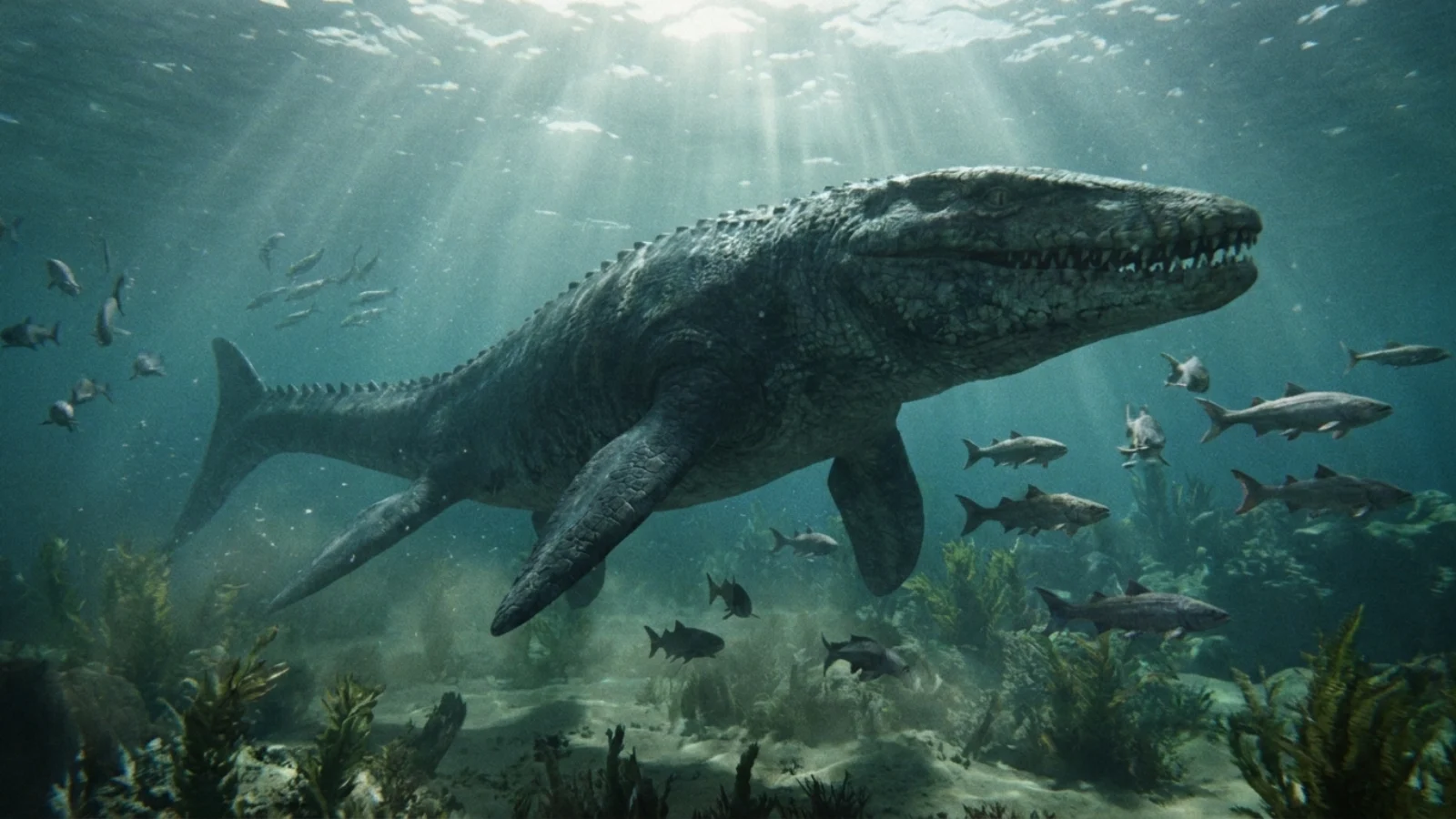
Mosasaurus was a giant marine lizard that lived from about 82 to 66 million years ago, in the Campanian and Maastrichtian stages of the Late Cretaceous. The largest species, Mosasaurus hoffmannii, is most recently estimated at about 12 m long, though older studies pushed it to 17 m or more. It was not a dinosaur: mosasaurs were squamates, the group that includes monitor lizards and snakes. It swam with a shark-like tail fluke, ate fish, sharks, turtles and other mosasaurs, and vanished in the end-Cretaceous extinction.
Mosasaurus
How big was Mosasaurus really?
The best current estimate for the largest species, Mosasaurus hoffmannii, is about 12 m. Bigger figures you see online come from an older rule of thumb that probably overstated body length.
Mosasaur size estimates nearly all start from the skull, because complete skeletons of the biggest animals are rare. The question is how to scale a skull up to a whole body, and that is where the numbers diverge. Dale Russell proposed in 1967 that a mosasaur’s jaw was about one-tenth of its total length. Apply that to the largest jaws and you get giants: Theagarten Lingham-Soliar estimated 17.6 m in 1995 from a jaw reconstructed at 160 cm, and Gleb Grigoriev reached 17.1 m in 2014 from the 171 cm lower jaw of the Penza specimen in Russia. Everhart and colleagues (2016) went further, extrapolating roughly 18 m from an unusually large quadrate bone.
Later work suggests that one-to-ten ratio was too generous. Fanti and colleagues (2014) found body length was closer to about seven times skull length, which gives a little over 11 m for skulls longer than 145 cm. Using that ratio, Gayford and colleagues (2024) put the Penza animal at about 12 m. That is the figure this page uses, and it is still enormous: longer than a city bus and heavier than an elephant.
Was Mosasaurus a dinosaur?
No. Mosasaurus was a squamate, a lizard, more closely related to today’s monitor lizards and snakes than to any dinosaur.
Dinosaurs were land animals. The big Mesozoic sea reptiles came from several separate reptile lineages that each moved into the ocean, and mosasaurs were the last to do it, appearing in the Late Cretaceous. If you want the wider family tree, our explainer on prehistoric marine reptiles lays out how mosasaurs relate to ichthyosaurs and plesiosaurs.
When and where did Mosasaurus live?
Mosasaurus lived from about 82 to 66 million years ago, and its fossils have been found on every continent except Australia, including Antarctica.
Late Cretaceous sea levels were very high. A shallow seaway split North America in two, and much of Europe and North Africa lay under warm water. Mosasaurus fossils come from North America, South America, Europe, Africa, Western Asia and Antarctica. That near-global spread is one reason it is the best-known mosasaur, alongside the Kansas giant Tylosaurus.
More than fifty species have been assigned to the genus over the years, most of them on scrappy material. A 2017 review by Daniel Street and Michael Caldwell accepted about five as likely valid: M. hoffmannii, M. missouriensis, M. conodon, M. lemonnieri and M. beaugei, with several Pacific species awaiting reassessment. A 2026 study by Sharpe and colleagues has since treated M. conodon as doubtful, which shows how live this taxonomy still is.
| Species | Status |
|---|---|
| — | — |
| M. hoffmannii | Valid; the giant type species from Maastricht |
| M. missouriensis | Valid; large skulls often exceed 1 m |
| M. lemonnieri | Likely valid |
| M. beaugei | Likely valid |
| M. conodon | Treated as a nomen dubium by Sharpe et al. 2026 |
| M. mokoroa, M. hobetsuensis, M. flemingi, M. prismaticus | Pacific species, possibly valid, pending reassessment |
How was Mosasaurus discovered?
The first Mosasaurus fossil, a skull, came out of a chalk quarry near Maastricht in the Netherlands in 1764, and was first taken for a whale.
A second, better skull was found in the same area in 1778. Johann Leonard Hoffmann, the local collector, thought it was a crocodile; the anatomist Petrus Camper argued in 1786 that it was a whale. French forces seized the skull in 1794 when Maastricht was taken. The species name hoffmannii honors that first collector.
What did Mosasaurus eat?
Almost anything it could catch. Stomach contents, bite marks and chemistry show bony fish, sharks, squid-like cephalopods, birds, sea turtles and even other mosasaurs.
Carbon-isotope work by Anne Schulp and colleagues (2013) found the lowest values in the largest individuals, the signature you expect from an animal at the very top of the food web. Tooth microwear points to a generalist rather than a specialist. A subadult specimen nicknamed “Lars” reportedly preserves bones of juvenile turtles and possibly birds in its gut region, according to a 2024 conference report.
Mosasaurus hoffmannii had 14 to 16 teeth in each upper jaw, 14 to 15 in each lower jaw, and a further eight on the pterygoid bones in the roof of the mouth. Those palate teeth worked like a ratchet, helping to walk struggling prey down the throat, the same trick many snakes use today.
How did Mosasaurus swim?
Like a shark, with its tail. The end of the tail bent downward and carried a two-lobed fluke, while the four paddle-shaped limbs acted as hydrofoils for steering.
Johan Lindgren and colleagues showed from exceptionally preserved mosasaur fossils that the tail was not a simple eel-like paddle. The vertebrae kink downward near the tip, supporting a crescent-shaped fin very like a shark’s or an ichthyosaur’s. That points to a sub-carangiform style of swimming, similar to a mackerel, with most of the thrust coming from the rear of the body.
Mosasaurs also seem to have run warm. Work by Alexandra Houssaye and colleagues estimated a resting metabolic rate between that of the leatherback turtle and that of ichthyosaurs and plesiosaurs. Among squamates that is remarkable; the only living lizard with even partial endothermy is the Argentine black and white tegu.
How accurate is the Mosasaurus in Jurassic World?
The film animal is far larger than any real Mosasaurus, and it lacks the tail fluke that fossils now show.
The movie creature is scaled to swallow a great white shark whole. The real animal, at about 12 m, could certainly have killed a large shark, and mosasaurs did eat sharks, but nothing in the fossil record supports a mosasaur several times that size. The film also gives it a crest of spikes along the back and a straight tail, both outdated or invented. Fossils show a fairly smooth, scaly body and a fluked tail. If you want to see how it stacks up against the real ocean giants, see megalodon vs Mosasaurus and our ranking of the largest prehistoric sea creatures.
Why did Mosasaurus go extinct?
Mosasaurus vanished 66 million years ago, in the same end-Cretaceous catastrophe that ended the non-avian dinosaurs and the ammonites.
The impact at Chicxulub collapsed marine food chains from the bottom up. Large predators that depend on a steady supply of big prey are especially vulnerable when plankton production crashes, and every mosasaur lineage disappeared. The ammonites they ate went with them. The niche of giant marine predator stayed empty for millions of years until whales and large sharks such as megalodon’s ancestors filled it.
Where are the original Maastricht skulls today?
Two skulls from the chalk around Maastricht started the whole story, and both survive in museums. The first was found in 1764 in an underground chalk quarry beneath Mount Saint Peter, the hill just south of the city. A French army officer, Lieutenant Jean Baptiste Drouin, collected the fragments in 1766, and in 1784 Martinus van Marum, director of the Teylers Museum in Haarlem, bought them for his museum. They are still there, catalogued as TM 7424. Van Marum described the animal in 1790 as a big breathing fish, effectively placing it with the whales.
The second skull is the more famous one. The date of its discovery is debated: a 2012 review suggested around 1780, while a magazine in Liège reported the find in October 1778, the date used above. The retired Dutch army physician Johann Leonard Hoffmann believed it was a crocodile, but the land belonged to a church canon, Theodorus Joannes Godding, who claimed the skull and displayed it in a grotto on his property. In 1786 Petrus Camper’s study called it an unknown species of toothed whale.
When French troops captured Maastricht in November 1794, soldiers seized the skull from Godding four days later, and the National Convention ordered it sent to the National Museum of Natural History in Paris, where it carries the number MNHN AC 9648. A popular story, told by the geologist Barthélemy Faujas de Saint-Fond in 1799, says the French offered 600 bottles of wine to whoever brought the skull in. Historians consider that account largely unsupported. Godding was eventually compensated in 1827, when the French government exempted him from war taxes, and in 1942 Charles Lewis Camp formally designated the Paris skull as the holotype of the species.
How did Mosasaurus get its name?
Slowly. For decades the animal had no formal name at all. In 1822 James Parkinson published a suggestion by William Daniel Conybeare to call it Mosasaurus, offered as a temporary label. The name means lizard of the Meuse, from the Latin Mosa for the river that flows past Maastricht and the Greek sauros for lizard. Georges Cuvier adopted Mosasaurus as the genus name in 1829.
The species name came the same year. In 1829 Gideon Mantell named it Mosasaurus hoffmannii in honour of Hoffmann, the physician who had first studied the second skull. The animal therefore carries the name of a man who never owned its type specimen, and of the river near where it was dug up.
Did Lewis and Clark find a mosasaur?
Possibly. During their expedition up the Missouri River between 1804 and 1806, Meriwether Lewis and William Clark recorded a partial skeleton they described as a fish. It may have been a mosasaur, but the specimen was lost, so nobody can check.
The first North American Mosasaurus to be named came from the same region. In 1834 Richard Harlan described a fossil snout as Ichthyosaurus missouriensis, mistaking it for an ichthyosaur. Joseph Leidy recognised it as a mosasaur and renamed it Mosasaurus missouriensis in 1857. The original snout then disappeared from view for well over a century, until it was rediscovered in 2004 in the Paris museum, where it is catalogued as MNHN 9587. Mosasaurus missouriensis is one of the species listed as valid in the table above.
Were mosasaurs still thriving when the asteroid hit?
Yes, and that is one of the clearest lessons of recent fossil finds from Morocco. Phosphate mines there expose sea-floor sediments from the last stretch of the Cretaceous, when the Atlantic coast of Morocco was home to a remarkable range of marine reptiles. In March 2024 Nick Longrich of the University of Bath, with colleagues from the Marrakech Museum of Natural History, the Paris museum, Southern Methodist University and the University of the Basque Country, described Khinjaria acuta in Cretaceous Research.
Khinjaria came from a phosphate mine southeast of Casablanca and lived close to 66 million years ago. It was about the length of an orca, roughly 7 to 8 m, with a short face full of huge, dagger-shaped teeth, and N.E. Jalil of the Paris museum said its jaw structure suggests a terrible biting force. It joins other Moroccan mosasaurs named in recent years, including Thalassotitan, Xenodens and Stelladens, and several species in the assemblage were larger than a great white shark.
Longrich called it one of the most diverse marine faunas seen anywhere, at any time in history, and a dangerous time to be a fish, a sea turtle or even a marine reptile. The point matters for the extinction question discussed further down: mosasaurs were not a group already fading away. Many kinds were living side by side right up to the end, and the impact cut them off at or near their peak.
How different were Mosasaurus seas from today’s oceans?
Very different at the top of the food chain. Longrich noted that modern marine food webs have only a few large apex predators, such as orcas, great white sharks and leopard seals. The Late Cretaceous seas had many more, with several big mosasaurs, large sharks and other marine reptiles hunting the same waters. He described a huge change in the structure of ocean ecosystems over the past 66 million years.
Size helps put that in perspective. Khinjaria, at 7 to 8 m, was about as long as an orca and still well short of the roughly 12 m estimate used on this page for Mosasaurus hoffmannii. In other words, an animal that would be the largest predator in many modern seas was a mid-sized member of the Moroccan mosasaur community. Mosasaurus hoffmannii sat at the very top of that crowded system, which is why its carbon isotopes look the way they do and why its gut contents include other predators. When it disappeared, it took one of the most varied predator communities in the history of the ocean with it.
How big was a Mosasaurus?
The largest species, Mosasaurus hoffmannii, is best estimated at about 12 m long (Gayford et al. 2024). Older estimates of 17 to 18 m used a jaw-to-body ratio that later research suggests was too large.
When did Mosasaurus live?
About 82 to 66 million years ago, during the Campanian and Maastrichtian stages of the Late Cretaceous.
Is Mosasaurus a dinosaur?
No. Mosasaurus was a marine lizard, a squamate related to monitor lizards and snakes. It lived at the same time as the last dinosaurs.
Is Mosasaurus bigger than megalodon?
No. Megalodon’s typical large-adult estimate is about 16 m, with an upper estimate of 24.3 m (Shimada et al. 2025), versus about 12 m for the largest Mosasaurus.
What did Mosasaurus eat?
Fish, sharks, cephalopods, sea turtles, birds and other mosasaurs. Isotope evidence suggests the largest individuals were apex predators.
Where have Mosasaurus fossils been found?
In North America, South America, Europe, Africa, Western Asia and Antarctica. The first was a skull from a chalk quarry near Maastricht in 1764.
Could Mosasaurus breathe underwater?
No. Like all reptiles it breathed air with lungs and had to surface to breathe.
How many teeth did Mosasaurus have?
M. hoffmannii had 14 to 16 teeth in each upper jaw row, 14 to 15 in each lower jaw row, and eight pterygoid teeth on each side of the palate.
Blane Perun has been exploring Earth’s oceans and marine life for over 25 years. Founder of TheSea.Org in 1999, underwater photographer, coral aquaculture pioneer, and explorer of 80+ countries.
About Blane Perun → All prehistoric sea creatures →