What Killed Megalodon? — The Great White Competition Theory
Nothing “killed” megalodon in a single blow, but the leading suspect is competition from the great white shark. Great whites spread through the world’s oceans about 4 million years ago, and megalodon vanished about 3.6 million years ago. A 2022 study of zinc isotopes in fossil teeth found that early Pliocene great whites fed at largely the same level of the food chain as megalodon, so the two probably hunted some of the same prey. Most scientists see this competition as one pressure among several, alongside a changing climate, shrinking coastal habitats and changes in the whales megalodon ate.
A smaller, more flexible predator arrived, ate the same food, and helped push an already stressed giant over the edge. The theory is supported by timing and diet evidence but not yet proven.
What killed megalodon?
Megalodon, the giant shark Otodus megalodon, disappeared about 3.6 million years ago. Nobody witnessed its last days, and no fossil shows a megalodon dying of starvation or losing a fight. What scientists can do is look for suspects: changes in the world around it that coincide with its disappearance and that plausibly could have contributed to it. Several such suspects exist, from cooling seas to changing whale populations, and our article on why megalodon went extinct weighs them all.
This article focuses on the suspect that has attracted the most attention: the great white shark, Carcharodon carcharias. The idea that a smaller relative helped drive the largest predatory shark of all time to extinction sounds almost too neat. But it rests on two independent lines of evidence, the timing of the two species in the fossil record and chemical clues to their diets preserved in their teeth, and it has become one of the most discussed ideas in the study of prehistoric sharks.
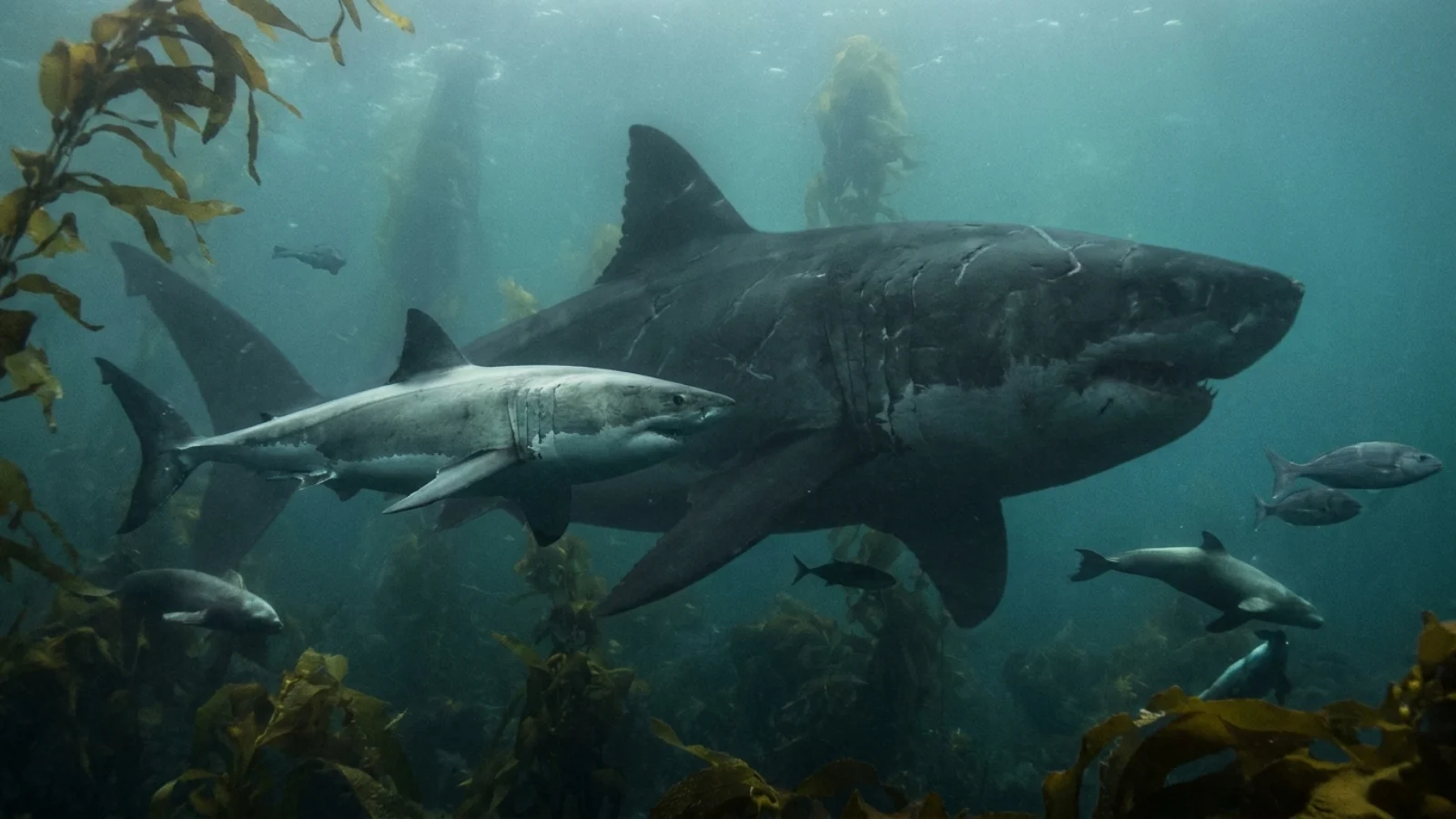
How could a smaller shark outcompete megalodon?
At first glance the idea seems absurd. Megalodon was estimated to reach up to around 20 m in length, while the largest modern great whites reach about 6 m. A full-grown megalodon could have swallowed a great white whole. How could the smaller shark possibly win?
The answer is that competition in nature is rarely about fights. Two species compete when they need the same limited resource, usually food. If one of them can find, catch or survive on that food more efficiently, it can gradually reduce the share available to the other. Over generations, the less efficient species produces fewer surviving young and its population shrinks, even if individual adults are never directly harmed.
Size is not always an advantage in this kind of contest. A smaller predator needs less food in total, can live in a wider range of places and can switch more easily between different kinds of prey. The great white eats fish, seals, sea lions, dolphins, other sharks and the carcasses of dead whales, and it ranges from warm seas into cold temperate waters. A giant like megalodon, which needed vast amounts of food to stay alive, had much less room for manoeuvre when prey became scarce.
There is another possibility. Megalodon did not start life as a giant. Young megalodon, growing up in coastal waters, would have been similar in size to adult great whites. Some researchers have suggested that competition may have been most intense at this stage of life, with young megalodon and great whites hunting the same seals, dolphins and fish in the same places. If great whites made it harder for young megalodon to survive to adulthood, the effect on the species could have been severe even if adult giants still ruled the open sea.
When did great white sharks appear?
The timing is the foundation of the competition theory. Great whites evolved from an older lineage of sharks with broad, unserrated teeth, and fossils of their immediate ancestors are found in Miocene rocks. The modern great white, with its distinctive serrated, triangular teeth, became widespread later, during the early Pliocene.
In their 2019 study in PeerJ, Robert Boessenecker and colleagues re-examined the youngest megalodon fossils from California and Baja California and concluded that megalodon was extinct by about 3.6 million years ago, a million years earlier than the previously accepted date. Great whites, they noted, had spread through the world’s oceans by about 4 million years ago. As Boessenecker put it, that short overlap of around 400,000 years was “sufficient time for great white sharks to spread worldwide”.
The revised date matters. When megalodon was thought to have survived until 2.6 million years ago, it seemed to have coexisted with great whites for well over a million years, and its extinction appeared to coincide with a broader wave of marine extinctions. Moving the date back made its disappearance follow closely on the arrival of the great white, and made the great white a far more obvious suspect. The full story of how that date was worked out is told in when did megalodon go extinct?
How can fossil teeth reveal what a shark ate?
Timing alone shows that two species overlapped, not that they competed. To test competition, scientists need to know what each animal ate. That is a tall order for animals that died millions of years ago, especially sharks, whose skeletons are made of cartilage and rarely fossilise. Almost all that remains of megalodon is its teeth.
For more recent animals, researchers often analyse nitrogen isotopes in collagen, a protein preserved in bones and teeth. Nitrogen isotope ratios change in a predictable way with each step up the food chain, so they reveal an animal’s trophic level, how high in the food web it fed. But collagen does not survive for millions of years, so the method cannot be used on megalodon.
In 2022, a team led by Jeremy McCormack, then at the Max Planck Institute for Evolutionary Anthropology, with Thomas Tütken, Sora Kim, Michael Griffiths and Kenshu Shimada, tried a different approach. They measured zinc isotopes in enameloid, the hard, highly mineralised outer layer of shark teeth. Like nitrogen, zinc enters an animal through its food, and the ratio of zinc isotopes in body tissues shifts as it passes up the food chain. Crucially, the zinc in enameloid is locked into a durable mineral and can survive for millions of years.
The team first tested the method on modern sharks and other animals whose diets are known, and found that the zinc values matched their positions in the food web. That gave them confidence to apply the same method to fossil teeth.
What did the zinc isotope study find?
The researchers analysed teeth from around the world, including Otodus chubutensis, megalodon’s ancestor from the Early Miocene, about 20 to 16 million years ago; megalodon itself; and fossil and modern great whites. Their study, published in Nature Communications, produced several findings.
First, both megalodon and its ancestor were apex predators, feeding at the top of their food chains, which is what you would expect from their size and teeth.
Second, and most important for the competition theory, early Pliocene great whites from North Carolina had trophic levels that largely overlapped with those of megalodon. As Shimada put it, the results “likely imply at least some overlap in prey hunted by both shark species.” In other words, the great white was not feeding lower down the food chain on smaller fish, but taking prey at a similar level to the giant.
The authors were careful about what this does and does not show. Overlapping trophic levels mean the two sharks fed at similar heights in the food web, which is consistent with competition, but they do not prove that the sharks ate exactly the same animals or that great whites caused megalodon’s decline. Shimada said that while additional research is needed, the results appear to support the possibility of dietary competition. The zinc method is also new and still being refined.
What were megalodon and great whites competing for?
The likely prize was marine mammals. Megalodon’s diet included whales, as shown by bite marks on fossil whale bones, and it probably also took seals, sea cows, dolphins and large fish. Great whites today are famous for hunting seals and sea lions, and they also feed on dolphins, fish and dead whales. In the early Pliocene, both sharks would have been drawn to the same coastal hunting grounds where marine mammals gathered to feed and breed.
That prey base was changing. The small and medium-sized baleen whales that were abundant in the Miocene declined, and the ancestors of today’s giant filter-feeding whales grew larger and increasingly fed in cold, productive waters at high latitudes. Pimiento and Clements, in their 2014 study of megalodon’s extinction, noted that the gigantic sizes of modern filter-feeding whales became established around the time megalodon disappeared. A predator that depended on mid-sized whales in warm seas would have found its menu shrinking, just as a new competitor arrived to take a share of what was left.
Seen this way, the great white did not need to be a superior hunter of every prey type. It only needed to take enough of the remaining food, in enough places, to tip a giant with high energy demands into decline.
Why did megalodon’s warm body make competition worse?
In 2023, a team led by Michael Griffiths used isotope methods to estimate megalodon’s body temperature. They found it averaged about 27°C, higher than that of cold-blooded sharks, indicating that megalodon was at least partly warm-blooded, like the modern great white and mako. Those modern sharks have body temperatures of about 22 to 26.6°C, which can be 10 to 21°C above the surrounding water.
Being warm-bodied means burning energy to stay warm, so megalodon needed a great deal of food. The researchers suggested that this high metabolic cost may have made megalodon vulnerable at a time of changing climate, sea level and prey. A competitor taking the same food would make that vulnerability worse. The great white is also warm-bodied, but being much smaller, it needs far less food in total, and it can switch to fish and scavenging when large prey is scarce.
Were other predators competing with megalodon?
The great white was not megalodon’s only rival. During the Miocene, the oceans also held giant raptorial sperm whales, predators with large teeth in both jaws that hunted big prey. The best known is Livyatan melvillei, from Peru, which was roughly comparable in size to megalodon and probably hunted similar prey. These whales declined and disappeared during the same broad period, suggesting that the conditions that favoured giant predators were ending.
Killer whales are sometimes suggested as competitors or even predators of megalodon, partly because modern orcas are known to kill great whites. However, there is no evidence that orcas of the modern type lived alongside megalodon. Competition from the great white remains the best-supported case of a new rival appearing just before megalodon’s extinction.
Is there a modern example of this kind of competition?
Modern oceans offer a glimpse of how a top shark can be displaced by another predator. Off South Africa, killer whales have in recent years attacked and killed great white sharks, and white sharks have been reported to abandon some of their traditional hunting areas after orcas appear. This is not the same as competition for food, and it is not evidence about megalodon, but it shows that even a powerful apex shark can be pushed out of its favoured hunting grounds by another predator.
Ecologists call the long-term version of this process competitive exclusion: two species that rely on the same limited resource cannot coexist indefinitely in the same place, and one will eventually lose out unless they divide the resource between them. Great whites and megalodon may have coexisted for a while by using different prey, habitats or life stages, but as conditions changed, that division may have broken down.
What does the competition theory not explain?
The great white hypothesis has limits. The overlap in time between the two sharks is based on dates that are themselves uncertain, and the 2019 study looked in detail only at fossils from the eastern North Pacific. If future work shows that megalodon survived longer in some regions, or that great whites arrived later in others, the timing argument will need to be revised.
The zinc study also shows similar trophic levels in one region at one time, not a full picture of diets across the oceans. Similar trophic levels can be reached by eating different animals, and the study’s authors called for further research.
Finally, competition alone does not easily explain why a species that had survived 20 million years of changing climates and rivals should give way now. That is why most researchers see the great white as one factor in a combination that included cooling seas, fluctuating sea levels, the loss of coastal habitats and changes in the whales megalodon fed on. In the end, megalodon may have been killed not by any one cause but by a world that no longer suited a giant.
What killed megalodon?
No single cause is proven. The leading suspect is competition from great white sharks, combined with climate change, habitat loss and changes in its whale prey.
Did great white sharks kill megalodon?
Not directly. They may have outcompeted it for prey; a 2022 zinc isotope study found they fed at overlapping trophic levels.
When did great white sharks appear?
Great whites had spread through the world’s oceans by about 4 million years ago, shortly before megalodon disappeared.
How could a smaller shark beat megalodon?
By eating the same prey more efficiently. A smaller, more flexible predator needs far less food and can switch prey more easily.
Did orcas kill megalodon?
There is no evidence. Orcas of the modern type are not known to have lived alongside megalodon.
How do scientists know what megalodon ate?
From bite marks on fossil whale bones and from isotopes, such as zinc, preserved in the enameloid of its teeth.
Was megalodon an apex predator?
Yes. Zinc isotopes show that megalodon and its ancestor Otodus chubutensis fed at the top of their food chains.
Could great whites have eaten young megalodon?
There is no direct evidence. The likelier interaction was competition with juvenile megalodon for the same prey.
- McCormack, J. et al. (2022), “Trophic position of Otodus megalodon and great white sharks through time revealed by zinc isotopes”, Nature Communications; Max Planck Institute for Evolutionary Anthropology news release.
- Boessenecker, R.W. et al. (2019), “The Early Pliocene extinction of the mega-toothed shark Otodus megalodon“, PeerJ; Live Science coverage (Feb 2019).
- Griffiths, M.L. et al. (2023), “Endothermic physiology of extinct megatooth sharks”, PNAS 120(27).
- Pimiento, C. & Clements, C.F. (2014), “When did Carcharocles megalodon become extinct?”, PLoS ONE.
Blane Perun has been exploring Earth’s oceans and marine life for over 25 years. Founder of TheSea.Org in 1999, underwater photographer, coral aquaculture pioneer, and explorer of 80+ countries.
About Blane Perun →